

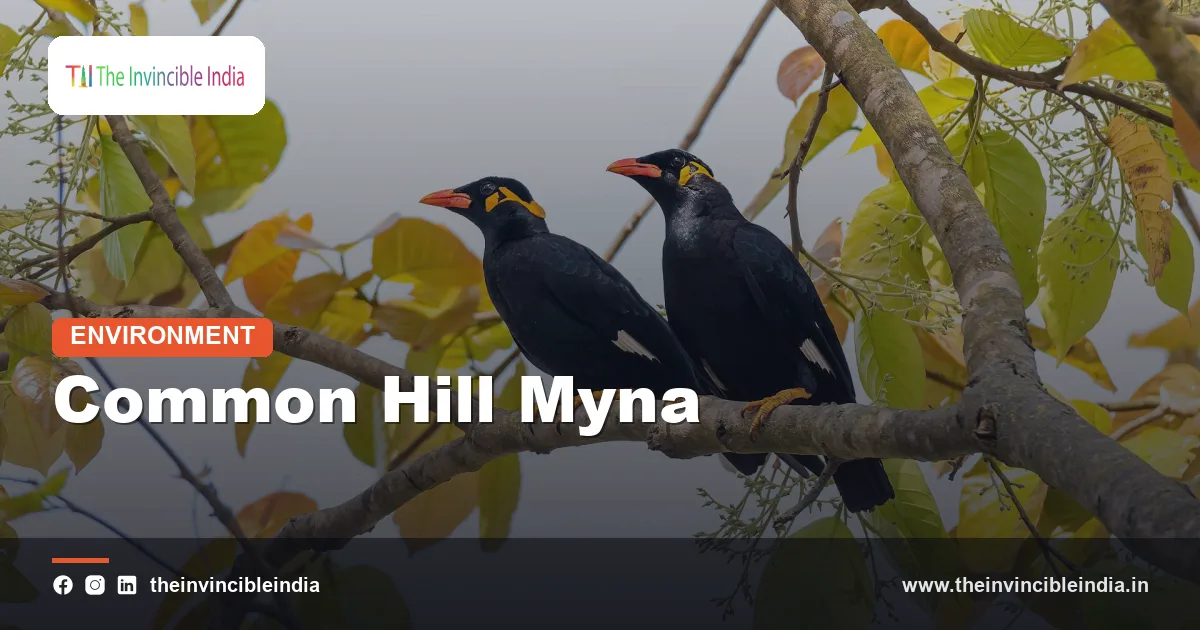
The common hill myna (Gracula religiosa) is a glossy black forest myna with an orange-yellow bill and yellow head wattles, famous for its ability to mimic human speech. In India it lives in the evergreen and moist forests of the Western Ghats, the Himalayan foothills and northeast India, where wild birds feed on fruit in the canopy and nest in tree holes.
The common hill myna is a member of the starling family and is one of the most skilled vocal mimics of any bird. In the wild it uses a loud, varied repertoire of whistles and calls, and its talent for imitation is the very reason it has been so heavily trapped for the cage-bird trade, a practice now illegal in India.
| Attribute | Detail |
|---|---|
| Common name | Common hill myna (also called hill myna or talking myna) |
| Scientific name | Gracula religiosa |
| Family | Sturnidae (starlings and mynas) |
| Size | About 25 to 29 cm long |
| India range and habitat | Western Ghats, Himalayan foothills, northeast India and parts of the eastern hills and islands; evergreen and moist deciduous forest, mostly in the canopy |
| Diet | Fruit (especially figs and berries), nectar and insects |
| Breeding | Nests in tree holes, often old woodpecker or barbet holes; usually two to three eggs, mostly in the spring and early summer |
| Conservation status | Least Concern on the IUCN Red List; listed in CITES Appendix II and protected in India |
Key Takeaways
- The common hill myna (Gracula religiosa) is a glossy black myna about 25 to 29 cm long, with an orange-yellow bill and yellow wattles on the head.
- The common hill myna is celebrated as one of the best bird mimics in the world, capable of copying human voices in captivity.
- In India, the common hill myna lives in forests of the Western Ghats, the Himalayan foothills and the northeast, and it spends most of its time in the high canopy.
- The common hill myna eats mainly fruit, such as wild figs and berries, along with nectar and insects.
- The common hill myna nests in tree holes, so it depends on old trees and on holes dug by woodpeckers and barbets.
- Catching or keeping wild hill mynas is illegal in India, where the species is protected under the Wildlife (Protection) Act, 1972, and international trade is regulated by CITES.
What is the common hill myna?
The common hill myna is a large, glossy, black songbird of the starling family Sturnidae, known scientifically as Gracula religiosa. It belongs to the same family as the common myna, the bank myna and the starlings, but it is larger and stockier than those familiar birds and lives mainly in forest rather than in towns.
The species is sometimes simply called the hill myna, and in the pet trade it is known as the talking myna. Several regional forms exist across South and Southeast Asia. Some authorities treat the birds of the Western Ghats as a separate species, the southern hill myna, while others treat them as a form of the common hill myna. In all cases the birds look and behave very similarly.
Within India, one of the regional forms is associated with the Bastar region of Chhattisgarh and is the state bird of Chhattisgarh. It is known locally as the Bastar hill myna, and this gives the species a particular cultural importance in central India.
How do you identify a common hill myna?
A common hill myna can be identified by its glossy black plumage, bright orange-yellow bill, yellow legs, yellow wattles on the head and a white patch on each wing that shows in flight. Together these features set it apart from every other Indian myna.
Key features
- Plumage is mostly black with a purplish and greenish gloss, depending on the light.
- The bill is thick and bright orange, with a yellowish tip in some individuals.
- Two bare yellow patches or wattles mark the head, one behind the eye extending to the nape and another below the eye.
- A conspicuous white patch on the primary feathers flashes in flight.
- The legs and feet are yellow, and the tail is short and square.
Male and female hill mynas look alike, so it is not possible to tell the sexes apart by plumage. Young birds are duller, with smaller wattles and a paler bill. A flock flying overhead is often identified first by sound, as the birds give loud, ringing calls and whistles in flight.
Where does the common hill myna live in India?
The common hill myna lives in the evergreen and moist forests of the Western Ghats, the Himalayan foothills and northeast India, and it also occurs in parts of the eastern hills and in the Andaman and Nicobar group. It generally prefers forest with tall trees, in lowlands and hills rather than at very high altitudes.
The bird spends most of its time in the upper canopy, where it moves between fruiting trees. It is often seen in pairs or small flocks and can gather in larger numbers at a heavily fruiting fig tree. Because it keeps high in the trees, it can be easy to miss without listening for its calls.
The species relies on large, old forest, although it will also visit forest edges, plantations and wooded estates in the Western Ghats where tall shade trees remain. It is much less likely to be seen in towns than the common myna.
What does the common hill myna eat?
The common hill myna eats mainly fruit, particularly wild figs and other berries, supplemented by flower nectar and insects. Its diet makes it an important seed disperser in the forest, as the seeds of the fruit it swallows are carried and dropped over large areas.
Figs are especially important because many species fruit throughout the year and provide food when little else is available. Hill mynas feed alongside hornbills, barbets, bulbuls, parakeets and pigeons at fruiting trees, forming part of a busy community of fruit-eaters. The birds also take nectar from flowering trees and catch insects, which become more important when the young are being fed.
Role in the forest
Fruit-eating birds help forests regenerate. When a hill myna swallows a fig and later drops the seed far from the parent tree, it gives the seed a chance to grow in a new place. This is one reason that conservationists consider hill mynas valuable members of forest ecosystems.
Why can the common hill myna talk?
The common hill myna can talk because it is a vocal learner, meaning it copies sounds that it hears and has a flexible voice box, called the syrinx, that can reproduce a wide range of tones. In captivity, this ability allows the bird to imitate human words and phrases with striking clarity.
Vocal learning is found in only a few groups of animals, including songbirds, parrots, hummingbirds, some bats and humans. In the hill myna, the imitation often reproduces the pitch and tone of the speaker’s voice, so a mimic can sound remarkably like a person. The bird does not understand the meaning of the words, although it may associate certain sounds with situations.
In the wild, hill mynas use mimicry in a different way. They imitate calls of other forest birds and animals, and their own loud, ringing whistles, screams and chuckles are learned within local groups, so neighbouring populations can have slightly different vocal dialects. Researchers believe these calls help birds recognise members of their group and keep in touch in dense forest.
How does the common hill myna breed?
The common hill myna breeds in tree cavities, laying about two to three pale blue-green eggs in a hole lined with leaves, twigs and other soft material. The season varies by region, but in much of India it falls in the spring and early summer.
The pair often chooses an existing hole, such as an old woodpecker or barbet nest, rather than excavating its own. The hole is generally high in a large tree, and the pair may use the same site over several years. Both parents help feed the young, bringing fruit and insects, and the chicks leave the nest after several weeks.
Because the species relies on holes in mature trees, it competes with other hole-nesting birds such as parakeets, barbets and owls. When large old trees are logged, the number of suitable holes falls, and hill myna numbers may decline.
Is it legal to keep a hill myna in India?
It is not legal to catch, trade or keep a wild common hill myna in India, because the species is protected under the Wildlife (Protection) Act, 1972. The law prohibits the capture of wild birds, and international trade in hill mynas is regulated through the CITES convention.
In the past, large numbers of nestlings were taken from tree holes to be sold as talking pets, which drastically reduced local populations. Trappers often cut down nest trees or removed chicks directly from holes, causing both bird loss and forest damage. Tighter laws and enforcement have reduced but not eliminated this trade, and illegal capture remains a conservation concern in some areas.
The table below summarises the main points of protection and trade.
| Aspect | Position |
|---|---|
| Indian law | Protected under the Wildlife (Protection) Act, 1972; capture and trade are illegal |
| International trade | Regulated under CITES Appendix II |
| IUCN global status | Least Concern |
| Main threat | Illegal capture of nestlings and loss of old forest |
| Best alternative | Watch wild birds in protected forests |
How is the common hill myna different from the common myna?
The common hill myna differs from the common myna in colour, habitat and behaviour: it is larger, glossy black with a bright orange bill and yellow wattles, and it lives in forest canopy rather than in towns and fields. The common myna is brown with a yellow bill and eye patch and is abundant around human settlements.
| Feature | Common hill myna | Common myna |
|---|---|---|
| Scientific name | Gracula religiosa | Acridotheres tristis |
| Colour | Glossy black | Brown with a black head |
| Head | Yellow wattles | Bare yellow patch behind the eye |
| Habitat | Forest canopy | Towns, fields and gardens |
| Diet | Mostly fruit and nectar | Omnivorous: insects, grain, fruit and scraps |
| Mimicry | Exceptional | Limited, though present |
Both species are in the starling family and are intelligent, social birds, but the hill myna is much more specialised in its habitat and diet.
Is the common hill myna threatened?
The common hill myna is not threatened globally and is classified as Least Concern on the IUCN Red List because it has a large range, but local populations have declined where forest is cleared and where birds have been trapped. It is more vulnerable in India than the global classification suggests, since its habitat is concentrated in a few forest regions.
The main threats are the loss of old forest, the felling of hole-bearing trees and illegal capture. Protecting reserved forests, preserving large fruiting trees and enforcing the ban on bird trade are the most effective measures.
What can people do?
- Never buy a hill myna or any wild bird, and report illegal sales to the forest department.
- Support the protection of old-growth forest and sacred groves where large trees remain.
- Plant and protect native fig trees on forest edges, which feed many fruit-eating birds.
- Enjoy these birds in the wild by visiting a forest reserve and listening for their calls.
Bottom Line
The common hill myna is a glossy black forest bird whose extraordinary talent for mimicry has made it both admired and endangered by human demand. It is secure as a species, but its survival in India depends on old forests, fig trees, tree holes and strict enforcement of the laws that protect wild birds.
Frequently Asked Questions
Can the common hill myna really talk?
The common hill myna can imitate human speech very accurately because it is a vocal learner with a flexible voice box. It copies sounds without understanding their meaning, and wild birds use mimicry mainly to imitate other forest sounds.
Where is the common hill myna found in India?
The common hill myna is found in the forests of the Western Ghats, the Himalayan foothills and northeast India, and in parts of the eastern hills and islands. It prefers tall evergreen and moist forest, where it lives mostly in the canopy.
What does the common hill myna eat?
The common hill myna eats mainly fruit, especially wild figs and berries, as well as flower nectar and insects. By swallowing fruit and dropping the seeds elsewhere, it helps spread forest trees.
How can you tell a hill myna from a common myna?
A hill myna is glossy black with a bright orange bill, yellow head wattles and white wing patches, while the common myna is brown with a black head. The hill myna also lives in forest canopy, while the common myna lives around towns and fields.
Is it legal to keep a hill myna as a pet in India?
Keeping a wild hill myna as a pet is illegal in India, because the species is protected under the Wildlife (Protection) Act, 1972. International trade in the species is also regulated under CITES Appendix II.
Which Indian state has the hill myna as its state bird?
Chhattisgarh has the hill myna, known locally as the Bastar hill myna, as its state bird. The bird is strongly associated with the forests of the Bastar region in central India.
{“@context”:”https://schema.org”,”@graph”:[{“@type”:”FAQPage”,”mainEntity”:[{“@type”:”Question”,”name”:”Can the common hill myna really talk?”,”acceptedAnswer”:{“@type”:”Answer”,”text”:”The common hill myna can imitate human speech very accurately because it is a vocal learner with a flexible voice box. It copies sounds without understanding their meaning, and wild birds use mimicry mainly to imitate other forest sounds.”}},{“@type”:”Question”,”name”:”Where is the common hill myna found in India?”,”acceptedAnswer”:{“@type”:”Answer”,”text”:”The common hill myna is found in the forests of the Western Ghats, the Himalayan foothills and northeast India, and in parts of the eastern hills and islands. It prefers tall evergreen and moist forest, where it lives mostly in the canopy.”}},{“@type”:”Question”,”name”:”What does the common hill myna eat?”,”acceptedAnswer”:{“@type”:”Answer”,”text”:”The common hill myna eats mainly fruit, especially wild figs and berries, as well as flower nectar and insects. By swallowing fruit and dropping the seeds elsewhere, it helps spread forest trees.”}},{“@type”:”Question”,”name”:”How can you tell a hill myna from a common myna?”,”acceptedAnswer”:{“@type”:”Answer”,”text”:”A hill myna is glossy black with a bright orange bill, yellow head wattles and white wing patches, while the common myna is brown with a black head. The hill myna also lives in forest canopy, while the common myna lives around towns and fields.”}},{“@type”:”Question”,”name”:”Is it legal to keep a hill myna as a pet in India?”,”acceptedAnswer”:{“@type”:”Answer”,”text”:”Keeping a wild hill myna as a pet is illegal in India, because the species is protected under the Wildlife (Protection) Act, 1972. International trade in the species is also regulated under CITES Appendix II.”}},{“@type”:”Question”,”name”:”Which Indian state has the hill myna as its state bird?”,”acceptedAnswer”:{“@type”:”Answer”,”text”:”Chhattisgarh has the hill myna, known locally as the Bastar hill myna, as its state bird. The bird is strongly associated with the forests of the Bastar region in central India.”}}]}]}


