

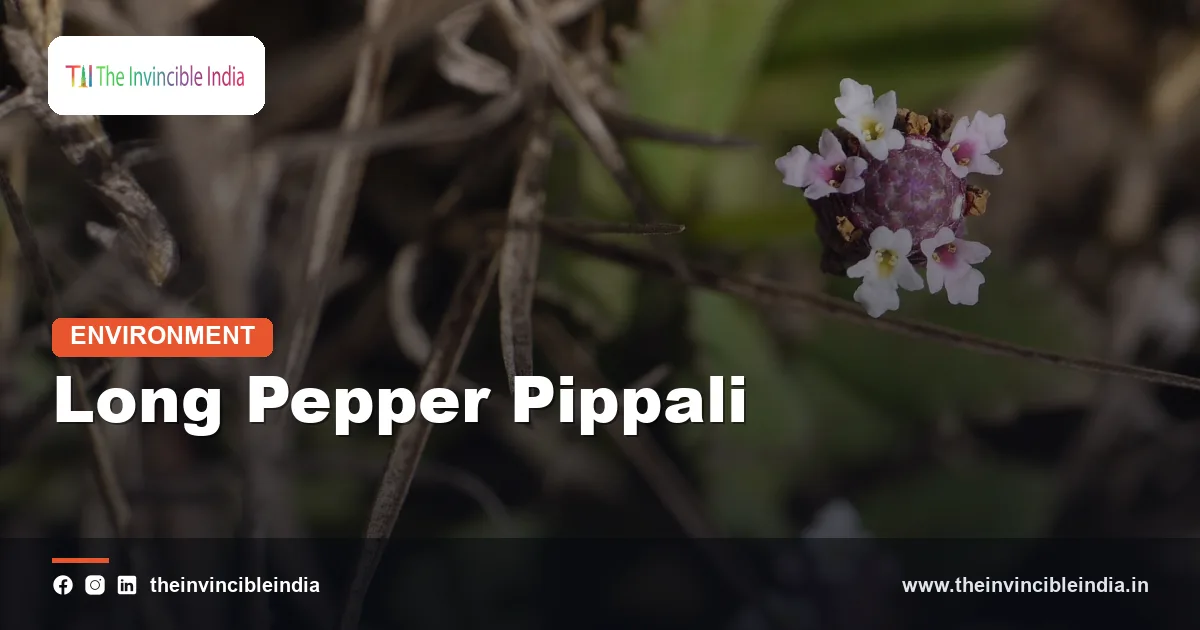
The long pepper (Piper longum), known in India as pippali, is a slender climbing spice plant of the pepper family whose dried, catkin-like fruiting spikes are hotter than black pepper and highly valued in Ayurveda. Long pepper was one of the principal hot spices of the Indian subcontinent for centuries before the chilli arrived from the Americas, and it was a sought-after trade good in the ancient Mediterranean world.
Today long pepper survives mainly as a medicinal and specialty spice. It grows wild in the warm, humid forests of northeast India, the Western Ghats and the Andaman and Nicobar Islands, and it is cultivated on a modest scale in several states. This explainer covers what long pepper is, how it differs from black pepper, where and how it grows, how it is harvested, and how it is used in Indian tradition and cooking.
Long Pepper Quick Facts
| Scientific name | Piper longum |
|---|---|
| Common Indian names | Pippali (Sanskrit and Hindi), pipli, tippili or thippili (Tamil and Malayalam), pippallu (Telugu), hippali (Kannada) |
| Plant family | Piperaceae, the pepper family that also includes black pepper and the betel vine |
| Plant type | Slender, creeping or climbing perennial vine with separate male and female plants |
| Where grown in India | Wild and cultivated in Assam, Meghalaya and the northeast, the Western Ghats, parts of Kerala, Tamil Nadu, Karnataka, West Bengal and Odisha, and the Andaman and Nicobar Islands |
| Season | Warm, humid climate; spikes are gathered once mature but before they ripen fully, mainly after the rains |
| Part used | Dried unripe fruiting spikes (pippali) and the root (pippalimula) |
| Main uses | Ayurvedic medicine, spice blends, pickles and traditional remedies |
| Notable fact | Pippali is one of the three pungent ingredients of the classical Ayurvedic combination called trikatu, along with dried ginger and black pepper |
Key Takeaways
- Long pepper (Piper longum), called pippali in India, is a climbing vine of the pepper family whose dried fruiting spikes are used as a spice and as an Ayurvedic medicine.
- Long pepper tastes hotter and more lingering than black pepper, and its heat comes mainly from a compound called piperine.
- Before chillies reached India in the sixteenth century, long pepper and black pepper were the main sources of pungent heat in Indian cooking.
- Pippali forms part of trikatu, the classical Ayurvedic trio of dried ginger, black pepper and long pepper.
- Long pepper plants are either male or female, and the spice is made from the short, thick spikes of the female plant.
- Wild long pepper is collected from forests in the northeast, the Western Ghats and the Andaman and Nicobar Islands, which has put pressure on natural populations.
What is long pepper?
Long pepper is a perennial climbing vine, Piper longum, grown for its tiny fruits, which are packed together into a cylindrical spike that looks like a small catkin or a miniature finger. Each spike is typically a few centimetres long, grey-green to dark brown when dried, with a surface that looks finely knobbed because of the fruits embedded in it. The spice is sold whole or ground and has a sweet, warm scent followed by a strong, lingering heat.
The plant itself is a slender trailing or climbing stem with heart-shaped to oval, glossy leaves. It roots at the nodes where stems touch the ground and can also climb a support or a tree trunk. The plants are dioecious, which means that separate male and female plants exist. Male plants bear longer and more slender spikes, while the female plants bear shorter, thicker spikes, and it is the female spikes that are collected as the spice.
Names and related plants
In Sanskrit the plant is called pippali and also magadhi, a reference to the ancient region of Magadha. The Hindi name is pipli, while Tamil and Malayalam speakers call it thippili. The root is known separately as pippalimula and is also used in traditional medicine. A few related Piper species, such as Piper retrofractum, are sometimes traded under similar names, so the botanical name matters when identifying genuine pippali.
How is long pepper different from black pepper?
Long pepper differs from black pepper in the part that is harvested, the shape of the spice and the intensity of its heat. Black pepper is the dried, rounded single berry of Piper nigrum, a different species. Long pepper is made up of many tiny fruits fused into one elongated spike. Both belong to the same genus and share the same pungent compound, piperine, but long pepper is usually described as hotter, sweeter in aroma and slower to fade on the tongue.
| Feature | Long pepper | Black pepper |
|---|---|---|
| Species | Piper longum | Piper nigrum |
| Shape | Elongated cylindrical spike of many fused fruits | Round single berry |
| Heat | Stronger and longer lasting | Sharp but shorter |
| Aroma | Warm, sweetish, faintly cinnamon-like | Pungent and woody |
| Main source in India | Northeast, Western Ghats and Andamans (wild and cultivated) | Kerala and the Western Ghats (extensively cultivated) |
| Trade today | Small, specialty and medicinal | Large, global spice |
Where does long pepper grow in India?
Long pepper grows wild and in small plantations in the humid, warm parts of India, especially the northeast, the Western Ghats, and the Andaman and Nicobar Islands. It needs a tropical climate with plentiful rain, warm temperatures and light shade, so it thrives under the canopy of forests and in garden plots shaded by other trees.
Assam, Meghalaya and the broader northeast are well known as sources of wild long pepper, and the plant also occurs in the lower Himalayan foothills. In peninsular India, the Western Ghats forests of Kerala, Karnataka and Tamil Nadu host the plant. Small-scale cultivation exists in parts of Kerala, Tamil Nadu, Karnataka, West Bengal, Odisha and Uttar Pradesh, often promoted by medicinal plant programmes because of steady demand from the Ayurvedic industry.
Outside India, long pepper is found across tropical South and Southeast Asia, which explains why the spice travelled so readily along ancient trade routes.
Why was long pepper so important in history?
Long pepper was important in history because it was India’s original hot spice, traded westward to Greece and Rome long before chilli peppers were known outside the Americas. Ancient writers in the Mediterranean world knew pepper from India and valued long pepper highly, and Roman accounts mention it among costly imported goods. It was often more expensive than black pepper.
Within India, pippali is described in the classical Ayurvedic texts, including the Charaka Samhita and the Sushruta Samhita, which count it among the principal medicinal herbs. The Sanskrit literature treats it as both food and medicine, and the plant has long had a place in household remedies.
The decline of long pepper as an everyday cooking spice came after the Portuguese brought chillies to India in the sixteenth century. Chillies were easy to grow, cheap and fiery, and they quickly replaced long pepper and black pepper as the main source of heat in Indian cooking. Long pepper then retreated into medicine, pickles and a few regional spice mixes, where it remains today.
How is long pepper grown?
Long pepper is grown by planting stem cuttings of female vines in loose, fertile, well-drained soil under light shade, with regular watering. It is a perennial that can crop for several years once established, and it is often raised as a small garden plant or as an intercrop under taller trees, such as areca nut or coconut palms, where it receives dappled light.
Propagation
Plants are multiplied from rooted stem cuttings or runners rather than from seed, because this lets growers select the female plants that produce the spice. The cuttings are first rooted in a nursery and then transplanted to the field at the start of the rains. Because male and female plants look similar until they flower, growers rely on selected planting stock to keep the proportion of female plants high.
Conditions and care
- Climate: warm and humid, with regular rainfall and protection from strong sun.
- Soil: loamy and rich in organic matter, with good drainage, since standing water rots the roots.
- Support: the vine is allowed to trail on the ground or climb a low support or companion tree.
- Management: light weeding and regular watering during dry periods; the plants are generally less pest-prone than black pepper but can suffer from root diseases in wet soil.
When and how is long pepper harvested and processed?
Long pepper spikes are harvested when they are fully grown but still unripe, usually after the monsoon, and are then dried in the sun until they turn dark and hard. If they are left on the plant until fully ripe, the spikes lose much of their pungency. Pickers snip the mature green spikes by hand, which means the work is slow and labour-intensive.
After harvest, the spikes are spread out in thin layers on mats or clean surfaces and dried for several days. They change from green to a dark greyish-brown or nearly black colour and become hard and brittle. The roots are dug up, cleaned, cut into pieces and dried separately for use as pippalimula. The dried spice keeps well when stored in airtight containers away from damp and light, and it is usually ground only when needed to preserve its aroma.
What gives long pepper its heat?
Long pepper gets its heat mainly from piperine, an alkaloid also responsible for the pungency of black pepper, together with related compounds. Piperine stimulates pain and heat receptors in the mouth, producing a burning sensation that is different in character from the capsaicin heat of chillies. The sensation tends to be slower to build and may linger, which is part of why long pepper is considered more intense than black pepper.
The spice also contains aromatic oils that give it a warm, sweetish scent. Another alkaloid, piperlongumine, is characteristic of the plant and has been studied in the laboratory. Such research is still preliminary and does not establish that long pepper cures or prevents any disease. Anyone considering medicinal use should consult a qualified practitioner, particularly during pregnancy or when taking regular medication.
How is long pepper used in Indian tradition?
Long pepper is used in Indian tradition mainly as an Ayurvedic ingredient, a pickling spice and a flavouring in some regional spice mixes. In Ayurveda, pippali is regarded as a warming herb that supports digestion and the respiratory system, and it appears in many classical formulations.
- Trikatu: a powder of equal or varied parts of dried ginger (shunthi), black pepper (maricha) and long pepper (pippali), used as a digestive stimulant in traditional practice.
- Sitopaladi churna: a well-known traditional powder for coughs and colds that includes pippali among its ingredients.
- Pippali rasayana: a classical tonic regimen in which the number of pippali fruits taken is raised gradually and then reduced, described in older texts and used only under practitioner guidance.
- Pickles and spice blends: whole or ground pippali flavours certain pickles and specialty masalas, and it can be added to some meat and lentil dishes.
- Root: pippalimula is used on its own in traditional decoctions and powders.
Modern studies have examined whether piperine can improve the absorption of other compounds in the body, but such findings are not a substitute for medical advice.
Is long pepper endangered?
Long pepper is not a rare plant everywhere, but wild populations have come under pressure in parts of India because of repeated collection from forests and loss of habitat. Because demand from the Ayurvedic industry is steady and a large share of the supply has traditionally come from wild gathering, researchers and forest departments have encouraged planting long pepper in gardens and farms to ease the pressure on natural stands.
Cultivation also helps buyers obtain material of known identity, since pippali is sometimes adulterated or substituted with related species. Growers who raise long pepper on their own land, especially under tree cover, can earn a modest supplementary income while helping conserve wild plants.
How can genuine long pepper be recognised?
Genuine long pepper can be recognised by its small, cylindrical, finely knobbed spikes, which are dark greyish-brown, hard and heavy for their size, with a sweet-pungent smell that is released when a spike is snapped. Each spike is composed of many tiny, closely packed fruits arranged in a spiral, and a broken spike shows a solid, seed-bearing structure rather than a hollow shell.
Buyers should be aware that spikes of related Piper species and old, stale or insect-damaged material are sometimes sold as pippali. Spikes that are pale, crumbly, odourless or mouldy are generally of poor quality. Purchasing from reputable sellers who state the botanical name, Piper longum, is the most reliable safeguard. Whole spikes keep their potency far longer than powder, so they are best ground fresh just before use.
Bottom Line
Long pepper, or pippali, is the hot, sweet-scented spike of a climbing vine native to the humid forests of India. It was India’s main fiery spice before chillies arrived, and today it endures mostly in Ayurveda and specialty cooking. Wild collection has strained natural populations, so cultivation under light shade is increasingly encouraged.
Frequently Asked Questions
What is long pepper (pippali)?
Long pepper, or pippali, is the dried, unripe fruiting spike of the climbing vine Piper longum. It looks like a small catkin and is hotter and more lingering than black pepper. It is used as a spice and as an Ayurvedic ingredient.
Is long pepper the same as black pepper?
No, long pepper and black pepper are different species of the same genus. Black pepper (Piper nigrum) is a round single berry, while long pepper (Piper longum) is an elongated spike of many fused fruits. Both contain piperine, but long pepper is usually hotter and sweeter in aroma.
Where is long pepper grown in India?
Long pepper grows wild and in small plantations in the northeast, the Western Ghats, and the Andaman and Nicobar Islands. It is also cultivated on a modest scale in states such as Kerala, Tamil Nadu, Karnataka, West Bengal and Odisha. It needs a warm, humid climate and light shade.
What is trikatu and why does it include pippali?
Trikatu is a classical Ayurvedic combination of dried ginger, black pepper and long pepper. The name means “three pungents,” and pippali provides one of the three hot components. The mixture is traditionally taken to stimulate digestion.
Why did long pepper lose popularity in Indian cooking?
Long pepper lost popularity after chillies reached India in the sixteenth century. Chillies were cheaper, easier to grow and hotter, so they replaced long pepper as the everyday source of heat. Pippali then remained mainly in medicine, pickles and a few spice mixes.
Can long pepper be grown at home?
Yes, long pepper can be grown in warm, humid regions from stem cuttings of female plants. It needs fertile, well-drained soil, regular water and partial shade. In cooler or dry climates it is hard to grow outdoors.
{“@context”:”https://schema.org”,”@graph”:[{“@type”:”FAQPage”,”mainEntity”:[{“@type”:”Question”,”name”:”What is long pepper (pippali)?”,”acceptedAnswer”:{“@type”:”Answer”,”text”:”Long pepper, or pippali, is the dried, unripe fruiting spike of the climbing vine Piper longum. It looks like a small catkin and is hotter and more lingering than black pepper. It is used as a spice and as an Ayurvedic ingredient.”}},{“@type”:”Question”,”name”:”Is long pepper the same as black pepper?”,”acceptedAnswer”:{“@type”:”Answer”,”text”:”No, long pepper and black pepper are different species of the same genus. Black pepper (Piper nigrum) is a round single berry, while long pepper (Piper longum) is an elongated spike of many fused fruits. Both contain piperine, but long pepper is usually hotter and sweeter in aroma.”}},{“@type”:”Question”,”name”:”Where is long pepper grown in India?”,”acceptedAnswer”:{“@type”:”Answer”,”text”:”Long pepper grows wild and in small plantations in the northeast, the Western Ghats, and the Andaman and Nicobar Islands. It is also cultivated on a modest scale in states such as Kerala, Tamil Nadu, Karnataka, West Bengal and Odisha. It needs a warm, humid climate and light shade.”}},{“@type”:”Question”,”name”:”What is trikatu and why does it include pippali?”,”acceptedAnswer”:{“@type”:”Answer”,”text”:”Trikatu is a classical Ayurvedic combination of dried ginger, black pepper and long pepper. The name means u201cthree pungents,u201d and pippali provides one of the three hot components. The mixture is traditionally taken to stimulate digestion.”}},{“@type”:”Question”,”name”:”Why did long pepper lose popularity in Indian cooking?”,”acceptedAnswer”:{“@type”:”Answer”,”text”:”Long pepper lost popularity after chillies reached India in the sixteenth century. Chillies were cheaper, easier to grow and hotter, so they replaced long pepper as the everyday source of heat. Pippali then remained mainly in medicine, pickles and a few spice mixes.”}},{“@type”:”Question”,”name”:”Can long pepper be grown at home?”,”acceptedAnswer”:{“@type”:”Answer”,”text”:”Yes, long pepper can be grown in warm, humid regions from stem cuttings of female plants. It needs fertile, well-drained soil, regular water and partial shade. In cooler or dry climates it is hard to grow outdoors.”}}]}]}


