

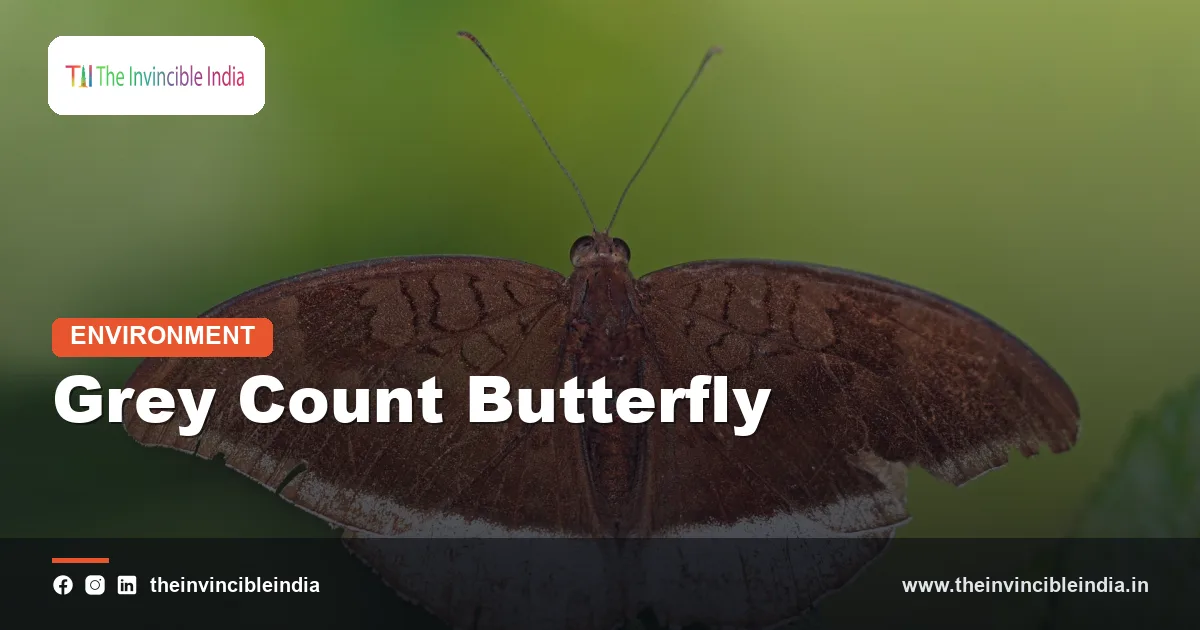
The grey count (Tanaecia lepidea) is a fast-flying, medium-to-large forest butterfly of the brush-footed family Nymphalidae, found in the Western Ghats and the hill forests of India, with greyish bands on dark wings and a pale underside marked with fine dark bars. It is an alert, swift butterfly that spends much of its time in the shade of the forest and is more often seen at rotting fruit, tree sap and damp ground than at flowers.
The grey count belongs to a group of forest butterflies that carry noble titles in their English names, alongside the earls and the barons. This explainer describes how to recognise the species, where it lives in India, what its caterpillars eat, how its life cycle works and how it behaves in the wild.
Quick Facts
| Attribute | Detail |
|---|---|
| Common name | Grey count |
| Scientific name | Tanaecia lepidea |
| Family | Nymphalidae (brush-footed butterflies) |
| Wingspan | Roughly 6 to 8 centimetres, a medium-to-large butterfly |
| Host plants | Melastoma malabathricum (Indian rhododendron) and Careya arborea (kumbhi tree, also placed in Planchonia) |
| Range and habitat | Forests of the Western Ghats, the lower Himalayas from Kumaon eastwards, central India, Odisha, Bengal and Assam; also the Malay Peninsula |
| Broods | Several broods a year in suitable forest, with most activity in and after the rains |
| Close relatives | Common earl (Tanaecia julii) and the barons of the genus Euthalia |
Key Takeaways
- The grey count, Tanaecia lepidea, is a medium-to-large Nymphalidae butterfly of Indian hill and evergreen forests, including the Western Ghats.
- The grey count has dark brown wings with broad grey bands on the upper side and a paler underside crossed by fine dark bars.
- Grey count caterpillars feed on the leaves of Melastoma malabathricum and Careya arborea, both common forest trees and shrubs.
- The grey count caterpillar is green with a row of red, blue-centred eyespots along its back and spines tipped in yellow.
- Adult grey counts are fast fliers that feed more on rotting fruit, tree sap, dung and wet soil than on flower nectar.
- The grey count depends on forest habitat, so loss of forest cover in the Western Ghats and Himalayan foothills is the main threat to local populations.
What Is the Grey Count Butterfly?
The grey count is a forest-dwelling butterfly, Tanaecia lepidea, that belongs to the family Nymphalidae and is found across the hill and evergreen forests of South and Southeast Asia. In India it is best known from the Western Ghats, the foothills of the Himalayas and the forests of the north-east.
The genus Tanaecia includes the butterflies called earls and counts. The names come from an old English custom of giving noble titles, such as baron, earl and count, to a group of related, strongly flying forest butterflies. The grey count is placed in the Limenitidinae, the subfamily that also includes the admirals and sailers, which are known for their gliding flight.
The butterfly is not rare within its habitat, but it is not usually seen in open towns or farmland. It is mainly a species of shaded forest, forest edges, forest tracks and the banks of hill streams.
What Does the Grey Count Look Like?
The grey count has dark brown to blackish wings crossed by broad greyish bands on the upper side, and a paler underside with a dense pattern of fine dark bars and lines. The overall impression of a flying individual is a darkish butterfly with a flash of grey.
The underside, which is seen when the butterfly closes its wings, is lighter and patterned with narrow dark bars, giving a barred or finely lined look. This pattern helps the butterfly blend into dappled forest light and into the bark and leaf litter where it rests. The shape of the wings is rounded, with a fairly sturdy body, which suits its strong gliding and darting flight.
Males and females are similar in general appearance, but females are often larger and have broader wings. As with many forest butterflies, subspecies in different regions show small variations in pattern and shade. Two commonly named subspecies are T. l. miyana, recorded from Kerala in the Western Ghats, and T. l. lepidea, recorded from areas such as Nepal and Nagaland.
Where Is the Grey Count Found in India?
The grey count is found in forested parts of the Western Ghats, the lower Himalayas east from Almora in Uttarakhand, central India, Odisha, West Bengal and Assam. It also occurs in the Malay Peninsula and other parts of Southeast Asia.
Within India, the species is best seen in the following areas:
- The evergreen and moist deciduous forests of the Western Ghats, including Kerala, Karnataka, Goa and Maharashtra
- The foothill forests of the Himalayas from Kumaon eastwards, through Nepal-bordering regions and Sikkim
- The forests of north-eastern India, including Assam and Nagaland
- Parts of the central Indian highlands and the forests of Odisha
The butterfly generally lives from low elevations to moderate hills, wherever the forest is intact. It is less common in dry thorn forest and open scrub, where other butterflies, such as the yellow pansy, take over.
What Habitat Does the Grey Count Prefer?
The grey count prefers shaded forest with a moist microclimate, particularly where host plants grow along streams, forest tracks and clearings. The butterfly is closely tied to wooded land and is rarely found far from the forest canopy.
Within the forest, individuals patrol along trails and edges, often flying at a moderate height among the trees and shrubs. They descend to the ground or to low vegetation to feed on damp soil, animal droppings and fallen fruit. A mix of dense vegetation, flowing water and fruiting trees provides everything the species needs.
Because the butterfly depends on this kind of habitat, it is regarded as a useful indicator of forest quality. Where the forest has been cleared or heavily fragmented, the grey count gradually disappears.
What Do Grey Count Caterpillars Eat?
Grey count caterpillars eat the leaves of Melastoma malabathricum, a common shrub of forest edges and hill slopes, and Careya arborea, a medium-sized deciduous tree known as the kumbhi tree. Both plants are widespread across the hills of India.
Melastoma is a hardy, flowering shrub with purple blooms and is often found along roadsides and clearings in the hills. Careya arborea grows in moist and dry deciduous forests and is notable for its large flowers and round fruit. The use of both a shrub and a tree gives the butterfly some flexibility in where it can breed.
| Host plant | Type | Typical habitat |
|---|---|---|
| Melastoma malabathricum | Flowering shrub | Forest edges, hill slopes, clearings and roadsides |
| Careya arborea (Planchonia) | Deciduous tree | Moist and dry deciduous forests, foothills |
Because the butterfly needs these plants for its young, the loss of host trees and shrubs directly limits the number of grey counts a patch of forest can support.
What Is the Life Cycle of the Grey Count?
The grey count passes through four stages, namely egg, caterpillar, pupa and adult, and the complete metamorphosis takes several weeks in warm, humid weather. Like other nymphalids, it repeats the cycle through several generations in a year where conditions are suitable.
Egg
The female lays her eggs on the leaves of host plants, usually singly. The eggs hatch after a short period, and the young caterpillar begins to feed on the surrounding leaf.
Caterpillar
The mature caterpillar is green, with a dorsal row of light red eyespots that have blue centres, and with spines tipped in yellow. This unusual pattern is thought to break up the outline of the body and may startle small predators. The caterpillar feeds on the host plant leaves and sheds its skin several times as it grows.
Pupa
The pupa is green and angular, with golden-tipped projections marked with black and a few large gold spots. It hangs from the host plant and is well camouflaged among the leaves, with the metallic gold touches resembling droplets of water or flecks of light.
Adult
The adult butterfly emerges from the pupa, dries its wings and begins to fly within hours. It then feeds, mates and lays eggs, completing the cycle.
How Does the Grey Count Behave?
The grey count is a swift, strong flier that darts through the forest and often glides on stiff, level wings between short bursts of flapping. It commonly settles on sunlit leaves with its wings spread to bask, and it can be wary and quick to take off when approached.
Unlike many butterflies, the grey count visits flowers only occasionally. Its favourite foods are rotting fruit, tree sap, animal dung, carrion and wet earth, which supply sugars, salts and minerals. Butterfly watchers sometimes attract it by placing overripe banana or fruit in a shaded spot.
The butterfly is territorial, in the sense that individuals often return to the same perch, and they may chase off rivals or other large insects. Activity is greatest during the warmer parts of the morning and again in the late afternoon, while the middle of the day may be spent resting in shade.
How Many Broods Does the Grey Count Have?
The grey count has several broods in a year, and adults are on the wing for much of the year in the warm, moist forests of southern India. Numbers tend to be highest during and after the monsoon, when new leaves appear on the host plants.
In regions with a cooler or drier season, the butterfly is fewer in number or is absent for some months, and it returns as conditions improve. The pattern varies between the Western Ghats, the Himalayan foothills and the north-east, because each region has its own rainfall and temperature cycle.
How Is the Grey Count Different from Its Relatives?
The grey count differs from its relatives mainly in its grey banding and finely barred underside, whereas the common earl and the barons show different colour patterns, often with stronger brown, blue or green tones. All belong to the same wider group of strongly flying forest nymphalids that feed on fruit and sap.
| Butterfly | Genus | Typical features |
|---|---|---|
| Grey count | Tanaecia | Dark wings with greyish bands; pale underside with fine bars |
| Common earl | Tanaecia | A related forest species with a different banded pattern |
| Barons (such as the common baron) | Euthalia | Robust forest butterflies; caterpillars often feed on mango and related trees |
Identification in the field is not always easy, since several forest nymphalids look broadly similar in flight. Photographs that show both the upper side and underside are the best way to separate them reliably.
Is the Grey Count Threatened?
The grey count is not generally regarded as a rare butterfly, but it depends on healthy forest, so the clearing and fragmentation of forests in the Western Ghats and the Himalayan foothills can reduce local populations. Species that rely on forest canopy, host trees and moist streams are the first to decline when the habitat changes.
Several actions help protect such butterflies:
- Protecting forests, forest corridors and stream banks
- Retaining native host plants such as Melastoma and Careya along trails and clearings
- Limiting pesticide use near forest edges and plantations
- Recording sightings in citizen-science projects to track population changes over time
How Can You Spot a Grey Count?
The best way to spot a grey count is to walk slowly along shaded forest trails in the Western Ghats or Himalayan foothills in the warmer parts of the morning, watching for a dark, grey-banded butterfly gliding along the path. Patience, a quiet approach and good timing make a big difference.
- Choose trails near streams, forest edges and fruiting trees.
- Visit in the monsoon and post-monsoon months, when numbers are higher.
- Look at sunlit leaves at about head height, where individuals often bask.
- Use ripe fruit as bait in a shaded place and wait at a distance.
- Photograph both the upper side and underside when possible.
- Stay on marked paths and avoid disturbing the vegetation or wildlife.
Bottom Line
The grey count is a fast, strongly patterned forest butterfly whose life depends on shaded woodland, a few key host plants and a steady supply of fruit and sap. Watching for it along Western Ghats and Himalayan foothill trails is a good way to learn how closely butterflies are tied to intact forest.
Frequently Asked Questions
What is a grey count butterfly?
The grey count is a medium-to-large forest butterfly, Tanaecia lepidea, of the family Nymphalidae. It has dark wings with greyish bands and a paler, finely barred underside. It lives in the hill and evergreen forests of India and Southeast Asia.
Where is the grey count found in India?
The grey count is found in the Western Ghats, the lower Himalayas from Kumaon eastwards, central India, Odisha, West Bengal and Assam. It occurs mainly in forested areas. It is also found in the Malay Peninsula.
What do grey count caterpillars eat?
Grey count caterpillars eat the leaves of Melastoma malabathricum and Careya arborea. Melastoma is a flowering shrub of forest edges, while Careya arborea, or kumbhi, is a deciduous tree. Both are widespread in Indian hill forests.
What does a grey count caterpillar look like?
A grey count caterpillar is green with a row of light red eyespots that have blue centres along its back. It also carries spines with yellow tips. The pupa is green and angular, with golden-tipped points.
What does the grey count feed on as an adult?
Adult grey counts feed mainly on rotting fruit, tree sap, animal dung and moisture from damp soil. They visit flowers only occasionally. This is a common habit among forest nymphalid butterflies.
Why is it called a count?
The grey count is called a count because butterflies in its group of strong-flying forest nymphalids were given noble titles, such as count, earl and baron, in English. The titles are only names and do not describe any biological rank. The word grey refers to the greyish bands on its wings.
{“@context”:”https://schema.org”,”@graph”:[{“@type”:”FAQPage”,”mainEntity”:[{“@type”:”Question”,”name”:”What is a grey count butterfly?”,”acceptedAnswer”:{“@type”:”Answer”,”text”:”The grey count is a medium-to-large forest butterfly, Tanaecia lepidea, of the family Nymphalidae. It has dark wings with greyish bands and a paler, finely barred underside. It lives in the hill and evergreen forests of India and Southeast Asia.”}},{“@type”:”Question”,”name”:”Where is the grey count found in India?”,”acceptedAnswer”:{“@type”:”Answer”,”text”:”The grey count is found in the Western Ghats, the lower Himalayas from Kumaon eastwards, central India, Odisha, West Bengal and Assam. It occurs mainly in forested areas. It is also found in the Malay Peninsula.”}},{“@type”:”Question”,”name”:”What do grey count caterpillars eat?”,”acceptedAnswer”:{“@type”:”Answer”,”text”:”Grey count caterpillars eat the leaves of Melastoma malabathricum and Careya arborea. Melastoma is a flowering shrub of forest edges, while Careya arborea, or kumbhi, is a deciduous tree. Both are widespread in Indian hill forests.”}},{“@type”:”Question”,”name”:”What does a grey count caterpillar look like?”,”acceptedAnswer”:{“@type”:”Answer”,”text”:”A grey count caterpillar is green with a row of light red eyespots that have blue centres along its back. It also carries spines with yellow tips. The pupa is green and angular, with golden-tipped points.”}},{“@type”:”Question”,”name”:”What does the grey count feed on as an adult?”,”acceptedAnswer”:{“@type”:”Answer”,”text”:”Adult grey counts feed mainly on rotting fruit, tree sap, animal dung and moisture from damp soil. They visit flowers only occasionally. This is a common habit among forest nymphalid butterflies.”}},{“@type”:”Question”,”name”:”Why is it called a count?”,”acceptedAnswer”:{“@type”:”Answer”,”text”:”The grey count is called a count because butterflies in its group of strong-flying forest nymphalids were given noble titles, such as count, earl and baron, in English. The titles are only names and do not describe any biological rank. The word grey refers to the greyish bands on its wings.”}}]}]}


