

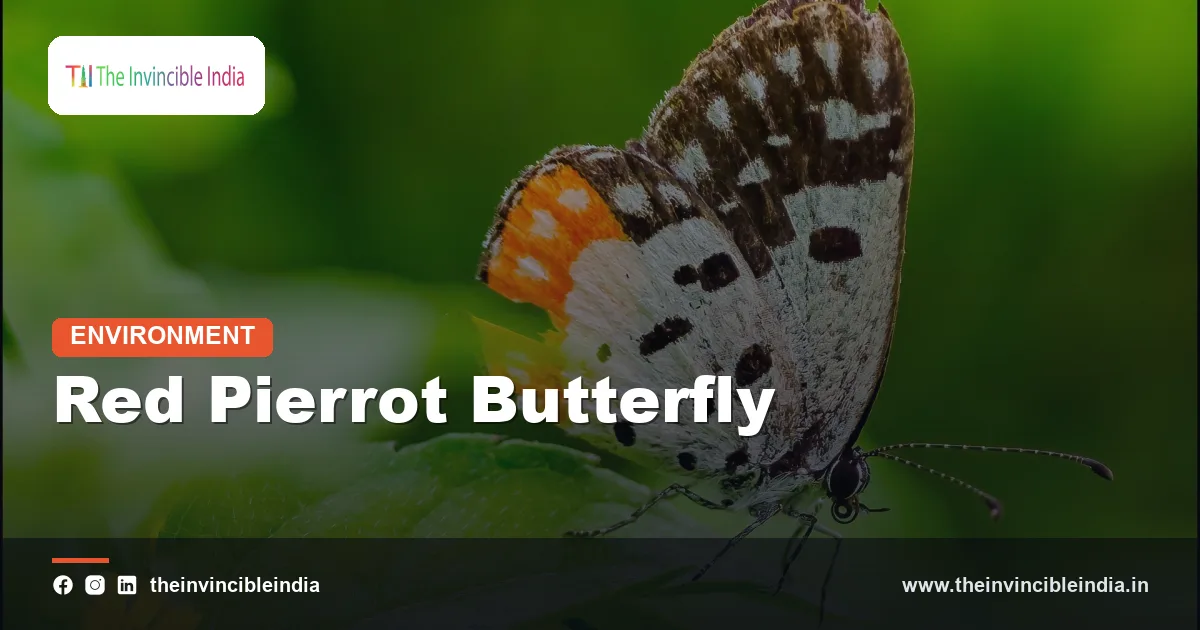
The red pierrot (Talicada nyseus) is a small black-and-white butterfly with orange-red markings, found across India, whose caterpillars live inside the leaves of Kalanchoe and related fleshy plants and feed as leaf miners. It belongs to the gossamer-winged family Lycaenidae and is one of the most familiar tiny butterflies of Indian gardens, rooftops, hedgerows and rocky scrub.
Few insects show the link between a butterfly and one particular plant group as clearly as the red pierrot does. Wherever Kalanchoe grows, whether as a pot plant on a balcony or as a hardy weed on a wall, the red pierrot is likely to turn up, and its translucent leaf mines are often the first sign that it has arrived.
| Quick Fact | Detail |
|---|---|
| Common name | Red pierrot |
| Scientific name | Talicada nyseus |
| Family | Lycaenidae (gossamer-winged butterflies) |
| Wingspan | Roughly 20 to 30 mm |
| Host plants | Kalanchoe species and other fleshy Crassulaceae |
| Range and habitat in India | Peninsular India, the Himalayan foothills and the north-east; gardens, scrub, rocky slopes and light forest edges |
| Flight season and broods | Seen for much of the year, with several overlapping broods and peaks in and after the monsoon |
| Notable features | Black-and-white pattern with orange-red markings; caterpillars mine leaves from the inside |
Key Takeaways
- The red pierrot is a small lycaenid butterfly, Talicada nyseus, with a wingspan of roughly 20 to 30 mm.
- Red pierrot caterpillars are leaf miners that feed inside the leaves of Kalanchoe and similar succulent plants of the family Crassulaceae.
- The red pierrot has a black-and-white pattern with orange-red markings, which is the reason for the “red” in its common name.
- The red pierrot is widespread in India, from peninsular cities to the Himalayan foothills and the north-east, and is common in gardens.
- The red pierrot breeds through the year in warm regions, with several overlapping generations rather than a single annual brood.
- Red pierrot caterpillars cause only cosmetic damage to Kalanchoe leaves, so the species is not treated as a serious garden pest.
What does the red pierrot look like?
The red pierrot is a tiny butterfly whose wings combine a dark, black-and-white pattern with bright orange-red markings, which makes it easy to separate from most other small butterflies once it is seen well. The butterfly is small enough to be mistaken for a moth at a glance, but the neat arrangement of dots and bands on the wings is distinctive.
The upperside of the wings is dark, with orange-red patches near the margins that show when the butterfly basks with its wings spread. The underside is the side most people see, because the red pierrot often rests with its wings folded upright. It is pale, marked with rows of black spots and with bands of orange-red along the edges of the wings.
Males and females look similar to the casual observer. Females tend to appear slightly paler or more rounded in the wing, but the difference is too small to be reliable in the field without a close look. Unlike many of its relatives, the red pierrot does not carry long, obvious tails on the hindwings, so its outline is compact and rounded.
Why is it called a pierrot?
The name pierrot refers to the white-faced clown of French pantomime, and it has been used for several small Indian butterflies with a bold black-and-white or spotted look. The word “red” was added for this species because of the orange-red markings that set it apart from its black-and-white cousins.
Where is the red pierrot found in India?
The red pierrot is found across much of India, including the peninsula, the Himalayan foothills and the north-east, and it also occurs in parts of the wider Indian subcontinent. It is a butterfly of open, sunny, disturbed places rather than deep forest.
Typical places where observers record the red pierrot include:
- Gardens, terraces and balconies where Kalanchoe is grown in pots
- Rocky outcrops, stone walls and old ruins where wild succulents grow in crevices
- Scrub, dry deciduous woodland edges and roadsides
- Hill stations and foothill towns, where the butterfly is also seen in the cooler months
The red pierrot is not confined to a single state. Local abundance depends mainly on whether suitable host plants are present within a short distance, because the adult butterfly is a weak flier that tends to stay close to the plants on which its caterpillars feed.
What does the red pierrot caterpillar eat?
The red pierrot caterpillar eats the soft tissue inside the leaves of Kalanchoe and related fleshy plants, which makes it a leaf miner. The best-known host in Indian gardens is the plant often called air plant, miracle leaf or Bryophyllum, which belongs to the genus Kalanchoe in the family Crassulaceae.
Crassulaceae is the stonecrop family, a group of succulent plants with thick, water-storing leaves. The red pierrot has adapted to feeding on this plant group, and its caterpillars are among the few insect larvae that regularly feed on succulent leaves from the inside.
What is a leaf miner?
A leaf miner is an insect larva that lives and feeds between the upper and lower surfaces of a leaf, eating the tissue in between. In a red pierrot leaf, the caterpillar removes the juicy tissue inside the thick leaf and leaves the outer skin largely intact. The affected area turns pale and translucent, forming a visible patch or window, and a small entry hole is often visible on the surface.
Living inside the leaf gives the caterpillar protection from many predators and from direct sun, and it supplies a constant source of water-rich food. The thick leaves of Kalanchoe make this an ideal arrangement, since the leaf is large enough to hold a growing caterpillar for days at a time.
How does the red pierrot life cycle work?
The red pierrot passes through four stages, egg, caterpillar, pupa and adult, in a cycle that takes a few weeks in warm weather. Like all butterflies, the red pierrot undergoes complete metamorphosis, so each stage looks completely different from the next.
| Stage | What happens |
|---|---|
| Egg | The female lays tiny eggs singly on the surface of a Kalanchoe leaf or on young shoots |
| Caterpillar | The newly hatched larva enters the leaf and feeds on the tissue inside, growing through several moults |
| Pupa | The fully grown caterpillar transforms into a small, compact pupa on or near the host plant |
| Adult | The butterfly emerges, dries its wings, feeds on nectar and begins to look for a mate |
Because the generations overlap, eggs, caterpillars, pupae and adults can all be found on the same cluster of plants at the same time in warm months. This is one reason the red pierrot can seem to appear suddenly after rain, when new growth on the host plants triggers a burst of breeding.
Why do the broods overlap?
Red pierrot broods overlap because a warm climate lets each stage develop quickly, so a female that emerged early in a season can lay eggs while her offspring are still caterpillars. In regions without a hard winter, there is no clear break between one generation and the next, and the population simply rises and falls with the supply of fresh Kalanchoe leaves. This is very different from butterflies of cold regions, which pass the winter in a resting stage and fly in a single short season.
Caterpillars also vary in how long they take to mature. Cool or dry spells stretch the larval stage, while warm and humid weather shortens it. As a result, two plants growing side by side can hold caterpillars at quite different stages of growth.
What time of year can you see the red pierrot?
The red pierrot can be seen for much of the year in warm parts of India, with numbers usually highest during and just after the monsoon, when host plants put out fresh leaves. In regions with cold winters, such as the foothills of the Himalaya, activity drops in the coldest months and picks up as temperatures rise.
Because the butterfly breeds in several broods, there is no single month in which it is the only one on the wing. A simple rule for observers is to look on warm, sunny mornings, when adults are most active and visit flowers or rest in the sun near host plants.
How can you tell the red pierrot from other pierrots?
The red pierrot is told apart from other pierrots mainly by its orange-red bands and its lack of tails, whereas related pierrots show different spot patterns and, in some species, small tails. India has a small group of butterflies that share the pierrot name, and beginners often confuse them.
- Red pierrot (Talicada nyseus): black-and-white with orange-red markings; caterpillars feed on Kalanchoe.
- Common pierrot (Castalius rosimon): a larger-looking black-and-white butterfly with a white ground colour, bold black spots and touches of red or orange near the wing edges; its caterpillars feed on plants such as Ziziphus.
- Striped pierrot (Tarucus nara): a pierrot with a striped underside and a small tail-like projection.
- Spotted pierrot (Tarucus callinara): similar to the striped pierrot but with spotted rather than banded markings.
Host plants provide one more clue. Seeing a small butterfly hovering around Kalanchoe is a strong hint that it is a red pierrot, since few other butterflies in Indian gardens are tied to this plant.
How does the red pierrot behave?
The red pierrot is a low, fluttering flier that spends much of its time near host plants, resting on leaves or visiting small flowers for nectar. It is an unhurried butterfly and easy to approach, which makes it a good subject for beginners in butterfly photography.
Several behaviours are worth noting:
- Adults often rest with the wings folded upright, showing the pale underside.
- Males perch or patrol near host plants to find females.
- Both sexes feed on nectar from small flowers, usually close to the ground.
- Females flit from leaf to leaf, touching the plant with the abdomen to lay single eggs.
The red pierrot is not known for long-distance migration. Populations are tied to patches of host plants, and the butterfly typically stays within a small area throughout its life.
Like most small lycaenids, the red pierrot is easily overlooked by people who walk quickly. Watching a single Kalanchoe plant for ten minutes on a sunny morning is often more rewarding than walking a long trail, because the butterflies come to the plant rather than the other way round. Patience, a camera with a close-focus setting and a steady hand are all the equipment a beginner needs.
Is the red pierrot a garden pest?
No, the red pierrot is not regarded as a serious garden pest, because the damage its caterpillars cause is limited to pale patches inside the leaves of a hardy, fast-growing plant. Kalanchoe is tough, regrows readily and is often considered a weed in warm regions, so the occasional mined leaf rarely matters.
Gardeners who grow Kalanchoe purely for decoration may dislike the blemishes, but the damage seldom threatens the plant itself. In practice the red pierrot is viewed as a harmless and even welcome visitor, since it signals that the garden supports wildlife. Where a gardener wishes to protect a particular plant, removing a few mined leaves by hand is usually enough, with no need for chemical sprays.
Spraying insecticide is best avoided in any garden that hosts butterflies. Chemicals that kill leaf miners also kill other beneficial insects, and the red pierrot’s presence is usually a sign of a reasonably healthy small habitat.
How can you attract and support the red pierrot?
The simplest way to support the red pierrot is to grow Kalanchoe or similar succulent plants and leave a few mined leaves alone. Because the species depends on its host plants, the presence of the plant is the single most important factor.
- Grow Kalanchoe in pots or in a sunny, well-drained corner of the garden.
- Avoid pesticides, especially systemic insecticides that enter the plant tissue.
- Provide small nectar flowers, such as those of low herbs, near the host plants.
- Keep a sunny, sheltered spot, since the butterfly prefers warm, bright conditions.
- Resist the urge to remove every leaf with a visible mine.
Growing host plants also turns a small balcony into a place where children and adults can watch the whole life cycle, from egg to adult, within a few weeks.
Why does a small butterfly like the red pierrot matter?
The red pierrot matters because it shows how closely a butterfly can be tied to a single group of plants, and because it is an easy, accessible species for citizen science and nature education in India. Tiny lycaenids are often overlooked, but they form a large share of India’s butterfly diversity.
The red pierrot is also a useful indicator of local conditions. Its presence near buildings, gardens and roadsides shows that even built-up places can support specialised insects when the right plants are available. Recording sightings through nature-observation platforms and local butterfly groups helps researchers track how common species change over time, and the red pierrot, being easy to identify, is a good candidate for such records.
Bottom Line
The red pierrot is a small, easily recognised Indian butterfly whose life revolves around Kalanchoe and similar succulent plants. Its leaf-mining caterpillars, overlapping broods and tolerance of gardens make it a good first species for anyone interested in butterflies, and it asks for little more than a pot of host plants and an absence of pesticides.
Frequently Asked Questions
What is the red pierrot butterfly?
The red pierrot is a small black-and-white butterfly with orange-red markings, scientifically named Talicada nyseus, found across India. It belongs to the family Lycaenidae and has a wingspan of roughly 20 to 30 mm. Its caterpillars feed on Kalanchoe and related succulent plants.
What does the red pierrot caterpillar eat?
The red pierrot caterpillar eats the inner tissue of Kalanchoe leaves and those of related fleshy plants in the family Crassulaceae. It lives inside the leaf as a leaf miner, leaving the outer skin intact. The mined area turns pale and translucent, which is often the first sign that the butterfly is breeding nearby.
Is the red pierrot harmful to plants?
No, the red pierrot is not considered seriously harmful to plants. Its caterpillars cause only cosmetic damage to Kalanchoe leaves, and the plant is hardy enough to recover. Gardeners who want to protect a leaf can remove it by hand without using chemical sprays.
Where can I see the red pierrot in India?
The red pierrot can be seen in gardens, on rocky slopes, in scrub and along roadsides across much of India. It is most likely to be found wherever Kalanchoe or similar succulents grow, from peninsular cities to Himalayan foothills. Warm, sunny mornings are the best time to look.
How is the red pierrot different from the common pierrot?
The red pierrot is smaller and is marked by orange-red bands, while the common pierrot is a larger-looking butterfly with a white ground colour and bold black spots. The two also use different host plants. The red pierrot depends on Kalanchoe, while the common pierrot feeds on other plants such as Ziziphus.
How long does the red pierrot life cycle take?
The red pierrot life cycle, from egg to adult, takes a few weeks in warm weather. The butterfly passes through egg, caterpillar, pupa and adult stages, and broods overlap, so all stages can be present on the same plants at once. Cooler weather slows development.
{“@context”:”https://schema.org”,”@graph”:[{“@type”:”FAQPage”,”mainEntity”:[{“@type”:”Question”,”name”:”What is the red pierrot butterfly?”,”acceptedAnswer”:{“@type”:”Answer”,”text”:”The red pierrot is a small black-and-white butterfly with orange-red markings, scientifically named Talicada nyseus, found across India. It belongs to the family Lycaenidae and has a wingspan of roughly 20 to 30 mm. Its caterpillars feed on Kalanchoe and related succulent plants.”}},{“@type”:”Question”,”name”:”What does the red pierrot caterpillar eat?”,”acceptedAnswer”:{“@type”:”Answer”,”text”:”The red pierrot caterpillar eats the inner tissue of Kalanchoe leaves and those of related fleshy plants in the family Crassulaceae. It lives inside the leaf as a leaf miner, leaving the outer skin intact. The mined area turns pale and translucent, which is often the first sign that the butterfly is breeding nearby.”}},{“@type”:”Question”,”name”:”Is the red pierrot harmful to plants?”,”acceptedAnswer”:{“@type”:”Answer”,”text”:”No, the red pierrot is not considered seriously harmful to plants. Its caterpillars cause only cosmetic damage to Kalanchoe leaves, and the plant is hardy enough to recover. Gardeners who want to protect a leaf can remove it by hand without using chemical sprays.”}},{“@type”:”Question”,”name”:”Where can I see the red pierrot in India?”,”acceptedAnswer”:{“@type”:”Answer”,”text”:”The red pierrot can be seen in gardens, on rocky slopes, in scrub and along roadsides across much of India. It is most likely to be found wherever Kalanchoe or similar succulents grow, from peninsular cities to Himalayan foothills. Warm, sunny mornings are the best time to look.”}},{“@type”:”Question”,”name”:”How is the red pierrot different from the common pierrot?”,”acceptedAnswer”:{“@type”:”Answer”,”text”:”The red pierrot is smaller and is marked by orange-red bands, while the common pierrot is a larger-looking butterfly with a white ground colour and bold black spots. The two also use different host plants. The red pierrot depends on Kalanchoe, while the common pierrot feeds on other plants such as Ziziphus.”}},{“@type”:”Question”,”name”:”How long does the red pierrot life cycle take?”,”acceptedAnswer”:{“@type”:”Answer”,”text”:”The red pierrot life cycle, from egg to adult, takes a few weeks in warm weather. The butterfly passes through egg, caterpillar, pupa and adult stages, and broods overlap, so all stages can be present on the same plants at once. Cooler weather slows development.”}}]}]}


