

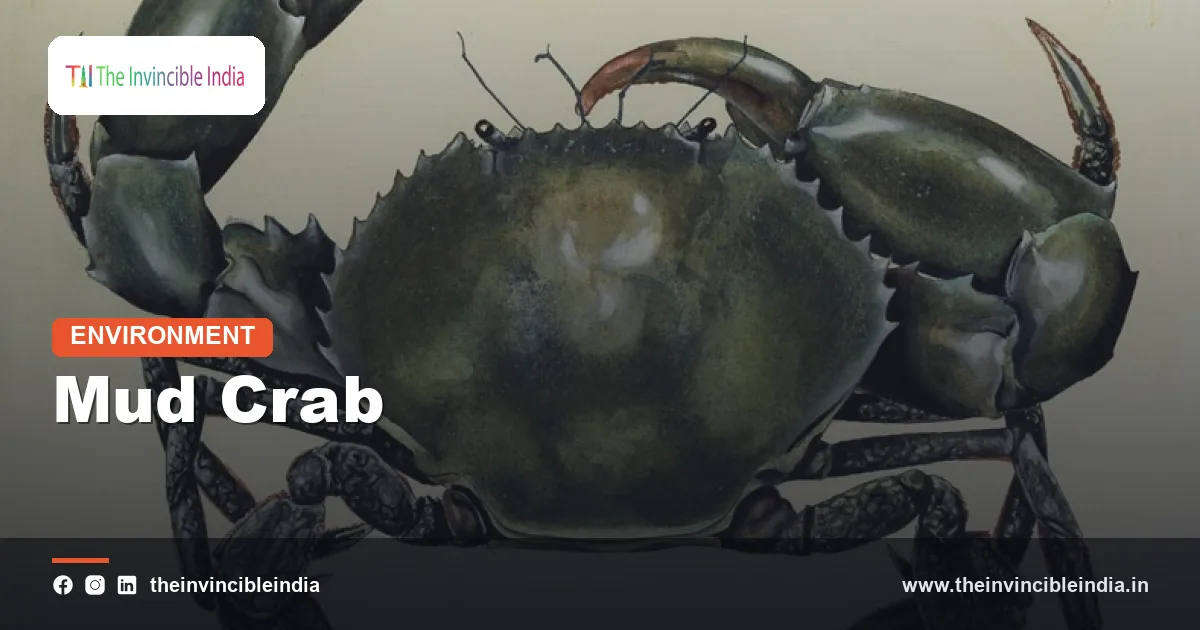
The mud crab is a large, powerful, edible swimming crab of the genus Scylla that lives in the muddy estuaries, mangrove creeks and brackish backwaters of India’s coasts, and it is one of the country’s most valuable crustaceans. It is prized in restaurants at home and abroad, collected from the wild by coastal communities and increasingly raised in brackish-water ponds.
The mud crab is easy to recognise by its smooth, broad, olive-green to dark carapace and its heavy claws, which can crush shells and give a painful nip. In India, the species most often meant by the name is the giant mud crab (Scylla serrata), although other closely related species of Scylla also occur and are sold under the same name.
| Fact | Detail |
|---|---|
| Common names | Mud crab, mangrove crab, giant mud crab (kekda in Hindi and Bengali, nandu in Tamil, njandu in Malayalam) |
| Scientific names | Scylla serrata (giant mud crab); other Indian species include Scylla olivacea and Scylla tranquebarica |
| Family | Portunidae (swimming crabs) |
| Size | Carapace width commonly 10 to 20 cm; large males can weigh well over a kilogram, and the biggest reach around 2 to 3 kg |
| Range and habitat in India | Estuaries, mangroves, creeks, lagoons and brackish backwaters on both coasts, including the Sundarbans, Chilika, Pichavaram and Kerala backwaters |
| Diet | Omnivorous scavenger and predator: molluscs, small crustaceans, fish, worms and plant or animal debris |
| Breeding | Mated females migrate to the sea to spawn; eggs hatch into planktonic larvae that return to estuaries as juveniles |
| Economic importance | High-value seafood; wild fishery and growing aquaculture, including crab fattening; exported live and chilled |
Key Takeaways
- The mud crab (genus Scylla) is a large edible swimming crab of the family Portunidae that lives in the estuaries and mangroves of India.
- The giant mud crab (Scylla serrata) is the best-known mud crab species and can grow to a carapace width of around 20 cm and a weight of two to three kilograms.
- Female mud crabs migrate from estuaries to the sea to release their eggs, and the larvae later drift back to mangrove nurseries.
- Mud crab is a high-value seafood in India, harvested from the wild and farmed through grow-out and fattening in brackish-water ponds.
- Mud crabs depend on healthy mangrove forests for shelter and food, so mangrove loss directly harms crab populations.
- Sustainable practices, such as releasing egg-bearing females and undersized crabs, help keep wild mud crab stocks productive.
What is a mud crab?
A mud crab is a large estuarine crab with a smooth, wide carapace, strong claws and flattened rear legs, belonging to the genus Scylla in the swimming crab family Portunidae. It spends most of its life in soft muddy bottoms of tidal creeks and mangrove forests, where it digs burrows and hunts at night.
The name mud crab covers a small group of closely related species that look similar and were once considered a single species. Worldwide, four species of Scylla are now recognised. In India, at least three have been reported: the giant mud crab (Scylla serrata), the orange mud crab (Scylla olivacea) and the purple mud crab (Scylla tranquebarica). The giant mud crab is the biggest and the most valuable.
The common names also differ by language. In Hindi and Bengali, the crab is called kekda, in Tamil nandu and in Malayalam njandu. Sellers often divide the catch into grades by size, sex and shell hardness, since these influence price.
What does a mud crab look like?
A mud crab has a heavy, rounded, smooth carapace that is usually olive green, brown or dark purplish, with a front edge bearing prominent spines. Two strong claws, one often larger than the other, are used for crushing shells, and the last pair of legs is flattened into paddles for swimming.
Several features help identify the mud crab and its sex:
- The carapace is smooth and broad, with nine spines on each side and four between the eyes.
- Males have a narrow, triangular abdominal flap on the underside, while mature females have a broad, rounded flap that holds eggs.
- Males usually grow larger and carry bigger claws than females.
- The giant mud crab has distinct polygonal marks on the legs and claws, which help separate it from related species.
The crab sheds its shell as it grows, a process called moulting. Soon after moulting, the shell is soft and the crab is vulnerable, and the meat content is low. Crabs with hard shells and full bodies, known as full crabs, fetch the best prices in the market.
Where do mud crabs live in India?
Mud crabs live in the brackish waters of India’s east and west coasts, including estuaries, tidal creeks, lagoons and mangrove forests. They are found in the Sundarbans of West Bengal, the backwaters of Kerala, Chilika lake in Odisha, the Pichavaram mangroves in Tamil Nadu, the deltas of Andhra Pradesh and the creeks of Maharashtra and Gujarat.
Within these habitats, the crab prefers soft, muddy ground and areas with plenty of cover. Juveniles settle in sheltered mangrove roots and seagrass beds, while adults roam through tidal channels and dig burrows in the banks. They tolerate a wide range of salt levels, from nearly fresh to full sea water, but need to return to the sea to breed.
Outside India, mud crabs occur across the Indo-West Pacific, from East Africa and the Red Sea region to Australia and Japan, and they are important in fisheries in Southeast Asia and Australia.
What does the mud crab eat?
The mud crab is an omnivore and opportunistic feeder that eats molluscs, small crustaceans, fish, worms and dead plant or animal matter. Its powerful claws allow it to crack open the shells of oysters, clams and snails, and it also scavenges on dead fish.
Young crabs feed mainly on tiny animals and detritus in mangrove mud, while larger crabs hunt bigger prey. Feeding is most active at dusk and during the night, and many crabs hide in burrows or among roots by day. In the ecosystem, mud crabs help recycle nutrients, aerate the mud through their burrowing and keep populations of molluscs and other invertebrates in check.
Mud crabs can also be aggressive and cannibalistic. When kept together in tanks or ponds without cover, they may attack each other, especially during moulting. This behaviour has strongly influenced the design of crab farming systems.
How does the mud crab breed and grow?
The mud crab breeds by mating in estuaries, after which the fertilised female migrates to the sea to release her eggs, and the tiny larvae then develop in open water before returning to coastal nurseries. A single female can carry millions of eggs under her abdomen before they hatch.
The life cycle follows these stages:
- Mating: a male guards a female that is about to moult, then mates with her just after she sheds her shell.
- Spawning: the female moves toward higher-salinity sea water and releases fertilised eggs, which she carries beneath her abdomen until hatching.
- Larval phase: the eggs hatch into zoea larvae that swim in the plankton, followed by a megalopa stage that resembles a tiny crab with a tail.
- Juvenile phase: the megalopa settles in mangroves and creeks, becomes a juvenile crab and grows through repeated moults.
- Adult phase: the crab reaches maturity within roughly one to two years and moves to deeper channels.
Because spawning females move offshore, they are sometimes caught in large numbers by fishers. Removing them can reduce the stock of young crabs entering the estuaries later, so many fishery managers encourage the release of egg-bearing females.
How are mud crabs caught and farmed in India?
Mud crabs are caught in India by hand, with traps, hooks and scoop nets in creeks and mangroves, and they are farmed by growing wild-caught juveniles in brackish-water ponds or by fattening soft crabs until they harden. Crab farming has grown because wild stocks alone cannot meet demand.
Wild collection
In regions such as the Sundarbans, crab collectors travel in small boats into narrow mangrove creeks and search for crabs hiding in burrows. The work is hard, and in the Sundarbans, collectors also face risks from tigers, crocodiles and tides. Trapping with baited traps and lines is common in backwaters and lagoons, and bait usually consists of cheap fish or offal.
Farming and fattening
Two main farming methods are used in India:
- Grow-out culture: small wild-caught juveniles or hatchery-reared seed are stocked in brackish-water ponds, enclosures or pens and fed trash fish, clams or formulated feed for several months until they reach market size.
- Crab fattening: soft-shelled or thin crabs (called water crabs) are kept in individual boxes, cages or small ponds for a few weeks and fed until the meat fills out and the shell hardens.
Individual cages or compartments are used for fattening because they stop the crabs from fighting and cannibalism. Some farms also produce soft-shell crabs, which are crabs removed and sold just after moulting, so that the entire animal can be eaten.
Research bodies such as the Central Institute of Brackishwater Aquaculture (CIBA) and the Rajiv Gandhi Centre for Aquaculture (RGCA) have developed hatchery methods and farming practices for mud crab. Hatchery-produced seed is still being scaled up, and many farmers continue to rely on wild-collected juveniles.
Why is the mud crab economically important?
The mud crab is economically important because it commands a high price in domestic and export markets and supports the incomes of thousands of fishers, farmers and traders in coastal areas. Live and chilled mud crabs are exported to markets in East and Southeast Asia, and demand from restaurants is steady.
The economic value comes from several sources:
- High unit price: large, meaty crabs sell at premium rates compared with most other crustaceans of comparable size.
- Livelihood diversity: wild collection, trading, transport and farming all give work to coastal households, including women and small farmers.
- Complementary income: crab culture can be added to existing shrimp or fish ponds in brackish-water areas.
- Export potential: live crabs are shipped by air and sea to overseas buyers.
Crabs are sold according to weight and condition, so careful handling matters. Live crabs are tied to restrain their claws and kept cool and moist for transport, and fullness of the meat, the crab’s sex and the hardness of the shell all influence price.
Mud crab compared with other Indian edible crabs
| Crab | Scientific name | Habitat | Notes |
|---|---|---|---|
| Giant mud crab | Scylla serrata | Estuaries and mangroves | Largest and most valuable; farmed and wild-caught |
| Blue swimming crab | Portunus pelagicus | Shallow sandy coastal seas | Commercial coastal fishery; smaller, with a blue-patterned shell |
| Three-spotted crab | Portunus sanguinolentus | Coastal waters | Three spots on the back; caught by trawlers |
| Freshwater crab | Various genera | Streams and paddy fields | Small; eaten locally in some regions |
How does the mud crab depend on mangroves?
The mud crab depends on mangroves for nursery habitat, shelter from predators and a steady supply of food, and its numbers tend to fall when mangrove forests are cleared. The tangled roots give juveniles safe hiding places, and leaf litter and the animals it supports form the base of the food web.
Mangroves also protect coasts from storms and erosion, filter water and support many fishes and prawns, so the conservation of mangroves benefits crab fisheries and the wider coastal economy. In places such as the Sundarbans and Pichavaram, crab collection and mangrove protection are closely tied, because communities depend on healthy forests for their catch.
Threats to mangroves include conversion to shrimp ponds, aquaculture and agriculture, coastal construction, pollution and sea-level rise. When mangroves are lost, the nursery function is weakened, and the effect is felt by the entire coastal fishery.
How can mud crab stocks be protected?
Mud crab stocks can be protected by controlling the harvest of breeding females and undersized crabs, conserving mangroves, and expanding hatchery-based farming so that wild juveniles are not the only source of seed. These steps address both fishing pressure and habitat loss.
Recommended practices are:
- Releasing egg-bearing (berried) females and crabs below a minimum size.
- Avoiding destructive collection that damages mangrove banks and burrows.
- Protecting and restoring mangrove forests and tidal creeks.
- Using hatchery-produced seed and good farm management to reduce reliance on wild stock.
- Keeping crabs alive, cool and well handled so that fewer die before sale.
Community-based programmes in several coastal states have promoted crab farming and fattening as an alternative livelihood for people who might otherwise cut mangroves, linking income with conservation.
Bottom Line
The mud crab is a valuable estuarine crustacean that links India’s mangroves, fishing communities and seafood markets. Healthy mangroves, careful harvesting and responsible farming are the key to keeping this prized crab abundant.
Frequently Asked Questions
What is a mud crab?
A mud crab is a large edible swimming crab of the genus Scylla that lives in muddy estuaries and mangroves. The giant mud crab, Scylla serrata, is the best known species and can weigh two to three kilograms. It is a valuable seafood in India and across the Indo-Pacific.
Where are mud crabs found in India?
Mud crabs are found in estuaries, mangroves, lagoons and backwaters along both Indian coasts. Well-known areas include the Sundarbans, Chilika, Pichavaram, the Kerala backwaters and the deltas of Andhra Pradesh. They prefer soft muddy ground with plenty of cover.
Is mud crab farming possible in India?
Yes, mud crab farming is practised in India through grow-out in brackish-water ponds and through crab fattening. Farmers use wild-caught juveniles or hatchery seed and feed them until they reach market size or until their shells harden. Institutes such as CIBA and RGCA have developed hatchery and farming methods.
How do mud crabs breed?
Mud crabs mate in estuaries and the fertilised female then travels to the sea to spawn. She carries millions of eggs under her abdomen until they hatch into larvae that drift in the plankton. The young crabs later return to mangroves and creeks to grow.
Why are mangroves important for mud crabs?
Mangroves are important because they give juvenile mud crabs shelter, food and protection from predators. The roots and mud provide nursery habitat, and the leaf litter supports the food web. Losing mangroves reduces crab populations and harms coastal fisheries.
Is it legal to catch egg-bearing female mud crabs?
Rules differ between states and are often guided by advisories, but releasing egg-bearing female mud crabs is widely recommended for sustainability. These females carry the next generation, and removing them reduces future crab numbers. Fishers should check local fisheries regulations and follow released-size guidance.
{“@context”:”https://schema.org”,”@graph”:[{“@type”:”FAQPage”,”mainEntity”:[{“@type”:”Question”,”name”:”What is a mud crab?”,”acceptedAnswer”:{“@type”:”Answer”,”text”:”A mud crab is a large edible swimming crab of the genus Scylla that lives in muddy estuaries and mangroves. The giant mud crab, Scylla serrata, is the best known species and can weigh two to three kilograms. It is a valuable seafood in India and across the Indo-Pacific.”}},{“@type”:”Question”,”name”:”Where are mud crabs found in India?”,”acceptedAnswer”:{“@type”:”Answer”,”text”:”Mud crabs are found in estuaries, mangroves, lagoons and backwaters along both Indian coasts. Well-known areas include the Sundarbans, Chilika, Pichavaram, the Kerala backwaters and the deltas of Andhra Pradesh. They prefer soft muddy ground with plenty of cover.”}},{“@type”:”Question”,”name”:”Is mud crab farming possible in India?”,”acceptedAnswer”:{“@type”:”Answer”,”text”:”Yes, mud crab farming is practised in India through grow-out in brackish-water ponds and through crab fattening. Farmers use wild-caught juveniles or hatchery seed and feed them until they reach market size or until their shells harden. Institutes such as CIBA and RGCA have developed hatchery and farming methods.”}},{“@type”:”Question”,”name”:”How do mud crabs breed?”,”acceptedAnswer”:{“@type”:”Answer”,”text”:”Mud crabs mate in estuaries and the fertilised female then travels to the sea to spawn. She carries millions of eggs under her abdomen until they hatch into larvae that drift in the plankton. The young crabs later return to mangroves and creeks to grow.”}},{“@type”:”Question”,”name”:”Why are mangroves important for mud crabs?”,”acceptedAnswer”:{“@type”:”Answer”,”text”:”Mangroves are important because they give juvenile mud crabs shelter, food and protection from predators. The roots and mud provide nursery habitat, and the leaf litter supports the food web. Losing mangroves reduces crab populations and harms coastal fisheries.”}},{“@type”:”Question”,”name”:”Is it legal to catch egg-bearing female mud crabs?”,”acceptedAnswer”:{“@type”:”Answer”,”text”:”Rules differ between states and are often guided by advisories, but releasing egg-bearing female mud crabs is widely recommended for sustainability. These females carry the next generation, and removing them reduces future crab numbers. Fishers should check local fisheries regulations and follow released-size guidance.”}}]}]}


