

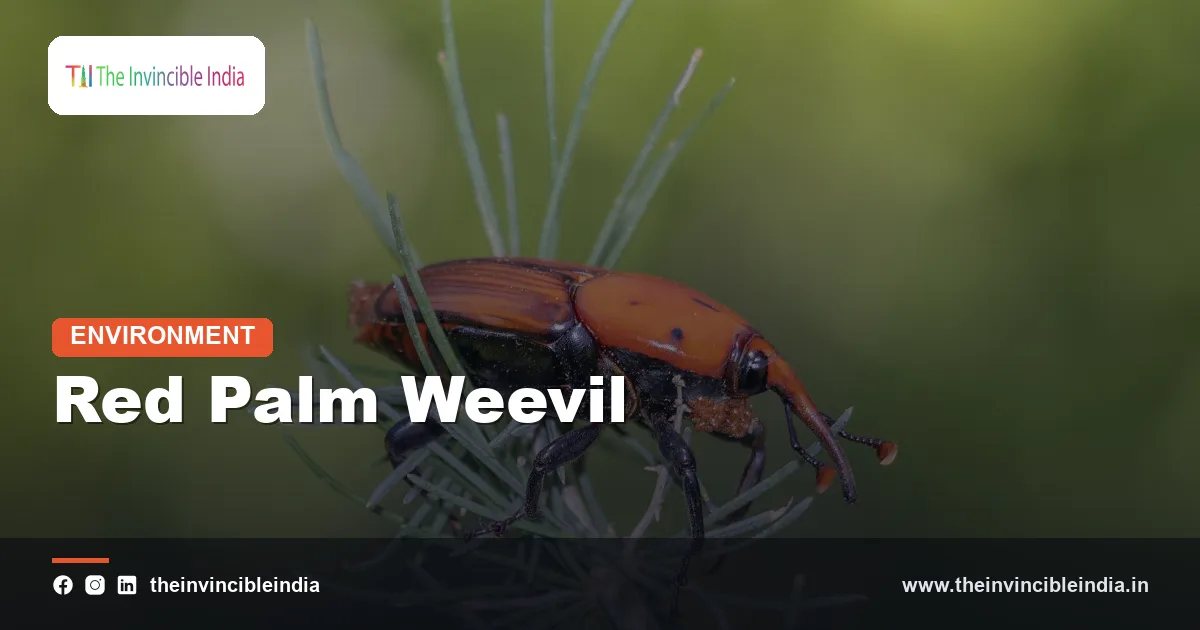
The red palm weevil is a large, reddish-brown snout beetle, Rhynchophorus ferrugineus, whose grubs tunnel inside the trunk and crown of palms and can kill coconut, date and other palm trees from within. It is one of the most destructive insect pests of palms in the world, and it is native to tropical Asia, including India, from where it has spread widely through the trade in live palms.
In India, the red palm weevil is a serious concern for coconut growers in Kerala, Tamil Nadu, Karnataka and Andhra Pradesh, and for date and ornamental palm growers elsewhere. The insect is hard to detect early because it lives hidden inside the tree for most of its life. This article explains what the red palm weevil is, how it damages palms, how to recognise an attack and how farmers manage it.
Quick Facts
| Common names | Red palm weevil, Asian palm weevil, coconut red weevil |
|---|---|
| Scientific name, order, family | Rhynchophorus ferrugineus; order Coleoptera; family Dryophthoridae (the palm weevils, earlier placed in Curculionidae) |
| Size | Adult about 2 to 4 cm long; full-grown grub about 5 cm |
| Habitat in India | Coconut and other palm-growing regions, especially coastal and southern India, including Kerala, Tamil Nadu, Karnataka and Andhra Pradesh |
| Diet and hosts | Tissue of living palms: coconut, date palm, oil palm, areca palm, palmyra, sago palm and ornamental palms |
| Life cycle | Egg, grub (larva), pupa in a fibre cocoon, adult; roughly 3 to 5 months for a full generation, mostly hidden inside the palm |
| Ecological and economic role | Major pest; weakens or kills palms, causing loss of nuts, dates and trees |
| Notable features | Long curved snout, reddish-brown body, strong flight; spread worldwide by movement of infested palms; listed as a quarantine pest in several regions |
Key Takeaways
- The red palm weevil is a reddish-brown beetle, Rhynchophorus ferrugineus, whose grubs feed inside the trunk and crown of palms and can destroy the growing point of the tree.
- The red palm weevil is native to tropical Asia and has spread to the Middle East, North Africa, the Mediterranean and other regions mainly through the movement of infested palm plants.
- The first visible signs of a red palm weevil attack are often a brown, foul-smelling ooze from the trunk, chewed fibre at the crown and a yellowing or drooping of the central fronds.
- A female red palm weevil lays hundreds of eggs, so one infested palm can release many adults that spread to neighbouring trees.
- Wounds on palms, such as cuts from frond removal or damage by the rhinoceros beetle, attract egg-laying red palm weevils, so careful pruning and wound care are the first line of prevention.
- Management in India relies on an integrated approach that combines pheromone traps, sanitation, early detection, treatment of infested palms and removal of dead trees.
What is the red palm weevil?
The red palm weevil is a species of snout beetle in the order Coleoptera, scientifically named Rhynchophorus ferrugineus, that lives and breeds inside palm trees. The adult is among the largest weevils found in India, and the grub is a pale, legless, fleshy larva with a hard brown head.
The adult beetle has a reddish-brown body, often with dark irregular markings on the thorax, and a long, curved snout used for feeding and, in females, for making holes to lay eggs. Males can be told from females by a tuft of short hairs on the upper side of the snout, while the snout of the female is smoother and slightly longer and more curved.
The weevil is called red because of its colour, which varies from bright reddish-orange to dark brown with black patches. Some scientists treat the Asian red palm weevil as a complex of closely related species, and the name Rhynchophorus vulneratus is used for part of the Southeast Asian population. In practice, the insect described in Indian agricultural literature is generally referred to as R. ferrugineus.
Where does the red palm weevil come from and where has it spread?
The red palm weevil is native to tropical southern and Southeast Asia, and it has spread from there to the Middle East, Africa and Europe. It was first known as a pest of coconut in South Asia, and in the late twentieth century it became a major pest of date palms in the Gulf region.
The spread occurred largely through the trade in mature ornamental palms and offshoots, because the larvae and pupae can travel unseen inside a planted tree. The insect was recorded in the Arabian Gulf countries in the 1980s, then in Egypt and the Mediterranean countries in the 1990s and 2000s. It later reached parts of Europe, the Caribbean and other regions. In many of these places, it has been listed as a quarantine pest.
In India, the weevil has long been a pest of coconut in the southern states. Kerala, Tamil Nadu and Karnataka, with their dense coconut plantations, are among the most affected. The weevil is also reported on areca palm, oil palm, palmyra and date palm in various parts of the country. Its flying ability allows it to move between gardens, and infested seedlings or offshoots allow it to cross long distances.
How does the red palm weevil life cycle work?
The red palm weevil has a complete life cycle of egg, larva, pupa and adult, and almost all of it takes place inside the palm. The time for one generation is usually three to five months, depending on temperature and the condition of the host palm.
Eggs
The female makes small holes in soft palm tissue with her snout, usually in wounds, leaf bases or the crown, and lays eggs in them. A single female may lay a few hundred eggs in her life. The eggs hatch in two to five days.
Grubs
The grubs burrow into the soft tissue and feed on the plant’s sap-rich inner parts. They are the destructive stage. They may live for one to three months, grow to about five centimetres and cause large tunnels that weaken the trunk or destroy the growing bud at the crown.
Pupa and adult
The full-grown grub makes an oval cocoon from the fibres of the palm and pupates inside it. After a few weeks, the adult emerges, mates and may either stay on the same palm or fly to another. The adults can live for several months and fly well, sometimes over distances of a kilometre or more in search of suitable palms.
How does the red palm weevil damage palms?
The red palm weevil damages palms by its grubs boring into the soft tissue of the trunk and crown, which destroys the water-carrying and growing parts of the tree. A palm has only one growing bud, and when the larvae destroy it, the tree cannot recover.
The damage takes place in stages. In the early phase, there is little outward sign, since the grubs are feeding inside. Later, the tunnels grow, tissue rots and the crown becomes unstable. In coconut palms, the central spindle leaf may fall or the whole crown may topple. In date palms, offshoots and the trunk base are often attacked. In severe cases, the trunk may snap or the whole palm may die.
The weevil often enters through existing wounds, such as the cut bases of fronds, damage from the rhinoceros beetle (Oryctes rhinoceros), lightning scars, climbing marks or injuries during harvesting. Fermenting sap and decaying tissue attract adult beetles, so a damaged palm becomes more vulnerable to repeated attack.
What are the signs of red palm weevil infestation?
The main signs of red palm weevil infestation are a thick, brown, fermented-smelling liquid oozing from holes in the trunk, chewed fibre sticking out of the crown and wilting of the central fronds. Because these signs appear late, regular inspection is important.
- Brown, sticky ooze with a sour or fermented smell from the trunk or leaf bases.
- Small holes in the trunk or at the base of fronds, sometimes with chewed fibre pushed out.
- Yellowing, drooping or dried central fronds, or a crown that appears hollow or tilted.
- Dead or empty cocoons made of fibre at the base of the fronds.
- A gnawing or chewing sound, which is sometimes heard when a person puts an ear against the trunk of a heavily infested palm.
- Presence of adult weevils walking or flying around the base of the palm, especially in the evening.
Any palm showing these signs should be examined by an agricultural officer or a trained person, because late treatment is rarely successful once the growing point is destroyed.
Which palms does the red palm weevil attack?
The red palm weevil attacks many palm species, and in India the most important hosts are the coconut palm and the date palm. It prefers young and stressed palms with soft tissue, but it can also attack mature trees.
| Host palm | Scientific name | Relevance in India |
|---|---|---|
| Coconut | Cocos nucifera | Most important host in coastal and southern India |
| Date palm | Phoenix dactylifera | Attacked where grown, including dry regions of western India |
| Oil palm | Elaeis guineensis | Attacked in growing areas, especially young plantations |
| Areca palm | Areca catechu | Occasionally attacked |
| Palmyra palm | Borassus flabellifer | Host in many regions |
| Sago palm and ornamental palms | Caryota, Phoenix and others | Attacked in gardens, avenues and nurseries |
Ornamental palms in gardens, housing societies and avenues are also vulnerable, and these can act as a reservoir of infestation near plantations.
How is the red palm weevil controlled in India?
The red palm weevil is controlled in India through integrated pest management, which means combining several methods rather than relying on a single treatment. The approach is recommended by agricultural universities and by research institutions that work on plantation crops, such as the ICAR-Central Plantation Crops Research Institute (CPCRI) at Kasaragod in Kerala.
- Preventing wounds: Fronds should be cut at a distance from the trunk, not flush with it, and fresh cuts or injuries should be protected. Wounds attract egg-laying females.
- Pheromone traps: Traps baited with the weevil’s aggregation pheromone, together with a food attractant such as pieces of palm tissue or fermenting sugar source, are used to catch adults and monitor numbers.
- Sanitation: Dead, badly damaged palms are cut and destroyed, and the trunk is chopped or buried so that no grubs or pupae survive.
- Chemical treatment: Approved insecticides can be applied to the crown and injected into the trunk of affected palms under expert advice. Farmers should follow label instructions and official recommendations.
- Biological control: Fungi such as Beauveria bassiana and entomopathogenic nematodes have been tested and used as a part of management, though results vary with local conditions.
- Quarantine and inspection: Movement of palms and offshoots is regulated, and plants are inspected before they are moved.
Community action is as important as treatment in a single garden, since adults fly between plots. Neighbouring farmers who cooperate in trapping and removing infested palms get better results than those who act alone.
Regular monitoring is a practical habit for any grower. A trained farmer or plantation worker walks through the garden at fixed intervals, looks up at the crown of each palm, checks the trunk for oozing and holes, and records the position of any suspect tree. Traps are emptied on a schedule, and the number of adults caught is noted, because a sudden rise in catches warns of an outbreak nearby. Such records help officers to decide where treatment is most needed.
Can an infested palm be saved?
An infested palm can sometimes be saved if the red palm weevil attack is found early and the growing point is intact. Once the central bud has been destroyed or the trunk is badly hollowed out, the palm usually cannot recover and must be removed.
Treatment of an early-stage palm involves cleaning out the tunnels, applying approved insecticide in the affected region and protecting the wounds. Trained personnel generally do this work, because it requires care to avoid causing more damage. Palms that are saved should be watched for several months, and traps should be kept near them to catch new adults.
When palms must be felled, they should be cut up and either burned or buried deep, because leaving infested trunks standing or lying in the field allows adults to emerge and attack other palms.
Why does the red palm weevil matter?
The red palm weevil matters because palms are central to rural livelihoods, food and landscapes in India, and a single pest can destroy trees that take years to mature. A coconut palm begins to bear nuts several years after planting and continues for decades, so losing a mature palm is a heavy economic loss for a farming family.
Coconut is used for food, oil, fibre, shell products and religious rituals throughout India, and date palms are an important crop in dry parts of western India. In addition, palms form the character of coastal landscapes, gardens and avenues. Because the weevil travels with the plant trade, it also raises questions about the biosecurity of nurseries and plant movement across borders and states.
Bottom Line
The red palm weevil is a native Asian beetle whose hidden grubs can kill coconut, date and other palms from the inside. Early detection, wound care, pheromone trapping, sanitation and cooperation between neighbouring growers are the best defences.
Frequently Asked Questions
What is the red palm weevil?
The red palm weevil is a large reddish-brown snout beetle, Rhynchophorus ferrugineus, whose grubs feed inside palm trees. It is a major pest of coconut and date palms and is native to tropical Asia. The grubs can destroy the growing bud and kill the tree.
Which palms does the red palm weevil attack in India?
The red palm weevil attacks coconut, date, oil, areca, palmyra and several ornamental palms in India. Coconut is the most important host in southern and coastal regions. Date palms are also affected where they are grown, including dry regions of western India.
How do you know if a palm has red palm weevil?
A palm with red palm weevil often shows a brown, fermented-smelling ooze from the trunk, chewed fibre at the crown and yellowing or drooping of the central fronds. Small holes and empty fibre cocoons at the leaf bases are other signs. These signs appear late, so regular inspection is recommended.
How long does the red palm weevil live?
A full generation of the red palm weevil takes roughly three to five months, most of it spent as a grub inside the palm. Adults can live for several months. A female can lay hundreds of eggs during her life.
How can red palm weevil be prevented?
Red palm weevil can be prevented by avoiding wounds on palms, cutting fronds at a distance from the trunk and keeping plantations clean. Pheromone traps help catch adults, and infested palms should be treated or destroyed quickly. Only healthy, inspected planting material should be moved or bought.
Is the red palm weevil harmful to humans?
The red palm weevil is not harmful to humans and does not bite or sting people. Its harm is to palms and the livelihoods that depend on them. It does not spread disease to humans or animals.
{“@context”:”https://schema.org”,”@graph”:[{“@type”:”FAQPage”,”mainEntity”:[{“@type”:”Question”,”name”:”What is the red palm weevil?”,”acceptedAnswer”:{“@type”:”Answer”,”text”:”The red palm weevil is a large reddish-brown snout beetle, Rhynchophorus ferrugineus, whose grubs feed inside palm trees. It is a major pest of coconut and date palms and is native to tropical Asia. The grubs can destroy the growing bud and kill the tree.”}},{“@type”:”Question”,”name”:”Which palms does the red palm weevil attack in India?”,”acceptedAnswer”:{“@type”:”Answer”,”text”:”The red palm weevil attacks coconut, date, oil, areca, palmyra and several ornamental palms in India. Coconut is the most important host in southern and coastal regions. Date palms are also affected where they are grown, including dry regions of western India.”}},{“@type”:”Question”,”name”:”How do you know if a palm has red palm weevil?”,”acceptedAnswer”:{“@type”:”Answer”,”text”:”A palm with red palm weevil often shows a brown, fermented-smelling ooze from the trunk, chewed fibre at the crown and yellowing or drooping of the central fronds. Small holes and empty fibre cocoons at the leaf bases are other signs. These signs appear late, so regular inspection is recommended.”}},{“@type”:”Question”,”name”:”How long does the red palm weevil live?”,”acceptedAnswer”:{“@type”:”Answer”,”text”:”A full generation of the red palm weevil takes roughly three to five months, most of it spent as a grub inside the palm. Adults can live for several months. A female can lay hundreds of eggs during her life.”}},{“@type”:”Question”,”name”:”How can red palm weevil be prevented?”,”acceptedAnswer”:{“@type”:”Answer”,”text”:”Red palm weevil can be prevented by avoiding wounds on palms, cutting fronds at a distance from the trunk and keeping plantations clean. Pheromone traps help catch adults, and infested palms should be treated or destroyed quickly. Only healthy, inspected planting material should be moved or bought.”}},{“@type”:”Question”,”name”:”Is the red palm weevil harmful to humans?”,”acceptedAnswer”:{“@type”:”Answer”,”text”:”The red palm weevil is not harmful to humans and does not bite or sting people. Its harm is to palms and the livelihoods that depend on them. It does not spread disease to humans or animals.”}}]}]}


