

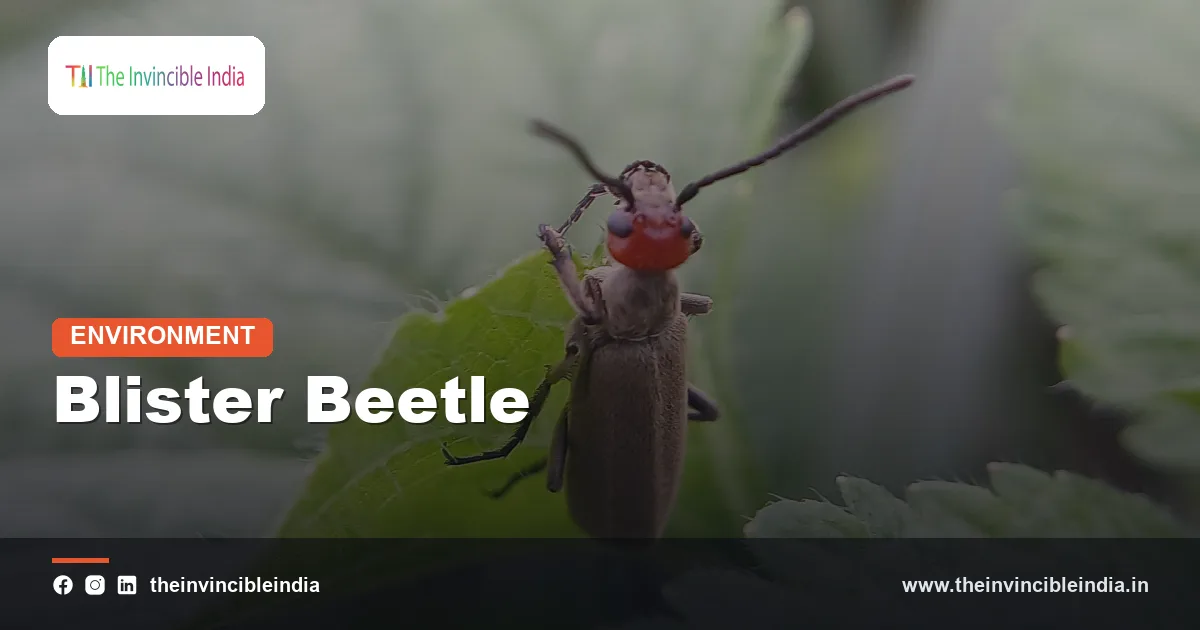
A blister beetle is a soft-bodied beetle of the family Meloidae that releases a toxic chemical called cantharidin, which can raise painful blisters on human skin and poison livestock if the insect is crushed or eaten. In India, blister beetles such as Mylabris and Epicauta species are common in fields and gardens during the rainy season, where the adults eat flowers and are treated as agricultural pests.
Blister beetles do not bite or sting, and they are harmless if left alone. The danger comes from the defensive fluid they release when they are pressed against the skin or swallowed. This article explains what blister beetles are, how cantharidin works, which species are found in India, what harm they do to crops and animals, and how to handle an encounter safely.
Quick Facts
| Common names | Blister beetle, oil beetle (for some genera), Spanish fly (for a European species) |
|---|---|
| Scientific classification | Order Coleoptera; family Meloidae; Indian genera include Mylabris, Epicauta, Hycleus and Meloe |
| Size | Adults typically 1 to 3 cm long, with a soft, elongated body |
| Habitat in India | Farmland, gardens, grassland and scrub across the country, most active in the rainy and post-monsoon seasons |
| Diet | Adults feed on flowers, pollen and tender leaves of many crops; larvae of many species feed on grasshopper egg pods or on bee nests |
| Life cycle | Egg, several larval stages (hypermetamorphosis), pseudopupa, pupa, adult; commonly one generation a year |
| Ecological and economic role | Crop pest as adults; useful predators of grasshopper eggs as larvae; source of cantharidin |
| Notable features | Produces cantharidin; bold black-and-orange or black-and-yellow banding in many species; soft wing covers; narrow neck |
| Number of species | Around 7,500 described species worldwide |
Key Takeaways
- A blister beetle is a beetle of the family Meloidae that defends itself with cantharidin, a toxic chemical that causes blisters on human skin.
- Blister beetles do not bite or sting, and a blister forms only when the beetle is crushed, rubbed or squashed against the skin.
- Common blister beetles in Indian fields include Mylabris species, often banded in black and orange, and Epicauta species, which are usually black, grey or striped.
- Adult blister beetles damage crops such as pulses, cotton, millets, sunflower and vegetables by eating flowers, which reduces fruit and grain set.
- Blister beetle larvae are helpful in many species because they feed on grasshopper egg pods or on the nests of bees.
- Cantharidin can poison livestock, especially horses, if beetles are eaten in fodder, so beetle-infested hay or fodder should not be fed to animals.
What is a blister beetle?
A blister beetle is a member of the beetle family Meloidae, a group of about 7,500 species found on every continent except Antarctica. The family is easy to recognise by its soft, flexible wing covers, a head that is wider than the neck, and a long body that appears loosely built compared with the hard, armoured bodies of most beetles.
The name comes from the way the insect defends itself. When disturbed, a blister beetle releases a fluid from its leg joints, a process called reflex bleeding, and this fluid contains cantharidin. Cantharidin is a colourless, odourless, terpenoid chemical that irritates tissue and causes blisters when it touches the skin. The insect uses it to deter predators such as birds, frogs and lizards.
Many blister beetles show bright warning colours, such as black bodies with orange or red bands. These are examples of aposematic colouring, which advertises that the insect is toxic or distasteful. Others are plain black, grey or metallic green, and they are more difficult to spot.
What does cantharidin do?
Cantharidin is a toxic chemical that irritates and damages skin cells, causing a fluid-filled blister to form hours after contact. It is the reason blister beetles are known and feared, and it is also the active ingredient of the historical medicine called Spanish fly, which was made from the European blister beetle Lytta vesicatoria.
On the skin, cantharidin causes a separation of the outer skin layers. The affected area becomes red and then forms a clear blister within a few hours, and the blister usually heals within one to two weeks without scarring if it is not infected. The effect is slow, so people often do not realise the cause until the blister appears.
- Skin contact: causes redness, burning and blisters. Rubbing the eyes after touching a beetle can cause a painful eye injury.
- Swallowing: is much more dangerous and can damage the mouth, throat, stomach and kidneys. Cantharidin is a poison and has caused deaths when taken as a folk remedy or aphrodisiac.
- Animals: grazing animals can be poisoned if they eat fodder or hay that contains crushed beetles.
Male beetles make cantharidin and pass it to females during mating, and females use it to protect their eggs. In medicine, carefully prepared and controlled cantharidin is used by doctors as a topical treatment for some skin conditions, such as warts and molluscum contagiosum. Self-treatment with beetles is unsafe and should never be attempted.
Which blister beetles are found in India?
India has many species of blister beetles, and the best-known in farm fields belong to the genera Mylabris, Epicauta and Hycleus. They are widespread across plains and peninsular India, where they appear in large numbers during flowering seasons.
| Genus or species | Appearance | Typical hosts |
|---|---|---|
| Mylabris pustulata and related Mylabris species | Black with orange, yellow or red cross-bands on the wing covers | Flowers of pigeon pea, mung bean, cowpea, cotton, sunflower, okra, millets and many wild plants |
| Epicauta species (for example E. hirticornis) | Elongate, black, grey or striped, with a slender body | Flowers and leaves of pulses, vegetables, potato and other crops |
| Hycleus species | Small to medium, banded or spotted | Flowers of various crops and weeds |
| Meloe species (oil beetles) | Dark, rounded, short wing covers, swollen abdomen | Ground-living; larvae attach to bees |
The Mylabris group has long been noted in Indian farm literature as a seasonal pest, and some species were once collected for use in traditional medicine. Identification to species level usually needs an entomologist, but farmers can recognise the group from the banded pattern and the soft body.
How does the blister beetle life cycle work?
The blister beetle has a complete life cycle with an unusual feature called hypermetamorphosis, in which the larva changes shape several times as it grows. The cycle includes egg, a series of larval stages, a resting stage called the pseudopupa, the pupa and the adult.
Eggs and the first larva
The female digs a hole in the soil and lays a few hundred eggs, sometimes several batches over her life. The first-stage larva is called a triungulin. It has long legs, is active and searches for food. In many Epicauta species, the triungulin hunts for grasshopper egg pods buried in the soil.
Later larval stages
After finding a host, the larva sheds its skin and becomes a plump, short-legged grub that feeds on the egg pod or other food. In other genera, such as Meloe, the triungulin climbs onto a flower, clings to a visiting bee and is carried to its nest, where it eats the bee’s eggs and stored pollen and nectar.
Pseudopupa, pupa and adult
The larva then turns into a hardened, inactive pseudopupa, which can rest in the soil through the dry season. It later pupates and emerges as an adult, usually at the start of the rains. The adults feed on flowers for some weeks, mate and lay eggs. Most Indian species have one generation a year.
Because the adults appear in a short window each year, many farmers notice blister beetles suddenly at flowering and assume that they have arrived from elsewhere. In fact, the beetles have usually spent the previous months as resting larvae in the soil. Their numbers depend on the rainfall and on how many grasshopper egg pods were available the year before, since a good year for grasshoppers is often followed by a good year for blister beetles.
Adult blister beetles are active mainly in warm daylight hours. They climb flower stalks, feed on petals, anthers and pollen, and drop to the ground when disturbed, sometimes pretending to be dead. This habit of falling off the plant is useful when collecting them in a net or a tray placed under the crop.
What damage do blister beetles cause to crops?
Adult blister beetles damage crops by feeding on flowers, buds and pollen, which prevents fruit and grain from forming. A few beetles can strip many flowers in a short time, and the damage is most serious in crops where yield depends on the flowering stage.
The beetles are commonly seen on pulses such as pigeon pea (arhar), green gram, black gram and cowpea, and on crops such as cotton, pearl millet, sorghum, maize, sunflower, okra, brinjal and potato. They sometimes gather in groups and move from one plot to another. Damage may also occur on leaves, which are chewed from the edges, though flower feeding is the more serious issue.
Not all of their effect is harmful. The grubs of many blister beetle species eat grasshopper egg pods and so help to reduce grasshopper numbers. Adults feeding on pollen may even transfer some pollen between flowers. Because of this mixed role, farmers are generally advised to take action only when beetle numbers are high during flowering.
How can blister beetles be controlled safely?
Blister beetles can be controlled by collecting them carefully, protecting crops during flowering and using targeted insecticides only when necessary. Safety for the person handling the beetles is as important as protection of the crop.
- Hand collection with protection: Beetles can be knocked into a bucket of soapy water or kerosene-water early in the morning or in the evening when they are less active. People should wear gloves and long sleeves and should never crush the insects with bare hands.
- Light traps and sweep nets: Nets can be used to collect adults from flowers, and light traps may attract some species at night.
- Weed management: Removing flowering weeds near fields reduces the number of beetles that settle in the crop.
- Chemical control: If numbers cross the threshold level recommended by local agricultural officers, approved insecticides can be applied. Sprays at flowering time may harm bees and other pollinators, so timing and product choice need care.
- Conservation of natural enemies: Birds and predators help to control beetles, and avoiding broad-spectrum sprays helps these natural enemies survive.
Farmers should follow the advice of Krishi Vigyan Kendras and state agriculture departments, which provide crop-specific recommendations and threshold levels.
What should you do if a blister beetle touches your skin?
If a blister beetle touches your skin, flick it off gently without crushing it, and wash the area with soap and plenty of water as soon as possible. Quick washing removes the cantharidin before it can cause a severe reaction.
- Do not rub or squash the insect. Brush it away using a leaf, paper or a gloved hand.
- Wash the skin thoroughly with soap and running water.
- Avoid touching the eyes and mouth until the hands are washed.
- If a blister forms, leave it intact where possible, keep it clean and covered, and avoid popping it, since the fluid can spread cantharidin to other skin.
- Seek medical advice if blisters are large, painful, near the eyes, on the genitals or if the person has swallowed a beetle.
Blister beetles are sometimes confused with rove beetles of the genus Paederus, which are slender, black-and-orange insects often seen near lights during the monsoon. Paederus beetles release a different chemical called pederin that causes streaky rashes known as linear dermatitis. First aid is similar for both, which is washing and avoiding crushing the insect.
Are blister beetles dangerous to livestock?
Blister beetles can be dangerous to livestock because cantharidin remains toxic even when the beetles are dead and dried, and animals that eat contaminated hay or fodder may be poisoned. Horses are especially sensitive, and even a small number of beetles can make an animal seriously ill.
The risk arises when fodder crops are harvested while beetles are feeding on flowers, and the insects get crushed and baled with the crop. Cattle, sheep and goats are also affected, though usually less severely than horses. Signs of poisoning include colic, drooling, blistering of the mouth, depression, increased thirst and blood in urine or dung.
Prevention includes cutting fodder before the crop flowers, inspecting fodder for beetles, avoiding feeding the crushed material to animals, and consulting a veterinarian at once if poisoning is suspected. These precautions are especially important where flowering forage legumes and mixed fodder are fed to working or breeding animals.
Bottom Line
The blister beetle is a soft-bodied beetle that defends itself with cantharidin, a chemical that blisters skin and poisons animals. In Indian fields it is both a flower-eating crop pest and a helpful predator of grasshopper eggs, so careful, targeted management and safe handling are the best approaches.
Frequently Asked Questions
What is a blister beetle?
A blister beetle is a soft-bodied beetle of the family Meloidae that releases cantharidin, a chemical that causes skin blisters. There are around 7,500 species worldwide, including Mylabris and Epicauta species common in India. The beetles do not bite or sting.
Does a blister beetle bite?
A blister beetle does not bite or sting people. Blisters form only when the beetle is crushed or pressed against the skin and releases cantharidin. Brushing the insect away gently usually causes no harm.
Are blister beetles poisonous to touch?
Blister beetles are not dangerous to look at or briefly touch, but crushing one on the skin releases cantharidin, which can raise a painful blister hours later. The chemical is much more dangerous if swallowed or if it gets in the eyes. Washing the skin with soap and water quickly reduces the effect.
Why are blister beetles a problem for farmers?
Blister beetles are a problem for farmers because the adults eat flowers of crops such as pulses, cotton, millets and sunflower. This reduces fruit and grain formation. They are also a risk to livestock when crushed beetles contaminate hay or fodder.
Are blister beetles useful in any way?
Blister beetle larvae are useful in many species because they feed on grasshopper egg pods, which helps to reduce grasshopper numbers. Cantharidin is also used in carefully controlled medical preparations for some skin conditions. However, the adults remain pests in crops during flowering.
How do I treat a blister from a blister beetle?
To treat a blister beetle blister, wash the area with soap and water, keep the blister clean and covered, and avoid popping it. Most blisters heal within one to two weeks. See a doctor if the blisters are large, near the eyes or if a beetle has been swallowed.
{“@context”:”https://schema.org”,”@graph”:[{“@type”:”FAQPage”,”mainEntity”:[{“@type”:”Question”,”name”:”What is a blister beetle?”,”acceptedAnswer”:{“@type”:”Answer”,”text”:”A blister beetle is a soft-bodied beetle of the family Meloidae that releases cantharidin, a chemical that causes skin blisters. There are around 7,500 species worldwide, including Mylabris and Epicauta species common in India. The beetles do not bite or sting.”}},{“@type”:”Question”,”name”:”Does a blister beetle bite?”,”acceptedAnswer”:{“@type”:”Answer”,”text”:”A blister beetle does not bite or sting people. Blisters form only when the beetle is crushed or pressed against the skin and releases cantharidin. Brushing the insect away gently usually causes no harm.”}},{“@type”:”Question”,”name”:”Are blister beetles poisonous to touch?”,”acceptedAnswer”:{“@type”:”Answer”,”text”:”Blister beetles are not dangerous to look at or briefly touch, but crushing one on the skin releases cantharidin, which can raise a painful blister hours later. The chemical is much more dangerous if swallowed or if it gets in the eyes. Washing the skin with soap and water quickly reduces the effect.”}},{“@type”:”Question”,”name”:”Why are blister beetles a problem for farmers?”,”acceptedAnswer”:{“@type”:”Answer”,”text”:”Blister beetles are a problem for farmers because the adults eat flowers of crops such as pulses, cotton, millets and sunflower. This reduces fruit and grain formation. They are also a risk to livestock when crushed beetles contaminate hay or fodder.”}},{“@type”:”Question”,”name”:”Are blister beetles useful in any way?”,”acceptedAnswer”:{“@type”:”Answer”,”text”:”Blister beetle larvae are useful in many species because they feed on grasshopper egg pods, which helps to reduce grasshopper numbers. Cantharidin is also used in carefully controlled medical preparations for some skin conditions. However, the adults remain pests in crops during flowering.”}},{“@type”:”Question”,”name”:”How do I treat a blister from a blister beetle?”,”acceptedAnswer”:{“@type”:”Answer”,”text”:”To treat a blister beetle blister, wash the area with soap and water, keep the blister clean and covered, and avoid popping it. Most blisters heal within one to two weeks. See a doctor if the blisters are large, near the eyes or if a beetle has been swallowed.”}}]}]}


