

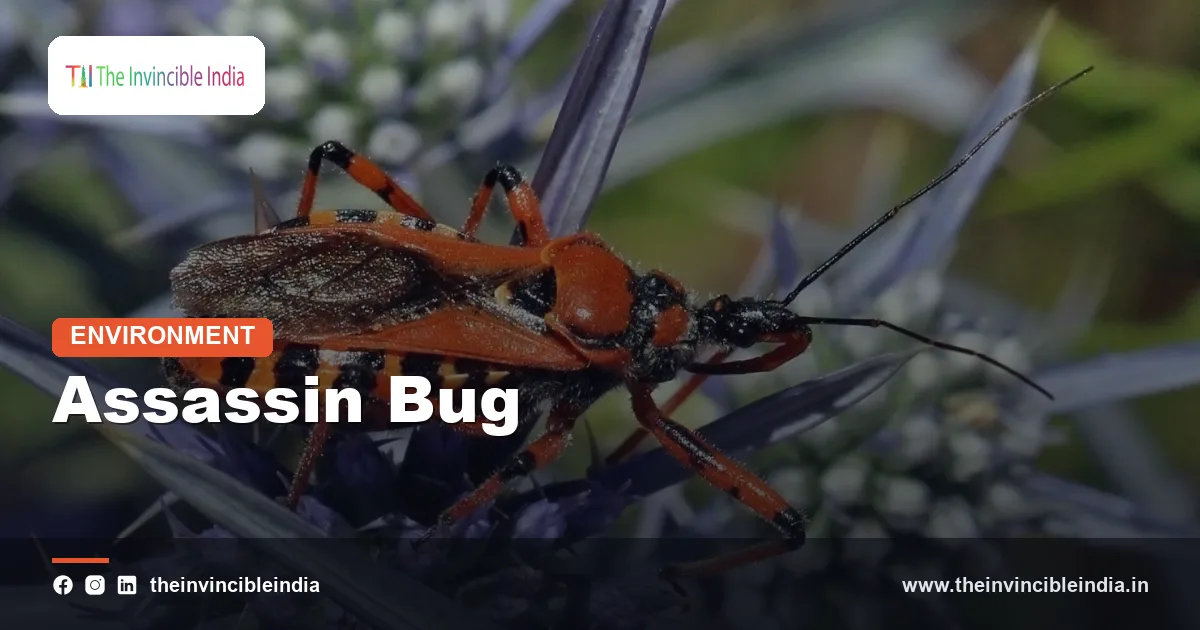
An assassin bug is a predatory true bug of the family Reduviidae that hunts other insects by stabbing them with a short, curved, needle-like beak, injecting saliva that paralyses and liquefies the prey, and then sucking the contents out. Found in gardens, crop fields, scrub and forests across India, the assassin bug is one of the most useful natural enemies of caterpillars, aphids and other plant-eating insects.
Because it ambushes rather than chases, the assassin bug is easy to overlook, and because it can deliver a sharp bite when handled, it is often mistaken for a dangerous pest. This article explains what an assassin bug is, how it hunts, which kinds occur in India, why farmers value it, and how to treat the occasional bite.
Quick Facts
| Common name | Assassin bug (also called a reduviid; the related blood-feeding forms are called kissing bugs) |
|---|---|
| Scientific classification | Order Hemiptera, suborder Heteroptera; family Reduviidae |
| Size | Roughly 4 mm to about 4 cm in Indian species; most garden species are between 1 and 2.5 cm |
| Habitat in India | Crop fields, gardens, scrub, forest edges, grassland, bark, leaf litter and the walls of houses |
| Diet | Insects and other small arthropods, especially caterpillars, bugs, beetles and flies; a few groups feed on blood |
| Life cycle | Incomplete metamorphosis: egg, five nymph stages, adult; a generation may take from a few months to a year |
| Ecological role | Generalist predator and natural biological control agent of crop pests |
| Notable features | Three-segmented curved beak, narrow head with a neck-like constriction, strong front legs, and in some species sticky legs and camouflage |
Key Takeaways
- The assassin bug belongs to the family Reduviidae, which contains several thousand species and is one of the largest families of predatory bugs.
- An assassin bug kills by piercing its prey with a curved beak and injecting saliva that paralyses the victim and digests its tissues.
- In Indian farms and gardens, assassin bugs such as Rhynocoris and Sycanus species feed on caterpillars and other insects that damage crops.
- An assassin bug does not seek out humans, but it can deliver a painful defensive bite when picked up or pressed against the skin.
- Assassin bug nymphs look like smaller, wingless versions of adults, and they must moult five times before they are able to fly.
- Broad-spectrum insecticide sprays kill assassin bugs along with pests, so reducing such spraying helps predator populations to build up.
What is an assassin bug and where does it fit among insects?
An assassin bug is a member of the family Reduviidae, which belongs to the order Hemiptera, the group of insects known as true bugs. All members of Hemiptera feed with piercing and sucking mouthparts, but only a few families, including the Reduviidae, use those mouthparts mainly to kill other animals.
The family has roughly seven thousand described species worldwide, and it is divided into more than twenty subfamilies. The name Reduviidae comes from the Latin word reduvia, meaning a hangnail or a scrap. The members show a bewildering range of forms: stout and sturdy hunters, long thread-legged species that resemble twigs, brightly coloured warning forms, and flattened bark dwellers.
It is worth stressing that the word “bug” is often used loosely for any insect, but biologists reserve it for Hemiptera. An assassin bug is therefore a close relative of shield bugs, stink bugs, cicadas, aphids and bed bugs, and not of beetles or flies, even though the folded wings can look similar at first glance.
What does an assassin bug look like?
An assassin bug typically has an elongated body, a narrow head with a distinct neck-like region behind the eyes, long antennae, and a stout, curved, three-segmented beak that is held under the head when not in use. The adults have two pairs of wings folded flat over the back, forming a characteristic X or triangle pattern.
The beak, formally called the rostrum, is the best field mark. It is short, thick and strongly curved, unlike the long, straight, thread-like beak of plant-feeding bugs, which usually lies flat against the underside of the body. Many assassin bugs also have a groove on the underside of the thorax, which they rub with the tip of the beak to produce a faint squeaking sound.
Colour and shape differ greatly among genera:
- Red and black species, such as Sycanus and Rhynocoris, carry bright warning colours that advertise their painful bite.
- Brown and grey species blend with soil, bark and leaf litter.
- Thread-legged bugs of the subfamily Emesinae have very long, thin front legs and look like pieces of straw or cobwebs.
- Masked hunters are nymphs that coat their bodies with dust and lint, which camouflages them in houses and sheds.
How does an assassin bug hunt and kill its prey?
An assassin bug hunts by ambush: it waits motionless or walks slowly on a plant until an insect comes within reach, then seizes the victim with its front legs and stabs it with its rostrum. The saliva injected through the beak contains enzymes that quickly paralyse the prey and break down its internal tissues into a liquid that the bug can drink.
This method is called extra-oral or external digestion, because the food is partly digested outside the predator’s body. The venomous saliva acts within seconds on small prey, and the assassin bug is able to subdue insects larger than itself, such as caterpillars and big beetles. After feeding, the empty skin of the victim is dropped, often leaving a crumpled, hollow husk.
Several species improve their odds with special tools. Some Indian assassin bugs have sticky glands on their front legs that help to hold slippery prey. Others have a coating of resin or secretions on the legs, which they gather from plants. The predators also use sensitive antennae and hairs on the legs to detect the vibrations of nearby prey, so they can strike accurately even in poor light.
Which assassin bugs are found in India?
India has a large number of assassin bug species, and several genera are common enough to be noticed in ordinary gardens and fields. The table below lists some well-known examples and what is generally said about them.
| Genus or species | Appearance | Typical habitat and prey |
|---|---|---|
| Rhynocoris marginatus and Rhynocoris fuscipes | Medium-sized, red and black bugs | Crop fields and scrub; studied as natural enemies of caterpillars such as the gram pod borer |
| Sycanus collaris | Large, black bug with red or orange markings | Forests and plantations; preys on caterpillars and other large insects |
| Ectomocoris | Dark, glossy bugs with orange patches | Ground-dwelling and found under stones and logs; feeds on insects and, sometimes, termites |
| Coranus and Endochus | Slender brown or yellowish bugs | Grassy fields and low plants; feed on small insects |
| Emesinae (thread-legged bugs) | Very thin, twig-like bugs | Corners of walls, verandahs and caves; catch small insects and spiders |
The red and black Rhynocoris species are among the best studied, since Indian agricultural researchers have explored raising them in laboratories for release against crop pests. Their life cycle, feeding rate and prey preferences have been documented in many scientific papers.
What does an assassin bug eat?
An assassin bug eats other arthropods, mostly insects, and most species are generalist predators that attack whatever prey they can overpower. Caterpillars, aphids, leafhoppers, plant bugs, beetle larvae, flies and even other predators can all be taken.
Adult assassin bugs may kill a few prey items each week, while young nymphs take smaller prey such as aphids and tiny caterpillars. The bugs are patient: they can survive for days or weeks without feeding, and they feed in bursts when prey is available. Some species also take nectar or plant sap in small amounts, which helps them to survive when insects are scarce.
A specialised subfamily, the Triatominae, or kissing bugs, feeds on the blood of vertebrates. In Latin America certain kissing bugs transmit the parasite that causes Chagas disease. The disease is largely confined to the Americas, and in India it has not become an established public health problem, although a kissing bug species has been recorded in parts of the country. Most Indian assassin bugs are insect hunters and are not blood feeders.
How does the assassin bug life cycle work?
The assassin bug develops by incomplete metamorphosis, which means that its young, called nymphs, resemble small wingless adults and grow through a series of moults instead of passing through a larva and a pupa. A typical assassin bug goes through an egg stage, five nymphal stages and then the winged adult.
Eggs
Females lay eggs in clusters, often glued to leaves, stems, bark or the ground. The eggs are small, barrel-shaped or elongated, and often have a lid or a ring at one end through which the nymph emerges. Some species cover the eggs with a sticky or resin-like layer for protection. A female may lay several dozen to a few hundred eggs during her life, depending on the species and how well she feeds.
Nymphs and adults
The newly hatched nymphs often stay together for a short time and then disperse to hunt on their own. Each moult brings a larger body and the gradual development of wing pads. The whole life cycle may take from about two months in warm weather to a year in cooler regions. Adults live for several weeks to a few months and can fly short distances, although they are not strong flyers. Cannibalism among nymphs is common when food is limited.
Why is the assassin bug useful to farmers and gardeners?
The assassin bug is useful to farmers and gardeners because it kills many of the insects that damage crops, acting as a free and self-renewing form of biological pest control. A single assassin bug can eat a considerable number of caterpillars and sap-feeding bugs over its lifetime.
Biological control is the use of living natural enemies to keep pests below damaging levels. Assassin bugs are classed as generalist predators, meaning that they do not target only one pest. This is a strength in a field where many pests occur together, but it also means that they sometimes eat other helpful insects. On balance, studies in cotton, pulses, vegetables and other crops show that they contribute to pest suppression.
Gardeners and farmers can protect and encourage assassin bugs in several ways:
- Reduce the use of broad-spectrum insecticides, which kill predators as readily as pests.
- Keep some weedy borders, hedges and flowering plants, which give the bugs shelter and alternative food.
- Learn to recognise the nymphs and adults so that they are not killed by mistake.
- Use selective pest-control options and spray only when pests exceed locally recommended thresholds.
Can an assassin bug bite humans, and is it dangerous?
An assassin bug can bite humans, but it does so only in defence, usually when it is picked up, trapped against the skin or pressed in clothing. The bite is typically painful, like a sharp sting, and may cause local redness, swelling and itching that lasts a few hours to a few days.
The pain is caused by the enzyme-rich saliva that the bug uses to digest prey. In most people the effect remains local and resolves without treatment. Rarely, a person with allergy may have stronger swelling or a systemic reaction, and in that case medical help should be sought. The bug does not carry a known infection in India that is spread by ordinary bites from the common field species.
If bitten, the following steps are generally advised:
- Wash the area with soap and clean water.
- Apply a cold compress to reduce pain and swelling.
- Avoid scratching, which can cause a secondary infection.
- See a doctor if swelling spreads, if there is fever or difficulty in breathing, or if the pain does not improve after a couple of days.
The simplest way to avoid a bite is to not handle the insect. A bug on a leaf can be left alone, or gently moved with a stick or a piece of paper.
How can an assassin bug be told apart from look-alike insects?
An assassin bug can be told apart from look-alike insects mainly by its short, thick, curved beak held under the head, and by its narrow head with a neck-like constriction. Plant-feeding bugs have a thin, straight beak that lies flat against the body, and their heads are wider and more closely joined to the thorax.
Common confusions include the red cotton bug and other seed bugs, which are plant feeders and often found in groups; shield bugs, which are broad and shield-shaped; and predatory stink bugs, which are also broad but have a stout, straight beak. Cockroach nymphs and small beetles can also look similar, but they have chewing mouthparts and lack a rostrum.
Bottom Line
The assassin bug is a skilled ambush predator of the family Reduviidae and a valuable ally in Indian fields and gardens. It should be left undisturbed whenever possible, as its occasional painful bite is a defensive reaction rather than aggression, and its work in controlling caterpillars and sap-feeding pests is well documented.
Frequently Asked Questions
What is an assassin bug?
An assassin bug is a predatory insect of the family Reduviidae that stabs its prey with a curved beak and sucks out the liquefied contents. It belongs to the true bugs (Hemiptera). Several thousand species exist worldwide, and many occur in India.
Is an assassin bug poisonous to humans?
An assassin bug is not deadly to humans, but its bite can be painful. The saliva it uses to digest prey can cause local redness, swelling and itching. Most bites heal without treatment, though a doctor should be consulted if symptoms are severe.
Are assassin bugs good for gardens?
Assassin bugs are good for gardens because they eat caterpillars, aphids and other plant-damaging insects. They act as natural pest controllers and reduce the need for chemical sprays. They are most effective when broad-spectrum insecticides are used sparingly.
What is the difference between an assassin bug and a kissing bug?
A kissing bug is a blood-feeding member of a subfamily (Triatominae) within the assassin bug family, while most other assassin bugs hunt insects. Kissing bugs feed on mammals and birds, and in the Americas some transmit Chagas disease. Most assassin bugs seen in Indian gardens are insect hunters, not blood feeders.
How do I treat an assassin bug bite?
A bite from an assassin bug is treated by washing the area with soap and water and applying a cold compress. Avoid scratching to prevent infection. Seek medical advice if swelling spreads, if fever develops or if breathing becomes difficult.
How long does an assassin bug live?
An assassin bug typically lives for several months to about a year, depending on the species and climate. The nymphs pass through five moults before becoming winged adults. Adults then live for a few weeks to several months.
{“@context”:”https://schema.org”,”@graph”:[{“@type”:”FAQPage”,”mainEntity”:[{“@type”:”Question”,”name”:”What is an assassin bug?”,”acceptedAnswer”:{“@type”:”Answer”,”text”:”An assassin bug is a predatory insect of the family Reduviidae that stabs its prey with a curved beak and sucks out the liquefied contents. It belongs to the true bugs (Hemiptera). Several thousand species exist worldwide, and many occur in India.”}},{“@type”:”Question”,”name”:”Is an assassin bug poisonous to humans?”,”acceptedAnswer”:{“@type”:”Answer”,”text”:”An assassin bug is not deadly to humans, but its bite can be painful. The saliva it uses to digest prey can cause local redness, swelling and itching. Most bites heal without treatment, though a doctor should be consulted if symptoms are severe.”}},{“@type”:”Question”,”name”:”Are assassin bugs good for gardens?”,”acceptedAnswer”:{“@type”:”Answer”,”text”:”Assassin bugs are good for gardens because they eat caterpillars, aphids and other plant-damaging insects. They act as natural pest controllers and reduce the need for chemical sprays. They are most effective when broad-spectrum insecticides are used sparingly.”}},{“@type”:”Question”,”name”:”What is the difference between an assassin bug and a kissing bug?”,”acceptedAnswer”:{“@type”:”Answer”,”text”:”A kissing bug is a blood-feeding member of a subfamily (Triatominae) within the assassin bug family, while most other assassin bugs hunt insects. Kissing bugs feed on mammals and birds, and in the Americas some transmit Chagas disease. Most assassin bugs seen in Indian gardens are insect hunters, not blood feeders.”}},{“@type”:”Question”,”name”:”How do I treat an assassin bug bite?”,”acceptedAnswer”:{“@type”:”Answer”,”text”:”A bite from an assassin bug is treated by washing the area with soap and water and applying a cold compress. Avoid scratching to prevent infection. Seek medical advice if swelling spreads, if fever develops or if breathing becomes difficult.”}},{“@type”:”Question”,”name”:”How long does an assassin bug live?”,”acceptedAnswer”:{“@type”:”Answer”,”text”:”An assassin bug typically lives for several months to about a year, depending on the species and climate. The nymphs pass through five moults before becoming winged adults. Adults then live for a few weeks to several months.”}}]}]}


