

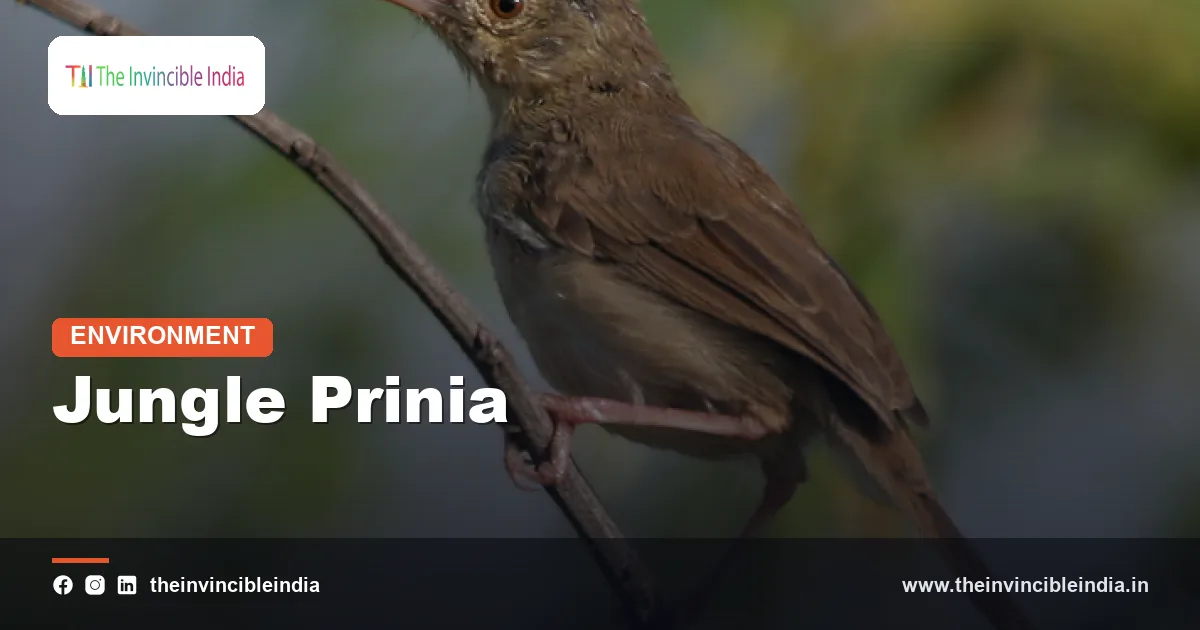
The jungle prinia (Prinia sylvatica) is a large, long-tailed, grey-brown warbler of scrub, tall grass and dry thickets across much of India, and it is the bulkiest and loudest of the Indian prinias. Despite its name, the jungle prinia is not a bird of deep forest but of open, bushy country, where it clambers through low vegetation and announces itself with a harsh, repeated call.
The jungle prinia is a resident, insect-eating species that builds a rough ball-shaped nest in grass or low bushes. This article explains how to recognise the jungle prinia, where it lives in India, what it eats, how it calls and nests, how it differs from other prinias, and how the bird is faring.
Quick Facts
| Common name | Jungle prinia |
|---|---|
| Scientific name | Prinia sylvatica |
| Family | Cisticolidae (cisticolas, prinias and allies) |
| Size | Roughly 15 to 17 cm, with a long tail; the largest of the common prinias in India |
| India range and habitat | Resident across much of peninsular, central and northern India, and in Sri Lanka; dry scrub, tall grass, thorn thickets, rocky hillsides and field edges |
| Diet | Insects and their larvae, including grasshoppers, caterpillars and beetles, plus spiders |
| Breeding | Mainly during and after the monsoon; a rough oval ball of grass with a side entrance, low in grass or bushes |
| Conservation status | Least Concern on the IUCN Red List |
Key Takeaways
- The jungle prinia is the largest of the common Indian prinias, about 15 to 17 cm long, with a heavy bill and a long, loose tail.
- The jungle prinia is grey-brown above and buffy below, with a pale eyebrow stripe, and it lacks the bold streaks of the zitting cisticola and the graceful prinia.
- The jungle prinia lives in dry scrub, tall grass, thorn thickets and rocky or bushy hillsides across India, not in dense closed forest.
- The jungle prinia has a loud, sharp, repetitive call that is often the first sign of its presence in a thicket or grass patch.
- The jungle prinia feeds mainly on insects such as grasshoppers, caterpillars and beetles, which it picks from vegetation and the ground.
- The jungle prinia is classed as Least Concern because it is common, widely distributed and tolerant of disturbed, bushy habitats.
What does the jungle prinia look like?
The jungle prinia is a large, long-tailed prinia with grey-brown upperparts, a pale buff or whitish underside, a pale eyebrow, a stout dark bill and a tail with a dark band near the tip. It looks bulkier and more solid than the other prinias, and the overall impression is of a plain, sturdy, rather shaggy bird.
The upperparts are an even earth-brown or greyish-brown, usually with little contrast and no strong streaking. The underparts are buff to whitish, and the flanks are a warmer tone. The wings are short and rounded, with a faint rufous wash in some birds. The eye is pale, and the legs are pinkish or light brown.
The tail and bill
The tail is long and graduated, with a dark subterminal band and pale tips on the outer feathers that show when the bird spreads it. The tail is flicked, waved and cocked, especially when the bird is calling or alarmed. The bill is noticeably thicker than in the plain prinia or the graceful prinia, and it helps the jungle prinia handle larger insects such as grasshoppers.
Males, females and young
Males and females of the jungle prinia look alike, so sex cannot be told in the field. Young birds are similar but a little softer in colour. The seasonal change in plumage is much less obvious than in the plain prinia, though birds become paler and more worn towards the end of the hot, dry season.
Where is the jungle prinia found in India?
The jungle prinia is found across much of peninsular and central India and extends into parts of the northern plains, where it is a year-round resident. It is common in dry, bushy country from the Deccan and the Western Ghats foothills to Rajasthan, Madhya Pradesh, Uttar Pradesh and the eastern states, and it is absent from the high Himalaya.
Outside India the species is also found in Sri Lanka, where a separate form occurs, and in neighbouring parts of the subcontinent. Because the jungle prinia is bound to its home range and does not migrate, the same birds can often be found in the same patch of scrub year after year.
Within its range the jungle prinia is patchy. It is abundant where dry scrub, tall grass and rocky slopes occur together, and scarce in intensively cultivated plains with little cover, in dense evergreen forest and in very wet regions.
Which habitats does the jungle prinia prefer?
The jungle prinia prefers dry scrub, tall grass, thorn thickets and rocky, bushy hillsides, and it is also found in field margins, plantations and neglected gardens. The word “jungle” in the name reflects the older Indian usage for scrub and wasteland, not for dense forest.
Common habitats
- Dry deciduous scrub and thorn forest with a thick understorey
- Tall grassland and grass-covered slopes
- Lantana, bushes and thickets on rocky hills and quarry edges
- Field boundaries, sugarcane and tall crops
- Overgrown wasteland, ravines and the banks of seasonal streams
The jungle prinia generally forages low, between ground level and the middle of a bush. It rarely goes high into trees, and it does not enter bare open ground. A pair often keeps to a small territory of thick cover for the whole year.
How does the jungle prinia sound?
The jungle prinia has a loud, sharp, penetrating call of repeated notes, often delivered from the top of a bush or grass stem with the tail wagging. The sound is much stronger and harsher than the thin voices of smaller prinias and carries a long way across scrub.
Several kinds of sounds are noticeable:
- A repeated, rhythmic, emphatic series of sharp notes used as song and as a territorial declaration
- A harsh, scolding chatter given when a snake, cat, mongoose or human comes near
- Soft contact notes exchanged between pair members as they feed
Calling is most intense in the breeding season, when males sing from exposed perches for long periods. Because the bird is often hidden in thick stems, its voice is the most reliable way to find it.
What does the jungle prinia eat?
The jungle prinia eats insects, mainly grasshoppers, caterpillars, beetles, bugs and ants, together with spiders and other small invertebrates. It is almost wholly insectivorous, and its stronger bill lets it take larger prey than the small prinias can manage.
The bird feeds by gleaning, which means picking food from leaves, stems and the ground. It climbs through grass and bushes, peers into leaf bases and sometimes hops along the ground to snatch an insect. Pairs feed close together and keep in contact by soft calls. During the monsoon, when insect numbers rise sharply, the jungle prinia feeds the growing young with large quantities of caterpillars and other soft-bodied prey.
Since a considerable part of its diet consists of grasshoppers and crop-eating caterpillars, the jungle prinia contributes in a small way to natural pest control in farmland edges and wasteland.
How does the jungle prinia breed?
The jungle prinia breeds mainly during and after the monsoon, building a rough oval ball of grass with a side entrance low in a grass tussock or bush. The nest is generally less neat than the nests of smaller prinias and is placed within a metre or two of the ground.
Nest
The nest is made of grass blades, stems and plant fibres, loosely woven and held in place by surrounding vegetation. A small hole on the side serves as the entrance, and the inside is lined with finer material. The overall appearance can resemble a ball of dry grass wedged in a bush, which makes it hard to see.
Eggs and young
The female lays a small clutch of three to five eggs, which usually have a reddish tone. The parents take turns incubating, and both feed the chicks on insects. The young leave the nest after about two weeks and remain near the adults for a while. Nests are exposed to snakes, lizards, crows and heavy rain, so replacement nests and repeat attempts are common.
How does the jungle prinia behave?
The jungle prinia is a bold, noisy, restless bird that moves through thickets in short hops, pauses on top of bushes to call, and flicks its long tail almost constantly. Pairs defend a territory of dense cover and respond sharply to intruders, whether other prinias or larger animals.
In the morning and evening, males sing from exposed perches. In the middle of the day the birds retreat into thick cover to avoid the heat. The flight is short, low and weak, with the tail trailing, and a flushed bird usually dives into the nearest bush. Outside the breeding season, the jungle prinia may be found alone, in pairs or in small family groups, and sometimes accompanies mixed flocks of other insect-eating birds moving through scrub.
How is the jungle prinia different from other prinias?
The jungle prinia is separated from other prinias mainly by its larger size, heavier bill, plain grey-brown plumage, pale eyebrow and loud, harsh voice. Many small warblers in Indian scrub share the cocked, wagging tail, so a few direct comparisons are helpful.
| Bird | Key difference from the jungle prinia |
|---|---|
| Plain prinia | Smaller and slimmer with a thinner bill; the jungle prinia is bulkier and more solid |
| Ashy prinia | Smaller and greyer with a dark ear patch; the jungle prinia is larger and browner |
| Graceful prinia | Tiny, pale and finely streaked; the jungle prinia is large and unstreaked |
| Striated prinia | Heavily streaked and found in hill grassland; the jungle prinia is plain and found in dry scrub |
| Zitting cisticola | Short-tailed with bold streaks and a bounding song-flight; the jungle prinia has a long tail and no song-flight |
A quick rule is to judge the bird by size and bulk. If the warbler looks as large as a small babbler with a long, floppy tail and a loud call, the jungle prinia is the likely identification. The ashy and plain prinias look neater and lighter in comparison.
Is the jungle prinia a bird of the forest?
The jungle prinia is not a forest bird in the modern sense; it is a bird of dry scrub, tall grass and bushy hillsides that lives in open or semi-open country. The name was given when “jungle” was used broadly for wild, uncultivated land, which is why the jungle prinia and the jungle babbler, jungle crow and jungle myna all carry the word.
The bird does sometimes occur at the edges of dry deciduous forest, where a dense shrub layer grows beneath scattered trees. It generally avoids evergreen rainforest and closed canopy, where it would have little low cover to forage in.
Is the jungle prinia an endangered bird?
The jungle prinia is not endangered, and the International Union for Conservation of Nature (IUCN) lists it as Least Concern because its range is large and its population is stable. It adapts well to scrub and wasteland that many other species avoid.
Local threats include the clearing of scrub for farmland and construction, frequent burning of grass, the overgrazing of hillsides and heavy pesticide use. In some places the spread of invasive shrubs such as lantana has actually given the bird extra cover, though this is not a benefit to the wider ecosystem. Leaving patches of thicket and tall grass in rocky and unused land supports the bird and the many insects and small animals that share its habitat.
How can you watch the jungle prinia?
The jungle prinia is best watched in the early morning in scrub and grass, when males call from the tops of bushes. Listening for the loud repeated notes and then scanning the nearest bush usually produces a sighting.
- Visit dry scrub, rocky hillsides and tall grass at dawn or in the late afternoon.
- Follow the harsh repeated call and look at the highest twigs of the nearest thicket.
- Check for the large size, the heavy bill, the plain brown plumage and the long wagging tail.
- Keep a respectful distance during the monsoon, since nests are low and easily abandoned if disturbed.
- Note the habitat, as the bird favours dry, bushy country over wet or closed forest.
Bottom Line
The jungle prinia is a big, noisy, plain-coloured warbler of Indian scrub and tall grass, recognised by its size, heavy bill, long wagging tail and loud repeated call. It is common, secure and a useful insect-eater, and its name is a good reminder that “jungle” in older bird names often meant wild bushland rather than dense forest.
Frequently Asked Questions
What is a jungle prinia?
A jungle prinia is a large, long-tailed warbler of the family Cisticolidae that lives in dry scrub, tall grass and thickets across India. It is grey-brown above and buff below, with a pale eyebrow, a stout bill and a tail with a dark band near the tip. It eats insects and is known for its loud, repeated call.
Where is the jungle prinia found in India?
The jungle prinia is found across much of peninsular, central and northern India, from the Deccan to Rajasthan and the eastern states. It lives in dry scrub, tall grass, thorn thickets and rocky bushy slopes. It is a resident and is absent from the high Himalaya and from dense evergreen forest.
How big is the jungle prinia?
The jungle prinia is about 15 to 17 cm long, including its long tail, which makes it the largest of the common prinias in India. It has a heavier bill and a bulkier build than the plain, ashy and graceful prinias. Its size is one of the quickest ways to identify it.
What does the jungle prinia sound like?
The jungle prinia has a loud, sharp, repetitive call made of emphatic notes, usually given from the top of a bush with the tail wagging. It also makes a harsh scolding chatter when alarmed. The voice is much stronger than that of the smaller prinias and carries far across scrub.
What does the jungle prinia eat?
The jungle prinia eats insects such as grasshoppers, caterpillars, beetles and bugs, along with spiders. It picks prey from leaves, stems and the ground in low vegetation. Its stout bill allows it to handle larger insects than smaller prinias can.
Is the jungle prinia a forest bird?
The jungle prinia is not a forest bird; it lives in open or semi-open dry scrub, tall grass and bushy hillsides. The word jungle in its name comes from older usage that applied to any wild, uncultivated land. It may occur at the edges of dry deciduous forest but generally avoids dense, closed canopy.
{“@context”:”https://schema.org”,”@graph”:[{“@type”:”FAQPage”,”mainEntity”:[{“@type”:”Question”,”name”:”What is a jungle prinia?”,”acceptedAnswer”:{“@type”:”Answer”,”text”:”A jungle prinia is a large, long-tailed warbler of the family Cisticolidae that lives in dry scrub, tall grass and thickets across India. It is grey-brown above and buff below, with a pale eyebrow, a stout bill and a tail with a dark band near the tip. It eats insects and is known for its loud, repeated call.”}},{“@type”:”Question”,”name”:”Where is the jungle prinia found in India?”,”acceptedAnswer”:{“@type”:”Answer”,”text”:”The jungle prinia is found across much of peninsular, central and northern India, from the Deccan to Rajasthan and the eastern states. It lives in dry scrub, tall grass, thorn thickets and rocky bushy slopes. It is a resident and is absent from the high Himalaya and from dense evergreen forest.”}},{“@type”:”Question”,”name”:”How big is the jungle prinia?”,”acceptedAnswer”:{“@type”:”Answer”,”text”:”The jungle prinia is about 15 to 17 cm long, including its long tail, which makes it the largest of the common prinias in India. It has a heavier bill and a bulkier build than the plain, ashy and graceful prinias. Its size is one of the quickest ways to identify it.”}},{“@type”:”Question”,”name”:”What does the jungle prinia sound like?”,”acceptedAnswer”:{“@type”:”Answer”,”text”:”The jungle prinia has a loud, sharp, repetitive call made of emphatic notes, usually given from the top of a bush with the tail wagging. It also makes a harsh scolding chatter when alarmed. The voice is much stronger than that of the smaller prinias and carries far across scrub.”}},{“@type”:”Question”,”name”:”What does the jungle prinia eat?”,”acceptedAnswer”:{“@type”:”Answer”,”text”:”The jungle prinia eats insects such as grasshoppers, caterpillars, beetles and bugs, along with spiders. It picks prey from leaves, stems and the ground in low vegetation. Its stout bill allows it to handle larger insects than smaller prinias can.”}},{“@type”:”Question”,”name”:”Is the jungle prinia a forest bird?”,”acceptedAnswer”:{“@type”:”Answer”,”text”:”The jungle prinia is not a forest bird; it lives in open or semi-open dry scrub, tall grass and bushy hillsides. The word jungle in its name comes from older usage that applied to any wild, uncultivated land. It may occur at the edges of dry deciduous forest but generally avoids dense, closed canopy.”}}]}]}


