

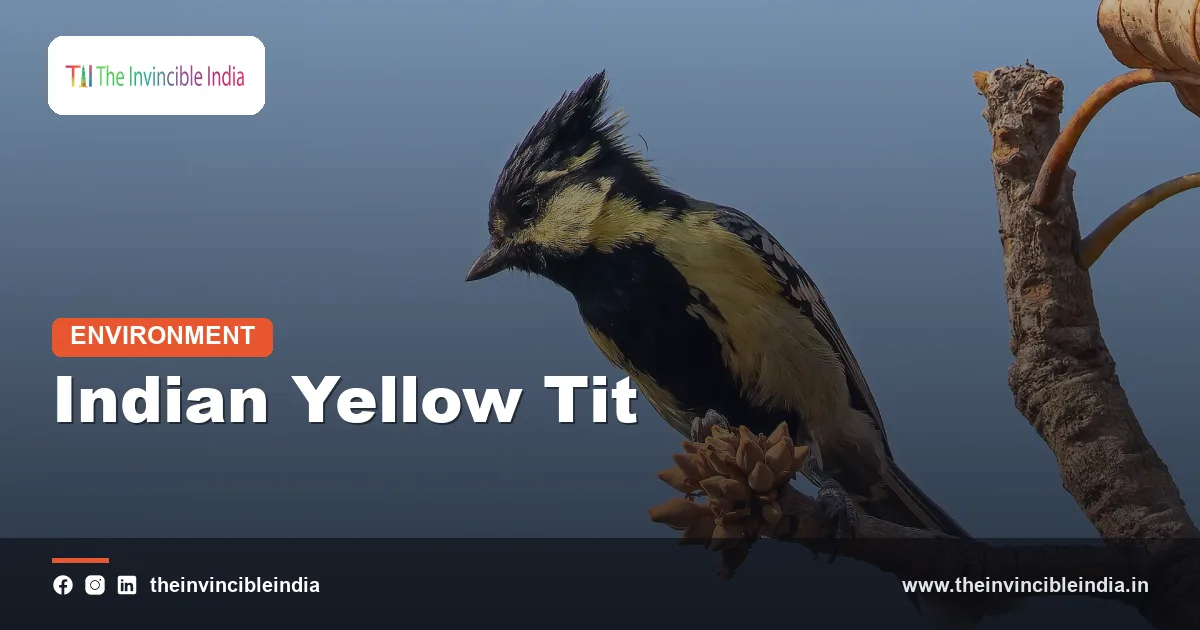
The Indian yellow tit (Machlolophus aplonotus), also known in older field guides as the black-lored tit, is a small, crested, yellow-and-black songbird of the tit family that lives in the hill forests and wooded country of peninsular India. The Indian yellow tit measures only about 13 cm, spends most of its day in noisy, restless foraging parties among the branches, and nests in holes in trees, which makes it one of the more eye-catching small birds of the Western Ghats and the central and southern Indian hills.
The Indian yellow tit is a bird of broadleaved woodland rather than of towns, so many people meet it only on forest walks, in hill-station gardens and in well-wooded plantations. This article explains what the Indian yellow tit is, how to identify it, where it lives, what it eats, how it breeds and why it matters to the health of Indian forests.
| Quick Facts: Indian Yellow Tit | |
|---|---|
| Scientific name | Machlolophus aplonotus (formerly treated as a southern form of Machlolophus xanthogenys) |
| Family | Paridae (tits and chickadees) |
| Other names | Black-lored tit (older usage), yellow-cheeked tit group |
| Size | About 13 cm in length, a little smaller than a house sparrow |
| India range and habitat | Hills and forests of peninsular India, including the Western Ghats and Eastern Ghats and wooded hills of the central and southern peninsula |
| Diet | Insects, caterpillars, spiders, small seeds and some berries |
| Breeding | Nests in tree holes lined with moss, hair and feathers; usually 3 to 6 eggs; mainly in the dry season before the monsoon |
| Conservation status | Least Concern on the IUCN Red List; also protected under Indian wildlife law |
Key Takeaways
- The Indian yellow tit is a roughly 13 cm crested songbird with a bright yellow face, a black eye stripe, a black crest and a black stripe down a yellow belly.
- The Indian yellow tit belongs to the family Paridae and is the peninsular Indian counterpart of the Himalayan yellow-cheeked and black-lored tits.
- The Indian yellow tit lives mainly in broadleaved hill forests, wooded valleys and well-treed plantations rather than in open country or large cities.
- The Indian yellow tit feeds mostly on insects and caterpillars, which it picks from leaves, twigs and bark, and so helps to control forest pests.
- The Indian yellow tit nests in a hole in a tree, which it lines with soft material, and the female lays about three to six eggs.
- The Indian yellow tit is currently assessed as Least Concern, but it depends on mature trees with natural holes, so loss of old forest can reduce its local numbers.
What Is the Indian Yellow Tit?
The Indian yellow tit is a small passerine bird in the family Paridae, the tits, that lives in the forests of peninsular India. Like other tits, it has a short, stout, pointed bill, strong feet that let it hang upside down from twigs, and a restless, acrobatic way of searching for food.
For many years, birdwatchers in India used the name black-lored tit for a single, widely distributed yellow tit found in both the Himalayan foothills and the southern hills. Later studies of plumage, voice and genetics led most authorities to treat the peninsular birds as a separate species, now called the Indian yellow tit, while the Himalayan birds kept the name black-lored tit or Himalayan black-lored tit. Because older books and many local guides still use the earlier name, it is common to see both names applied to the Indian yellow tit.
The genus name Machlolophus groups the yellow tits of Asia, which differ from the greyer tits of the genus Parus in having a bright yellow face and underside. The Indian yellow tit is therefore a distinctive bird that is unlikely to be confused with the common great tit or the cinereous tit once its yellow colouring is seen clearly.
How Can You Identify the Indian Yellow Tit?
The Indian yellow tit is easiest to identify by its yellow face, black crest and black central stripe on a yellow underside. The male has an olive-green back, a vivid yellow forehead and cheeks, a black line running through the eye, a black crest tipped with yellow, and a broad black stripe from the throat down the middle of the belly. The wings are dark with pale wing bars, and the tail is dark with white tips on the outer feathers.
The female Indian yellow tit has the same pattern but looks duller, with olive or greenish tones where the male is black and a narrower, less solid stripe on the underparts. Young birds are paler still and take a few months to acquire full adult colours.
Voice
The Indian yellow tit has a varied voice. Its song is a series of ringing, repeated notes that carry through the forest, and its contact calls include sharp, high-pitched notes that keep a foraging group together. A flock of yellow tits is often heard before it is seen, particularly in the early morning.
Quick field marks
- Bright yellow face and breast with a black eye stripe.
- Pointed black crest with a yellow tip, often raised when the bird is excited.
- Black stripe running down the centre of the yellow underparts.
- Compact body, short bill and constant movement through foliage.
Where Does the Indian Yellow Tit Live in India?
The Indian yellow tit lives in the hills and forests of peninsular India, with its stronghold in the Western Ghats and its outliers in the Eastern Ghats and the wooded hills of the central and southern peninsula. Within that range, it favours moist and dry deciduous forest, semi-evergreen woodland and the edges of evergreen forest at low to middle elevations.
The bird is also found in forest plantations, coffee and tea estates with shade trees, and large well-wooded gardens in hill stations, provided that tall trees and some old, hole-bearing trunks remain. It tends to avoid treeless scrub, intensively farmed plains and the dense interior of the wettest evergreen forest, where other birds take over.
The Indian yellow tit is resident, which means it stays in the same region throughout the year and does not make long migrations. Some birds may move short distances to lower slopes or to forests that are fruiting or flowering, but the species does not have a true seasonal migration.
What Does the Indian Yellow Tit Eat?
The Indian yellow tit eats mainly small insects and their larvae, along with spiders and a modest amount of seeds and berries. Caterpillars are an especially important food, and a pair raising chicks may take hundreds of caterpillars in a single day to feed the nestlings.
The bird forages by hopping along twigs, leaning into leaf clusters, probing bark crevices and sometimes dangling beneath a branch to reach insects on the underside of a leaf. It also searches flowers and buds for small insects, and it will take soft fruit or seeds when insects are scarce, especially in the dry months.
- Insects and larvae: beetles, small bugs, flies, moths and above all caterpillars.
- Spiders and eggs: spiders and insect eggs found on bark and in curled leaves.
- Plant food: small seeds, soft fruit and occasional nectar or flower parts.
How Does the Indian Yellow Tit Behave?
The Indian yellow tit behaves as an active, social forager that usually moves in pairs or small family parties and often joins mixed-species hunting flocks. These flocks may include other tits, warblers, drongos, minivets, flycatchers and babblers, which move together through the canopy and flush insects for one another.
Joining a mixed flock gives the Indian yellow tit more eyes to watch for predators and more chances to find food. The tit tends to forage in the middle layers of the forest, between the shrub layer and the high canopy, while other flock members work different heights.
Outside the breeding season, the Indian yellow tit is more tolerant of company. In the breeding season, a pair becomes territorial and defends a patch around its nest hole, chasing away rivals with raised crests, spread wings and sharp calls.
How Does the Indian Yellow Tit Breed?
The Indian yellow tit breeds by nesting in a hole in a tree, usually a natural cavity or an old woodpecker or barbet hole, and the female lays about three to six eggs. Breeding generally takes place in the drier months before the monsoon, although the exact timing varies from region to region.
The nest chamber is padded with moss, plant fibre, hair, wool and feathers, forming a soft cup at the bottom of the hole. The female does most of the incubation, while the male brings food to her and defends the territory. After hatching, both parents feed the chicks with a steady supply of caterpillars and other insects.
The young leave the nest after a few weeks and are fed by the parents for some time afterwards. Family groups often remain together and join mixed flocks, which helps the juveniles learn where and how to find food.
How Does the Indian Yellow Tit Differ From Other Tits in India?
The Indian yellow tit differs from other Indian tits mainly in its yellow face and underparts and in its range, which is the peninsula rather than the Himalaya. The table below compares it with other tits that birdwatchers commonly meet in India.
| Bird | Main colours | Typical range in India |
|---|---|---|
| Indian yellow tit | Yellow face and belly, black crest, black belly stripe | Peninsular hills and forests, Western and Eastern Ghats |
| Black-lored tit (Himalayan form) | Very similar yellow and black pattern | Himalayan foothills and lower hills |
| Cinereous tit | Grey and white with black head and black belly stripe | Widespread across much of India |
| Green-backed tit | Green back, yellow underparts, white cheek patch | Himalaya and northeast hills |
| Coal tit group | Greyish with black cap and white nape patch | Higher Himalaya |
The simplest rule is that a yellow-faced tit in the southern or central Indian hills is the Indian yellow tit, whereas a similar bird in the Himalayan foothills is its close relative, the black-lored tit.
Why Is the Indian Yellow Tit Important to Forests?
The Indian yellow tit is important because it eats large numbers of leaf-eating insects, which makes it a natural pest controller in Indian forests and plantations. A foraging group can remove many caterpillars from a tree in a season, and the effect adds up across a landscape with healthy bird populations.
The Indian yellow tit also acts as a useful indicator of forest quality. Because it needs mature trees with natural cavities, the presence of a healthy population suggests that old trees, a layered canopy and a good supply of insects are still present. Its mixed-flock habit also supports the wider bird community by sharing information about food and danger.
In cultural terms, small forest birds such as the Indian yellow tit are rarely mentioned in folklore, but they are valued by birdwatchers and nature photographers. Interest in such birds supports local guiding, homestays and forest tourism in many hill regions.
Is the Indian Yellow Tit Threatened?
The Indian yellow tit is not considered globally threatened and is assessed as Least Concern on the IUCN Red List because it is fairly widespread and tolerates some habitat change. It is also covered by India’s wildlife protection law, so capturing or harming it is not permitted.
Even so, the bird faces local pressures. The removal of old trees for timber or firewood reduces the supply of nest holes, and the conversion of mixed forest to monoculture plantations or farmland reduces both nest sites and food. Heavy pesticide use in plantations can also reduce the insects that the birds depend on.
- Protecting old, hole-bearing trees helps cavity-nesting birds directly.
- Keeping native trees in estates and plantations provides shelter and insect food.
- Limiting pesticide use preserves the insect supply that feeds nestlings.
How Can You See the Indian Yellow Tit?
The best way to see the Indian yellow tit is to walk quietly through broadleaved hill forest in the early morning and listen for ringing calls and the chatter of a mixed flock. Once a flock is located, standing still beside a tree where the birds are working usually gives good views as they move through the branches.
Good places include the forests of the Western Ghats, the wooded hills of Karnataka, Kerala, Tamil Nadu and Maharashtra, and other protected forest areas in the central and southern peninsula. Binoculars are helpful because the bird often stays high in the canopy, and patience is rewarded since the flock tends to pass slowly along a forest trail.
Observers should avoid playing recorded calls repeatedly, particularly during the breeding season, as this can disturb nesting birds. A distance from nest holes and a quiet approach are better for the birds and usually lead to better sightings.
Bottom Line
The Indian yellow tit is a small, bright, crested forest bird of peninsular India that eats insects, forages in lively flocks and nests in tree holes. It is not threatened at present, but its dependence on old trees means that careful forest management is the best way to keep it common.
Frequently Asked Questions
What is the Indian yellow tit?
The Indian yellow tit is a small crested songbird of the tit family that lives in the hill forests of peninsular India. It is about 13 cm long, with a yellow face, a black crest and a black stripe on a yellow belly. It was formerly treated as the southern form of the black-lored tit.
Where is the Indian yellow tit found in India?
The Indian yellow tit is found in the forests and hills of peninsular India, especially the Western Ghats and the Eastern Ghats. It also occurs in wooded hills of the central and southern peninsula. It prefers broadleaved forest and well-treed plantations, and it is a year-round resident.
What does the Indian yellow tit eat?
The Indian yellow tit eats mainly insects, especially caterpillars, along with spiders and some seeds and berries. It searches leaves, twigs and bark, often hanging upside down to reach prey. Nestlings are fed almost entirely on caterpillars and other soft insects.
How does the Indian yellow tit nest?
The Indian yellow tit nests in a hole in a tree, often an old woodpecker or barbet hole. The cavity is lined with moss, hair and feathers, and the female usually lays about three to six eggs. Breeding mostly takes place in the dry months before the monsoon.
How is the Indian yellow tit different from the black-lored tit?
The Indian yellow tit is the peninsular Indian species, while the black-lored tit is its close relative in the Himalayan foothills. The two look very similar and were once treated as one species. They are now separated mainly on the basis of range, voice and genetic differences.
Is the Indian yellow tit endangered?
The Indian yellow tit is not endangered and is assessed as Least Concern on the IUCN Red List. It remains fairly common in suitable forest. However, the loss of old trees with nest holes and heavy pesticide use can reduce local populations.
{“@context”:”https://schema.org”,”@graph”:[{“@type”:”FAQPage”,”mainEntity”:[{“@type”:”Question”,”name”:”What is the Indian yellow tit?”,”acceptedAnswer”:{“@type”:”Answer”,”text”:”The Indian yellow tit is a small crested songbird of the tit family that lives in the hill forests of peninsular India. It is about 13 cm long, with a yellow face, a black crest and a black stripe on a yellow belly. It was formerly treated as the southern form of the black-lored tit.”}},{“@type”:”Question”,”name”:”Where is the Indian yellow tit found in India?”,”acceptedAnswer”:{“@type”:”Answer”,”text”:”The Indian yellow tit is found in the forests and hills of peninsular India, especially the Western Ghats and the Eastern Ghats. It also occurs in wooded hills of the central and southern peninsula. It prefers broadleaved forest and well-treed plantations, and it is a year-round resident.”}},{“@type”:”Question”,”name”:”What does the Indian yellow tit eat?”,”acceptedAnswer”:{“@type”:”Answer”,”text”:”The Indian yellow tit eats mainly insects, especially caterpillars, along with spiders and some seeds and berries. It searches leaves, twigs and bark, often hanging upside down to reach prey. Nestlings are fed almost entirely on caterpillars and other soft insects.”}},{“@type”:”Question”,”name”:”How does the Indian yellow tit nest?”,”acceptedAnswer”:{“@type”:”Answer”,”text”:”The Indian yellow tit nests in a hole in a tree, often an old woodpecker or barbet hole. The cavity is lined with moss, hair and feathers, and the female usually lays about three to six eggs. Breeding mostly takes place in the dry months before the monsoon.”}},{“@type”:”Question”,”name”:”How is the Indian yellow tit different from the black-lored tit?”,”acceptedAnswer”:{“@type”:”Answer”,”text”:”The Indian yellow tit is the peninsular Indian species, while the black-lored tit is its close relative in the Himalayan foothills. The two look very similar and were once treated as one species. They are now separated mainly on the basis of range, voice and genetic differences.”}},{“@type”:”Question”,”name”:”Is the Indian yellow tit endangered?”,”acceptedAnswer”:{“@type”:”Answer”,”text”:”The Indian yellow tit is not endangered and is assessed as Least Concern on the IUCN Red List. It remains fairly common in suitable forest. However, the loss of old trees with nest holes and heavy pesticide use can reduce local populations.”}}]}]}


