

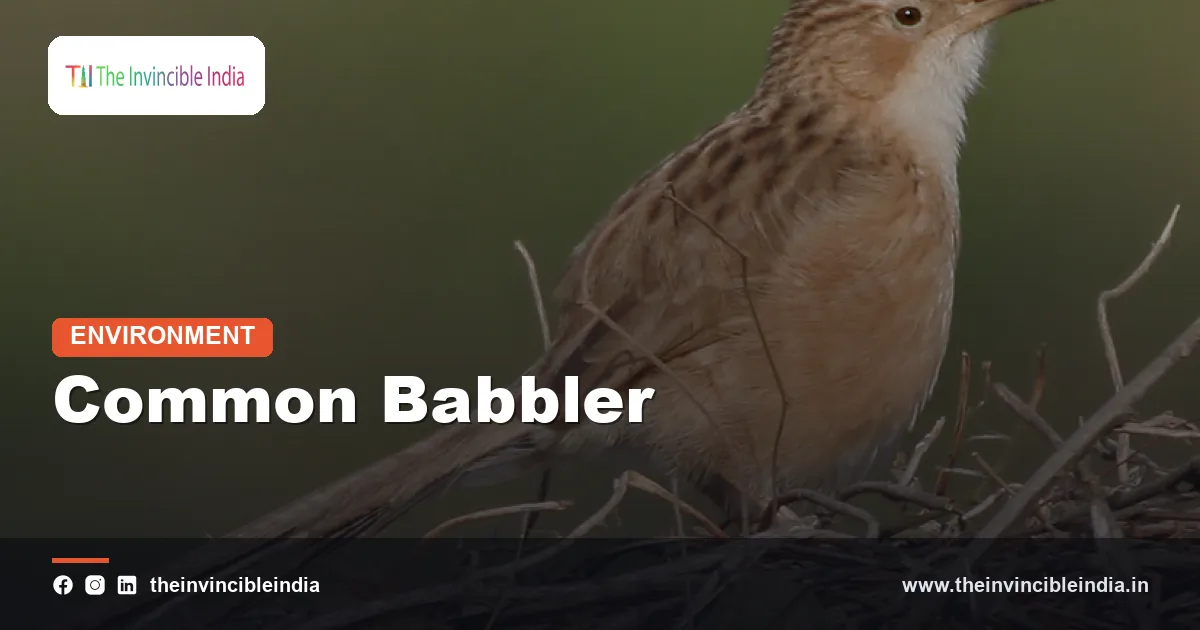
The common babbler (Argya caudata) is a slim, long-tailed, streaked brown songbird of the Indian subcontinent that lives in dry scrub, thorn country and semi-desert, usually in small, noisy groups that forage on or close to the ground. It belongs to the babbler group of birds, named for the constant chattering, trilling and squeaking with which members of a flock keep in touch.
Many Indians know babblers only as the “seven sisters” that hop about in gardens, but the common babbler is a distinct species with its own look, habitat and habits. This explainer covers how to recognise the common babbler, where it lives in India, what it eats, how its social groups work, how it breeds and how it differs from its better-known relatives. Information was last reviewed on 23 October 2026.
| Attribute | Details |
|---|---|
| Common name | Common babbler |
| Scientific name | Argya caudata (earlier placed in the genus Turdoides) |
| Family | Leiothrichidae (laughingthrushes and allied babblers) |
| Size | About 23 cm long, with a long, loosely graduated tail |
| Range and habitat in India | Dry plains, scrub, thorn forest, field edges and semi-desert across much of the country, mostly away from the wettest forests |
| Diet | Mainly insects and other small invertebrates, with some seeds, berries and nectar |
| Breeding | Cooperative; a cup nest of twigs and grass in a thorny bush, usually with three to four blue-green eggs |
| Conservation status | Least Concern on the IUCN Red List |
Key Takeaways
- The common babbler (Argya caudata) is a streaked, sandy-brown, long-tailed babbler of dry scrub and open thorn country in the Indian subcontinent.
- Common babblers live in tight groups, typically of around six to ten birds, that forage together, call to one another and roost close together.
- The common babbler eats mostly insects, picked from the ground, leaf litter and low bushes, and supplements them with seeds, small fruits and nectar.
- Breeding in the common babbler is cooperative, meaning that birds other than the parents may help to guard the nest and feed the chicks.
- The common babbler is told from the jungle babbler by its dark streaking, slimmer build and longer tail, and from other scrub birds by its group behaviour.
- The common babbler is classified as Least Concern, although loss of scrub and thorn habitat to development can reduce local populations.
What Is the Common Babbler?
The common babbler is a medium-sized, ground-loving songbird in the family Leiothrichidae, and it is one of several babblers found in India. The group is known for sociable, chattering behaviour, and the common babbler shows this clearly: a flock moves through low vegetation in a loose line, with members calling constantly to each other.
The scientific name Argya caudata refers to the long tail (caudata means “tailed”). For many years the species was placed in the genus Turdoides along with other Afro-Asian babblers. Later studies of the genetic relationships among babblers led to many of these species, including the common babbler, being moved to the genus Argya. Older field guides and websites may therefore list the same bird as Turdoides caudata.
The common babbler is native to the Indian subcontinent and is widespread in the dry regions of India, Pakistan and neighbouring countries. It is a resident species, which means it stays in the same general area through the year rather than migrating. Individual groups defend a home territory and live out their lives within it.
What Does the Common Babbler Look Like?
The common babbler is a slender, sandy-brown bird with dark streaking on the back, a pale throat and a long tail that gives it a lean, stretched appearance. Adults are about 23 cm from bill tip to tail tip, with the tail making up a large part of the length.
The key features that help an observer identify the common babbler are:
- Streaked upperparts: the back, wings and crown show dark brown streaks on a paler brown ground colour, giving a scaly, mottled look.
- Long, graduated tail: the tail is long and loose, often looking ragged and slightly shaky, and is usually held low or cocked a little as the bird hops.
- Pale, slightly streaked underparts: the throat and chest are paler and finely marked, while the belly is a warmer buff.
- Slim, slightly curved bill: the bill is slender, dark and suited to picking insects from the ground.
- Light, wiry legs: the legs are pale and strong, built for hopping and running across open ground.
Males and females of the common babbler look alike, so the sexes cannot easily be told apart in the field. Young birds resemble adults but are usually a little duller and may have a shorter tail. In general the common babbler appears paler and more streaked than the plain, rufous-grey babblers of garden and forest edges.
Where Is the Common Babbler Found in India?
The common babbler is found across much of the Indian plains and peninsula, wherever dry scrub, thorn bushes and open ground are available. It is typical of arid and semi-arid landscapes, and it is far less common in thick, wet evergreen forest, in the high Himalaya and in the humid northeast.
Habitats the common babbler uses include:
- Dry thorn scrub and wasteland with acacia, ber and similar bushes.
- Edges of crop fields, hedges and fence lines.
- Rocky, stony or sandy ground with scattered shrubs.
- Semi-desert regions in western India, where low scrub offers shelter.
- Village outskirts, open gardens and scrubby road verges with enough cover.
Within these habitats the common babbler prefers places with a mix of dense low cover and open patches. The thick bushes give shelter from the sun and from predators, while the open ground between them is where the birds search for insects. A flock does not travel far; it usually keeps to a territory of a modest size and returns to the same roosting bushes each evening.
The common babbler tolerates heat and dry conditions better than many forest birds. Because it is closely tied to scrub, however, it is rarely seen in the heart of large cities or in dense plantations. Its range overlaps with the jungle babbler in some areas, although the two tend to use different parts of the landscape.
What Does the Common Babbler Eat?
The common babbler eats mainly insects and other small invertebrates, which it finds by searching through leaf litter, loose soil and the base of bushes. Beetles, grasshoppers, ants, termites, caterpillars and spiders are typical items, and the bird also takes occasional small lizards or other tiny animals when it finds them.
The diet is supplemented with plant food. The common babbler also eats seeds, small wild berries and, at times, flower nectar. This mixed diet helps the species survive in dry regions where insect numbers fall in the hottest months and after poor rains.
Foraging techniques of the common babbler include:
- Ground probing: the bird pokes its bill into soil and under dry leaves to flush out hidden insects.
- Leaf flipping: loose debris is turned over or pushed aside to expose prey underneath.
- Low gleaning: insects are picked from the stems and lower leaves of bushes.
- Group searching: several birds forage side by side, and the movement of one bird often disturbs prey that another can catch.
Eating insects makes the common babbler useful to farmers, because it helps to control crop pests in field edges and orchards. The birds rarely damage crops in any meaningful way.
How Do Common Babblers Live in Groups?
Common babblers live in cohesive groups, usually of around six to ten birds, that forage, rest and roost together throughout the year. The group is the basic social unit of the species, and a bird is rarely seen alone for long.
Several features characterise babbler society, and the common babbler shares most of them:
- Constant contact calls: flock members chatter and squeak softly while feeding, so that each bird knows where the others are even in dense scrub.
- Staggered movement: birds hop and fly short distances in a loose procession, one after another, rather than all at once.
- Group defence: when a predator such as a snake, cat or bird of prey appears, the flock gives sharp alarm calls and may gather to mob the intruder.
- Social grooming: birds often preen each other, a behaviour that strengthens bonds within the group.
- Communal roosting: at night the group often settles close together in a bush, sometimes pressed against one another.
Group living gives the common babbler some real advantages. More eyes mean predators are noticed sooner, and a shared territory gives access to reliable food and nesting sites. The flock also protects the young birds that are raised within it.
What Does the Common Babbler Sound Like?
The call of the common babbler is a rapid, rising series of squeaky or whistling notes, often repeated in a chorus by several birds at once. Observers often describe it as a trilling, chattering or musical babble, and it is one of the most characteristic sounds of dry scrub in the early morning.
The vocabulary of the common babbler includes several kinds of calls:
- Contact calls: soft, repeated notes that keep the group together while foraging.
- Chorus calls: louder, excited calls given by many birds at once, often at dawn or when the group meets another flock.
- Alarm calls: sharp, harsh notes that warn the flock of a snake, cat or hawk.
- Begging calls: thin, urgent notes from young birds asking to be fed.
Learning the call is often the easiest way to find the common babbler, because the bird is quite good at hiding in thorny cover. A listener who hears a lively chorus in a dry bush can usually find the flock by waiting quietly and watching for birds hopping along the ground.
How Does the Common Babbler Breed?
The common babbler breeds cooperatively, meaning that a breeding pair is often assisted by other group members who help to defend the nest and feed the young. The nest is a cup of grass, twigs and rootlets placed in a thorny bush or low tree, usually not far above the ground.
Key details of the breeding cycle are:
- Season: breeding takes place at different times in different regions, but it often follows the arrival of rains, when insects are most abundant.
- Nest: a loosely built cup, often hidden in dense foliage or a thorn bush for protection.
- Eggs: the clutch is usually three to four, and the eggs are typically a clean blue-green.
- Care of the young: parents, and sometimes other group members, bring insects to the chicks until they leave the nest.
- After fledging: young birds often stay with the group, learning to forage and call.
Cooperative breeding is a feature of many babblers and is of interest to biologists because it shows how helpers can improve the survival of chicks. In the common babbler, as in related species, the tight social group makes this system possible. Exact details such as the number of helpers vary between groups and from year to year.
How Is the Common Babbler Different from Other Babblers?
The common babbler differs from other Indian babblers mainly in its streaked plumage, slimmer body and longer tail, as well as in its preference for dry scrub rather than gardens or forest. Several similar species share parts of its range, and a quick comparison helps to avoid confusion.
| Species | Size and build | Main identification clues | Typical habitat |
|---|---|---|---|
| Common babbler | About 23 cm, slim, long tail | Streaked sandy-brown upperparts, pale throat | Dry scrub and thorn country |
| Jungle babbler | About 25 cm, stocky | Plain greyish-brown, no streaks, pale eyes | Gardens, towns, woodland edges |
| Large grey babbler | About 28 cm, largest | Grey-brown with white sides to the tail | Open country and farmland |
| Striated babbler | About 25 cm | Heavily streaked brown, with a very long tail | Tall grassland on river floodplains in north and northeast India |
The jungle babbler is the species most often confused with the common babbler, because both live in groups and both call loudly. The jungle babbler is a plainer, more heavily built bird that is common around houses, while the common babbler looks sleeker and more streaked and stays mostly in drier scrub. When in doubt, a good look at the back and tail usually settles the question.
Is the Common Babbler Threatened?
The common babbler is not globally threatened and is listed as Least Concern by the International Union for Conservation of Nature (IUCN). The species is widespread, has a large range across the Indian subcontinent and adapts well to disturbed scrub and farmland edges.
Even so, local populations can face pressures, including:
- Clearance of thorn scrub for construction, roads and industry.
- Conversion of wasteland and field margins into intensive agriculture.
- Heavy use of pesticides, which reduces the insects the birds need.
- Removal of hedges and native thorny bushes used for nesting.
Protecting patches of scrub, hedges and field boundaries helps the common babbler and many other small birds that share its habitat. Dry scrub is often regarded as wasteland, yet it is a living ecosystem with its own specialised wildlife.
How Can You Watch the Common Babbler?
The best way to watch the common babbler is to visit dry scrub or field edges early in the morning, stand quietly and listen for the group’s chattering calls. The birds are active in the cooler hours and are often easiest to see just after sunrise or in late afternoon.
Some practical tips for birdwatchers are:
- Move slowly and avoid sudden gestures, because the flock is alert and shy of people.
- Scan the ground between bushes, where the birds are likely to be hopping.
- Use binoculars to see the streaking on the back and the long tail.
- Note the number of birds and their behaviour, which can help with identification.
- Do not play recorded calls repeatedly, as this can stress the birds and disturb breeding.
Watching a flock for even a few minutes gives a good picture of its social life: the staggered movement, the calls, the grooming and the sentinel-like alertness. Many beginners find the common babbler a rewarding species precisely because it is easy to observe once located.
Why Does the Common Babbler Matter?
The common babbler matters because it is a natural controller of insects, an indicator of healthy scrub habitat and a rewarding subject for studying social behaviour in birds. As a common species of dry regions, it also helps people connect with the wildlife of ordinary landscapes.
By eating large numbers of insects, the common babbler reduces pests in fields and gardens. Its presence suggests that thorny cover, open ground and food supply are all still available. Because the birds live in groups for their whole lives, they have also become important subjects for researchers who study cooperation, communication and family life in animals.
Bottom Line
The common babbler is a streaked, long-tailed, sociable bird of India’s dry scrub that eats insects, breeds cooperatively and announces itself with a lively chorus. It is not threatened, but its future depends on keeping patches of scrub and hedgerow alive across the countryside.
Frequently Asked Questions
What is the scientific name of the common babbler?
The scientific name of the common babbler is Argya caudata. It was earlier placed in the genus Turdoides, so older books may list it as Turdoides caudata. It belongs to the family Leiothrichidae.
Is the common babbler the same as the jungle babbler?
No, the common babbler is a separate species from the jungle babbler. The common babbler is slimmer, streaked and long-tailed and prefers dry scrub, while the jungle babbler is plain greyish-brown, more heavily built and common around gardens and houses.
What does the common babbler eat?
The common babbler eats mostly insects and other small invertebrates, such as beetles, grasshoppers, ants and caterpillars. It also takes seeds, small berries and nectar. This mixed diet helps it survive in dry regions.
Do common babblers live in groups?
Yes, common babblers live in groups, usually of about six to ten birds. The group forages, calls, preens and roosts together, and members often help to defend the nest and feed the young.
Where can I see the common babbler in India?
The common babbler can be seen in dry scrub, thorn country, field edges and semi-desert across much of India. It is easiest to find early in the morning by listening for the flock’s chattering calls. It is less likely in wet evergreen forest or dense urban areas.
Is the common babbler an endangered bird?
No, the common babbler is not endangered and is classified as Least Concern by the IUCN. It is widespread and adaptable, although local populations can decline when scrub and hedgerow habitats are cleared.
{“@context”:”https://schema.org”,”@graph”:[{“@type”:”FAQPage”,”mainEntity”:[{“@type”:”Question”,”name”:”What is the scientific name of the common babbler?”,”acceptedAnswer”:{“@type”:”Answer”,”text”:”The scientific name of the common babbler is Argya caudata. It was earlier placed in the genus Turdoides, so older books may list it as Turdoides caudata. It belongs to the family Leiothrichidae.”}},{“@type”:”Question”,”name”:”Is the common babbler the same as the jungle babbler?”,”acceptedAnswer”:{“@type”:”Answer”,”text”:”No, the common babbler is a separate species from the jungle babbler. The common babbler is slimmer, streaked and long-tailed and prefers dry scrub, while the jungle babbler is plain greyish-brown, more heavily built and common around gardens and houses.”}},{“@type”:”Question”,”name”:”What does the common babbler eat?”,”acceptedAnswer”:{“@type”:”Answer”,”text”:”The common babbler eats mostly insects and other small invertebrates, such as beetles, grasshoppers, ants and caterpillars. It also takes seeds, small berries and nectar. This mixed diet helps it survive in dry regions.”}},{“@type”:”Question”,”name”:”Do common babblers live in groups?”,”acceptedAnswer”:{“@type”:”Answer”,”text”:”Yes, common babblers live in groups, usually of about six to ten birds. The group forages, calls, preens and roosts together, and members often help to defend the nest and feed the young.”}},{“@type”:”Question”,”name”:”Where can I see the common babbler in India?”,”acceptedAnswer”:{“@type”:”Answer”,”text”:”The common babbler can be seen in dry scrub, thorn country, field edges and semi-desert across much of India. It is easiest to find early in the morning by listening for the flock’s chattering calls. It is less likely in wet evergreen forest or dense urban areas.”}},{“@type”:”Question”,”name”:”Is the common babbler an endangered bird?”,”acceptedAnswer”:{“@type”:”Answer”,”text”:”No, the common babbler is not endangered and is classified as Least Concern by the IUCN. It is widespread and adaptable, although local populations can decline when scrub and hedgerow habitats are cleared.”}}]}]}


