

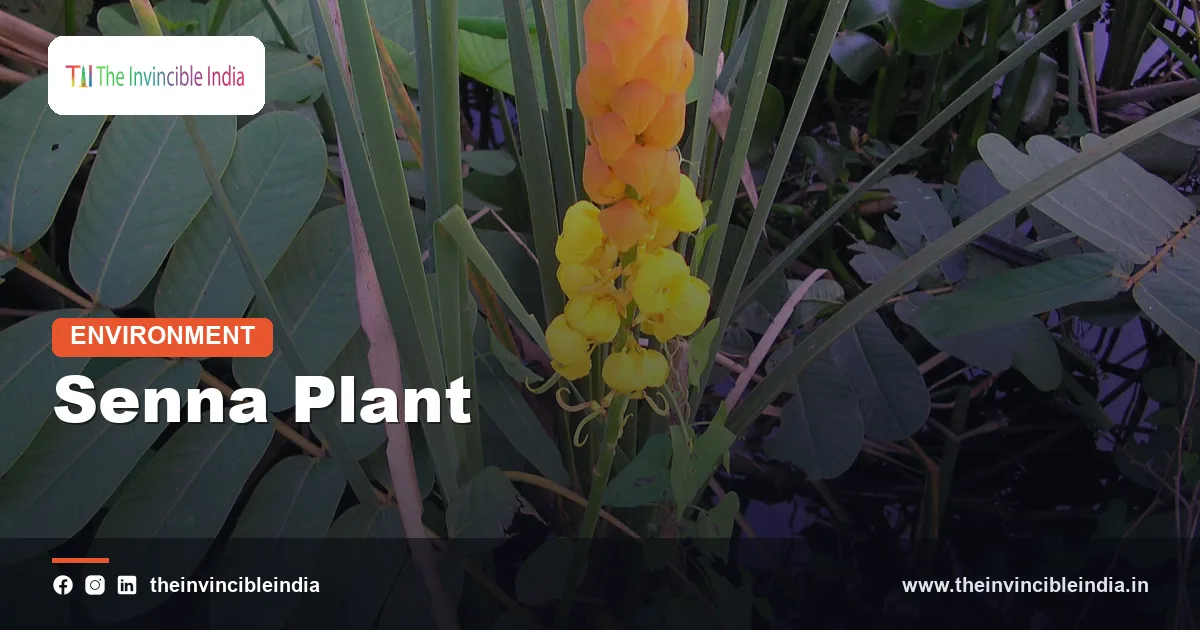
The senna plant (Senna alexandrina, formerly Cassia angustifolia) is a small perennial shrub of the pea family whose dried leaves and pods are used around the world as a natural stimulant laxative, and India is one of the leading growers and exporters of the crop. The plant is known in Hindi as sonamukhi, in Tamil as nilavarai and in Sanskrit as svarnapatri, and the best-known Indian type is called Tinnevelly senna after the old name of the Tirunelveli region of Tamil Nadu.
Unlike many medicinal plants that are gathered from forests, senna is a true field crop. It is sown, irrigated lightly, harvested several times and dried in shade before being sold to pharmaceutical and herbal companies. This explainer covers what the plant is, how it grows, where and how it is cultivated in India, what makes it work as a laxative, and what precautions apply to its use.
| Quick Facts: Senna | |
|---|---|
| Scientific name | Senna alexandrina Mill. (synonyms include Cassia angustifolia and Cassia senna) |
| Family | Fabaceae (the legume or pea family) |
| Common Indian names | Sonamukhi (Hindi), nilavarai (Tamil), svarnapatri (Sanskrit), Indian senna, Tinnevelly senna |
| Where grown in India | Mainly southern Tamil Nadu (Tirunelveli, Thoothukudi, Madurai and neighbouring districts), with smaller areas in Gujarat and Rajasthan |
| Growing season | Sown mostly with the northeast monsoon rains or under irrigation in other seasons; leaves are cut several times over about five to six months |
| Part used | Dried leaflets and dried pods |
| Main active compounds | Sennosides A and B, which are anthraquinone glycosides |
| Main uses | Short-term relief of constipation, Ayurvedic and herbal formulations, herbal teas and bowel preparation under medical direction |
| Notable facts | A major Indian export crop; the name senna comes from the Arabic word sana |
Key Takeaways
- Senna is a small shrub of the legume family, Fabaceae, whose scientific name is Senna alexandrina.
- The leaves and pods of the senna plant contain sennosides, compounds that stimulate the large intestine and act as a laxative.
- Tinnevelly senna, grown mainly in southern Tamil Nadu, is the principal Indian commercial type of senna.
- Senna is grown as a semi-arid field crop that tolerates poor, dry soils and is harvested for leaves several times in one crop cycle.
- Senna is recommended only for short-term use, and long-term daily use can cause dependence and loss of body salts.
- Senna is a distinct plant from Cassia fistula (amaltas) and from Senna tora (charota), although they share a genus history.
What is senna and where does the name come from?
Senna is a group of flowering plants in the legume family, and in everyday and commercial use the word refers to Senna alexandrina, the species whose leaves and pods are sold as a laxative drug. The genus Senna includes several hundred species of trees, shrubs and herbs found in warm regions across the world, many of them ornamental or used as fodder and green manure.
The common name senna is generally traced to the Arabic word sana, which Arab physicians used for the plant. Arab traders and doctors are credited with carrying senna from the region of the Red Sea, Sudan and Arabia into medical practice in the Islamic world, and from there into European and Indian use. The older botanical name Cassia was used for the whole group of plants until taxonomists separated many of them into the genus Senna, which is why labels and old texts still show names such as Cassia angustifolia or Cassia senna.
Two commercial types are traded internationally. Alexandrian senna, from the Nile valley and Sudan, has broader leaflets, while Tinnevelly senna, from India, has longer and narrower leaflets. Both are accepted in pharmacopoeias, and India has become the main source of the Tinnevelly type.
What does the senna plant look like?
The senna plant is a low, erect, much-branched shrub that usually grows to about one metre in height, with a woody base and a deep taproot. Its stems are pale green to greyish and carry compound leaves that are described as paripinnate, meaning the leaf has pairs of leaflets along a central stalk without a single leaflet at the tip.
Each leaf carries roughly four to eight pairs of leaflets, and each leaflet is narrow, pointed and a few centimetres long, with a pale green colour and a slightly leathery feel. Tinnevelly senna is recognised by these lance-shaped leaflets, which are longer and narrower than those of the Alexandrian type.
The flowers are bright yellow and open in loose clusters called racemes, arising where the leaves meet the stem. After flowering the plant forms flat, oblong, slightly curved pods that start green and turn pale brown when mature. Each pod holds several flat seeds, and the pods themselves are also collected and sold as a drug. The seeds are hard-coated, which affects how the crop is sown.
Where is senna grown in India?
Senna is grown in India mainly in the dry southern districts of Tamil Nadu, with Tirunelveli, Thoothukudi, Madurai and nearby districts forming the traditional core of the crop. The plant is generally said to have been brought to this region from Arabia and the Red Sea area in the nineteenth century, and it adapted well to the red and black soils and the low, seasonal rainfall of the southern plains.
Smaller areas of senna are grown in Gujarat and Rajasthan, where the hot, dry climate and light soils suit the crop and where it is sometimes taken up as a low-input alternative to water-demanding field crops. Interest in senna has also spread to other dry parts of peninsular India, though southern Tamil Nadu remains the best-known source of Indian senna.
Because senna is exported and traded in bulk, its area and output change from year to year depending on rainfall and market price. Specific production figures are therefore best checked in current government and medicinal-plant board data rather than quoted from memory. What is stable is the broad pattern: India supplies a substantial part of the senna leaf and pod entering world trade.
How is senna cultivated?
Senna is cultivated as a semi-arid crop that is sown by seed, grows through the cooler months and is harvested repeatedly, with the crop needing relatively little water and few inputs. The plant tolerates poor soils and low rainfall, which is the main reason farmers in dry districts choose it.
Soil and climate
Senna prefers a warm, dry climate and does well on well-drained red sandy loams and lighter black soils. Waterlogging and heavy clay damage the roots, so drainage is important. The crop is sensitive to prolonged cold and to heavy rain during harvest, because wet weather spoils the colour of the leaf.
Sowing and crop care
Because the seed has a hard coat, farmers often soak it in water or roughen it lightly to improve germination. Sowing is commonly timed with the northeast monsoon rains, and in areas with irrigation the crop can also be taken in other seasons. The seed is sown in lines, and the young plants are thinned and weeded in the first weeks. A few light irrigations during dry spells improve yield, and moderate organic manure supports leaf growth.
Pests and diseases
Senna is relatively hardy, though leaf-eating caterpillars, sucking insects and occasional leaf spot or root rot can reduce yield. Farmers generally manage these through crop rotation and clean field practice, since heavy chemical use is undesirable for a crop that ends up as a medicine.
How are senna leaves and pods harvested and processed?
Senna leaves are harvested by cutting or stripping the mature leaflets, usually the first time about three months after sowing, and then again at intervals of roughly a month to six weeks as new growth appears. Pods are gathered when they turn from green to pale brown but before they split open and scatter the seed.
After harvest the leaves are spread thinly in the shade to dry. Shade drying matters because strong sun bleaches the leaflets and reduces the quality grade, while good drying keeps the leaf a bright green to greenish yellow. The dried material is then cleaned of stalks, stones and foreign matter, graded by leaf size and colour, and packed in bales or bags for sale to processors.
Buyers inspect senna for colour, leaf integrity, moisture and the proportion of stalk, and many also test the sennoside content. Leaf grades sold as whole leaf command higher prices than broken leaf or powder, and pods are traded separately. The following list summarises the main stages from field to market:
- Sowing: seed is soaked or scarified and planted in lines.
- First cut: leaflets are harvested about three months after sowing.
- Later cuts: further harvests follow as the plant regrows, with a final stripping and pod collection.
- Drying: leaves are dried in shade to keep colour.
- Grading and packing: leaves and pods are cleaned, graded and baled for trade.
What makes senna work as a laxative?
Senna works as a laxative because its leaves and pods contain sennosides, a group of anthraquinone glycosides, with sennosides A and B being the best known. These compounds pass through the stomach and small intestine largely unchanged and are broken down by bacteria in the colon into active forms such as rhein anthrone.
Once activated, the compounds stimulate the muscular movement of the large intestine and also reduce the absorption of water from the stool, so the bowel contents become softer and move on more quickly. Because the action happens in the colon, the effect usually appears several hours after a dose, commonly overnight if taken in the evening, rather than within minutes.
Senna is classed as a stimulant laxative, which is different from bulk-forming fibre such as psyllium husk and from osmotic laxatives. Pods are traditionally regarded as somewhat milder than leaves, while concentrated extracts are standardised to a stated sennoside content so that the dose is predictable. Other substances in the plant, including flavonoids and mucilage, are present but are not considered the main source of the effect.
How is senna used in medicine and daily life?
Senna is used mainly for short-term treatment of occasional constipation, either in traditional preparations or in modern standardised tablets, syrups and teas. It has one of the longest records of use of any laxative herb and is listed in many national pharmacopoeias.
Traditional use
In Ayurveda the plant is known as svarnapatri or markandika and is used as a purgative in carefully prepared formulations. Unani medicine, which drew on Arab and Greek sources, also values senna, known there as sana makki, and Indian herbal traders have long supplied it to both systems.
Modern products
- Standardised tablets and capsules of sennosides sold as over-the-counter laxatives.
- Dried leaf and pod used to make herbal teas and decoctions.
- Powders and granules that are blended into compound herbal laxative formulations.
- Liquid extracts and syrups, including paediatric preparations used under medical advice.
Senna products are also prescribed in hospitals as part of bowel preparation before certain examinations and procedures, but this is done under a doctor’s direction and with a set dose. Self-medication for any purpose beyond occasional constipation is not advised.
What are the safety concerns and side effects of senna?
Senna is considered safe for short-term, occasional use at the recommended dose, but it can cause cramps, diarrhoea and loss of body fluids and salts if overused, and it should not be taken for long periods without medical advice. The usual side effects are abdominal cramping, loose stools and, with excess, dehydration.
Prolonged daily use may reduce the bowel’s own response and lead to dependence on the laxative, and it can lower blood potassium, which matters especially for people with heart conditions or those taking certain medicines. Senna is not suitable for people with intestinal blockage, inflammatory bowel disease or undiagnosed abdominal pain. Pregnant and breastfeeding women, children and older adults should use it only on professional advice.
A harmless side effect is that senna can darken urine to a yellow-brown or reddish colour. As with all herbal medicines, quality varies, so products from reputable manufacturers with a stated sennoside content are preferable to unlabelled bulk material.
How does Tinnevelly senna differ from Alexandrian senna and related plants?
Tinnevelly senna comes from India and has longer, narrower leaflets, while Alexandrian senna comes from the Nile region and Sudan and has broader, shorter leaflets, though both are the same species in modern classification. Several other plants with similar names are often confused with them.
| Plant | Scientific name | Main distinction |
|---|---|---|
| Tinnevelly senna | Senna alexandrina (Cassia angustifolia) | Indian commercial senna with narrow lance-shaped leaflets, grown mainly in southern Tamil Nadu |
| Alexandrian senna | Senna alexandrina (Cassia senna) | Traditional Egyptian and Sudanese senna with broader leaflets |
| Amaltas (Indian laburnum) | Cassia fistula | A flowering tree with long cylindrical pods and showy yellow flower clusters, used for its pod pulp |
| Charota (sickle senna) | Senna tora | An annual weedy herb whose leaves and seeds are used locally, not the commercial senna |
| Avaram (tanner’s cassia) | Senna auriculata | A South Indian shrub used in tanning and as a folk herbal tea, not a laxative crop |
The key practical point is that only Senna alexandrina is the standard pharmacopoeial senna. Other plants in the group have their own uses and should not be substituted for it.
Why does senna matter to India’s economy and environment?
Senna matters to India because it is a medicinal export crop that gives farmers in dry districts a dependable cash income from land that supports few other crops. It is among the better-known examples of an Indian medicinal plant that has moved from the wild and the market bazaar into organised farming.
The crop suits the rainfall of semi-arid Tamil Nadu and uses less water than many field crops, which makes it relevant to discussions about climate-resilient farming. As a legume-family shrub it also helps cover and protect light soils, and the repeated leaf cutting means the same plants provide income across several harvests rather than a single yield.
Senna also illustrates a wider theme in Indian agriculture: the growth of contract and market linkages between small farmers and herbal and pharmaceutical processors. Quality standards, clean drying and traceable sourcing increasingly decide prices, so farmers who handle the leaf carefully earn more. Changes in world demand and in regulations on herbal products can affect the crop from year to year, which is why it is usually grown alongside other crops rather than as the only source of livelihood.
Bottom Line
Senna is a hardy legume shrub whose leaves and pods supply sennosides, the active compounds of one of the world’s oldest herbal laxatives. India, led by Tinnevelly senna from Tamil Nadu, is a major source, and the crop is useful for dry-land farmers, but the drug itself is meant for short-term, careful use.
Frequently Asked Questions
What is senna used for?
Senna is used mainly as a short-term remedy for occasional constipation. Its leaves and pods contain sennosides that stimulate the colon, and it is also used in Ayurvedic and herbal formulations and, under medical supervision, in bowel preparation before some procedures.
Is senna the same as sonamukhi?
Yes, sonamukhi is the Hindi name for senna, the plant Senna alexandrina. In Sanskrit it is called svarnapatri and in Tamil nilavarai, and all these names refer to the same laxative herb.
Where is senna grown in India?
Senna is grown mainly in the dry southern districts of Tamil Nadu such as Tirunelveli, Thoothukudi and Madurai. Smaller areas are grown in Gujarat and Rajasthan, and the Indian type is known as Tinnevelly senna.
How does senna work?
Senna works by stimulating the large intestine. Gut bacteria convert its sennosides into active compounds that increase bowel movement and reduce water absorption, so the stool softens and passes more quickly, usually within several hours.
Is it safe to take senna every day?
No, daily long-term use of senna is not recommended. Prolonged use can cause dependence, dehydration and low blood potassium, so it should be taken only for short periods and, in pregnancy, childhood or illness, only on medical advice.
What is the difference between senna and amaltas?
Senna and amaltas are different plants. Senna (Senna alexandrina) is a small shrub grown for its leaves and pods, while amaltas (Cassia fistula) is a large tree with long pods and hanging golden-yellow flowers, used for its pod pulp.
{“@context”:”https://schema.org”,”@graph”:[{“@type”:”FAQPage”,”mainEntity”:[{“@type”:”Question”,”name”:”What is senna used for?”,”acceptedAnswer”:{“@type”:”Answer”,”text”:”Senna is used mainly as a short-term remedy for occasional constipation. Its leaves and pods contain sennosides that stimulate the colon, and it is also used in Ayurvedic and herbal formulations and, under medical supervision, in bowel preparation before some procedures.”}},{“@type”:”Question”,”name”:”Is senna the same as sonamukhi?”,”acceptedAnswer”:{“@type”:”Answer”,”text”:”Yes, sonamukhi is the Hindi name for senna, the plant Senna alexandrina. In Sanskrit it is called svarnapatri and in Tamil nilavarai, and all these names refer to the same laxative herb.”}},{“@type”:”Question”,”name”:”Where is senna grown in India?”,”acceptedAnswer”:{“@type”:”Answer”,”text”:”Senna is grown mainly in the dry southern districts of Tamil Nadu such as Tirunelveli, Thoothukudi and Madurai. Smaller areas are grown in Gujarat and Rajasthan, and the Indian type is known as Tinnevelly senna.”}},{“@type”:”Question”,”name”:”How does senna work?”,”acceptedAnswer”:{“@type”:”Answer”,”text”:”Senna works by stimulating the large intestine. Gut bacteria convert its sennosides into active compounds that increase bowel movement and reduce water absorption, so the stool softens and passes more quickly, usually within several hours.”}},{“@type”:”Question”,”name”:”Is it safe to take senna every day?”,”acceptedAnswer”:{“@type”:”Answer”,”text”:”No, daily long-term use of senna is not recommended. Prolonged use can cause dependence, dehydration and low blood potassium, so it should be taken only for short periods and, in pregnancy, childhood or illness, only on medical advice.”}},{“@type”:”Question”,”name”:”What is the difference between senna and amaltas?”,”acceptedAnswer”:{“@type”:”Answer”,”text”:”Senna and amaltas are different plants. Senna (Senna alexandrina) is a small shrub grown for its leaves and pods, while amaltas (Cassia fistula) is a large tree with long pods and hanging golden-yellow flowers, used for its pod pulp.”}}]}]}


