

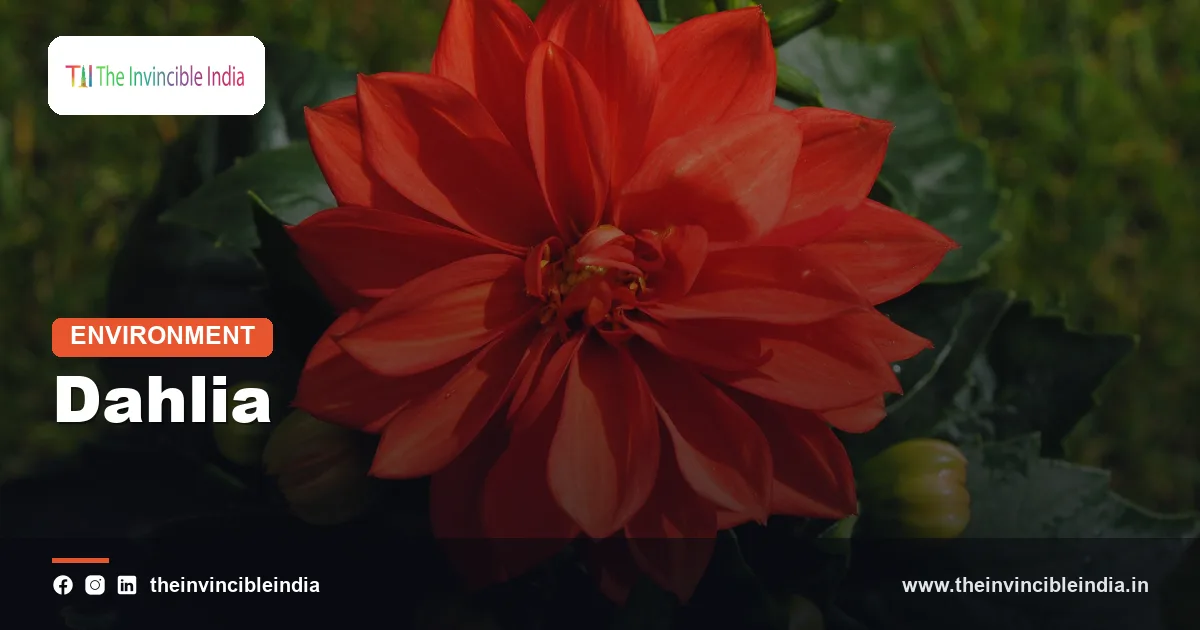
The dahlia is a showy tuberous perennial of the daisy family, native to Mexico and Central America, that is grown across India as a winter garden flower in an enormous range of colours, sizes and petal forms. A dahlia plant grows from a cluster of swollen underground roots and produces blooms that range from coin-sized buttons to heads wider than a dinner plate.
In the Indian plains, dahlia plants flower in the cool months from December to February, while in hill stations they bloom in the late summer and monsoon months. Breeders have produced many thousands of named cultivars, and dahlia displays are a highlight of garden and flower shows across the country.
| Attribute | Details |
|---|---|
| Common name | Dahlia (the same name is used in Hindi and most Indian languages) |
| Scientific name | Dahlia species; garden dahlias are complex hybrids, often listed as Dahlia x hybrida or Dahlia x hortensis |
| Family | Asteraceae (daisy or sunflower family) |
| Origin | Mexico and Central America; Dahlia is the national flower of Mexico |
| Where grown in India | Gardens, nurseries and flower shows in plains and hill stations, including Himachal Pradesh, Uttarakhand, Jammu and Kashmir, West Bengal (Darjeeling), Tamil Nadu (Nilgiris) and Karnataka |
| Flowering season | December to February in the plains; roughly July to October in cool hills |
| Uses | Ornamental bedding and pot plant, cut flower, exhibition flower; tubers were a food source for the Aztecs |
| Notable facts | Named after the Swedish botanist Anders Dahl; roughly 40 wild species and many thousands of cultivars; frost-tender, with tubers lifted and stored in cold climates |
Key Takeaways
- The dahlia is a tuberous perennial of the daisy family (Asteraceae) that is native to the highlands of Mexico and Central America.
- Dahlia plants grow from swollen storage roots called tubers, which are planted in the soil and are the main means of propagation.
- Dahlia flowers are divided into forms such as single, anemone, collarette, waterlily, decorative, ball, pompon and cactus, based on petal shape and arrangement.
- In the Indian plains the dahlia flowers from December to February, while in cool hill regions it blooms from mid-summer to autumn.
- The dahlia is named after Anders Dahl, a Swedish botanist and student of Carl Linnaeus, and it is the national flower of Mexico.
- Dahlia plants need full sun, loose well-drained soil, staking and regular feeding to produce large, healthy blooms.
What is a dahlia?
A dahlia is a bushy flowering plant of the genus Dahlia, grown for its large, brightly coloured flower heads. Like chrysanthemums, sunflowers and marigolds, the dahlia belongs to the daisy family, and its apparent flower is a composite head made of many small florets.
The plant arises each season from a clump of fleshy storage roots, usually called tubers, although botanists describe them as tuberous roots. A dahlia stem is hollow, soft and branching, and its leaves are divided into several leaflets arranged opposite each other. Heights vary from compact bedding plants of about 30 centimetres to tall varieties that exceed 1.5 metres.
Wild dahlias are far simpler than the garden kinds. The wild species have single flowers with a few petal-like rays around a yellow centre, in shades of red, orange, purple or yellow. All of the elaborate double and semi-double garden forms descend from this small group of wild plants, shaped by centuries of selection.
There are roughly forty wild species, most of them native to Mexico, and a few extend into Central America and northern South America. The garden dahlias belong to complex hybrids with many chromosome sets, which explains their extraordinary variability and why seed from a named cultivar produces mixed seedlings.
Where does the dahlia come from and how did it reach India?
The dahlia comes from the highlands of Mexico, where it grew wild and was cultivated long before European contact. The Aztecs grew dahlias for their tubers as a food source, for hollow stems used as water pipes, and for the flowers themselves, and the plant was known by local names that Spanish writers recorded in the sixteenth century.
Seeds and tubers reached Europe in the late eighteenth century, with the Royal Botanic Garden in Madrid receiving plants from Mexico in 1789. The plant was named Dahlia in honour of Anders Dahl, a Swedish botanist who had studied under Carl Linnaeus. Breeders in Europe, especially in Britain, Germany and the Netherlands, crossed the early plants and produced double flowers within a few decades.
The dahlia reached India during the nineteenth century through colonial botanical gardens and hill-station nurseries. The cool climate of Darjeeling, Shimla, Mussoorie, the Nilgiris, Kodaikanal and the Kashmir valley suited the plant well, and gardeners in the plains soon found that tubers planted at the right time give a good winter display.
The dahlia has been the national flower of Mexico since 1963, and the plant is also used as a symbol of dignity and elegance in various flower-language traditions.
What are the types and forms of dahlia flowers?
Dahlia flowers are classified into forms such as single, anemone, collarette, waterlily, decorative, ball, pompon and cactus, according to the shape and arrangement of the petal-like ray florets. Societies and flower-show judges use these categories so that cultivars can be compared fairly.
| Form | Key features |
|---|---|
| Single | One ring of flat rays around an open yellow disc, closest to the wild flower |
| Anemone | One or more rings of flat rays around a dense cushion of tubular florets |
| Collarette | One outer ring of flat rays and a small inner ring of shorter rays, like a collar |
| Waterlily | Fully double, shallow flower with broad, flat petals like a water lily |
| Decorative | Fully double with broad, flat or slightly curved petals and no visible centre |
| Ball and pompon | Rounded heads with petals rolled into short tubes; pompons are smaller and ball-like |
| Cactus and semi-cactus | Long, pointed petals that roll lengthwise, giving a spiky or twisted look |
Flower size is another way to group dahlias. Giant types carry blooms more than 25 centimetres across, medium types fall between 10 and 20 centimetres, and miniatures and pompons are much smaller. Dwarf bedding dahlias grown from seed are common in Indian nurseries, usually with single or semi-double flowers.
Colours cover most of the spectrum except true blue, including white, cream, yellow, orange, red, maroon, pink, lavender and purple, along with bicolours and blends. Some cultivars also have dark bronze or nearly black foliage, which makes the bright flowers stand out.
When and where does the dahlia grow in India?
The dahlia grows in India both in the plains, where it flowers in winter, and in cool hill regions, where it flowers from mid-summer to autumn. The difference comes from the plant’s dislike of heat and frost, which forces gardeners to plant at different times in different climates.
Dahlia in the plains
In north Indian plains, gardeners plant tubers or rooted cuttings in September to October, so that the plants grow through the mild autumn and bloom from December to February. Summer heat is hard on the tubers, and many plains growers lift the clumps after flowering, dry them and store them in a cool place until the next planting season.
Dahlia in the hills
In Himalayan and Nilgiri hills, tubers are planted in March to April after the last frost. The plants flower from July to October, when displays in hill gardens are at their best. In places with hard winters, tubers are dug up after the first frost kills the leaves and are stored indoors until spring.
Dahlia in the south
In peninsular India, the dahlia grows best at higher elevations such as Ooty, Kodaikanal, Coorg and the Nilgiris. In hot, humid lowland cities it is more difficult, and growers often rely on potted plants in cooler months and on partial shade in the afternoon.
Horticultural societies and botanical gardens hold flower shows each year with dahlia classes, where growers exhibit single blooms and arranged displays. These shows help preserve cultivars and share growing knowledge.
How do you grow a dahlia?
A dahlia is grown by planting a tuber with at least one visible eye or sprout, five to ten centimetres deep, in a sunny spot with loose, well-drained, fertile soil. The plant needs about six hours of direct sun a day and moderate, regular watering once shoots emerge.
Planting and early care
The tuber should be planted horizontally with the eye facing up, and water should be given sparingly until shoots show above the soil. Too much water before sprouting can rot the tuber. Spacing of 45 to 60 centimetres between plants allows air to move and keeps fungal diseases down.
Pinching, staking and disbudding
Pinching the main shoot after the plant has made three or four pairs of leaves encourages side branches and a bushier plant. Taller types need strong stakes because the hollow stems can snap in wind and rain. For exhibition-size blooms, growers remove the two side buds beside each main bud, a practice called disbudding.
Feeding and watering
Dahlias are heavy feeders. A balanced fertiliser at planting is usually followed by a feed lower in nitrogen and higher in potash once the buds form. Too much nitrogen gives lush leaves and few flowers. Watering should be deep but not frequent, and mulching with dry leaves or compost keeps the soil cool and moist.
Propagation
Dahlias are propagated by dividing tubers, taking cuttings from young shoots, or growing seed for dwarf bedding kinds. Division works by cutting a clump so that each piece has a part of the crown with at least one eye. Cuttings rooted in sand or coco peat give healthy new plants and are common in nurseries.
What pests and diseases affect dahlia plants?
Dahlia plants are affected mainly by aphids, thrips, spider mites, snails and slugs, caterpillars, powdery mildew and virus diseases. The soft growth of a dahlia attracts sap-sucking insects, and wet or crowded conditions favour fungal problems.
- Aphids and thrips: Small insects that feed on young shoots and buds, causing distorted growth and spoiled flowers.
- Spider mites: Tiny pests in hot, dry weather that leave leaves speckled and bronzed.
- Slugs and snails: Chew new shoots in damp weather, especially at planting time.
- Powdery mildew: A white powdery fungus on leaves that appears in cool, humid, still conditions.
- Tuber rot: Caused by waterlogged soil or damaged tubers; affected tubers turn soft and discoloured.
- Virus diseases: Cause stunted plants and mottled leaves; infected plants cannot be cured and should be removed.
Prevention is the best tool. Healthy tubers, well-drained soil, clean tools and good air movement lower most risks. Gardeners can also remove spent flowers, called deadheading, which keeps plants tidy and extends the flowering period.
What is the dahlia used for?
The dahlia is used mainly as an ornamental bedding plant, a pot plant, a cut flower and an exhibition flower, and in its native Mexico its tubers have also been used as food. Its main role in India is decorative, in home gardens, parks, hotels, hill-station gardens and flower shows.
- Garden display: Dwarf and medium types fill winter beds and borders with colour.
- Pot culture: Compact dahlias grow well in large containers on terraces and balconies.
- Cut flowers: Medium and small blooms are cut for arrangements, although their vase life is shorter than that of chrysanthemums, usually about five to seven days.
- Exhibition: Large decorative, cactus and ball types compete in flower-show classes.
- Food and traditional use: The tubers contain inulin, a plant carbohydrate, and were eaten by people in Mexico. In modern gardens, dahlia tubers are grown mostly for flowers, and petals of some varieties are used as an edible garnish.
The dahlia is also a plant that shows how selective breeding works. From a handful of wild species, breeders produced a vast range of flower shapes, sizes and colours in just over two centuries.
How does the dahlia differ from the chrysanthemum and zinnia?
The dahlia differs from the chrysanthemum and the zinnia in its tuberous roots, its hollow stem and the divided leaves of the plant, even though all three belong to the daisy family. They are often confused because of their similar flower heads.
- Dahlia: Grows from tuberous roots, has hollow stems and divided leaves, and is a Mexican native that flowers in the Indian winter or hill summer.
- Chrysanthemum: A fibrous-rooted East Asian perennial with lobed aromatic leaves that flowers in the shortening days of autumn.
- Zinnia: A seed-grown annual from the Americas with rough, undivided leaves that blooms in the rainy season and summer.
The simplest check is the root. A dahlia lifted from the soil carries a cluster of thick, tuber-like roots, while chrysanthemums and zinnias have fine fibrous root systems.
Why should dahlia tubers be lifted and stored?
Dahlia tubers are lifted and stored because they are frost-tender and can rot in cold wet soil or in hot monsoon conditions. In regions where winters are hard, or where summers are very hot and wet, lifting the tubers protects the plant until the next planting season.
Once the foliage has died back or been cut, the clump is carefully dug up, washed gently and dried in shade for several days. It is then packed in dry sand, sawdust, coco peat or paper in a cool, dark, frost-free place. Tubers should be checked from time to time and any soft or mouldy pieces removed.
In the Indian plains, many gardeners store tubers through the hot months and replant in autumn. In mild parts of the south and in some sheltered hill gardens, tubers can stay in the ground if the soil drains well.
Bottom Line
The dahlia is a Mexican tuberous plant that has become a favourite of Indian winter gardens and hill-station flower shows. Its range of forms and colours, easy propagation from tubers and strong show-bench appeal make it one of the most rewarding garden flowers in the daisy family.
Frequently Asked Questions
What is a dahlia flower?
A dahlia is a tuberous plant of the daisy family that produces large, colourful composite flower heads. It is native to Mexico and Central America, and it grows in India as a winter garden flower. Thousands of cultivars exist in many colours and shapes.
When do dahlias bloom in India?
Dahlias bloom in the Indian plains from December to February and in cool hill regions from July to October. The plant dislikes heat and frost, so planting time is adjusted to the climate. In the plains, tubers are usually planted in September or October.
Is the dahlia native to India?
No, the dahlia is not native to India. It is native to the highlands of Mexico and Central America and reached India in the nineteenth century through botanical gardens and hill-station nurseries. It is now widely grown in Indian gardens.
How do you plant a dahlia tuber?
To plant a dahlia tuber, set it horizontally with the eye facing up, five to ten centimetres deep, in loose, well-drained soil in full sun. Water lightly until shoots appear, then water regularly. Space plants 45 to 60 centimetres apart so air can move between them.
Why are dahlia tubers dug up and stored?
Dahlia tubers are dug up and stored because they cannot survive frost and may rot in cold, wet or very hot, humid soil. After the leaves die back, the clump is dried and kept in a cool, dark place in dry sand or coco peat. It is replanted at the start of the next growing season.
What is the difference between a dahlia and a chrysanthemum?
A dahlia has tuberous roots, hollow stems and divided leaves, while a chrysanthemum has fibrous roots and lobed, aromatic leaves. The dahlia comes from Mexico and the chrysanthemum from East Asia. Both belong to the daisy family and have similar-looking flower heads.
{“@context”:”https://schema.org”,”@graph”:[{“@type”:”FAQPage”,”mainEntity”:[{“@type”:”Question”,”name”:”What is a dahlia flower?”,”acceptedAnswer”:{“@type”:”Answer”,”text”:”A dahlia is a tuberous plant of the daisy family that produces large, colourful composite flower heads. It is native to Mexico and Central America, and it grows in India as a winter garden flower. Thousands of cultivars exist in many colours and shapes.”}},{“@type”:”Question”,”name”:”When do dahlias bloom in India?”,”acceptedAnswer”:{“@type”:”Answer”,”text”:”Dahlias bloom in the Indian plains from December to February and in cool hill regions from July to October. The plant dislikes heat and frost, so planting time is adjusted to the climate. In the plains, tubers are usually planted in September or October.”}},{“@type”:”Question”,”name”:”Is the dahlia native to India?”,”acceptedAnswer”:{“@type”:”Answer”,”text”:”No, the dahlia is not native to India. It is native to the highlands of Mexico and Central America and reached India in the nineteenth century through botanical gardens and hill-station nurseries. It is now widely grown in Indian gardens.”}},{“@type”:”Question”,”name”:”How do you plant a dahlia tuber?”,”acceptedAnswer”:{“@type”:”Answer”,”text”:”To plant a dahlia tuber, set it horizontally with the eye facing up, five to ten centimetres deep, in loose, well-drained soil in full sun. Water lightly until shoots appear, then water regularly. Space plants 45 to 60 centimetres apart so air can move between them.”}},{“@type”:”Question”,”name”:”Why are dahlia tubers dug up and stored?”,”acceptedAnswer”:{“@type”:”Answer”,”text”:”Dahlia tubers are dug up and stored because they cannot survive frost and may rot in cold, wet or very hot, humid soil. After the leaves die back, the clump is dried and kept in a cool, dark place in dry sand or coco peat. It is replanted at the start of the next growing season.”}},{“@type”:”Question”,”name”:”What is the difference between a dahlia and a chrysanthemum?”,”acceptedAnswer”:{“@type”:”Answer”,”text”:”A dahlia has tuberous roots, hollow stems and divided leaves, while a chrysanthemum has fibrous roots and lobed, aromatic leaves. The dahlia comes from Mexico and the chrysanthemum from East Asia. Both belong to the daisy family and have similar-looking flower heads.”}}]}]}


