

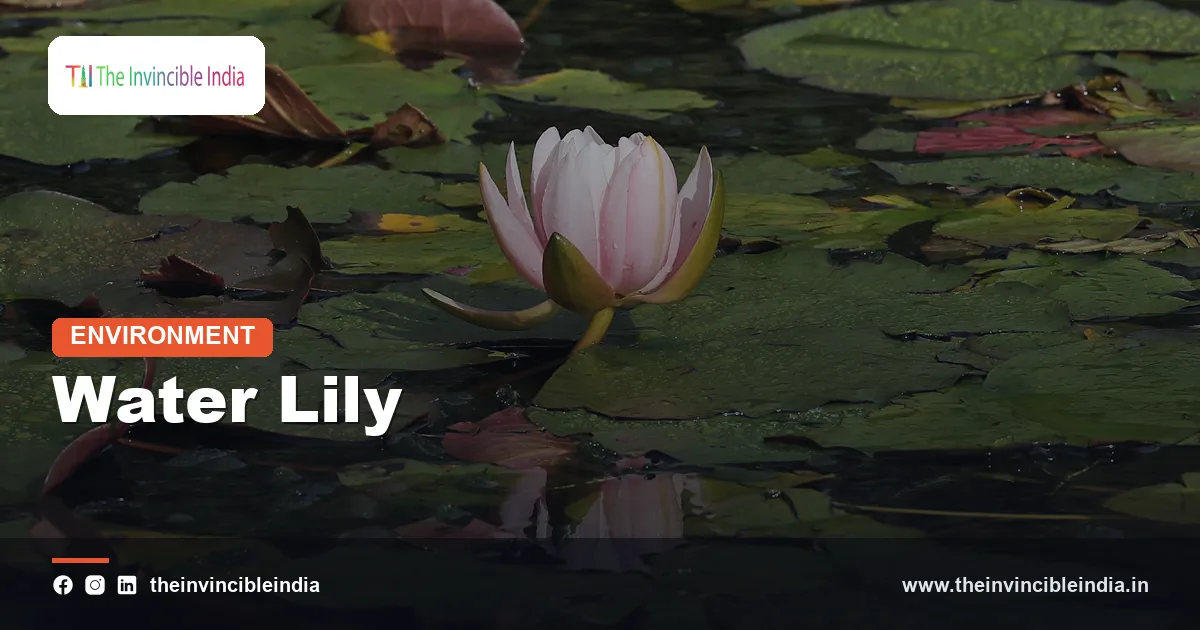
A water lily is a rooted aquatic plant of the genus Nymphaea, with round floating leaves and showy cup-shaped flowers that rest on or just above the water, found in ponds, tanks, lakes and slow streams across India. The water lily is a different plant from the lotus, which belongs to a separate family, and the two are often confused because both grow in still water and both are sacred or admired in Indian culture.
India has several native water lily species, the best known of which is the blue star water lily (Nymphaea nouchali), along with white and red night-flowering kinds. Water lilies shade the surface of ponds, shelter fish and insects, and are widely planted in ornamental pools and temple tanks.
| Attribute | Details |
|---|---|
| Common names | Water lily, Nymphaea; blue star water lily or blue lotus (N. nouchali); kumud, kumudini, ambal and nilotpal in various Indian languages |
| Scientific name | Nymphaea (genus); native Indian species include Nymphaea nouchali, Nymphaea pubescens and Nymphaea rubra |
| Family | Nymphaeaceae (water lily family), in the order Nymphaeales |
| Origin | Genus found on every continent except Antarctica; several species are native to tropical and subtropical Asia, including India |
| Where grown in India | Ponds, village tanks, lakes, wetlands and slow channels across the plains, Kerala backwaters and parts of the hills, plus ornamental pools and gardens |
| Flowering season | Mainly during the warm and rainy months, with some species flowering through much of the year in the tropics |
| Uses | Ornamental water gardens, edible rhizomes and seeds in some regions, traditional medicine, wildlife habitat |
| Notable facts | Nymphaea nouchali is the national flower of Bangladesh and, in its blue form, of Sri Lanka; water lilies belong to one of the oldest lineages of flowering plants |
Key Takeaways
- A water lily is an aquatic plant of the genus Nymphaea in the family Nymphaeaceae, with leaves that float on the surface and flowers that sit at or slightly above the water.
- The water lily is not the lotus: the lotus (Nelumbo nucifera) belongs to a different family, Nelumbonaceae, and its large leaves and flowers stand well above the water.
- India’s native water lilies include the blue star water lily (Nymphaea nouchali), which opens by day, and the night-flowering species Nymphaea pubescens and Nymphaea rubra.
- A water lily leaf has a distinct slit or notch running from its edge to the stalk, and its stalk attaches at that notch on the edge of the blade, whereas a lotus stalk attaches near the centre of the leaf.
- Water lilies belong to the order Nymphaeales, one of the earliest branches in the evolution of flowering plants.
- Nymphaea nouchali is the national flower of Bangladesh and, in its blue form, of Sri Lanka.
What is a water lily?
A water lily is a perennial aquatic herb of the genus Nymphaea that roots in the mud at the bottom of a pond or lake and sends long flexible stalks up to the surface. The round, flat leaves, called pads, float on the water, and the flowers either float or rise a short distance above the surface on their own stalks.
The genus Nymphaea has roughly fifty species spread across temperate and tropical regions of the world. The name comes from the Greek word nymphe, meaning nymph, because the plants were associated with water spirits in ancient Greek tradition. In English, the term water lily is used for the entire family and also for the genus.
The plant is anchored by a rhizome or a tuber-like root system in the soft mud. Long petioles carry the leaves and flowers up through the water, and the stalks are filled with air spaces that let oxygen flow down to the roots in oxygen-poor mud. This anatomy is typical of rooted floating-leaved aquatic plants.
A water lily flower has numerous petals arranged in a spiral, many stamens and a central cup-like stigma. The flowers open for only a few days, and a single plant may produce a succession of blooms through the season.
Which water lilies are native to India?
The main native water lilies of India are the blue star water lily (Nymphaea nouchali), the hairy water lily (Nymphaea pubescens) and the red water lily (Nymphaea rubra), all found in ponds and slow-moving water across the country. A few other species and many hybrids are grown in gardens.
| Species | Flower colour | Opening time | Habitat in India |
|---|---|---|---|
| Nymphaea nouchali (blue star water lily) | Blue to violet or sometimes white, star-shaped | Day-flowering | Ponds, tanks and shallow lakes across much of India |
| Nymphaea pubescens (hairy water lily) | White, sometimes pinkish, with hairy leaf undersides | Night-flowering | Ponds and wetlands, especially in the plains |
| Nymphaea rubra (red water lily) | Deep red to purplish red | Night-flowering | Ponds and tanks in the warmer parts of the country |
Different Indian languages use different names. Kumud and kumudini are widely used for night-flowering white forms, while blue water lilies are linked to the word utpala or nilotpal in Sanskrit literature. In Kerala, a water lily is often called ambal. Local naming is not always consistent, so one name may refer to more than one species depending on the region.
Botanists sometimes treat Nymphaea stellata as the same species as N. nouchali, and several botanical names have been used in older books. This is why a photograph of the blue star lily may be labelled with different scientific names in different sources.
How is a water lily different from a lotus?
A water lily differs from a lotus because the two plants belong to different families, with the water lily in Nymphaeaceae and the lotus in Nelumbonaceae, and because their leaves, flowers and seed structures look different. The confusion arises because Indian and English names for the two overlap.
| Feature | Water lily (Nymphaea) | Lotus (Nelumbo nucifera) |
|---|---|---|
| Family | Nymphaeaceae | Nelumbonaceae |
| Leaves | Float flat on the water, with a V-shaped slit to the stalk | Often held well above water on tall stalks, round and without a slit, with a water-repellent surface |
| Flowers | Float on or rise slightly above the water; often star-shaped and in many colours including blue | Stand tall above water; large, in white, pink or rarely other shades; no true blue |
| Fruit and seed | Fleshy fruit that ripens underwater | Flat-topped seed pod, like a shower head, with hard round seeds |
| Sacred or cultural role in India | Admired in poetry and gardens | National flower of India |
The lotus (Nelumbo nucifera) is India’s national flower and has a prominent place in Hindu and Buddhist art and thought. The water lily is not the national flower of India, although it appears in classical Indian poetry, in temple tank gardens and in folk traditions around ponds. When English texts speak of the blue lotus, they usually mean the blue water lily and not a true lotus.
What does a water lily look like and how does it grow?
A water lily has round floating leaves, usually 10 to 30 centimetres wide in native Indian species, with a slit from the edge to the point where the stalk attaches. The upper side of the leaf is smooth and waxy and sheds water, while the underside is often purple or reddish.
Flowers sit on long stalks that raise them slightly above the water. A bloom has four green sepals and many coloured petals that open widely in the day or at night depending on species. The petals are arranged in a spiral, and the central part of the flower contains numerous stamens that surround the stigma.
The rhythm of opening and closing
Each water lily flower follows a regular daily rhythm. Day-flowering kinds such as the blue star lily open in the morning and close by afternoon or evening, while night-flowering kinds open after dusk and close in the morning. A single flower generally lasts three or four days before it sinks beneath the surface to ripen its fruit.
Pollination and seed formation
Bees, flies and beetles are the main pollinators of water lilies, drawn by pollen and scent. After pollination the flower stalk coils and draws the developing fruit under the water, where seeds mature inside a spongy fruit. When the fruit ripens it releases seeds that float for a while before settling to the bottom.
Water lilies also spread by rhizome growth, which allows a single plant to cover a section of pond over a few seasons. Some tropical species produce small plantlets on the leaf surface at the flower or leaf junction.
Where and when do water lilies grow in India?
Water lilies grow in still or slow-moving fresh water across India, in ponds, village tanks, lakes, wetlands, marshes and quiet river backwaters, usually in water between 30 centimetres and one metre deep. They need sun and calm water, and they do poorly in fast currents.
Flowering is most active in the warm and rainy months. In much of India, water lilies bloom from the monsoon through the post-monsoon period, although some species flower over a longer span in warm southern regions. In cold hill regions, water lilies can be dormant or die back in winter.
Water lilies are common in village ponds in Bengal, Odisha, Assam, Bihar and the southern states, and in the freshwater backwaters of Kerala. In many places, the ponds themselves are traditional water sources, and the plants form a visible part of village landscapes.
Heavy nutrient runoff can make water lilies grow thickly and shade the water too much, while very polluted or drying ponds lose them altogether. For this reason, the presence of healthy water lilies is sometimes taken as a sign of a calm and fairly clean freshwater pond.
What role do water lilies play in the pond ecosystem?
Water lilies shade the water, shelter animals and provide food and perches, so they play a central role in the ecology of a pond. Their floating leaves reduce light reaching the water below, which limits algae growth and keeps the water cooler.
- Shade and shelter: Leaves give fish, tadpoles and aquatic insects a place to hide from predators and from the sun.
- Perching and nesting: Birds such as jacanas walk across the floating leaves on long toes, feeding on insects, and dragonflies and damselflies rest on the pads.
- Egg laying: Many insects and snails lay eggs on the underside of leaves, and frogs use the cover in breeding season.
- Nutrient uptake: Water lilies take in nutrients from the mud and the water, which can reduce excess nutrients available to algae.
- Food: Fish, ducks and some mammals eat parts of the plant, and seeds are consumed by waterbirds.
Too much cover can cause problems. A pond completely carpeted with leaves may have low oxygen below the surface, which harms fish. Keeping roughly half of the open water visible is a common rule of thumb in ornamental ponds.
How do you grow a water lily?
A water lily is grown by planting its rhizome or tuber in a container of heavy garden loam, sinking the container in a sunny pond or tub so that the leaves can reach the surface. The plant needs at least five or six hours of direct sun daily and still water.
Planting depth and site
Most tropical water lilies grow well in water between 30 and 60 centimetres deep above the crown. Small varieties suit tubs and shallow bowls, while large vigorous varieties need a bigger pond. After planting, the water level is raised gradually as the leaves grow.
Soil and feeding
Heavy clay loam without much fresh organic matter works best, because fresh manure rots in water and fouls it. Slow-release fertiliser tablets or pellets pushed into the soil near the roots give steady feeding. Flowering drops quickly if the plant is starved or shaded.
Propagation and care
Water lilies are propagated by dividing rhizomes, by separating small tubers or plantlets, and by seed. Division is done in the warm season once the plant is actively growing. Yellowing and old leaves should be trimmed regularly to keep the pond clean and to give new leaves room.
Stocking a garden pool with small fish such as gambusia or native larvivorous fish helps limit mosquito larvae, which are a concern in standing water. Water in tubs should be changed or topped up regularly, and the tub should be cleaned during the plant’s growing season.
What are water lilies used for?
Water lilies are used mainly as ornamental plants in garden ponds, temple tanks and water features, and in some regions their rhizomes, seeds and leaf stalks are eaten or used in traditional medicine. They are among the most popular aquatic plants in the nursery trade.
- Ornamental use: Hybrids in white, pink, yellow, blue, purple and red are sold for garden ponds, tubs and landscape pools.
- Food: In some parts of South and Southeast Asia, the seeds, rhizomes and leaf stalks of certain Nymphaea species are cooked or roasted, although the practice is local and not widespread in India.
- Traditional medicine: Water lily flowers and roots feature in some traditional systems, including Ayurveda, which names several plants of this group. Anyone considering such use should seek qualified advice.
- Cultural and literary use: Poets in Sanskrit, Bengali and other literatures describe the water lily as a flower that opens to the moon, a theme linked to night-flowering species.
- Ecological use: Water lilies are planted in constructed ponds and wildlife gardens for the shelter and shade they give.
The water lily family also includes plants of economic interest. The prickly water lily (Euryale ferox), grown in Bihar and eastern India, yields seeds that are popped to make makhana, and the giant Amazon water lily (Victoria amazonica) is a famous exhibit in botanical gardens.
Bottom Line
The water lily is a floating-leaved aquatic plant of the genus Nymphaea that is native to Indian ponds and tanks, and it is distinct from the lotus in family, leaf shape and flower habit. Its blue star species and night-flowering relatives enrich both wild wetlands and cultivated water gardens.
Frequently Asked Questions
What is a water lily?
A water lily is a rooted aquatic plant of the genus Nymphaea with floating round leaves and showy flowers that sit on or slightly above the water. It grows in ponds, tanks and slow streams across India. The plant belongs to the family Nymphaeaceae.
What is the difference between a water lily and a lotus?
The difference is that a water lily belongs to the family Nymphaeaceae and a lotus to Nelumbonaceae. Water lily leaves float and have a slit, while lotus leaves usually rise above the water and have no slit. The lotus is also the national flower of India, and the water lily is not.
Which water lily is native to India?
The blue star water lily (Nymphaea nouchali) is the best-known water lily native to India. The hairy water lily (Nymphaea pubescens) and the red water lily (Nymphaea rubra) are also native, and they flower at night. All three grow in ponds and tanks across the country.
Do water lilies open at night?
Some water lilies open at night and some open during the day. Night-flowering species such as Nymphaea pubescens and Nymphaea rubra open after dusk and close in the morning. The blue star water lily (Nymphaea nouchali) opens in the morning and closes later in the day.
How deep should water be for a water lily?
Water about 30 to 60 centimetres deep above the plant’s crown suits most tropical water lilies. Small varieties can grow in shallower tubs, and vigorous large ones need deeper ponds. The leaves need to reach the surface, so the water level is raised gradually as the plant grows.
Is the water lily the national flower of any country?
Yes, Nymphaea nouchali is the national flower of Bangladesh, where it is called shapla, and its blue form is the national flower of Sri Lanka. India’s national flower is the lotus, not the water lily. This is a common point of confusion between the two plants.
{“@context”:”https://schema.org”,”@graph”:[{“@type”:”FAQPage”,”mainEntity”:[{“@type”:”Question”,”name”:”What is a water lily?”,”acceptedAnswer”:{“@type”:”Answer”,”text”:”A water lily is a rooted aquatic plant of the genus Nymphaea with floating round leaves and showy flowers that sit on or slightly above the water. It grows in ponds, tanks and slow streams across India. The plant belongs to the family Nymphaeaceae.”}},{“@type”:”Question”,”name”:”What is the difference between a water lily and a lotus?”,”acceptedAnswer”:{“@type”:”Answer”,”text”:”The difference is that a water lily belongs to the family Nymphaeaceae and a lotus to Nelumbonaceae. Water lily leaves float and have a slit, while lotus leaves usually rise above the water and have no slit. The lotus is also the national flower of India, and the water lily is not.”}},{“@type”:”Question”,”name”:”Which water lily is native to India?”,”acceptedAnswer”:{“@type”:”Answer”,”text”:”The blue star water lily (Nymphaea nouchali) is the best-known water lily native to India. The hairy water lily (Nymphaea pubescens) and the red water lily (Nymphaea rubra) are also native, and they flower at night. All three grow in ponds and tanks across the country.”}},{“@type”:”Question”,”name”:”Do water lilies open at night?”,”acceptedAnswer”:{“@type”:”Answer”,”text”:”Some water lilies open at night and some open during the day. Night-flowering species such as Nymphaea pubescens and Nymphaea rubra open after dusk and close in the morning. The blue star water lily (Nymphaea nouchali) opens in the morning and closes later in the day.”}},{“@type”:”Question”,”name”:”How deep should water be for a water lily?”,”acceptedAnswer”:{“@type”:”Answer”,”text”:”Water about 30 to 60 centimetres deep above the plant’s crown suits most tropical water lilies. Small varieties can grow in shallower tubs, and vigorous large ones need deeper ponds. The leaves need to reach the surface, so the water level is raised gradually as the plant grows.”}},{“@type”:”Question”,”name”:”Is the water lily the national flower of any country?”,”acceptedAnswer”:{“@type”:”Answer”,”text”:”Yes, Nymphaea nouchali is the national flower of Bangladesh, where it is called shapla, and its blue form is the national flower of Sri Lanka. India’s national flower is the lotus, not the water lily. This is a common point of confusion between the two plants.”}}]}]}


