

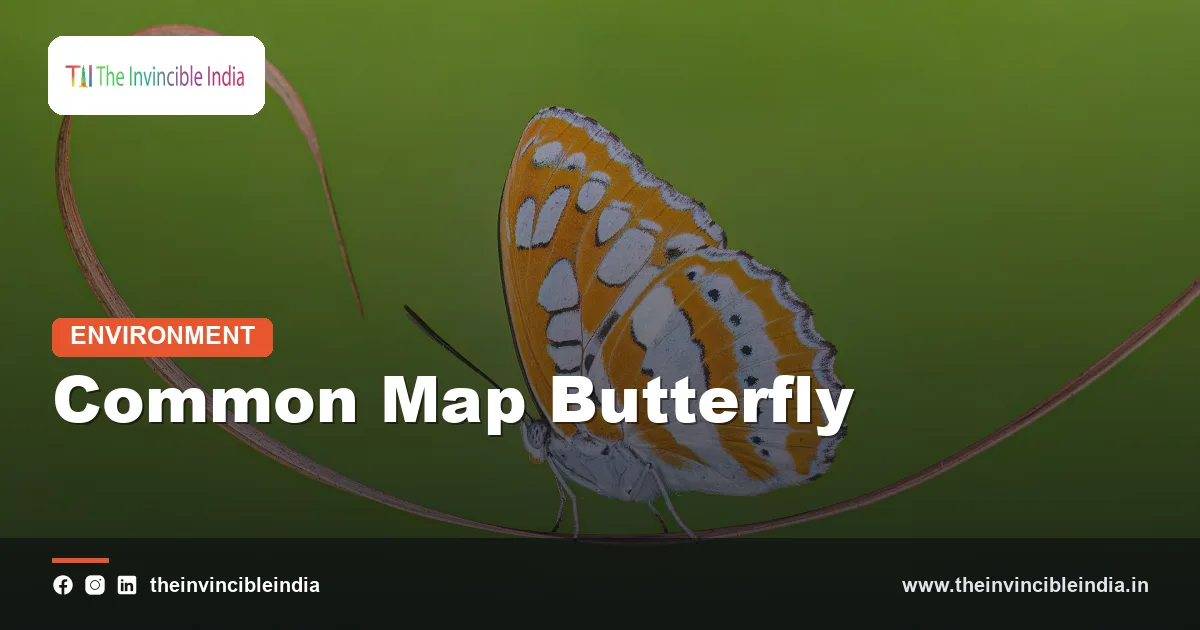
The common map (Cyrestis thyodamas) is a small to medium, creamy-white forest butterfly of the family Nymphalidae whose wings are covered with fine dark lines that look like the contours on a map. In India the common map butterfly is widely distributed in the foothills and hills of the Himalaya, the north-east, the Western Ghats and other peninsular forests, and it is best known for its habit of resting with its wings spread flat and for its wet-season and dry-season forms.
This guide explains how the common map looks, where it lives, what its caterpillars eat, why the butterfly changes appearance with the seasons and how to tell it from related map butterflies. It is written as a clear reference for students, trail walkers and amateur naturalists.
Quick Facts: Common Map Butterfly
| Attribute | Detail |
|---|---|
| Common name | Common map |
| Scientific name | Cyrestis thyodamas |
| Family | Nymphalidae (brush-footed butterflies), subfamily Cyrestinae |
| Wingspan | Roughly 50 to 65 millimetres |
| Host plants | Fig trees and related plants of the genus Ficus (family Moraceae) |
| Range and habitat in India | Forest, stream banks and forest edges in the Himalayan foothills, north-east India, the Western Ghats and other peninsular hills |
| Flight season and broods | Several broods in a year; two seasonal forms, a wet-season form and a dry-season form |
| Notable feature | Fine map-like lines on the wings, a short tail on each hindwing and a habit of resting with wings spread flat |
Key Takeaways
- The common map (Cyrestis thyodamas) is a nymphalid butterfly whose wings carry a network of fine dark lines resembling the contour lines of a map.
- Caterpillars of the common map butterfly feed on fig trees of the genus Ficus, which is one of the most important plant groups in Indian forests.
- The common map has distinct wet-season and dry-season forms, which differ in the tone of the ground colour and in the strength of the markings.
- In India the common map butterfly occurs in the Himalayan foothills, the north-east, the Western Ghats and several peninsular hill forests.
- The common map often rests with its wings spread flat on leaves, rocks or damp ground, unlike most butterflies that close their wings when they land.
- Males of the common map regularly gather at damp sand and stream margins to take up minerals, a behaviour called mud-puddling.
What is the common map butterfly?
The common map butterfly is a forest nymphalid, scientifically named Cyrestis thyodamas, belonging to the genus Cyrestis, whose members are known as the “map butterflies”. The group gets its name from the intricate line patterns on the wings, which resemble roads, rivers and boundaries on an old chart.
The species has a wide range across southern and eastern Asia, from the Indian subcontinent through South-East Asia to southern China, and several subspecies are recognised. Within India it is one of the most frequently recorded map butterflies, which is why it carries the word “common” in its name.
Like all members of its family, the common map has reduced front legs, so it appears to walk on four. The subfamily Cyrestinae, to which it belongs, also includes the maplets and related genera, and these butterflies are known for their flat-winged resting posture.
How does the common map butterfly look?
The common map butterfly has creamy-white to pale yellowish wings that are marked with fine, wavy brown or black lines, and each hindwing has a short, pointed tail. The wing pattern forms a delicate network that appears as a map when the butterfly sits with its wings fully open.
Key identification features include:
- Ground colour: white to cream, with a faintly translucent look in fresh specimens.
- Line pattern: numerous narrow bands and loops in brown and black, running across both wings and giving the map-like effect.
- Hindwing: a small tail and an edging of orange, yellow or reddish marks near the tail and margin.
- Shape: a slightly angular forewing and a rounded hindwing.
- Underside: a similar line pattern, with a slightly different tone that helps in recognising worn individuals.
The sexes are similar in pattern, although females are generally a little larger with a rounder wing shape. The exact tone of the colour varies with locality, with the season and with the age of the individual.
Why does the common map butterfly have wet-season and dry-season forms?
The common map butterfly has wet-season and dry-season forms because the temperature and humidity experienced by the developing caterpillar and pupa influence the pattern and colour of the adult wings. This phenomenon is called seasonal polyphenism, and it is common among tropical butterflies.
The two forms are the same species and they interbreed, but they can look noticeably different:
- Wet-season form: usually cleaner and paler, with a sharper, more contrasted line pattern, matching the green and humid conditions of the monsoon.
- Dry-season form: usually somewhat duller or warmer in tone, with weaker markings, which suits the dry leaf litter and sparse foliage of the dry months.
Scientists think the difference helps the butterfly to match its background better and to withstand the changing climate. The change is not a choice made by the individual butterfly. It is set during development, in response to environmental cues such as day length and temperature, and each generation takes on the form suited to the season in which it emerges.
Where does the common map butterfly live in India?
The common map butterfly lives in moist forest and forest margins across the Himalayan foothills, north-east India, the Western Ghats and several other peninsular hill ranges. It is a butterfly of hilly, wooded country with streams, rather than of open plains.
It is most easily found in these situations:
- shaded streamsides and damp ravines in evergreen and moist deciduous forest;
- forest roads and trails that pass near fig trees;
- hill-station woodlands and plantation edges that retain native trees;
- damp, sandy banks along small rivers, where males come to drink.
The butterfly generally follows its host plants, and since figs are widespread in the country’s forests, the common map is also widely spread. It becomes scarce in dry, treeless regions and in heavily built-up landscapes where large fig trees have been removed.
What do common map caterpillars eat?
Common map caterpillars eat the leaves of fig trees and related plants of the genus Ficus, in the mulberry family, Moraceae. Several fig species growing in Indian forests and along roads are reported as hosts, including both wild forest figs and large shade trees.
The female lays eggs singly on a young leaf of a fig tree. The caterpillar, which hatches within a few days, feeds on the leaf and often rests on a pad of silk on the leaf surface, where its body colour and shape help it avoid detection. As it grows, it moults several times before pupating.
Fig trees are valuable keystone species in tropical forests, since their fruit feeds many birds and mammals through the year. The common map is therefore a small part of a very rich web of life that depends on figs, from fig wasps and fruit-eating birds to the butterflies that use the foliage.
What is the life cycle of the common map butterfly?
The common map butterfly passes through complete metamorphosis, with four stages: egg, caterpillar, pupa and adult. In warm humid weather the cycle takes roughly a month or two, allowing several broods in a year.
| Stage | What happens | Approximate appearance |
|---|---|---|
| Egg | Laid singly on a fig leaf | Small, rounded and pale |
| Caterpillar (larva) | Feeds on fig leaves and moults several times | Well camouflaged, often resting on silk on the leaf |
| Pupa (chrysalis) | Hangs from the host plant or a nearby twig | Angular and brownish or greenish, resembling a leaf or bud |
| Adult | Feeds on moisture and minerals, mates and lays eggs | White or cream with fine map-like lines and a short hindwing tail |
The form of the adult depends on the season in which it develops, which is why individuals from monsoon and dry-season broods can look quite different. Adults live for a few weeks, and the next generation emerges once new leaf growth is available.
How does the common map butterfly behave?
The common map butterfly flies in a quick, gliding manner and frequently lands with its wings spread flat on leaves, rocks, tree trunks or damp ground. This posture shows the map pattern clearly and sets the species apart from many butterflies, which usually fold their wings above the back when they settle.
Observers commonly note the following behaviour:
- Males hold territories along forest trails or streams, perching on a leaf and darting out to investigate passing insects.
- Individuals often return to the same perch after a short flight.
- Flight is fast, with short bursts of flapping followed by glides, and it usually stays near the ground or at moderate height.
- In cool or cloudy weather, the butterfly basks to warm itself, spreading the wings to catch sunlight.
Because the butterfly rests in the open with its wings spread, it is a popular subject for photographers. A slow and quiet approach usually allows a good view, though a sudden movement will send it off in a quick flight.
What do adult common map butterflies feed on?
Adult common map butterflies feed mainly on moisture and minerals from damp sand, mud and animal droppings, as well as on rotting fruit and tree sap, and they visit flowers only occasionally. These foods give the butterflies the salts and amino acids they cannot get from nectar alone.
Males are the most frequent visitors to wet patches along streams. They may stay for long periods, probing the ground with their proboscis, and they sometimes sit in loose groups with other mud-puddling species such as sailors, crows and swallowtails. Fruit that has fallen from fig trees is another important source of sugars.
How is the common map different from other map butterflies?
The common map differs from other map butterflies mainly in its overall pale colour, the density of its fine lines and the shape of its hindwing tail. Several related species fly in Indian forests, especially in the north-east, and their patterns can look similar at first glance.
| Butterfly | Main impression | Distinguishing sign |
|---|---|---|
| Common map (Cyrestis thyodamas) | White to cream with fine brown lines | Short hindwing tail and a widespread distribution |
| Marbled map (Cyrestis cocles) | Bolder, marbled markings | Heavier, more irregular pattern; mostly in the north-east and the Himalayan region |
| Straight-line map (Cyrestis nivea) | Very pale with straighter lines | Cleaner, more regular line pattern |
| Common maplet (Chersonesia risa) | Smaller, brownish and tailless | Lacks the long tail and has a different genus |
For reliable identification, observers should note the tail, the colour of the ground, the thickness of the lines and the locality. A clear photograph of the open wings, taken from above, is usually enough to separate the common map from its relatives.
Why does the common map butterfly matter?
The common map butterfly matters because it is a good indicator of healthy streamside forest and because it is closely tied to fig trees, which are keystone species of tropical ecosystems. The presence of the butterfly suggests that mature figs, clean streams and shaded habitat are still available.
- Food web link: every stage is food for birds, lizards, spiders and insects.
- Link to fig ecology: the butterfly depends on figs, which support hundreds of other species.
- Indicator value: changes in numbers can reveal changes in humidity, canopy cover and water quality.
- Study of adaptation: the seasonal forms are a classic example of how climate shapes appearance.
Threats include the felling of large fig trees, the drying and pollution of forest streams and unregulated collection. Photography, the retention of native trees and the protection of stream margins all help to keep the species common.
Bottom Line
The common map is a delicate, map-patterned forest butterfly whose life revolves around fig trees and shaded streams. It appears in two seasonal forms, rests with its wings flat, and occurs across much of the Himalayan foothills, the north-east and the southern hills of India. Protecting fig trees and stream margins is the best way to keep it common.
Frequently Asked Questions
What is the common map butterfly?
The common map butterfly, Cyrestis thyodamas, is a small to medium forest butterfly with white or cream wings covered in fine map-like lines. It belongs to the family Nymphalidae. It is found in the hills and forests of India and much of Asia.
Why is it called the common map?
It is called the common map because the lines on its wings look like the contours, roads and rivers of a map. The word common reflects the fact that it is the most frequently seen of the Indian map butterflies. The pattern is clearest when the butterfly rests with open wings.
What do common map caterpillars eat?
Common map caterpillars eat the leaves of fig trees of the genus Ficus. The female lays her eggs singly on young fig leaves. The caterpillars are camouflaged and often rest on a small pad of silk.
Why does the common map change appearance with the seasons?
The common map changes with the seasons because temperature and humidity during development affect the pattern and colour of the adult. This is called seasonal polyphenism. The wet-season form is usually paler and sharper, while the dry-season form is generally duller.
Where can the common map butterfly be seen in India?
The common map butterfly can be seen in the Himalayan foothills, north-east India, the Western Ghats and several other peninsular hill forests. It prefers shaded streamsides, forest trails and damp banks near fig trees. It is rarely found in dry plains.
Why does the common map rest with its wings open?
The common map rests with its wings open to bask in warmth and to rely on the broken pattern of its wings for camouflage against leaves and stones. This flat-winged posture is typical of the map butterflies and their relatives. It also makes the species easy to photograph.
{“@context”:”https://schema.org”,”@graph”:[{“@type”:”FAQPage”,”mainEntity”:[{“@type”:”Question”,”name”:”What is the common map butterfly?”,”acceptedAnswer”:{“@type”:”Answer”,”text”:”The common map butterfly, Cyrestis thyodamas, is a small to medium forest butterfly with white or cream wings covered in fine map-like lines. It belongs to the family Nymphalidae. It is found in the hills and forests of India and much of Asia.”}},{“@type”:”Question”,”name”:”Why is it called the common map?”,”acceptedAnswer”:{“@type”:”Answer”,”text”:”It is called the common map because the lines on its wings look like the contours, roads and rivers of a map. The word common reflects the fact that it is the most frequently seen of the Indian map butterflies. The pattern is clearest when the butterfly rests with open wings.”}},{“@type”:”Question”,”name”:”What do common map caterpillars eat?”,”acceptedAnswer”:{“@type”:”Answer”,”text”:”Common map caterpillars eat the leaves of fig trees of the genus Ficus. The female lays her eggs singly on young fig leaves. The caterpillars are camouflaged and often rest on a small pad of silk.”}},{“@type”:”Question”,”name”:”Why does the common map change appearance with the seasons?”,”acceptedAnswer”:{“@type”:”Answer”,”text”:”The common map changes with the seasons because temperature and humidity during development affect the pattern and colour of the adult. This is called seasonal polyphenism. The wet-season form is usually paler and sharper, while the dry-season form is generally duller.”}},{“@type”:”Question”,”name”:”Where can the common map butterfly be seen in India?”,”acceptedAnswer”:{“@type”:”Answer”,”text”:”The common map butterfly can be seen in the Himalayan foothills, north-east India, the Western Ghats and several other peninsular hill forests. It prefers shaded streamsides, forest trails and damp banks near fig trees. It is rarely found in dry plains.”}},{“@type”:”Question”,”name”:”Why does the common map rest with its wings open?”,”acceptedAnswer”:{“@type”:”Answer”,”text”:”The common map rests with its wings open to bask in warmth and to rely on the broken pattern of its wings for camouflage against leaves and stones. This flat-winged posture is typical of the map butterflies and their relatives. It also makes the species easy to photograph.”}}]}]}


