

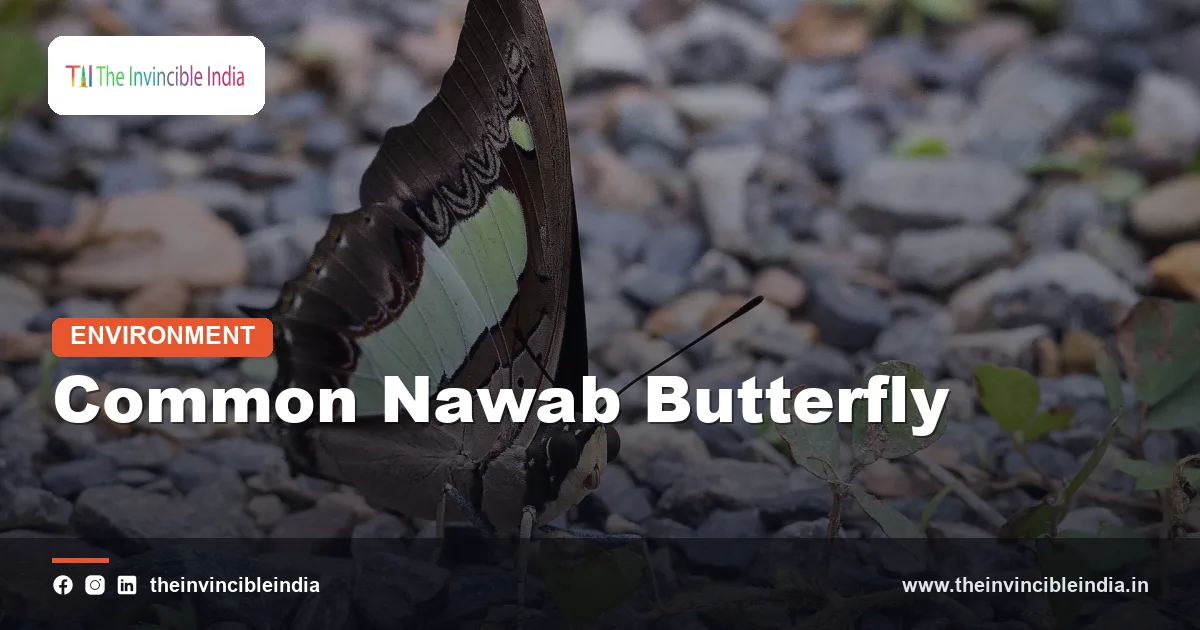
The common nawab (Polyura athamas) is a powerful, fast-flying forest butterfly of the family Nymphalidae, recognised by the broad pale band across its dark wings, the two slender tails on each hindwing and its horned green caterpillar. In India the common nawab butterfly is widespread in deciduous and moist forest from the Himalayan foothills and north-east to the peninsular hills, and it is one of the strongest and most striking fliers among Indian butterflies.
This guide explains what the common nawab looks like, where it lives, what its caterpillars eat, how it behaves and how it differs from similar species such as the rajahs. It is written as a plain reference for students, nature walkers and amateur butterfly watchers.
Quick Facts: Common Nawab Butterfly
| Attribute | Detail |
|---|---|
| Common name | Common nawab |
| Scientific name | Polyura athamas |
| Family | Nymphalidae (brush-footed butterflies), subfamily Charaxinae |
| Wingspan | Roughly 60 to 75 millimetres |
| Host plants | Leguminous trees and shrubs (family Fabaceae), such as Albizia, Acacia and Pithecellobium |
| Range and habitat in India | Deciduous and moist forest, scrub and forest edges across the Himalayan foothills, north-east India and the peninsular hills including the Western Ghats |
| Flight season and broods | Several broods in a year, with the greatest numbers during and after the monsoon |
| Notable feature | Dark wings with a broad pale band, two tails on each hindwing, very fast flight and a horned caterpillar |
Key Takeaways
- The common nawab (Polyura athamas) is a robust brush-footed butterfly with dark wings crossed by a broad pale green-white band.
- Each hindwing of the common nawab carries two slender tails, a feature that distinguishes the nawabs from most other Indian butterflies.
- Caterpillars of the common nawab feed on leguminous trees and shrubs such as Albizia, Acacia and Pithecellobium.
- The caterpillar of the common nawab is green and carries horn-like projections on its head, which gives the species its “horned” reputation.
- Adult common nawabs rarely visit flowers, and instead feed on rotting fruit, tree sap, animal droppings and mineral-rich mud.
- The common nawab is found across a large part of India and is among the most widespread members of the Charaxinae in the country.
What is the common nawab butterfly?
The common nawab butterfly is a large, strong-flying nymphalid, scientifically named Polyura athamas, belonging to the subfamily Charaxinae, which includes the nawabs and the rajahs. The genus name Polyura refers to the tails of the hindwing, and the English name “nawab” suggests a noble, imposing insect.
The species ranges widely across southern and south-eastern Asia, from the Indian subcontinent and Sri Lanka through the Himalayan region to South-East Asia and southern China. In India it is one of the more commonly recorded Charaxinae, which is the origin of its name.
The Charaxinae are noted for their stout bodies, powerful flight muscles and fast flight. They are among the most robust butterflies in the world, and their strong build allows them to fly at speed through the forest canopy and to defend perches against rivals.
How does the common nawab butterfly look?
The common nawab butterfly has a stout body and dark brown to black wings crossed by a broad, pale green-white band, with two slender tails on each hindwing. The upper surface is bold and contrasted, and the combination of the wide band and the double tails makes the butterfly easy to recognise.
The main identification features are:
- Upper side: a black or dark brown ground, a wide pale band of greenish-white to bluish-white across both wings and dark borders.
- Tails: two tails on each hindwing, the lower one noticeably longer than the upper.
- Hindwing border: small bluish or pale marks along the margin near the tails.
- Underside: a pale base with finely drawn brown and ochre lines, spots and bands, which provide camouflage against bark and leaf litter.
- Body: thick and muscular, with strong thoracic muscles that power the rapid flight.
Males and females are broadly similar, but females are normally larger and a little paler, with broader wings. The size and the width of the band vary with locality and with the form of the butterfly, so a number of regional variations exist.
Where does the common nawab butterfly live in India?
The common nawab butterfly lives in deciduous and moist forest, scrub and wooded country across much of India, from the Himalayan foothills and the north-east to the Western Ghats, the Eastern Ghats and other peninsular hills. It is more adaptable than many forest butterflies and is also found in dry deciduous woodland.
It is regularly recorded in the following habitats:
- moist deciduous and semi-evergreen forest, especially near streams;
- dry deciduous woodland and scrub where leguminous trees are common;
- forest edges, roadsides and clearings with Albizia and Acacia;
- hilltops and ridges, where males often gather to defend perches.
Its distribution follows the distribution of its leguminous hosts. It is generally absent from very high mountains and from treeless desert tracts, and it is less common in intensively cultivated plains with few trees.
What do common nawab caterpillars eat?
Common nawab caterpillars eat the leaves of leguminous trees and shrubs in the pea family, Fabaceae, with Albizia, Acacia and Pithecellobium among the commonly reported hosts. These plants are widespread in Indian forests, scrub and roadsides, which helps explain the butterfly’s wide range.
The female lays round, pale eggs singly on the leaves of the host. The caterpillar that hatches is green and slug-like, with a smooth, tapering body and a head bearing four horn-like projections. It often rests on a pad of silk on the upper side of a leaf, where its green colour makes it hard to see against the foliage.
The horned head is the most distinctive feature of the larva. The horns do not sting or inject anything, and they are thought to help the caterpillar break up its outline and look larger to predators. The same body plan is seen in other members of the subfamily, which share the same slug-like green caterpillar with a horned head.
What is the life cycle of the common nawab butterfly?
The common nawab butterfly passes through complete metamorphosis in four stages: egg, caterpillar, pupa and adult. In warm weather the whole cycle takes about one to two months, so several broods can appear in a year.
| Stage | What happens | Approximate appearance |
|---|---|---|
| Egg | Laid singly on a leaf of a leguminous host | Round, pale and smooth |
| Caterpillar (larva) | Feeds on leaves and moults several times | Green, slug-like, with four horn-like projections on the head |
| Pupa (chrysalis) | Hangs from a silk pad on a twig or leaf | Short, plump and green, blending with foliage |
| Adult | Feeds on fruit, sap and minerals, mates and lays eggs | Dark wings with a pale band and two hindwing tails |
The green pupa hangs by a small hook-like organ called the cremaster, attached to a silk pad, and the adult emerges after one to two weeks. Adults can live for several weeks in good conditions. Broods overlap, so butterflies of different ages are often seen together.
How does the common nawab butterfly fly and behave?
The common nawab butterfly flies extremely fast, with strong wingbeats and swift gliding, and it often moves in sudden darts between perches. Its flight is much more powerful than that of most other forest butterflies, and it is hard to follow with the eye.
Typical behaviour includes the following:
- Males choose a perch, often a leaf or branch on a hilltop, ridge or forest edge, and defend it from other males.
- A disturbed butterfly shoots away at speed, circles, and then frequently returns to the same perch.
- At rest, the butterfly may close its wings and sit motionless on a trunk or leaf, relying on the camouflage of the underside.
- Activity is highest in warm daylight hours, and the species is wary of sudden movement.
The common nawab is less approachable than a typical mud-puddling butterfly, though it can become oblivious to people when it is feeding. Observers who stay still near a feeding site often have the best chance of a close view.
What do adult common nawab butterflies feed on?
Adult common nawab butterflies feed mainly on rotting fruit, oozing tree sap, animal droppings and damp mineral-rich soil rather than on flower nectar. These foods supply sugars, salts and amino acids that fuel the insect’s powerful flight.
Like many members of the Charaxinae, the nawab is strongly drawn to fermenting substances. Overripe fruit such as banana or jackfruit, sap runs on trees and even carrion or dung can attract it. Naturalists use this habit to observe the butterflies, by placing fermenting fruit in a shaded spot at a forest edge. Males also gather on damp ground to absorb minerals.
How can the common nawab be told apart from similar butterflies?
The common nawab is told apart from similar butterflies mainly by its double hindwing tails, the broad pale band and its overall size. Other Charaxinae, particularly the rajahs, share the stout build, but they have a single tail or a different wing pattern.
| Butterfly | Main colour | Distinguishing sign |
|---|---|---|
| Common nawab (Polyura athamas) | Black with a broad pale green-white band | Two tails on each hindwing |
| Great nawab (Polyura eudamippus) | Larger, with a yellowish or pale band | Greater size and different band tone |
| Tawny rajah (Charaxes bernardus) | Orange-brown with a darker border | Warm tawny colour and a different tail arrangement |
| Other forest sailors and crows | Dark with white or blue marks | Weaker build, softer flight and no double tails |
A clear view of the hindwing, either from above or below, is the most reliable way to confirm identification. The presence of two distinct tails on each hindwing is a strong clue that the butterfly is a nawab.
Why does the common nawab butterfly matter?
The common nawab butterfly matters because it is a prominent forest insect that links leguminous trees, fruit, sap and predators in the food web. It reflects the health of woodland that has a mix of native trees and a natural supply of fruit and fermenting matter.
- Food web link: caterpillars, pupae and adults are eaten by birds, lizards, mantises and spiders.
- Tree interaction: larvae feed on legumes such as Albizia and Acacia without normally causing serious harm to mature trees.
- Nutrient recycling: by feeding on fermenting fruit and droppings, adults take part in the turnover of forest material.
- Education: the species is an engaging example of the Charaxinae and of horned caterpillars.
Threats include habitat loss, the clearing of native leguminous trees and pesticide use near forests. Collecting butterflies from protected areas is restricted under Indian law, and watching and photographing the species are the responsible alternatives.
Bottom Line
The common nawab is a bold, fast and widespread forest butterfly with a broad pale band, double hindwing tails and a horned green caterpillar. It depends on leguminous trees and on forests that supply fruit and sap, and it is found across much of India. Quiet observation at a fruit bait or a forest edge is the best way to see it.
Frequently Asked Questions
What is the common nawab butterfly?
The common nawab butterfly, Polyura athamas, is a large, fast-flying forest butterfly of the family Nymphalidae. It has dark wings with a broad pale band and two tails on each hindwing. It is widespread in India and other parts of Asia.
Why is it called the nawab?
It is called the nawab because of its imposing size, bold pattern and powerful flight, which suggested a noble ruler to early naturalists. The name is shared by other butterflies of the genus Polyura. The scientific name Polyura refers to the multiple tails on the hindwing.
What do common nawab caterpillars eat?
Common nawab caterpillars eat the leaves of leguminous trees and shrubs such as Albizia, Acacia and Pithecellobium. These plants are common in Indian forests and scrub. The green caterpillar rests on a silk pad on the leaf and is hard to spot.
Why does the common nawab caterpillar have horns?
The common nawab caterpillar has horn-like projections on its head that help to break up its outline and make it look larger to predators. The horns are harmless and do not sting. Similar horned larvae are found across the Charaxinae.
Where is the common nawab butterfly found in India?
The common nawab butterfly is found in deciduous and moist forest across the Himalayan foothills, north-east India and the peninsular hills, including the Western Ghats and Eastern Ghats. It is also seen in scrub and at forest edges where its host trees grow. It is less common in treeless regions.
What do adult common nawab butterflies feed on?
Adult common nawab butterflies feed on rotting fruit, tree sap, animal droppings and mineral-rich mud rather than on flower nectar. These foods supply sugars and salts for their powerful flight. Fermenting fruit placed in a shaded spot can attract them for observation.
{“@context”:”https://schema.org”,”@graph”:[{“@type”:”FAQPage”,”mainEntity”:[{“@type”:”Question”,”name”:”What is the common nawab butterfly?”,”acceptedAnswer”:{“@type”:”Answer”,”text”:”The common nawab butterfly, Polyura athamas, is a large, fast-flying forest butterfly of the family Nymphalidae. It has dark wings with a broad pale band and two tails on each hindwing. It is widespread in India and other parts of Asia.”}},{“@type”:”Question”,”name”:”Why is it called the nawab?”,”acceptedAnswer”:{“@type”:”Answer”,”text”:”It is called the nawab because of its imposing size, bold pattern and powerful flight, which suggested a noble ruler to early naturalists. The name is shared by other butterflies of the genus Polyura. The scientific name Polyura refers to the multiple tails on the hindwing.”}},{“@type”:”Question”,”name”:”What do common nawab caterpillars eat?”,”acceptedAnswer”:{“@type”:”Answer”,”text”:”Common nawab caterpillars eat the leaves of leguminous trees and shrubs such as Albizia, Acacia and Pithecellobium. These plants are common in Indian forests and scrub. The green caterpillar rests on a silk pad on the leaf and is hard to spot.”}},{“@type”:”Question”,”name”:”Why does the common nawab caterpillar have horns?”,”acceptedAnswer”:{“@type”:”Answer”,”text”:”The common nawab caterpillar has horn-like projections on its head that help to break up its outline and make it look larger to predators. The horns are harmless and do not sting. Similar horned larvae are found across the Charaxinae.”}},{“@type”:”Question”,”name”:”Where is the common nawab butterfly found in India?”,”acceptedAnswer”:{“@type”:”Answer”,”text”:”The common nawab butterfly is found in deciduous and moist forest across the Himalayan foothills, north-east India and the peninsular hills, including the Western Ghats and Eastern Ghats. It is also seen in scrub and at forest edges where its host trees grow. It is less common in treeless regions.”}},{“@type”:”Question”,”name”:”What do adult common nawab butterflies feed on?”,”acceptedAnswer”:{“@type”:”Answer”,”text”:”Adult common nawab butterflies feed on rotting fruit, tree sap, animal droppings and mineral-rich mud rather than on flower nectar. These foods supply sugars and salts for their powerful flight. Fermenting fruit placed in a shaded spot can attract them for observation.”}}]}]}


