

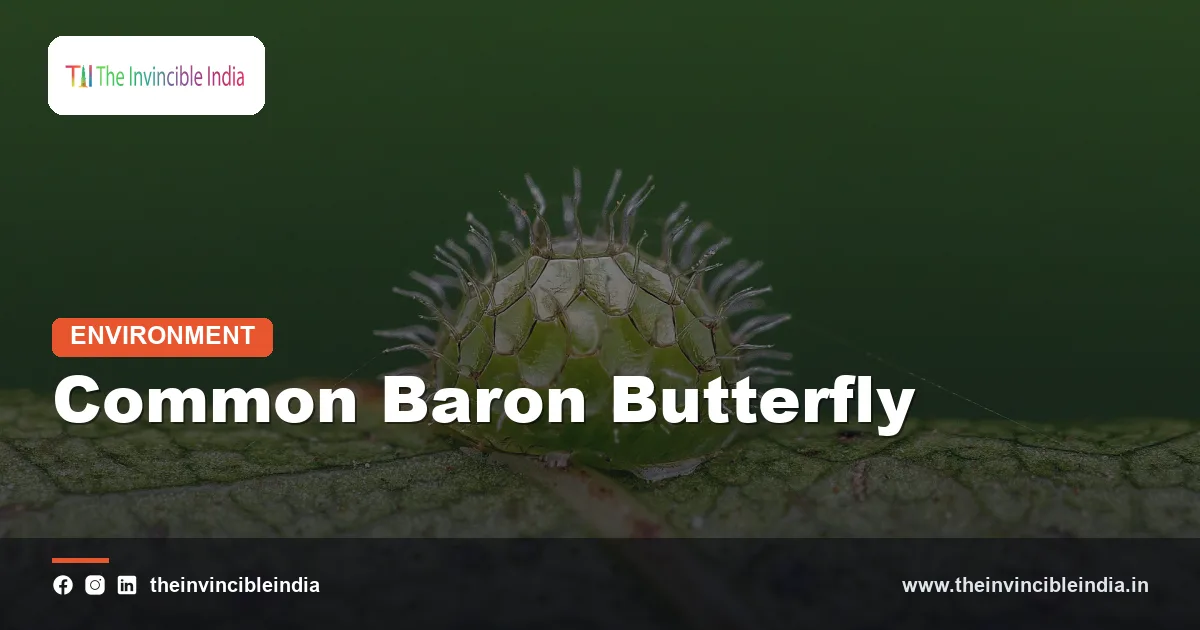
The common baron (Euthalia aconthea) is a medium-to-large brown butterfly of the family Nymphalidae, found across India in gardens, orchards and forest edges, and best known for its spiny green caterpillar that feeds mainly on mango leaves. Adults are fast, gliding fliers with broad, scalloped wings, and they are often seen basking with open wings on a sunlit leaf or feeding on fallen fruit.
The common baron is one of the most widespread members of its genus in the Indian subcontinent, so it is a good first butterfly for anyone learning to watch forest-edge species. This guide explains how to recognise the common baron, what it eats, how it grows and where it lives.
Quick Facts: Common Baron at a Glance
| Common name | Common baron |
|---|---|
| Scientific name | Euthalia aconthea (described by Pieter Cramer in the 1770s) |
| Family and subfamily | Nymphalidae (brush-footed butterflies), subfamily Limenitidinae |
| Wingspan | Roughly 70 to 90 mm; females are usually larger than males |
| Caterpillar host plants | Mango is the best-known host; cashew, jujube (ber) and mistletoe-type plants are also recorded |
| Range and habitat | Peninsular India, the Western Ghats, the Himalayan foothills and the north-east, extending to Sri Lanka and South-East Asia; gardens, orchards, open forest and forest edges |
| Broods | Several overlapping generations in a year, with the largest numbers usually after the monsoon |
| Notable features | Scalloped hindwing edge, powerful gliding flight, spiny green slug-like caterpillar, attraction to rotting fruit and sap |
Key Takeaways
- The common baron (Euthalia aconthea) is a brown, broad-winged butterfly of the family Nymphalidae that occurs widely across India.
- The caterpillar of the common baron is green, slug-shaped and spiny, and it feeds mainly on the leaves of mango trees.
- Adult common barons feed on rotting fruit, tree sap and animal droppings rather than on flower nectar.
- The common baron has several broods a year and can be found in most months in the warm parts of India.
- Males of the common baron are territorial and often return to the same sunlit perch day after day.
- The common baron is a common species and is not regarded as threatened, although it depends on trees and green cover.
What is the common baron butterfly?
The common baron is a brush-footed butterfly (family Nymphalidae) in the genus Euthalia, a group known as the barons. It is a sturdy insect with a wingspan that commonly reaches 70 to 90 millimetres, making it one of the larger brown butterflies seen in Indian gardens.
The scientific name Euthalia aconthea was given to the species by the Dutch naturalist Pieter Cramer in the late eighteenth century, when it was first described from specimens collected in Asia. Since then the species has been moved between genera and has had many local forms named, but Euthalia aconthea remains the accepted name for the common baron of India.
Within India, the common baron belongs to a large and varied family. The Nymphalidae also include the crows, tigers, castors, sailers, leopards and many of the brown butterflies that visit fallen fruit. A defining trait of the family is that the first pair of legs is small and brush-like, so the butterfly appears to walk on only four legs.
How can you identify a common baron?
A common baron can be identified by its broad, dark brown wings, a scalloped hindwing margin, a pale band or patches across the wings and a strong, gliding flight. The upperside is usually a dull brown, olive-brown or chocolate colour, sometimes with a faint green or bronze sheen in good light.
Male and female differences
Male common barons tend to be smaller and darker, with a more uniform brown upperside and a subtle pattern of lighter spots near the wing tips. Females are larger, have broader and rounder wings, and usually show more conspicuous pale markings. In practice the two sexes look similar enough that beginners often need a good photograph to be sure.
The underside
The underside of the common baron is lighter and more detailed than the upperside. It has a pattern of brown, buff and pale bands crossed by wavy lines and a row of small spots near the margin. This underside pattern acts as camouflage when the butterfly rests with its wings closed on bark or leaf litter.
Quick field marks
- Large size for a brown butterfly, with wings that look broad and slightly angular.
- Scalloped, wavy margin on the hindwing.
- Rapid glide followed by short bursts of wingbeats rather than fluttering.
- Habit of landing on leaves, tree trunks or the ground near fermenting fruit.
Where does the common baron live in India?
The common baron lives across much of India, from the Western Ghats and the peninsula to the Himalayan foothills and the north-east, wherever there are trees and sheltered green cover. Its range continues into Sri Lanka, Nepal, Bangladesh, Myanmar and large parts of South-East Asia.
Within this range the common baron prefers a combination of shade and sun. It is regularly recorded in mango orchards, village groves, hill-station gardens, plantations, light deciduous forest and the edges of evergreen forest. It is less often seen in dense, closed-canopy interior forest or in treeless, open farmland.
The butterfly is found mainly from the plains up to moderate elevations. In the hills it tends to be replaced or joined by other barons, so records from higher altitudes need careful identification. Because it adapts well to planted mango trees, the common baron has been able to persist in many towns and suburbs where the original forest has been cleared.
What does the common baron caterpillar eat?
The common baron caterpillar eats leaves, and mango (Mangifera indica) is its best-known host plant in India. Records also exist for cashew and for other trees and shrubs, including jujube and parasitic mistletoe-type plants, which shows that the butterfly is not tied to a single species.
Mango is a native tree of the Indian subcontinent and is planted in huge numbers, which is one reason the common baron is so frequently met in orchards and gardens. The female lays her eggs singly on the upper surface of a mature leaf, and each egg hatches into a caterpillar that eats from the leaf edge.
The caterpillar is not generally regarded as a significant pest. Numbers on a single tree are usually small, and the feeding damage is mostly confined to a few leaves, so orchard owners seldom notice it. A mango tree that carries caterpillars is often a sign that the garden has enough shelter and low chemical use to support insects.
How does the common baron develop from egg to adult?
The common baron develops through complete metamorphosis, passing through four stages: egg, caterpillar, pupa and adult. The whole cycle takes roughly a month or a little longer in warm weather and can slow down in cooler or drier periods.
| Stage | What it looks like | Where it is found |
|---|---|---|
| Egg | Small, rounded and pale green, laid singly | Upper surface of a mango or other host leaf |
| Caterpillar | Green, slug-shaped, with spiny projections along the body and a rough head | Resting on a silken pad on the leaf, often on the midrib |
| Pupa | Green, compact and leaf-like, hanging from a silk button | Underside of a leaf or a twig of the host tree |
| Adult | Brown, broad-winged butterfly with a scalloped hindwing | Sunlit leaves, fallen fruit, sap flows and shaded paths |
The caterpillar stage
The caterpillar of the common baron is a master of camouflage. Its green body and fringe of short spines break up its outline against a mango leaf, and it rests along the midrib on a patch of silk, where it is very hard to spot. It moves slowly and feeds mainly at night or in the cooler parts of the day.
The pupa and emergence
When fully grown, the caterpillar stops feeding and turns into a pupa. This green, angular chrysalis hangs head-down and resembles a curled leaf. After about a week or two the pupa splits and the adult emerges, pumps fluid into its crumpled wings and waits until they harden before its first flight.
How does the common baron behave?
The common baron behaves as a confident, territorial and ground-oriented butterfly: males choose a favoured perch and patrol it, and both sexes come down to feed on rotting fruit and sap. It is a strong flier, gliding between trees with only a few wingbeats, and it can look surprisingly fast when disturbed.
Basking and perching
In the morning the common baron often basks with its wings fully open, soaking up warmth from a leaf or a sunny patch of ground. During the hotter part of the day it prefers shaded perches and may rest with its wings folded, which hides the bright upperside and shows only the camouflaged underside.
Territorial males
Male common barons defend a small area, chasing off other butterflies and returning to the same twig or leaf again and again. This habit helps observers: if you see a baron on a particular branch, there is a good chance that it will be there again at the same time the next day.
Feeding habits
Adult common barons rarely visit flowers. Instead they drink from rotting fruit such as fallen mangoes and bananas, from oozing tree sap and from damp soil or animal droppings. These sources supply sugars, salts and amino acids, and they are the best places to find the butterfly during dry spells.
Why is it called the common baron?
The name “baron” is a traditional English label for the genus Euthalia, applied by butterfly collectors in the nineteenth century to a group of strong-flying, rich-brown forest butterflies. The word “common” simply marks the species as the one most likely to be met in ordinary habitats.
Other Euthalia species in India carry matching names, such as the gaudy baron and the baronet, and the family resemblance is plain once you have seen a few of them. The common baron is the baseline: it is widespread, variable and usually the first of its kind to be recorded in a new place.
- Genus: Euthalia, a large group of barons found in tropical Asia.
- Species: aconthea, the common baron.
- Subspecies: Several regional forms have been described across its Asian range, reflecting local variation in size and markings.
Is the common baron rare or threatened?
The common baron is not rare and is not generally regarded as a threatened butterfly, because it is widespread and adaptable. It uses planted mango trees and village groves as well as natural forest, which gives it a safety net that many forest specialists lack.
Even so, the common baron depends on trees, shelter and a supply of host plants, so heavy loss of tree cover can reduce its numbers locally. Pesticide spraying in orchards, felling of old fruit trees and the tidying away of fallen fruit can all make a garden less suitable for the species. Butterfly legal protection in India is set by schedules under the Wildlife (Protection) Act, 1972, which are revised from time to time, so readers should consult the current schedules if they need an up-to-date status.
How does the common baron compare with similar butterflies?
The common baron is most often confused with other brown woodland butterflies of the same family, such as other barons, the commander and some of the sailers. A few quick comparisons help separate them in the field.
| Butterfly | Key difference from the common baron |
|---|---|
| Gaudy baron | Males show richer colour and a more striking pattern, and the butterfly prefers forested hill country |
| Baronet | Smaller, with a different arrangement of pale patches and a lighter flight |
| Common sailer | Black and white pattern and a characteristic flap-and-glide flight |
| Commander | Dark brown with a bold white band, sharper wing shape and a habit of gliding along paths |
For a reliable identification, photograph both the upperside and the underside and note the habitat. The combination of a mango tree, a scalloped hindwing and a glide-and-flap flight usually points to the common baron.
Why does the common baron matter for gardens and forests?
The common baron matters because it is a visible indicator of healthy tree cover and because it takes part in the food web as both a herbivore and a prey species. Its caterpillars feed on leaves, and both caterpillars and adults are eaten by birds, lizards, spiders and wasps.
The butterfly is also a useful teaching species. It shows children that a butterfly does not need to be colourful to be interesting, and it demonstrates complete metamorphosis on a tree that many Indian families already know. Observing a baron on a mango tree is a simple, free way to begin citizen-science recording of butterflies.
Simple ways to support the common baron
- Keep mango, jujube or cashew trees in the garden and avoid heavy pesticide use.
- Leave some fallen fruit on the ground so that adults can feed.
- Protect shade trees and shrubs that provide perches and roosting places.
- Record sightings with date, place and a photograph on a community platform.
Bottom Line
The common baron is a large, brown, forest-edge butterfly whose green caterpillar feeds on mango leaves and whose adults feed on rotting fruit and sap. It is widespread across India, easy to recognise once its scalloped wings and gliding flight are known, and a good indicator of healthy tree cover.
Frequently Asked Questions
What does the common baron butterfly look like?
The common baron is a broad-winged brown butterfly with a wingspan of roughly 70 to 90 millimetres and a scalloped hindwing edge. The upperside is dark brown or olive-brown, while the underside is paler with wavy bands and small spots. Females are generally larger and show more pale markings than males.
What does the common baron caterpillar feed on?
The common baron caterpillar feeds mainly on mango leaves. It has also been recorded on cashew, jujube and mistletoe-type plants. The green, spiny, slug-like caterpillar rests on a pad of silk on the leaf and is very well camouflaged.
Is the common baron found throughout India?
The common baron is found across much of India, including the peninsula, the Western Ghats, the Himalayan foothills and the north-east. It prefers gardens, orchards, open forest and forest edges. The species also occurs in Sri Lanka, Nepal, Bangladesh, Myanmar and parts of South-East Asia.
What do adult common barons eat?
Adult common barons feed on rotting fruit, tree sap and animal droppings rather than flower nectar. They often come down to the ground to drink from damp soil. Fallen mangoes and bananas are especially attractive to them.
How long does the common baron life cycle take?
The common baron life cycle usually takes about a month or a little more from egg to adult in warm weather. It passes through egg, caterpillar, pupa and adult stages. Cooler or drier conditions can slow the development, and there are several broods in a year.
Is the common baron a threatened species?
The common baron is a common and adaptable butterfly and is not generally regarded as threatened. It can live in planted mango groves and gardens as well as natural forest. Local numbers can fall where trees are removed or heavy pesticides are used.
{“@context”:”https://schema.org”,”@graph”:[{“@type”:”FAQPage”,”mainEntity”:[{“@type”:”Question”,”name”:”What does the common baron butterfly look like?”,”acceptedAnswer”:{“@type”:”Answer”,”text”:”The common baron is a broad-winged brown butterfly with a wingspan of roughly 70 to 90 millimetres and a scalloped hindwing edge. The upperside is dark brown or olive-brown, while the underside is paler with wavy bands and small spots. Females are generally larger and show more pale markings than males.”}},{“@type”:”Question”,”name”:”What does the common baron caterpillar feed on?”,”acceptedAnswer”:{“@type”:”Answer”,”text”:”The common baron caterpillar feeds mainly on mango leaves. It has also been recorded on cashew, jujube and mistletoe-type plants. The green, spiny, slug-like caterpillar rests on a pad of silk on the leaf and is very well camouflaged.”}},{“@type”:”Question”,”name”:”Is the common baron found throughout India?”,”acceptedAnswer”:{“@type”:”Answer”,”text”:”The common baron is found across much of India, including the peninsula, the Western Ghats, the Himalayan foothills and the north-east. It prefers gardens, orchards, open forest and forest edges. The species also occurs in Sri Lanka, Nepal, Bangladesh, Myanmar and parts of South-East Asia.”}},{“@type”:”Question”,”name”:”What do adult common barons eat?”,”acceptedAnswer”:{“@type”:”Answer”,”text”:”Adult common barons feed on rotting fruit, tree sap and animal droppings rather than flower nectar. They often come down to the ground to drink from damp soil. Fallen mangoes and bananas are especially attractive to them.”}},{“@type”:”Question”,”name”:”How long does the common baron life cycle take?”,”acceptedAnswer”:{“@type”:”Answer”,”text”:”The common baron life cycle usually takes about a month or a little more from egg to adult in warm weather. It passes through egg, caterpillar, pupa and adult stages. Cooler or drier conditions can slow the development, and there are several broods in a year.”}},{“@type”:”Question”,”name”:”Is the common baron a threatened species?”,”acceptedAnswer”:{“@type”:”Answer”,”text”:”The common baron is a common and adaptable butterfly and is not generally regarded as threatened. It can live in planted mango groves and gardens as well as natural forest. Local numbers can fall where trees are removed or heavy pesticides are used.”}}]}]}


