

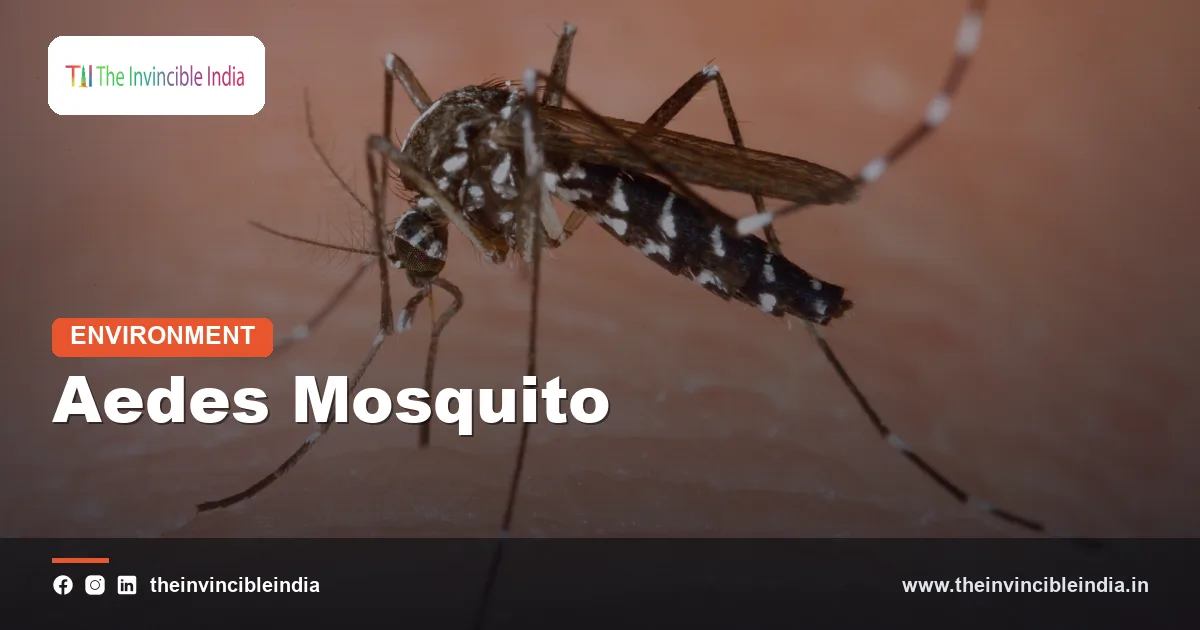
The Aedes mosquito is a small, black-and-white striped, day-biting mosquito that breeds in clean stagnant water and spreads the viruses that cause dengue and chikungunya in India. The two species that matter most are Aedes aegypti, the yellow fever mosquito, and Aedes albopictus, the Asian tiger mosquito, and both live close to people in towns, cities and villages.
The Aedes mosquito is one of the best-studied disease vectors in the world, yet it is often misunderstood. It does not breed in drains or dirty ponds, it bites mainly in daylight, and it can be controlled mostly by simple household habits. This explainer describes how to recognise the Aedes mosquito, how its life cycle works, which diseases it carries and what practical steps reduce its numbers.
Quick Facts: Aedes Mosquito
| Scientific names | Aedes aegypti and Aedes albopictus (genus Aedes) |
|---|---|
| Order and family | Diptera (true flies); Culicidae (mosquitoes) |
| Size | Small, roughly 4 to 7 mm long, with black body and white bands on the legs |
| Habitat in India | Urban and semi-urban areas, houses and surroundings; found across the country, from plains to hill towns |
| Breeding sites | Clean, still water collected in containers, such as coolers, buckets, flower pot trays, tyres, tanks and discarded items |
| Life cycle | Egg, larva (wriggler), pupa and adult; often about 7 to 10 days in warm weather |
| Feeding | Males feed on nectar and plant sap; females take blood, mainly in the early morning and late afternoon |
| Diseases spread | Dengue, chikungunya and Zika virus disease; yellow fever elsewhere in the world |
| Public health agency | National Centre for Vector Borne Diseases Control (NCVBDC), Directorate General of Health Services |
Key Takeaways
- The Aedes mosquito is a small, black-and-white striped mosquito whose main Indian species are Aedes aegypti and Aedes albopictus.
- Aedes mosquitoes breed in clean, still water held in containers around homes, and not in dirty drains or sewage.
- Female Aedes mosquitoes bite mainly in the early morning and late afternoon, which differs from the night-biting habit of malaria mosquitoes.
- The Aedes mosquito spreads dengue, chikungunya and Zika virus, and most dengue prevention depends on removing stagnant water.
- Emptying and scrubbing water containers at least once a week breaks the Aedes life cycle because eggs and larvae cannot complete development without water.
- Mosquito repellents, covered water storage, mesh on windows and protective clothing together lower the risk of Aedes bites.
What is the Aedes mosquito?
The Aedes mosquito is a mosquito of the genus Aedes in the family Culicidae, and the name usually refers to Aedes aegypti and Aedes albopictus, the two species responsible for most dengue and chikungunya transmission. The genus contains several hundred species worldwide, but only a few have adapted to living near humans.
Aedes aegypti is believed to have originated in Africa and spread across the tropics with human trade and shipping over the last few centuries. It has become highly domestic, preferring to rest indoors and to lay its eggs in man-made containers. Aedes albopictus originated in Asia and is more at home in gardens, plantations and the edges of forests, although it also thrives in towns and has spread widely.
Both species are small and dark. They are called tiger mosquitoes because of the white rings that run along their legs and the white markings on the body. A quick comparison of the two is helpful.
| Feature | Aedes aegypti | Aedes albopictus |
|---|---|---|
| Common name | Yellow fever mosquito | Asian tiger mosquito |
| Thorax marking | Lyre-shaped pattern of white scales | A single white stripe down the middle |
| Preferred setting | Inside and around houses, mainly in cities | Gardens, plantations, outdoor shade and towns |
| Preferred host | Humans strongly preferred | Humans and other animals |
| Breeding | Artificial containers | Containers, tree holes, plant axils |
How can you recognise an Aedes mosquito?
An Aedes mosquito can be recognised by its small size, black body, white bands on the legs and its habit of biting in daytime, often around the ankles and feet. The pattern of silvery-white bands on the legs is the feature that most clearly separates Aedes from the larger, plainer Culex mosquitoes common in homes at night.
Several other cues help. The Aedes mosquito flies quietly and does not make the loud whine many people associate with mosquitoes. It tends to approach from below and bite the lower legs. Indoors, it rests in dark, cool spots such as under beds, behind curtains and inside cupboards.
Distinguishing between mosquito groups matters because each one needs a different control approach. In India, the three groups responsible for most mosquito-borne disease are summarised below.
| Group | Typical breeding water | Main biting time | Main diseases |
|---|---|---|---|
| Aedes | Clean, still water in containers | Early morning and late afternoon | Dengue, chikungunya, Zika |
| Anopheles | Clean water in pools, fields, streams, wells | Dusk to dawn | Malaria |
| Culex | Dirty or polluted water, drains, cesspits | Night | Lymphatic filariasis, Japanese encephalitis |
Where does the Aedes mosquito breed?
The Aedes mosquito breeds in clean, still water collected in small containers, not in drains or dirty ponds, and it needs only a few spoonfuls of water to complete its early life stages. This habit explains why dengue cases often rise in the weeks after rain in crowded urban areas.
Common Aedes breeding sites around Indian homes and neighbourhoods include the following.
- Desert coolers and air-conditioner drip trays
- Buckets, drums, tanks and uncovered water storage containers
- Flower pots, plant saucers and decorative water bowls
- Discarded tyres, plastic cups, coconut shells and other rubbish that holds rainwater
- Water collected on rooftops, in sunshades and in blocked gutters
- Construction sites with curing water and open containers
- Bird baths and animal water bowls that are not changed regularly
A single neglected container can produce a large number of mosquitoes within a few days. Because the mosquito stays close to where it hatches, usually within about a hundred metres or so for much of its life, the household and the street around it are the most important targets of control.
How does the life cycle of the Aedes mosquito work?
The life cycle of the Aedes mosquito has four stages, egg, larva, pupa and adult, and the first three stages happen in water. In warm weather the cycle from egg to flying adult can take around a week to ten days.
Egg
The female lays tiny black eggs one by one on the inner wall of a container, just above the waterline. The eggs are resistant to drying and can remain alive for months. They hatch when rain or refilling covers them with water, which explains why a dry cooler can start producing mosquitoes again as soon as it is refilled.
Larva and pupa
The larva, commonly called a wriggler, lives in the water, feeds on microscopic organisms and hangs head-down from the surface to breathe through a tube. It grows through four stages. It then becomes a comma-shaped pupa, which does not feed but moves actively when disturbed.
Adult
The adult mosquito emerges from the pupal skin, rests on the water surface for a short time while its body hardens, and then flies away. Males live a shorter time and feed only on plant sugars. Females mate, take blood meals to develop eggs, and usually live for a few weeks.
The key public-health point is that no part of the early life cycle can finish without water. If containers are emptied and scrubbed once a week, the larvae and pupae die before they become biting adults.
Why does the Aedes mosquito bite?
Only female Aedes mosquitoes bite, because they need the protein in blood to develop their eggs. Male mosquitoes live on nectar and plant juices and do not bite.
Aedes aegypti females often feed several times in one egg-laying cycle, sometimes taking small meals from more than one person. This habit makes the species an efficient carrier of viruses, since an infected female can pass the virus to several people. Females locate hosts through the carbon dioxide in breath, body heat, body odour and visual contrast.
Daytime biting peaks in the early morning and again in the late afternoon, although Aedes mosquitoes can also bite indoors during the day. Because of this timing, bed nets used only at night offer limited protection against Aedes unless they cover a child or a sick person who rests in the daytime.
Which diseases does the Aedes mosquito spread in India?
The Aedes mosquito spreads dengue and chikungunya in India, and it can also transmit Zika virus disease. A mosquito becomes infected after biting a person who has the virus in the blood, and it can pass the virus to others after a short incubation period inside its body.
Dengue
Dengue is caused by the dengue virus, which exists as four related types, DENV-1 to DENV-4. Illness ranges from mild fever to severe disease. Typical symptoms include high fever, severe headache, pain behind the eyes, muscle and joint pain, nausea and rash. A small share of patients develop severe dengue, with warning signs such as severe abdominal pain, repeated vomiting, bleeding from the gums or nose, and unusual drowsiness or restlessness.
Chikungunya
Chikungunya is caused by a virus that produces sudden fever and intense joint pain, which can last for weeks or longer in some people. It is rarely fatal but can be very uncomfortable and may limit daily activity.
Zika
Zika virus disease is usually mild, but infection during pregnancy can harm the developing baby. Health authorities therefore advise pregnant women to avoid mosquito bites in areas where the virus is reported.
Anyone with a fever lasting more than a day or two in a dengue season should consult a doctor rather than self-medicate. Doctors generally advise rest, plenty of fluids and fever control with paracetamol, and they caution against taking anti-inflammatory painkillers such as aspirin or ibuprofen unless a doctor has said it is safe. Warning signs need urgent medical attention.
How can the Aedes mosquito be controlled?
The Aedes mosquito is controlled mainly by removing or covering the stagnant water where it breeds, supported by personal protection and by community and government programmes. This approach is called source reduction, and it is the most reliable and least costly method.
At home and in the neighbourhood
- Weekly dry day: Empty, scrub and dry coolers, flower pot saucers and similar containers at least once a week.
- Cover stored water: Keep tanks, drums and buckets covered with tight lids or fine mesh.
- Remove rubbish: Throw away or turn over containers, tyres and tins that can collect rainwater.
- Check hidden spots: Look at sunshades, roof gutters, plant trays and air-conditioner drains.
- Clean water bowls: Change bird baths and pet bowls every few days.
Personal protection
- Use skin repellents containing DEET, picaridin or similar approved ingredients, following the label instructions.
- Wear long sleeves and full-length trousers during the hours when Aedes is most active.
- Fit window and door screens, and use coils, vaporisers or nets where suitable.
- Protect children, the elderly and sick people who rest during the day, and use nets over cots.
Community and government action
Municipal bodies and health departments carry out larval surveys, treat water with larvicides, and use fogging in outbreak areas. Fogging only kills adult mosquitoes that are flying at the time, so it does not replace the removal of breeding sites. Larvivorous fish such as Gambusia are used in some large water bodies, although they are unsuitable for small household containers. Newer methods, such as releasing mosquitoes carrying the Wolbachia bacterium, have been tested in several countries and are under study.
Who tracks and manages vector-borne disease in India?
The National Centre for Vector Borne Diseases Control (NCVBDC), a unit of the Directorate General of Health Services under the Union Ministry of Health and Family Welfare, coordinates the national programme against dengue, malaria, chikungunya and other vector-borne diseases. State health departments and municipal corporations carry out the field work, including surveillance, testing and awareness drives.
Dengue and chikungunya are monitored by tracking confirmed cases, mosquito densities and outbreak reports, with public hospitals and approved laboratories providing diagnosis. Programmes also emphasise community participation, school awareness and weekly clean-up campaigns, because the breeding sites are mostly inside private homes and premises. Public health officers treat each household as part of the control programme.
Bottom Line
The Aedes mosquito is a small, striped, daytime biter that breeds in clean water kept in household containers. Because it lives so close to people, simple habits such as emptying coolers weekly, covering stored water and using repellents protect families far better than any spray.
Frequently Asked Questions
What is the Aedes mosquito?
The Aedes mosquito is a small, black-and-white striped mosquito that spreads dengue, chikungunya and Zika virus. In India the main species are Aedes aegypti and Aedes albopictus. Both live close to human homes and breed in small water containers.
Does the Aedes mosquito breed in dirty water?
No, the Aedes mosquito prefers clean, still water held in containers rather than dirty drains or sewage. Places such as coolers, buckets, flower pot trays and discarded tyres are typical breeding sites. Emptying and scrubbing them weekly removes the eggs and larvae.
At what time of day does the Aedes mosquito bite?
The Aedes mosquito bites mainly during the day, with peaks in the early morning and late afternoon. It can also bite indoors in daylight. This is different from malaria mosquitoes, which usually bite from dusk to dawn.
How can I prevent Aedes mosquito breeding at home?
Prevent Aedes breeding by emptying, scrubbing and drying all water containers at least once a week and covering stored water. Remove rubbish that holds rainwater and check plant saucers, coolers, sunshades and gutters. Keeping the surroundings free of stagnant water is more effective than fogging.
Which diseases are spread by the Aedes mosquito?
The Aedes mosquito spreads dengue, chikungunya and Zika virus disease. Dengue and chikungunya are the main concerns in India. Fever with severe body pain or any warning sign should be checked by a doctor.
Do mosquito nets and repellents work against Aedes?
Yes, repellents, screens and protective clothing help against Aedes, but nets are useful mainly for people who rest in the daytime. Skin repellents with DEET or picaridin protect exposed skin for several hours when used as directed. Window screens and covering water containers add further protection.
{“@context”:”https://schema.org”,”@graph”:[{“@type”:”FAQPage”,”mainEntity”:[{“@type”:”Question”,”name”:”What is the Aedes mosquito?”,”acceptedAnswer”:{“@type”:”Answer”,”text”:”The Aedes mosquito is a small, black-and-white striped mosquito that spreads dengue, chikungunya and Zika virus. In India the main species are Aedes aegypti and Aedes albopictus. Both live close to human homes and breed in small water containers.”}},{“@type”:”Question”,”name”:”Does the Aedes mosquito breed in dirty water?”,”acceptedAnswer”:{“@type”:”Answer”,”text”:”No, the Aedes mosquito prefers clean, still water held in containers rather than dirty drains or sewage. Places such as coolers, buckets, flower pot trays and discarded tyres are typical breeding sites. Emptying and scrubbing them weekly removes the eggs and larvae.”}},{“@type”:”Question”,”name”:”At what time of day does the Aedes mosquito bite?”,”acceptedAnswer”:{“@type”:”Answer”,”text”:”The Aedes mosquito bites mainly during the day, with peaks in the early morning and late afternoon. It can also bite indoors in daylight. This is different from malaria mosquitoes, which usually bite from dusk to dawn.”}},{“@type”:”Question”,”name”:”How can I prevent Aedes mosquito breeding at home?”,”acceptedAnswer”:{“@type”:”Answer”,”text”:”Prevent Aedes breeding by emptying, scrubbing and drying all water containers at least once a week and covering stored water. Remove rubbish that holds rainwater and check plant saucers, coolers, sunshades and gutters. Keeping the surroundings free of stagnant water is more effective than fogging.”}},{“@type”:”Question”,”name”:”Which diseases are spread by the Aedes mosquito?”,”acceptedAnswer”:{“@type”:”Answer”,”text”:”The Aedes mosquito spreads dengue, chikungunya and Zika virus disease. Dengue and chikungunya are the main concerns in India. Fever with severe body pain or any warning sign should be checked by a doctor.”}},{“@type”:”Question”,”name”:”Do mosquito nets and repellents work against Aedes?”,”acceptedAnswer”:{“@type”:”Answer”,”text”:”Yes, repellents, screens and protective clothing help against Aedes, but nets are useful mainly for people who rest in the daytime. Skin repellents with DEET or picaridin protect exposed skin for several hours when used as directed. Window screens and covering water containers add further protection.”}}]}]}


