

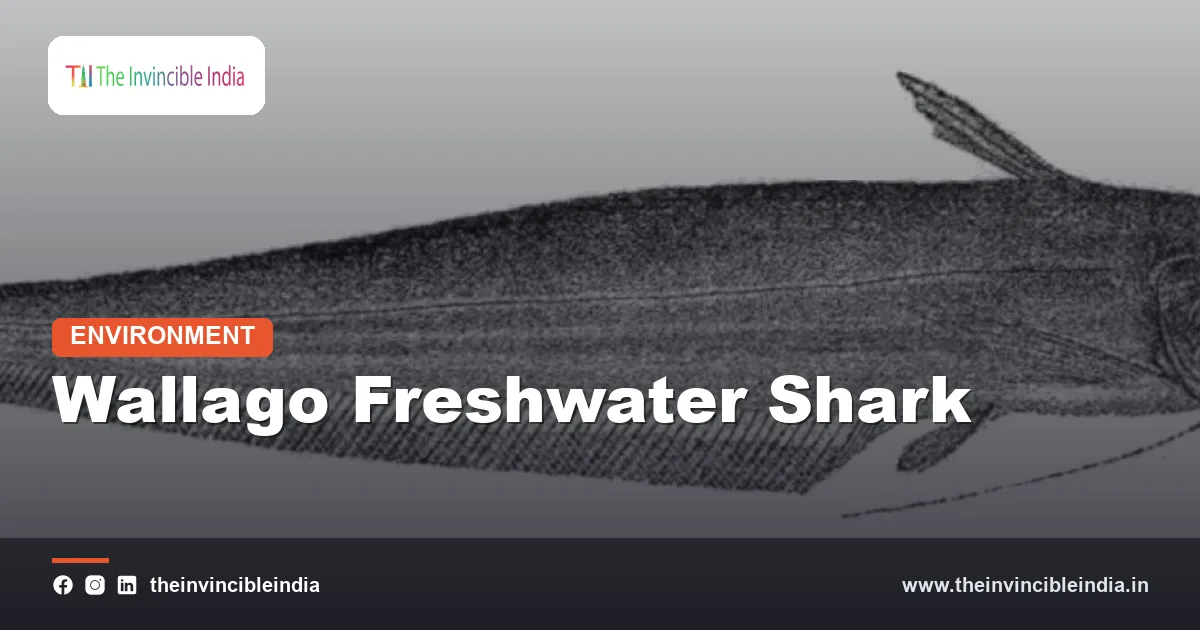
The wallago (Wallago attu) is a very large predatory catfish of South and Southeast Asian rivers and lakes, widely known in India as the “freshwater shark” because of its long body, wide mouth and fish-hunting habits. Called boal in Bengal and padhin in parts of northern India, the wallago is one of the largest freshwater fishes of the subcontinent and an important food fish wherever it still occurs in good numbers.
Although it is a catfish, not a shark, the wallago earns its nickname through a powerful, streamlined shape and an ambush style of hunting. This explainer covers how to recognise the wallago, where it lives, what it eats, how it breeds, why it is declining in some places and how it relates to people.
| Common names | Wallago, freshwater shark, boal (Bengali), padhin (northern India), helicopter catfish (in some regions) |
|---|---|
| Scientific name | Wallago attu |
| Family | Siluridae (Old World catfishes, or sheatfishes) |
| Size | Commonly around one metre; large individuals can reach about two metres and tens of kilograms |
| Range and habitat | Rivers, canals, floodplains, lakes and reservoirs of South and Southeast Asia |
| Diet | Mainly fish, plus frogs, crustaceans and other animals |
| Breeding | Spawns during the monsoon, often in flooded areas and shallow margins |
| Lifestyle | Ambush predator, most active at dusk, at night and in the early morning |
| Conservation status | Assessed by the IUCN as Near Threatened because of fishing pressure and habitat loss |
Key Takeaways
- The wallago (Wallago attu) is a large predatory catfish nicknamed the freshwater shark because of its shape and hunting style.
- Wallago belongs to the family Siluridae and can grow to roughly two metres, making it one of the largest freshwater fishes of the Indian subcontinent.
- The wallago has a flat head, a wide mouth with a projecting lower jaw, two long barbels on the upper jaw and a very long anal fin.
- Wallago hunts mostly at night and eats fish, frogs and crustaceans, which puts it near the top of the freshwater food chain.
- The wallago is a prized food fish in India, Bangladesh, Pakistan and Nepal, and is listed as Near Threatened.
- Wallago populations suffer from overfishing, river damming, pollution and loss of floodplain habitat.
What is the wallago?
The wallago is a big, scaleless catfish that lives in freshwater across South and Southeast Asia and hunts other fish. It belongs to the Old World catfish family Siluridae, whose members have long bodies, tiny or missing dorsal fins and a very long anal fin that runs along most of the underside.
In India, the wallago is a native fish found in the great river systems. People call it by many local names, and the English name “freshwater shark” is used in angling and wildlife writing. The fish lacks the cartilage skeleton and gill slits that define real sharks, so the comparison is only about appearance and behaviour.
What does a wallago look like?
A wallago has a long, laterally flattened body, a broad flattened head, a very wide mouth and a lower jaw that sticks out beyond the upper. The body is silvery grey to olive above and whitish below, without scales, and the skin is smooth. A very long anal fin runs along much of the lower body and is the fish’s main means of propulsion.
Distinctive features
- Barbels: two long barbels on the upper jaw that reach back past the head, and two short barbels on the chin.
- Teeth: rows of small, sharp teeth on the jaws and the roof of the mouth, suited to gripping slippery prey.
- Eyes: small and set low, close to the corner of the mouth, because the fish relies on touch and vibration more than on sight.
- Fins: a tiny dorsal fin, no adipose fin and a long anal fin, which together separate it from many other catfishes.
- Tail: a forked tail fin, joined to the anal fin at its base.
Young wallago are often spotted or mottled and more translucent than adults, and they lose much of that pattern as they grow.
Where does the wallago live in India?
The wallago lives in large rivers, canals, lakes, reservoirs and flooded plains across much of India, and it also occurs in neighbouring countries such as Pakistan, Nepal, Bangladesh and Sri Lanka. It is especially associated with the great river systems of the Indo-Gangetic plain, including the Ganga, Yamuna, Brahmaputra and Indus basins, and with many peninsular rivers.
The fish prefers slow to moderate currents and deep pools, where it can lurk close to the bottom or under cover such as submerged logs, rocky ledges and vegetation. During the monsoon, adults move into flooded fields and backwaters to feed and breed, and then return to the main channel as the water drops.
Its wide range, along with local names in nearly every language group, shows how long people have known the fish. It is part of the fishing tradition of Bengal, Assam, Bihar, Uttar Pradesh and many other regions.
What does the wallago eat?
The wallago eats mostly other fish, along with frogs, crabs, prawns and occasionally small birds or mammals that fall into the water. Adults are ambush predators that wait close to the bottom, sense movement through vibrations and strike with a sudden lunge.
The wallago swallows its prey whole, which is possible thanks to the very wide gape of the mouth. Juveniles feed on insects, small crustaceans and young fish, and gradually shift to larger prey as they grow. Because the wallago can take large carp and other food fish, fish farmers regard it as a pest in stocked ponds and reservoirs, even though it plays a natural role in rivers.
As a top predator, the wallago helps regulate populations of smaller fishes in its habitat. Its decline can therefore affect the balance of the whole freshwater community.
How does the wallago breed?
The wallago breeds during the monsoon, when rising water floods the margins and floodplains and provides shelter for eggs and young. Mature fish move into shallow, vegetated areas and lay adhesive eggs, which stick to plants and other surfaces.
Key points of the breeding cycle include:
- Timing is linked to the rains, usually from June to September in most of India.
- Eggs are laid in shallow water, and the parents are reported to guard the nest for a time.
- The young grow quickly on the abundant food of the flooded margins.
- Juveniles move into deeper water as the floods recede.
Because breeding depends on seasonal flooding and on free movement between river and floodplain, dams and embankments that block this connection can reduce wallago numbers. This dependence on natural flood pulses is shared by many large river fishes.
Is the wallago a danger to people?
The wallago is not a significant danger to people, although very large individuals are strong enough to bite if provoked. Accounts of the fish attacking swimmers are mostly anecdotal and are not well documented, and the wallago generally shuns human contact.
Real risks come from handling. The fish has sharp teeth and a muscular body, so anglers and fishers need to take care when landing a big specimen. Local communities treat the fish with respect, and in many areas, tales of enormous wallago in deep pools form part of village lore. These stories should be treated as folklore, not as evidence of aggression.
How does the wallago differ from a real shark?
The wallago differs from a real shark in almost every anatomical detail, even though the two animals can look similar at first glance. A shark is a cartilaginous fish, while the wallago is a bony fish and a catfish, a group that lives mostly in freshwater.
| Feature | Wallago (freshwater shark) | True shark |
|---|---|---|
| Skeleton | Bone | Cartilage |
| Skin | Smooth and scaleless | Covered with small tooth-like scales |
| Gills | One gill cover on each side | Five to seven open gill slits |
| Barbels | Present on upper jaw and chin | Absent in most species |
| Habitat | Freshwater | Mostly sea, a few in rivers |
| Family | Siluridae (catfish) | Many shark families |
Another fish sometimes confused with the wallago is the giant river catfish of Southeast Asia, but that species lives in different waters and belongs to another family. In India, the main look-alikes are other large catfishes, such as the goonch, which also hunts in rivers.
Why is the wallago declining?
The wallago is declining in parts of its range because of heavy fishing, loss of floodplain habitat, river regulation and pollution, and is therefore classed as Near Threatened by the IUCN. Large predators are the first to disappear from over-fished rivers, since they grow slowly and breed at a limited number of sites.
The main pressures are:
- Overfishing: big fish are targeted with nets, lines and traps, and juveniles are caught before they can breed.
- Dams and barrages: these block migration and alter the flood cycle that triggers spawning.
- Floodplain loss: drainage and embankments remove the shallow breeding areas.
- Pollution: industrial waste, sewage and agricultural runoff reduce water quality.
- Sand mining and dredging: these destroy the deep pools where adults shelter.
Despite these pressures, the wallago remains fairly widespread. Its fate depends on how well India manages its rivers and fisheries in the coming decades.
How is the wallago used and protected?
The wallago is used mainly as a food fish, and its flesh is sold fresh in local markets and cooked in curries, steaks and fries. In angling circles, it is a prized sport fish because of its size and strength, and many anglers practise catch-and-release.
Protection depends on the usual tools of freshwater conservation. These include seasonal fishing bans during the breeding period, minimum mesh sizes for nets, protected river stretches and sanctuaries, and the maintenance of floodplain wetlands. Community-led efforts, in which fishers themselves guard spawning pools, have helped in some regions. Wherever such measures keep large fish in the water, the wallago has a better chance of surviving.
How do people catch the wallago?
People catch the wallago with gill nets, cast nets, long lines and baited hooks, and anglers often use live fish as bait because the wallago prefers moving prey. The fish is strong, runs hard when hooked and can break light tackle, which is why it has a reputation as a hard-fighting sport fish.
In traditional river fisheries, fishers know the deep pools and bends where a wallago usually lies in the daytime. At night and at dawn the fish moves into shallower water, and catches rise. In the monsoon, when fish spread into flooded fields, fishers use traps and nets set at channels and outlets.
Why responsible fishing matters
- Large wallago are often the oldest breeding fish, so removing them reduces the number of eggs produced.
- Fishing during the spawning season can damage the next generation.
- Fine-mesh nets catch juveniles that have not yet had a chance to breed.
- Catch-and-release angling, when done carefully, allows big fish to return to the water.
Handling a large wallago also needs care for the fisher. The fish is slippery and powerful, the jaws carry sharp teeth and thrashing can cause cuts, so experienced fishers support the body and avoid putting hands near the mouth.
The wallago also appears in village stories and local cuisine across the Gangetic plain. In Bengal, boal is a well-known name on market stalls, and large fish fetch good prices, which adds to the pressure on wild stocks.
Bottom Line
The wallago is a native giant of Indian rivers: a scaleless, ambush-hunting catfish that justifies its freshwater-shark nickname. Keeping it in India’s waters requires free-flowing rivers, healthy floodplains and sensible fishing limits.
Frequently Asked Questions
Why is the wallago called a freshwater shark?
The wallago is called a freshwater shark because it has a long, streamlined body, a wide mouth and a predatory way of hunting. It is not related to sharks. It is a bony catfish that belongs to the family Siluridae.
How big can a wallago grow?
A wallago can grow to about two metres in length and weigh tens of kilograms in large individuals. Most fish caught today are smaller, often around one metre or less. Heavy fishing has reduced the number of very large fish in many rivers.
What does the wallago eat?
The wallago mostly eats other fish. It also takes frogs, crustaceans and other small animals, swallowing prey whole. It hunts by ambush, usually at night, and senses prey through vibrations in the water.
Where is the wallago found in India?
The wallago is found in large rivers, canals, lakes, reservoirs and floodplains across much of India. It is especially common in the Indo-Gangetic and Brahmaputra river systems. It also occurs in Pakistan, Nepal, Bangladesh and Sri Lanka.
Is the wallago endangered?
The wallago is not classed as endangered; the IUCN lists it as Near Threatened. Overfishing, dams and loss of floodplain habitat are driving local declines. The species is still fairly widespread in India.
Is the wallago dangerous to humans?
No, the wallago is not generally dangerous to people. Large individuals have sharp teeth and strong bodies, so they should be handled carefully, but stories of attacks on swimmers are largely unverified. The fish usually avoids humans.
{“@context”:”https://schema.org”,”@graph”:[{“@type”:”FAQPage”,”mainEntity”:[{“@type”:”Question”,”name”:”Why is the wallago called a freshwater shark?”,”acceptedAnswer”:{“@type”:”Answer”,”text”:”The wallago is called a freshwater shark because it has a long, streamlined body, a wide mouth and a predatory way of hunting. It is not related to sharks. It is a bony catfish that belongs to the family Siluridae.”}},{“@type”:”Question”,”name”:”How big can a wallago grow?”,”acceptedAnswer”:{“@type”:”Answer”,”text”:”A wallago can grow to about two metres in length and weigh tens of kilograms in large individuals. Most fish caught today are smaller, often around one metre or less. Heavy fishing has reduced the number of very large fish in many rivers.”}},{“@type”:”Question”,”name”:”What does the wallago eat?”,”acceptedAnswer”:{“@type”:”Answer”,”text”:”The wallago mostly eats other fish. It also takes frogs, crustaceans and other small animals, swallowing prey whole. It hunts by ambush, usually at night, and senses prey through vibrations in the water.”}},{“@type”:”Question”,”name”:”Where is the wallago found in India?”,”acceptedAnswer”:{“@type”:”Answer”,”text”:”The wallago is found in large rivers, canals, lakes, reservoirs and floodplains across much of India. It is especially common in the Indo-Gangetic and Brahmaputra river systems. It also occurs in Pakistan, Nepal, Bangladesh and Sri Lanka.”}},{“@type”:”Question”,”name”:”Is the wallago endangered?”,”acceptedAnswer”:{“@type”:”Answer”,”text”:”The wallago is not classed as endangered; the IUCN lists it as Near Threatened. Overfishing, dams and loss of floodplain habitat are driving local declines. The species is still fairly widespread in India.”}},{“@type”:”Question”,”name”:”Is the wallago dangerous to humans?”,”acceptedAnswer”:{“@type”:”Answer”,”text”:”No, the wallago is not generally dangerous to people. Large individuals have sharp teeth and strong bodies, so they should be handled carefully, but stories of attacks on swimmers are largely unverified. The fish usually avoids humans.”}}]}]}


