

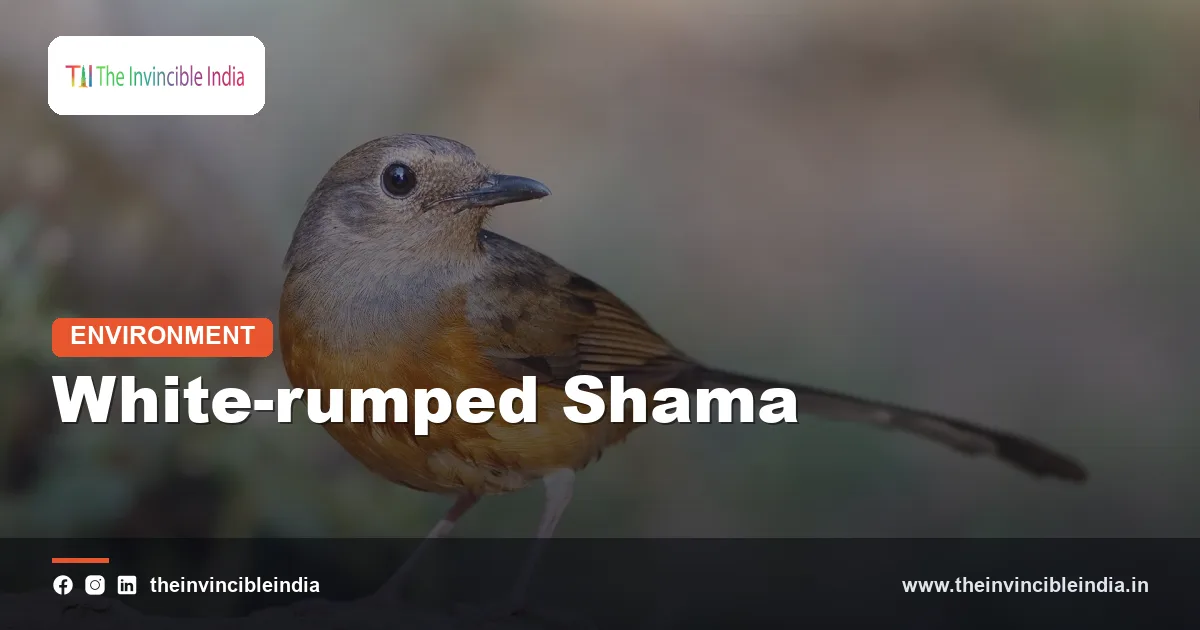
The white-rumped shama (Copsychus malabaricus) is a long-tailed forest songbird of southern and southeast Asia, found in India, in which the male is glossy black with a bright orange-chestnut belly and a white patch on the rump. It is celebrated across the region for a rich, flute-like song delivered from the shade of dense undergrowth, and it is far more often heard than seen.
In India the white-rumped shama is a bird of moist, shady forest, bamboo thickets and wooded ravines. This article explains how to identify the bird, where it lives, what it eats, how it breeds and why its voice has made it both admired and vulnerable.
Quick Facts
| Common name | White-rumped shama |
|---|---|
| Scientific name | Copsychus malabaricus (placed in the genus Kittacincla in some checklists) |
| Family | Muscicapidae (Old World flycatchers and chats) |
| Size | About 22 to 28 cm including the tail, the male having the longer tail |
| India range and habitat | Himalayan foothills, the northeast and scattered forest tracts of the peninsula; moist forest, bamboo and dense undergrowth, mostly in the plains and lower hills |
| Diet | Mainly insects, caterpillars and spiders taken from the forest floor and low branches |
| Breeding | Nests in a tree hollow or stump; usually 3 to 5 eggs; breeds mainly in the warmer months |
| Migration | Largely resident, with only local movements |
| Conservation status | Least Concern globally (IUCN), though trapping for the cage-bird trade has caused local declines |
Key Takeaways
- The white-rumped shama is a songbird of the Old World flycatcher family, Muscicapidae, and is not a true thrush, although older books grouped it with the thrushes.
- The adult male white-rumped shama is glossy blue-black above, orange-chestnut below, with a white rump and a long graduated tail edged in white.
- The white-rumped shama is a shy, low-level forest bird that spends most of its time in dense undergrowth, which is why its song is usually the first sign of its presence.
- The white-rumped shama feeds mainly on insects and spiders picked from the ground and low vegetation, and it nests in tree hollows, stumps and similar cavities.
- The white-rumped shama is a close relative of the Oriental magpie-robin, but it lives deeper in forest and is easily told apart by its orange belly, white rump and longer tail.
- The white-rumped shama is classed as Least Concern worldwide, yet capture for the pet trade is a recognised threat, and wild birds are protected under Indian law.
What is the white-rumped shama?
The white-rumped shama is a medium-small, long-tailed songbird of tropical forests, belonging to the family Muscicapidae, the Old World flycatchers and chats. Its scientific name, Copsychus malabaricus, hints at the Malabar coast of south-western India, the region from which early specimens were described for science.
The genus Copsychus also holds the Oriental magpie-robin, a familiar bird of Indian towns and gardens, and the two species share a habit of cocking the tail and a love of song. Some modern checklists move the shamas into a separate genus, Kittacincla, so a reader may meet either name in field guides and websites.
The word “shama” is used for the bird in Hindi and several other Indian languages, and the bird has been known in the Indian subcontinent for centuries as a singer. Across its wide range, from the Indian subcontinent through Southeast Asia to the islands of Indonesia, ornithologists recognise a number of subspecies that differ slightly in the colour of the belly, the length of the tail and the amount of white in it.
How can you identify a white-rumped shama?
A white-rumped shama is identified by a combination of a dark head and back, a conspicuous white rump, an orange-chestnut belly and a long, black, white-edged tail that is held cocked and wagged. The adult male is the more striking sex, with plumage that looks blue-black and glossy in good light.
The female is similar in pattern but duller. Her upperparts are slate-grey or dark brown rather than glossy black, her belly is a paler orange-buff and her tail is distinctly shorter. Young birds are mottled and streaked, with a spotted look on the upperparts and breast and only a short tail, and they gradually acquire adult plumage.
Field marks to look for
- Glossy black head, throat, breast and back in the male.
- A clean white rump that flashes when the bird flies or flicks its tail.
- Orange-chestnut belly and flanks, richer in the male.
- A long graduated tail, black above with white outer feathers.
- A habit of perching low, often in shadow, and cocking the tail upright.
The tail is the most useful clue in poor light. A long, slender silhouette with a wagging, upward-flicked tail near the forest floor is characteristic of the white-rumped shama, even when colour cannot be seen.
Where does the white-rumped shama live in India?
The white-rumped shama lives in India mainly in moist, shaded forest and bamboo thickets, from the Himalayan foothills and the northeast to forested pockets of the peninsula. It is typically a bird of the plains and lower hills rather than high mountains.
In the north it occurs along the forested foothills and the terai, and it is a regular resident of the lowland and hill forests of the northeast, where the combination of humidity, dense undergrowth and bamboo suits it well. Elsewhere its distribution is patchy and tied to the quality of forest. A bird that needs a dense, layered understorey disappears quickly when that layer is cleared for grazing, firewood or plantation.
The white-rumped shama is largely sedentary. Pairs defend territories year-round or for much of it, and the movements that occur are local, such as shifts between ravines and slopes with the seasons. Because of this settled behaviour, a patch of forest that holds a singing shama one year will often hold one the next, as long as the habitat survives.
Preferred habitats
- Evergreen and semi-evergreen forest with a dense, shady understorey.
- Bamboo brakes and forest edges with a thick tangle of shrubs.
- Shady ravines and stream-side vegetation within forest.
- Secondary growth and well-wooded plantations that retain a layer of undergrowth.
What does the white-rumped shama eat?
The white-rumped shama eats mainly insects, spiders and other small invertebrates, which it picks from the ground, leaf litter and low branches. Its diet includes beetles, ants, caterpillars, crickets, grasshoppers and other small prey, and now and then it takes a small fruit or berry.
The shama hunts in a manner familiar to anyone who has watched a magpie-robin. It perches low, watches the ground, then drops to seize prey and returns to a perch, or it hops along the forest floor turning over leaves. Larger prey is beaten against a branch before it is swallowed. During the breeding season, adults make repeated trips to carry insects to the nestlings, and the hungry young depend on a steady supply of soft-bodied prey such as caterpillars.
Because of this diet, the white-rumped shama plays a small but useful role in controlling forest insects. It is also a good indicator of a healthy undergrowth, since the leaf litter and shrub layer on which it forages support the insects it needs.
Why is the song of the white-rumped shama so famous?
The song of the white-rumped shama is famous because it is rich, loud, flute-like and unusually varied, made up of clear whistled phrases and warbles that the male repeats and recombines. The bird sings most vigorously at dawn and dusk, and the sound carries a long way through dense forest.
Males sing to advertise their territory and to attract a mate, and they often sing from a hidden perch in deep shade. Individual males build up repertoires of different phrases, and many also include imitations of other birds and sounds in their song. A shama also gives sharper alarm and contact calls, including harsh, scolding notes when disturbed near a nest.
The quality of this song is the reason the bird has long been prized as a cage bird in parts of Asia. Singing contests and a lively pet trade have placed heavy pressure on wild populations in some countries. In India, the capture and trade of wild birds is prohibited, and enjoying the song in the wild is the proper way to appreciate the bird.
How does the white-rumped shama breed?
The white-rumped shama breeds by nesting in a cavity, such as a hollow in a tree trunk, a rotting stump, a hole in a bank or a cleft among bamboo, where the female lays about three to five eggs. The breeding season in India falls mainly in the warmer months, from about spring into the early monsoon, though timing varies by region.
The nest itself is a loose pad of leaves, fibres, moss and fine roots placed inside the cavity. The eggs are pale greenish or bluish-white with reddish-brown markings. The female does most or all of the incubation, which lasts roughly two weeks, while the male defends the territory and sings nearby. Both parents feed the chicks, which leave the nest after around two weeks and are fed for some time afterwards.
The reliance on hollows means the white-rumped shama benefits from old trees, stumps and standing dead wood. Where such cavities are removed by felling and tidy-forest management, the species loses its nest sites, and in some countries conservationists have helped by providing nest boxes.
Breeding at a glance
- Nest site: tree hollow, stump, bank hole or bamboo cleft.
- Clutch: usually 3 to 5 eggs.
- Incubation: mainly by the female, for about two weeks.
- Care of young: both parents feed the chicks with insects.
- Season: warmer months, varying across regions.
How is the white-rumped shama different from the Oriental magpie-robin?
The white-rumped shama differs from the Oriental magpie-robin mainly in its orange belly, white rump, longer tail and preference for deep forest, whereas the magpie-robin is black and white and common in gardens and towns. The two belong to the same genus and look alike in posture, which is why beginners sometimes confuse them.
| Feature | White-rumped shama | Oriental magpie-robin |
|---|---|---|
| Belly colour | Orange-chestnut | White |
| Rump | White patch on the rump | Black, with white in the outer tail |
| Wing pattern | Dark, without a bold white bar | Bold white wing patch |
| Tail | Long and graduated, especially in the male | Moderately long, often cocked |
| Typical habitat | Dense, shady forest and bamboo | Gardens, towns, light woodland |
| Behaviour | Shy and secretive | Bold and conspicuous |
A simple rule is that a black-and-white bird singing from a rooftop is a magpie-robin, while a black-and-orange bird flitting low in forest shade is a shama.
Is the white-rumped shama threatened?
The white-rumped shama is not globally threatened and is classed as Least Concern by the International Union for Conservation of Nature (IUCN), because it has a very wide range across Asia. Even so, local populations have declined where forests have been cleared and where birds have been caught for sale as songsters.
Two pressures matter most. The first is habitat loss, because the species depends on dense understorey and old trees with cavities. The second is trapping, because a singing male has commercial value, which encourages poaching. Conservation work for the species therefore focuses on protecting forest, retaining old trees and standing stumps, and enforcing laws against the capture and sale of wild birds.
In India, wild birds are covered by the Wild Life (Protection) Act, 1972, which prohibits capturing, keeping and trading them. Anyone offered a caged shama should recognise that the bird has almost certainly been taken from the wild.
How can you watch and listen to a white-rumped shama responsibly?
The best way to watch a white-rumped shama is to visit good forest early in the morning or near dusk, stand quietly near dense undergrowth and listen for the song before searching for the singer. Patience is rewarded because the bird tends to appear briefly on a low perch and then vanish.
- Go at first light, when males sing most actively and are most likely to perch in the open.
- Learn the song first, since most contacts are by ear.
- Keep still near bamboo and shaded ravines, and avoid sudden movement.
- Do not use recorded calls to lure a bird repeatedly, as this stresses territorial males during breeding.
- Keep well away from nest holes and never disturb a nesting pair for a photograph.
Forest reserves, national parks and sanctuaries in the foothills and the northeast offer the best chances, and local naturalist guides know the shaded stretches where a pair is likely to hold territory.
Bottom Line
The white-rumped shama is one of the finest songbirds of Indian forests, recognised by its black-and-orange plumage, white rump and long tail. Its survival in the wild depends on dense undergrowth, old hollow trees and a strict end to illegal capture.
Frequently Asked Questions
What is a white-rumped shama?
A white-rumped shama is a long-tailed songbird of Asian forests with a glossy black back, orange belly and white rump in the male. It belongs to the Old World flycatcher family and is famous for a rich, flute-like song.
Where is the white-rumped shama found in India?
The white-rumped shama is found in moist, shady forest and bamboo, mainly in the Himalayan foothills, the northeast and scattered forest tracts of the peninsula. It prefers plains and lower hills with dense undergrowth.
What does the white-rumped shama eat?
The white-rumped shama eats mainly insects, caterpillars and spiders, which it picks from the ground and low branches. It occasionally takes small fruits as well.
How can I tell a white-rumped shama from an Oriental magpie-robin?
A white-rumped shama has an orange belly, a white rump and a longer tail, while an Oriental magpie-robin has a white belly and a bold white wing patch. The shama also lives in deeper forest, whereas the magpie-robin is common in gardens and towns.
Where does the white-rumped shama nest?
The white-rumped shama nests in cavities such as tree hollows, stumps, bank holes and bamboo clefts. The female usually lays three to five eggs on a loose pad of leaves, moss and fibres.
Is it legal to keep a white-rumped shama as a pet in India?
No, it is not legal to capture or keep a wild white-rumped shama in India, because wild birds are protected under the Wild Life (Protection) Act, 1972. Trapping for the cage-bird trade is also a recognised threat to the species in parts of Asia.
{“@context”:”https://schema.org”,”@graph”:[{“@type”:”FAQPage”,”mainEntity”:[{“@type”:”Question”,”name”:”What is a white-rumped shama?”,”acceptedAnswer”:{“@type”:”Answer”,”text”:”A white-rumped shama is a long-tailed songbird of Asian forests with a glossy black back, orange belly and white rump in the male. It belongs to the Old World flycatcher family and is famous for a rich, flute-like song.”}},{“@type”:”Question”,”name”:”Where is the white-rumped shama found in India?”,”acceptedAnswer”:{“@type”:”Answer”,”text”:”The white-rumped shama is found in moist, shady forest and bamboo, mainly in the Himalayan foothills, the northeast and scattered forest tracts of the peninsula. It prefers plains and lower hills with dense undergrowth.”}},{“@type”:”Question”,”name”:”What does the white-rumped shama eat?”,”acceptedAnswer”:{“@type”:”Answer”,”text”:”The white-rumped shama eats mainly insects, caterpillars and spiders, which it picks from the ground and low branches. It occasionally takes small fruits as well.”}},{“@type”:”Question”,”name”:”How can I tell a white-rumped shama from an Oriental magpie-robin?”,”acceptedAnswer”:{“@type”:”Answer”,”text”:”A white-rumped shama has an orange belly, a white rump and a longer tail, while an Oriental magpie-robin has a white belly and a bold white wing patch. The shama also lives in deeper forest, whereas the magpie-robin is common in gardens and towns.”}},{“@type”:”Question”,”name”:”Where does the white-rumped shama nest?”,”acceptedAnswer”:{“@type”:”Answer”,”text”:”The white-rumped shama nests in cavities such as tree hollows, stumps, bank holes and bamboo clefts. The female usually lays three to five eggs on a loose pad of leaves, moss and fibres.”}},{“@type”:”Question”,”name”:”Is it legal to keep a white-rumped shama as a pet in India?”,”acceptedAnswer”:{“@type”:”Answer”,”text”:”No, it is not legal to capture or keep a wild white-rumped shama in India, because wild birds are protected under the Wild Life (Protection) Act, 1972. Trapping for the cage-bird trade is also a recognised threat to the species in parts of Asia.”}}]}]}


