

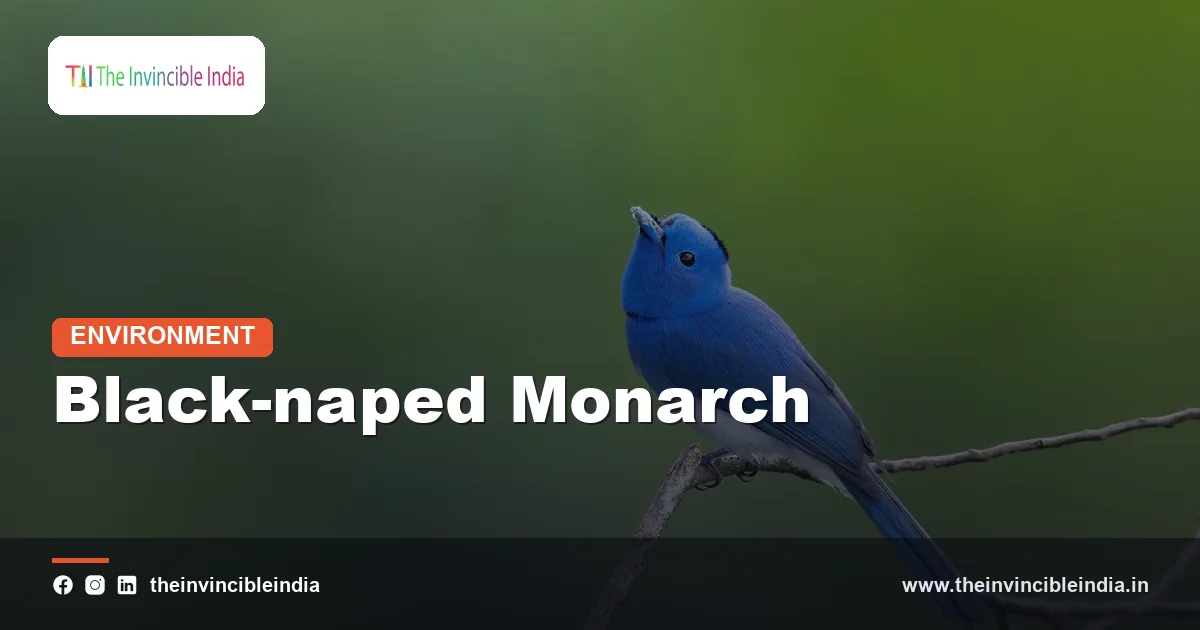
The black-naped monarch (Hypothymis azurea) is a small, azure-blue forest bird of India, a monarch flycatcher in which the male carries a bold black spot on the nape and a thin black band across the upper breast. It flits through the middle and lower storeys of woodland, snatching insects from the air and from leaves, and it is often the first bright blue flash that a visitor notices in a shady forest.
Older Indian field guides called the species the black-naped blue flycatcher, a name that is still widely used. This article explains how the bird is identified, where it lives in India, what it eats, how it builds its remarkably neat nest and how it fits into the wider group of flycatchers.
Quick Facts
| Common name | Black-naped monarch (formerly black-naped blue flycatcher) |
|---|---|
| Scientific name | Hypothymis azurea |
| Family | Monarchidae (monarch flycatchers) |
| Size | About 15 to 16 cm in length, with a slim body and a longish tail |
| India range and habitat | Widespread in forests across the Western Ghats, central and eastern India, the Himalayan foothills, the northeast and the Andaman and Nicobar Islands; broadleaved forest, bamboo, secondary growth and wooded gardens |
| Diet | Insects caught in the air or gleaned from foliage |
| Breeding | Builds a small cup nest in a fork of a thin branch; usually 2 to 4 eggs; breeds in the warmer months |
| Migration | Mostly resident, with local movements between hills and plains |
| Conservation status | Least Concern (IUCN) |
Key Takeaways
- The black-naped monarch is a small blue forest bird that belongs to the monarch flycatcher family, Monarchidae, and not to the Old World flycatcher family, Muscicapidae.
- The male black-naped monarch is bright azure blue with a black nape spot, a black forehead patch and a narrow black collar on the upper breast.
- The female black-naped monarch is duller, with a greyish-blue head and brownish-grey upperparts, and she lacks the black nape spot and the black breast band.
- The black-naped monarch is a resident of forests across much of India, from the Western Ghats to the Himalayan foothills, the northeast and the Andaman and Nicobar Islands.
- The black-naped monarch catches insects in short aerial sallies and often joins mixed hunting parties of forest birds.
- The black-naped monarch builds a neat cup nest bound with spider silk and covered with lichen or moss, placed low in the fork of a slender branch.
What is the black-naped monarch?
The black-naped monarch is a small insect-eating passerine bird that belongs to the monarch flycatcher family and is widespread in the forests of southern and southeast Asia. Its scientific name, Hypothymis azurea, refers to its azure colour, and its common name refers to the small black patch that the male wears at the back of the head.
The bird is often called a blue flycatcher, and this older name remains common among Indian birdwatchers. However, modern classification places the species in the family Monarchidae, which also includes the paradise flycatchers. This means that the black-naped monarch is more closely related to the Asian paradise flycatcher than to the small chat-like flycatchers such as the ultramarine flycatcher.
The family name comes from the tendency of many members to have a restless, active, crested look. The black-naped monarch has a small pointed crest, a slightly broad bill with bristles at the base and a tail that it often fans and sways as it moves. These traits help the bird to hunt in the cluttered space of the forest understorey.
How can you identify a black-naped monarch?
A black-naped monarch is identified by its overall blue plumage, a small crest, a black nape spot and a black band across the throat and upper breast in the male, with a whitish-grey belly. The female lacks the black marks and looks softer and browner.
The male is a vivid cobalt or azure blue on the head, neck and breast, with a fine black spot on the forehead, a distinct black patch at the nape and a thin black gorget across the throat. The belly and undertail are pale grey or whitish, and the wings and tail are blue-grey. A pale blue ring is sometimes visible around the dark eye.
The female has a blue-grey head, a duller greyish-brown back and wings with a faint blue wash, and a pale breast. Young birds look similar to the female but are even plainer and gradually develop the blue and black markings of an adult male.
Male, female and young compared
| Feature | Adult male | Adult female | Young bird |
|---|---|---|---|
| Head and neck | Bright azure blue | Dull grey-blue | Grey-brown |
| Black nape spot | Present | Absent | Absent |
| Black throat band | Thin black collar on the upper breast | Absent | Absent |
| Upperparts | Blue to blue-grey | Brownish-grey | Brownish |
| Belly | Whitish-grey | Whitish | Whitish |
Where does the black-naped monarch live in India?
The black-naped monarch lives across a large part of India, in moist and dry deciduous forest, evergreen forest, bamboo, secondary growth and well-wooded gardens, from the plains up to mid-level hills. It is found in the Western Ghats, the forests of central and eastern India, the Himalayan foothills, the northeast and the Andaman and Nicobar Islands.
The species is largely resident, so a pair may remain in the same stretch of forest for much of the year. In the hills it may move to lower elevations in the colder months. Beyond India the bird ranges through Sri Lanka, mainland Southeast Asia and into the islands of the Philippines and Indonesia, where several island populations differ slightly in shade and markings.
Within its range the black-naped monarch prefers the shaded middle and lower layers of the forest, usually between about two and ten metres above the ground. It tends to avoid open grassland and very dry scrub, but it will use mature gardens, orchards and wooded campuses where shrubs and trees give cover.
What does the black-naped monarch eat and how does it hunt?
The black-naped monarch eats small insects, which it catches by flying out from a perch to snatch prey in the air or by picking it from leaves. Its diet includes flies, small moths, beetles, caterpillars and similar prey, along with the occasional spider.
The hunting method is typical of a flycatcher. The bird sits on a low branch, scans, darts out in a quick curved flight to seize an insect and then often returns to the same or a nearby perch. It also hovers briefly and picks prey from the underside of leaves. The wide, flattened bill with bristles around the gape helps in catching and holding small flying insects.
A monarch frequently joins mixed hunting parties, loose flocks of babblers, tits, warblers, drongos and other small birds that move through the forest together. Flushing insects from foliage as the flock advances makes it easier for a flycatcher to catch them in the air, and the many eyes in the group give early warning of predators.
Typical foraging behaviour
- Perches low and upright, scanning for movement.
- Makes short aerial sallies of a few metres and returns to a perch.
- Fans and flicks the tail while moving between branches.
- Follows mixed flocks to exploit insects they disturb.
- Is most active in the cooler parts of the morning and late afternoon.
How does the black-naped monarch build its nest?
The black-naped monarch builds a small, deep cup nest of fine grass, plant fibres and spider silk, placed in the fork of a thin, often drooping branch at a low height. The outside is usually camouflaged with lichen, moss, bark scraps or cocoon silk, so the nest looks like a small knot on the branch.
The nest is usually built within a few metres of the ground, often in a sapling or shrub beside a track or stream. Both the male and the female take part in building, incubating and feeding the young. The clutch is usually two to four eggs, which are whitish or cream with reddish or brownish spots, often forming a ring at the broader end.
The breeding season in India falls broadly in the warmer months and early rains, though the exact timing differs between the hills and the plains. Pairs may raise more than one brood in a favourable season. The adults are watchful, and an intruder near the nest is met with scolding calls and fluttering displays.
What does the black-naped monarch sound like?
The black-naped monarch gives a harsh, repeated, slightly buzzing call that is often written as a nasal “chweet” or “tswee”, along with a simple song of short whistled phrases. The calls are most often heard from a hidden bird in the forest understorey, and they help a birdwatcher locate it before it is seen.
Males sing mainly during the breeding season to defend their territory and attract a mate. Calls are also used to keep the pair in touch while foraging and to warn of danger near the nest. A birdwatcher who learns the call can find monarchs more easily than by relying on sight alone, since the bird often stays within leafy cover.
Is the black-naped monarch related to the paradise flycatcher?
Yes, the black-naped monarch is related to the Asian paradise flycatcher, because both belong to the monarch flycatcher family, Monarchidae. The relationship is shown in shared features such as a crested head, a broad bill and a graceful, fanned tail.
The two birds differ greatly in size and appearance, however. The paradise flycatcher is larger, and the adult male has a white or chestnut body and extremely long tail streamers. The black-naped monarch is much smaller, mostly blue, and has a short to moderate tail. Both are insect-eaters of shaded woodland, and both are widely seen in Indian forests and gardens.
The family name Monarchidae is used for a group that spans Africa, Asia and Australasia, and the common name “flycatcher” is applied to birds in several unrelated families. This is why taxonomists urge birdwatchers to treat the term as a description of feeding style rather than a family label.
Is the black-naped monarch threatened?
The black-naped monarch is not threatened at present and is assessed as Least Concern by the International Union for Conservation of Nature (IUCN), because it has a wide range and a large population. It is still sensitive to clearance of forest and to the loss of shrub and sapling layers, since these provide hunting perches and nest sites.
Habitat degradation by logging, intensive grazing, clearing of undergrowth and conversion of forest to plantation can reduce local numbers. In a few island populations in Southeast Asia, restricted ranges make the birds more vulnerable than the mainland populations. In India the species gains from the protection of forest reserves, sanctuaries and national parks, and from the survival of tree-rich green spaces near towns.
How can you see a black-naped monarch?
The best way to see a black-naped monarch is to walk slowly through shaded forest or a wooded garden in the early morning, listen for its harsh call and scan low branches for a small blue bird making short flights. Mixed hunting parties are a good place to look, because a monarch often travels with them.
- Visit forest edges, stream-side paths and bamboo patches in the cooler hours.
- Look at eye level and below, not only high in the canopy.
- Learn the call to spot the bird before it moves on.
- Check any small blue bird for the black nape spot of the male.
- Keep away from low nests, since the cup is delicate and easily abandoned if disturbed.
Why does the black-naped monarch matter to forest ecosystems?
The black-naped monarch matters to forest ecosystems because it removes large numbers of small flying insects and serves as a sensitive indicator of healthy understorey. A single pair needs a steady supply of flies, moths and small beetles, particularly while feeding nestlings, and this predation helps to keep insect numbers in balance.
The bird is also a useful indicator species. Since it relies on a layered forest with saplings, shrubs and slender branches for hunting perches and nest sites, its presence in a patch of woodland suggests that the middle storey has not been stripped away. Surveys of birds often record monarchs as one of the common blue-coloured species in intact forest, and a decline in sightings can be an early sign of degradation.
In addition, the neat nest of the black-naped monarch shows how small birds use natural materials such as spider silk, lichen and moss, linking the bird to the wider web of life in the forest.
Bottom Line
The black-naped monarch is a lively blue monarch flycatcher found in forests across India, easily recognised by the male’s black nape spot and narrow black collar. It remains secure overall, as long as the shady forest layers that supply insects and nest sites are kept intact.
Frequently Asked Questions
What is a black-naped monarch?
A black-naped monarch is a small azure-blue forest bird of the monarch flycatcher family. The male has a black nape spot and a thin black collar on the upper breast.
Is the black-naped monarch the same as the black-naped blue flycatcher?
Yes, the black-naped monarch is the same species as the black-naped blue flycatcher, which is its older common name. Modern classification places it in the monarch flycatcher family, Monarchidae.
Where is the black-naped monarch found in India?
The black-naped monarch is found in forests across the Western Ghats, central and eastern India, the Himalayan foothills, the northeast and the Andaman and Nicobar Islands. It prefers shaded, leafy forest and wooded gardens.
How can I tell a male black-naped monarch from a female?
A male black-naped monarch has bright blue plumage with a black nape spot and a thin black collar, while the female is duller grey-blue and lacks the black marks. Young birds look much like the female.
What does the black-naped monarch eat?
The black-naped monarch eats small insects such as flies, moths, beetles and caterpillars. It catches them in short aerial sallies or picks them from leaves.
Where does the black-naped monarch build its nest?
The black-naped monarch builds a small cup nest in a fork of a thin branch, usually low in a sapling or shrub. The nest is bound with spider silk and camouflaged with lichen or moss, and it holds about two to four eggs.
{“@context”:”https://schema.org”,”@graph”:[{“@type”:”FAQPage”,”mainEntity”:[{“@type”:”Question”,”name”:”What is a black-naped monarch?”,”acceptedAnswer”:{“@type”:”Answer”,”text”:”A black-naped monarch is a small azure-blue forest bird of the monarch flycatcher family. The male has a black nape spot and a thin black collar on the upper breast.”}},{“@type”:”Question”,”name”:”Is the black-naped monarch the same as the black-naped blue flycatcher?”,”acceptedAnswer”:{“@type”:”Answer”,”text”:”Yes, the black-naped monarch is the same species as the black-naped blue flycatcher, which is its older common name. Modern classification places it in the monarch flycatcher family, Monarchidae.”}},{“@type”:”Question”,”name”:”Where is the black-naped monarch found in India?”,”acceptedAnswer”:{“@type”:”Answer”,”text”:”The black-naped monarch is found in forests across the Western Ghats, central and eastern India, the Himalayan foothills, the northeast and the Andaman and Nicobar Islands. It prefers shaded, leafy forest and wooded gardens.”}},{“@type”:”Question”,”name”:”How can I tell a male black-naped monarch from a female?”,”acceptedAnswer”:{“@type”:”Answer”,”text”:”A male black-naped monarch has bright blue plumage with a black nape spot and a thin black collar, while the female is duller grey-blue and lacks the black marks. Young birds look much like the female.”}},{“@type”:”Question”,”name”:”What does the black-naped monarch eat?”,”acceptedAnswer”:{“@type”:”Answer”,”text”:”The black-naped monarch eats small insects such as flies, moths, beetles and caterpillars. It catches them in short aerial sallies or picks them from leaves.”}},{“@type”:”Question”,”name”:”Where does the black-naped monarch build its nest?”,”acceptedAnswer”:{“@type”:”Answer”,”text”:”The black-naped monarch builds a small cup nest in a fork of a thin branch, usually low in a sapling or shrub. The nest is bound with spider silk and camouflaged with lichen or moss, and it holds about two to four eggs.”}}]}]}


