

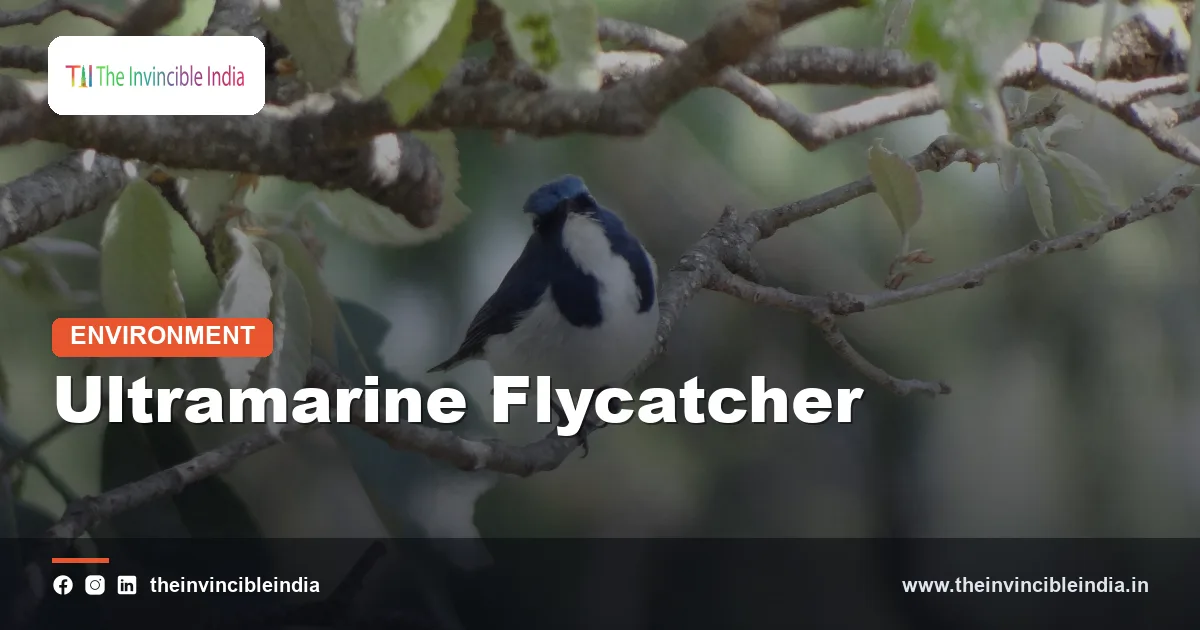
The ultramarine flycatcher (Ficedula superciliaris) is a tiny Himalayan songbird in which the male is deep ultramarine blue above and clean white below, and which breeds in mountain forests and winters in the foothills, gardens and wooded country of India. It is one of the smallest and most striking of the blue flycatchers, and many Indian birdwatchers meet it for the first time on a cold-weather trip to a hill station or a forest edge.
Because the species moves between high and low ground with the seasons, it is classed as an altitudinal migrant rather than a long-distance one. This article explains how to identify the bird, where it lives through the year, what it eats and how it breeds.
Quick Facts
| Common name | Ultramarine flycatcher |
|---|---|
| Scientific name | Ficedula superciliaris |
| Family | Muscicapidae (Old World flycatchers and chats) |
| Size | About 12 cm, a small, compact flycatcher |
| India range and habitat | Breeds in Himalayan forests across the hill states; winters at lower elevations in the foothills, wooded plains, orchards and gardens, with fewer birds farther south |
| Diet | Small insects caught in short sallies or picked from foliage |
| Breeding | Nests in a tree hole, stump, bank or crevice; usually 3 to 5 eggs; breeds in late spring and summer |
| Migration | Altitudinal migrant, moving down from the breeding hills in the cold season |
| Conservation status | Least Concern (IUCN) |
Key Takeaways
- The ultramarine flycatcher is a very small Old World flycatcher, about 12 cm long, belonging to the family Muscicapidae and the genus Ficedula.
- The male ultramarine flycatcher is deep blue above and white below, with a short white eyebrow stripe and white patches at the base of the tail.
- The female ultramarine flycatcher is greyish-brown above with a blue wash on the rump and tail, and has paler greyish underparts.
- The ultramarine flycatcher breeds in Himalayan forests and descends to the foothills, plains and gardens of India in winter as an altitudinal migrant.
- The ultramarine flycatcher feeds on small insects caught in brief aerial sallies from a low perch, and it often flicks or cocks its tail.
- The ultramarine flycatcher nests in a hole or crevice lined with moss and hair, and is classed as Least Concern worldwide.
What is the ultramarine flycatcher?
The ultramarine flycatcher is a small insect-eating songbird of the Himalayas, named for the intense blue of the adult male’s upperparts. It is one of the true Old World flycatchers, a large family that includes the chats, redstarts and robins, and it belongs to the genus Ficedula, which also contains the pied and slaty-blue flycatchers.
The species name superciliaris refers to the white eyebrow, or supercilium, that marks the male’s face. The bird is small and neat, with a rounded head, a fine bill and a short tail that it flicks as it perches. It is usually seen alone or in a pair, though in winter it may join mixed foraging flocks of small birds.
Within India, the ultramarine flycatcher is best known as a Himalayan breeder and a winter visitor to lower country. Its breeding range extends along the Himalayan arc across several hill states, and the species is also found beyond India in neighbouring mountain regions.
How can you identify an ultramarine flycatcher?
An ultramarine flycatcher can be identified by a very small size, a deep blue back, white underparts and a short white eyebrow in the male, with white patches at the sides of the tail base. The female is plainer, with a greyish-brown back and a blue tinge on the rump and tail.
The male’s blue is darker and richer than that of the paler verditer flycatcher and lacks the orange breast of Tickell’s blue flycatcher. The face is framed by a dark blue-black band that runs from the bill through the eye and down the side of the neck, and the white throat and belly stand out in contrast. Depending on the population, the breast sides may be washed with grey or blue.
The female has soft grey-brown upperparts, a buffy-white throat and a whitish belly, with pale edges on the wings. The only strong colour on her is the blue sheen on the rump and tail, which can be hard to see in poor light. Young birds are spotted with buff on a brown background.
Behaviour clues
- Perches low and upright on twigs, wires and fence posts.
- Flicks the tail and drops the wings slightly while perched.
- Makes short, sharp sallies to catch insects and returns to a perch.
- Gives a dry, ticking or rattling call, especially when disturbed.
Where does the ultramarine flycatcher live in India?
The ultramarine flycatcher lives in Himalayan forests during the breeding season and in lower foothills, wooded plains, orchards and gardens during the cold season. It is therefore a bird of the hills in summer and of lower, warmer ground in winter.
In the breeding season the bird occupies broadleaved and mixed forest at mid to high elevations, favouring shaded slopes with oaks, rhododendrons and a mix of tall trees and shrubs. When winter arrives, the bird descends. It can then be found in the foothills, the sub-Himalayan belt, wooded plains of the north and, in smaller numbers, in suitable habitat farther south in central and peninsular India.
The ultramarine flycatcher tends to prefer light woodland, forest edges, orchards, tea and coffee estates, and tree-rich gardens in winter. It is often found at modest heights, from the ground up to the lower branches of mid-sized trees, rather than in the high canopy.
Is the ultramarine flycatcher a migratory bird?
Yes, the ultramarine flycatcher is a migratory bird, but its migration is mainly altitudinal, meaning that it moves from higher breeding hills to lower ground in the cold season rather than travelling across continents. The movement is driven by the availability of insects, which fall in number in cold, high forests during winter.
The timing differs between years and places, though the general pattern is stable. Birds leave their breeding grounds in autumn and arrive in lower habitats by late autumn or early winter. They remain there through the cold months, and they return uphill in spring as temperatures rise and insect life increases in the mountains.
Altitudinal migration of this kind is common among Himalayan birds, and it has an interesting consequence for observers. A flycatcher that is rare or absent in a particular garden in summer may be a regular winter resident in the same garden. Records from lowland towns and cities in winter, therefore, often involve individuals that bred in distant mountains.
What does the ultramarine flycatcher eat?
The ultramarine flycatcher eats small insects and other tiny invertebrates, which it catches in the air or picks from leaves and twigs. Its diet includes flies, small beetles, moths, bugs and caterpillars, and in the breeding season it also feeds spiders and other small prey to its young.
Its feeding behaviour is the classic “sally” of a flycatcher. The bird sits on a low perch, watches for movement, flies out in a short dash to grab an insect and often returns to the same perch. In cooler weather, when insects are less active, it spends more time picking prey from foliage and the ground. It rarely eats plant material, although a bird may occasionally take a small berry.
Because the species depends on small insects, it is a useful participant in the natural control of insect populations in orchards and gardens during winter.
How does the ultramarine flycatcher breed?
The ultramarine flycatcher breeds in the Himalayan hills in late spring and summer, nesting in a hole or crevice in a tree, stump, bank or rock face. The female lays about three to five eggs in a neat cup of moss, fibre and hair.
The nest is lined with soft material such as fur, hair and fine plant down, which gives the eggs and chicks insulation in the cool mountain climate. The female usually incubates the eggs, while the male guards the territory, sings and brings food. Both parents feed the nestlings with insects, and the young leave the nest after about two weeks.
Eggs are pale and finely speckled. The breeding season generally runs from about May to July at the elevations where the species nests, though the timing varies with altitude and spring weather. High, cold sites warm up late, so birds at the upper end of the range may breed later than those on lower slopes.
Breeding at a glance
- Habitat: shaded, broadleaved or mixed hill forest.
- Nest site: hole, crevice, bank or stump.
- Nest material: moss, fibre, hair and down.
- Clutch: usually 3 to 5 eggs.
- Season: late spring and summer in the Himalayas.
How is the ultramarine flycatcher different from other blue flycatchers?
The ultramarine flycatcher differs from other blue flycatchers of India mainly in its deep blue-and-white pattern, its very small size and the white eyebrow of the male. Other blue flycatchers are generally larger or have different breast colours, and the table below compares three that are often seen in similar habitats.
| Species | Male colour | Breast and belly | Usual setting |
|---|---|---|---|
| Ultramarine flycatcher | Deep ultramarine blue above | White | Himalayan forests; winters in foothills and gardens |
| Verditer flycatcher | Turquoise-blue all over | Blue-green, with a dark patch at the bill base | Hill and plains forests, gardens |
| Tickell’s blue flycatcher | Blue above | Orange throat and breast, paler belly | Peninsular and eastern forests, scrub |
The simplest check is the underside. A small blue-backed flycatcher with a clean white belly and no orange or turquoise below is likely to be an ultramarine flycatcher. The slaty-blue flycatcher, another Himalayan species, is duller slate-blue with a whitish throat and belly and a less intense colour.
Where and when can you see the ultramarine flycatcher?
The best place and time to see an ultramarine flycatcher is the lower Himalayan hills and foothills in the cold season, from about late autumn to early spring, when birds from higher forests are present. Hill stations, forest edges, orchards and wooded gardens in the north are good places to look.
- Search low branches, wires and fence lines in sunny patches in the morning.
- Listen for a dry ticking or rattling call to locate the bird.
- Check any small blue-and-white bird for the male’s deep blue back and white eyebrow.
- Look for the female by the blue sheen on her rump and tail as she flies.
- Watch from a distance and avoid disturbing birds near nest holes in summer.
Visitors to Himalayan towns often find that a quiet walk along an oak or rhododendron forest path in the breeding season gives views of singing males, while winter walks at lower elevations give a better chance of seeing the species at close range.
Is the ultramarine flycatcher threatened?
The ultramarine flycatcher is not currently threatened and is classed as Least Concern by the International Union for Conservation of Nature (IUCN), because it has a large range and a stable overall population. Its fortunes nevertheless depend on the condition of Himalayan forests and the lower habitats that it uses in winter.
Loss of broadleaved forest in the hills, clearing of understorey, and the conversion of wooded foothills to intensive agriculture can reduce the habitat available. Because the species moves between altitudes, it needs a connected chain of forest from the high breeding zones to the winter sites. Protected areas in the Himalayas and wooded gardens in the plains both help to provide that chain.
How does the ultramarine flycatcher behave through the year?
The ultramarine flycatcher behaves as a territorial, vocal breeder in the hills during summer and as a quiet, solitary forager in the lowlands during winter. The change in behaviour follows the change in habitat and the demands of the breeding season.
In the breeding season the male sings from a perch within his territory and defends it against rivals, while the pair builds a nest and raises young. The song is a thin, high-pitched series of notes that blends into the sounds of the mountain forest. In winter, birds are usually silent apart from a dry call note, and each bird tends to hold a small winter feeding area, such as a corner of an orchard or a stretch of fence line, to which it returns day after day.
This habit of site fidelity is useful to birdwatchers. A bird found in a particular garden on one winter day is often present on later days, and the same site may host the bird again in the following winter.
Bottom Line
The ultramarine flycatcher is a tiny, deep-blue Himalayan songbird that links mountain forests and lowland gardens through its seasonal movements. Retaining oak and rhododendron forest in the hills and tree cover in the foothills keeps the species secure.
Frequently Asked Questions
What is an ultramarine flycatcher?
An ultramarine flycatcher is a tiny Himalayan songbird in which the male is deep blue above and white below. It belongs to the Old World flycatcher family and measures about 12 cm.
Where does the ultramarine flycatcher live in India?
The ultramarine flycatcher breeds in Himalayan forests and winters in the lower foothills, wooded plains, orchards and gardens. A few birds reach further south in central and peninsular India.
Is the ultramarine flycatcher a migrant?
Yes, the ultramarine flycatcher is an altitudinal migrant that moves from higher breeding hills to lower ground in the cold season. It does not usually make long continental journeys.
How can I tell an ultramarine flycatcher from a verditer flycatcher?
An ultramarine flycatcher is smaller and deep blue above with a clean white belly, while a verditer flycatcher is larger and turquoise-blue all over. The ultramarine male also shows a short white eyebrow that the verditer lacks.
What does the ultramarine flycatcher eat?
The ultramarine flycatcher eats small insects such as flies, beetles, moths and caterpillars. It catches them in short sallies from a low perch or picks them from foliage.
Where does the ultramarine flycatcher nest?
The ultramarine flycatcher nests in a hole or crevice in a tree, stump, bank or rock face in Himalayan forest. The cup is lined with moss, hair and down and holds about three to five eggs.
{“@context”:”https://schema.org”,”@graph”:[{“@type”:”FAQPage”,”mainEntity”:[{“@type”:”Question”,”name”:”What is an ultramarine flycatcher?”,”acceptedAnswer”:{“@type”:”Answer”,”text”:”An ultramarine flycatcher is a tiny Himalayan songbird in which the male is deep blue above and white below. It belongs to the Old World flycatcher family and measures about 12 cm.”}},{“@type”:”Question”,”name”:”Where does the ultramarine flycatcher live in India?”,”acceptedAnswer”:{“@type”:”Answer”,”text”:”The ultramarine flycatcher breeds in Himalayan forests and winters in the lower foothills, wooded plains, orchards and gardens. A few birds reach further south in central and peninsular India.”}},{“@type”:”Question”,”name”:”Is the ultramarine flycatcher a migrant?”,”acceptedAnswer”:{“@type”:”Answer”,”text”:”Yes, the ultramarine flycatcher is an altitudinal migrant that moves from higher breeding hills to lower ground in the cold season. It does not usually make long continental journeys.”}},{“@type”:”Question”,”name”:”How can I tell an ultramarine flycatcher from a verditer flycatcher?”,”acceptedAnswer”:{“@type”:”Answer”,”text”:”An ultramarine flycatcher is smaller and deep blue above with a clean white belly, while a verditer flycatcher is larger and turquoise-blue all over. The ultramarine male also shows a short white eyebrow that the verditer lacks.”}},{“@type”:”Question”,”name”:”What does the ultramarine flycatcher eat?”,”acceptedAnswer”:{“@type”:”Answer”,”text”:”The ultramarine flycatcher eats small insects such as flies, beetles, moths and caterpillars. It catches them in short sallies from a low perch or picks them from foliage.”}},{“@type”:”Question”,”name”:”Where does the ultramarine flycatcher nest?”,”acceptedAnswer”:{“@type”:”Answer”,”text”:”The ultramarine flycatcher nests in a hole or crevice in a tree, stump, bank or rock face in Himalayan forest. The cup is lined with moss, hair and down and holds about three to five eggs.”}}]}]}


