

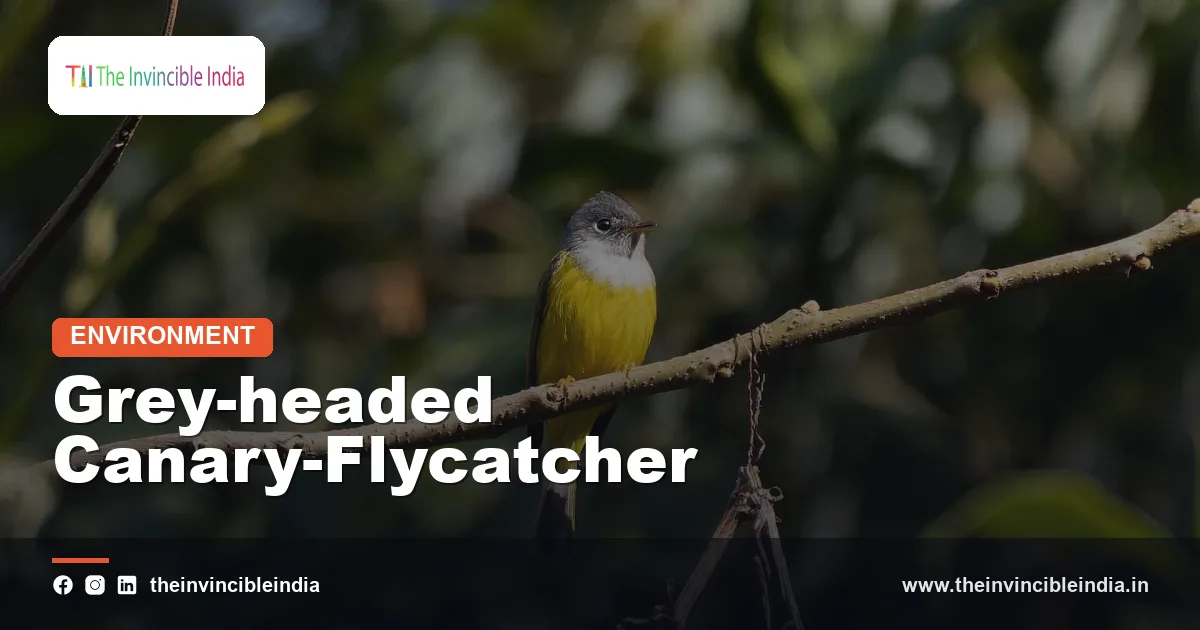
The grey-headed canary-flycatcher (Culicicapa ceylonensis) is a tiny, restless songbird of Indian hill forests, easily recognised by its grey hood, olive-green back and bright yellow belly. It darts out from a perch to snatch insects in mid-air, often joins mixed flocks of forest birds and sings a lively, ringing whistle that carries well through the trees.
The bird is widespread across the Himalayas, the northeast and the hills of peninsular India, where it is among the most commonly encountered small birds of cool, shaded woods. This article explains how to identify it, where it lives through the year, what it eats and how it breeds.
Quick Facts
| Common name | Grey-headed canary-flycatcher (also grey-headed flycatcher) |
|---|---|
| Scientific name | Culicicapa ceylonensis |
| Family | Stenostiridae (fairy flycatchers and canary-flycatchers) |
| Size | About 12 to 13 cm, a small, slim bird with a short crest |
| India range and habitat | Himalayan forests, the northeast, the Western and Eastern Ghats and other peninsular hills; shaded broadleaved forest, forest edges, wooded gardens and plantations |
| Diet | Small flying insects caught in aerial sallies, and insects gleaned from foliage |
| Breeding | Cup nest of moss in a bank, rock crevice, root tangle or tree hole; usually 3 or 4 eggs; breeds in spring and summer |
| Migration | Altitudinal migrant in the Himalayas; largely resident in the southern hills |
| Conservation status | Least Concern (IUCN) |
Key Takeaways
- The grey-headed canary-flycatcher is a small bird of the family Stenostiridae, not a true Old World flycatcher, although it hunts insects in the same way.
- The grey-headed canary-flycatcher has a grey head, throat and upper breast, an olive-green back and a bright yellow belly, and both sexes look alike.
- The grey-headed canary-flycatcher is found in hill forests across the Himalayas, the northeast and the Western and Eastern Ghats, and it extends into Sri Lanka and Southeast Asia.
- The grey-headed canary-flycatcher catches insects in short aerial sallies from an upright perch and is a regular member of mixed hunting flocks.
- The grey-headed canary-flycatcher sings a repeated, clear, ringing whistle and also gives sharp, thin contact calls.
- The grey-headed canary-flycatcher builds a mossy cup nest in a bank, crevice or hollow and is classified as Least Concern worldwide.
What is the grey-headed canary-flycatcher?
The grey-headed canary-flycatcher is a small insect-eating songbird of Asian hill forests, classified in the family Stenostiridae, a small group of flycatcher-like birds. The name “canary” refers to the yellow underside, while “flycatcher” describes its habit of catching insects on the wing.
The bird has been known by several names, including grey-headed flycatcher, and older books placed it among the Old World flycatchers of the family Muscicapidae. Modern genetic studies placed the genus Culicicapa in Stenostiridae, which also contains the fairy flycatchers of Africa. The genus name Culicicapa broadly means “gnat catcher”, a reference to the bird’s small prey.
The species is common and widely distributed, and it occupies a large range from the western Himalayas through the Indian subcontinent and Southeast Asia to the Greater Sunda Islands. The specific name ceylonensis points to Sri Lanka, where the bird is also found.
How can you identify a grey-headed canary-flycatcher?
A grey-headed canary-flycatcher can be identified by its grey head and breast, olive-green upperparts, bright yellow belly and flanks, a small peaked crest and a very upright posture. The sexes are alike, which means that every adult shows the same neat colours.
The hood is a cool slate-grey that covers the head, nape, throat and upper breast, and it contrasts sharply with the yellow underparts that begin at the lower breast. The back and wings are olive-green, the tail is dusky olive and the bill is dark above and paler below. The head often shows a slight crest that gives it a peaked outline, and the eye is dark.
Young birds resemble adults but are duller and show buffy tips on the wing feathers. In flight, the bird looks like a small, round-winged yellow-and-grey blur with short, quick dashes between perches.
Identification checklist
- Grey hood that extends to the upper breast.
- Olive-green back and wings.
- Bright yellow belly and flanks.
- Small crest and an alert, upright stance.
- Frequent tail fanning, flicking and short aerial sallies.
Where does the grey-headed canary-flycatcher live in India?
The grey-headed canary-flycatcher lives in shaded hill and mountain forests across India, from the Himalayan range and the northeast to the Western Ghats, Eastern Ghats and other peninsular hills. It prefers broadleaved forest with a moist, cool microclimate.
In the Himalayas, the species is a typical bird of the oak, rhododendron and mixed forests at mid-elevations, and it is also found in lower sal forest and hill gardens. In the south, it occurs in the evergreen and moist deciduous forests of the Western Ghats, the Nilgiris and the Eastern Ghats, and in cardamom and coffee estates that retain shade trees. The bird is particularly numerous in forest that is rich in mossy trunks and streams.
Away from the hills, a grey-headed canary-flycatcher may be seen in winter in the plains near the Himalayas and in wooded areas of the peninsula, where visiting birds mix with resident ones. The species may therefore appear in suburban gardens, particularly in the cold season.
Movements by region
| Region | Status | Typical pattern |
|---|---|---|
| Himalayas | Breeder and altitudinal migrant | Nests in hill forests in summer and moves downhill in the cold season |
| Northeast India | Resident and winter visitor | Common in hill forest, with some movement to lower ground |
| Western Ghats | Mostly resident | Present through the year in shaded forest and estates |
| Eastern Ghats and peninsular hills | Resident and local visitor | Present in suitable forest, with seasonal local shifts |
Does the grey-headed canary-flycatcher migrate?
The grey-headed canary-flycatcher migrates only locally, since populations that breed in the Himalayas move to lower elevations in winter, while birds in the southern hills are largely resident. The movement is a change of altitude, not a long journey between countries.
Cold, snowy weather reduces the supply of flying insects in high forests, so Himalayan birds move to warmer valleys, foothills and plains where food remains available. They return to the hills in spring, in time to claim territories and nest. The result is that the number of grey-headed canary-flycatchers seen at a given altitude changes noticeably with the seasons.
In the Western Ghats and other peninsular hills, the climate is mild enough that birds can remain in the same area, although some move between higher and lower slopes or shift in response to rain and flowering patterns. Observers who record the species through the year can detect these subtle movements.
What does the grey-headed canary-flycatcher eat?
The grey-headed canary-flycatcher eats small flying insects, such as flies, gnats, midges and small moths, which it catches in the air, and it also picks beetles, caterpillars and spiders from leaves. Insects form nearly all of its diet.
The bird typically sits upright on an exposed twig, watches the surrounding space, then dashes out with a snap of the bill to capture an insect before returning to the same perch or a nearby one. It often fans its tail and flicks its wings between sallies. It frequently hunts near streams, clearings and forest edges where insects are abundant.
Because it feeds on gnats and other tiny flies, the canary-flycatcher helps to control small insect populations in shaded woodland. Its active, conspicuous behaviour also makes it a good guide to the health of the understorey, which supports the insects on which it relies.
Why does the grey-headed canary-flycatcher join mixed flocks?
The grey-headed canary-flycatcher joins mixed-species flocks because such flocks help the bird to find insects more easily and to detect predators sooner. A mixed hunting party contains babblers, warblers, tits, minivets, drongos and other small birds that move together through the forest.
As the flock advances, birds that glean foliage flush out insects that are then snapped up by sallying species such as the canary-flycatcher. In addition, the group has many pairs of eyes, which makes it more likely that a hawk or other danger will be noticed early. Flocks are especially common in the non-breeding season, when territorial defence is relaxed.
Birdwatchers value these flocks because they bring many species into view at once. If a canary-flycatcher is spotted at the edge of a moving flock, there is a good chance that several other forest birds are close by, and patient observation often yields a long list.
What does the grey-headed canary-flycatcher sound like?
The grey-headed canary-flycatcher gives a clear, ringing, repeated whistle as its song, usually a rhythmic phrase of sweet notes that rises and falls, along with thin, sharp contact calls. The song is loud for such a small bird and is often the first clue to its presence.
Males sing from open perches, often in the early morning and at the start of the breeding season, and the song can be repeated many times. The pattern is sometimes rendered as a fast series of whistles ending on a higher note. Contact notes are short and thin and are used to keep birds in touch within a foraging flock.
The loud voice makes the canary-flycatcher easy to detect even in thick foliage, which is useful in the hills where visibility is poor. Learning the song and call gives birdwatchers a quick method of surveying the species.
How does the grey-headed canary-flycatcher breed?
The grey-headed canary-flycatcher breeds by building a small cup nest of moss in a sheltered spot such as a bank, rock crevice, root tangle or tree hollow, where the female lays about three or four eggs. The season runs from spring into summer, with timing that shifts with altitude and region.
The nest is a neat, rounded cup of moss, with a lining of fine roots, fibres and hair, often hidden on a mossy bank beside a path or stream. The eggs are whitish with fine reddish or brown speckling. Incubation is mainly by the female, and both parents feed the nestlings with small insects. The young leave the nest after around two weeks and are fed for a short while after fledging.
Because the nest is placed low and in cool, mossy surroundings, it is vulnerable to disturbance by people and livestock. Leaving banks and mossy slopes undisturbed helps nesting success.
Breeding at a glance
- Nest site: mossy bank, crevice, root tangle or hollow.
- Nest material: moss, fine roots, fibre and hair.
- Clutch: usually 3 or 4 eggs.
- Season: spring and summer, varying by altitude.
- Care of young: both parents feed the chicks.
Is the grey-headed canary-flycatcher threatened?
The grey-headed canary-flycatcher is not threatened and is assessed as Least Concern by the International Union for Conservation of Nature (IUCN), because it has a very large range and a healthy population. It remains common in many hill forests and tolerates some human-modified habitats.
The bird is adaptable and uses shade plantations, gardens and forest edges as well as intact forest. Even so, clearing of hill forests, loss of moist, mossy habitats and the removal of shade trees from estates can reduce local numbers. Maintaining native tree cover along streams and slopes helps to keep the species in the landscape.
Is the grey-headed canary-flycatcher a warbler?
No, the grey-headed canary-flycatcher is not a warbler, although it is often mistaken for one by beginners because of its small size, olive back and active habits. It belongs to a different family, Stenostiridae, and its posture and feeding method differ clearly from those of leaf warblers.
Leaf warblers typically hold a horizontal posture, flick their wings and glean insects from leaves in constant motion. The canary-flycatcher sits bolt upright on an exposed perch, wears a distinct grey hood, shows bright yellow underparts and makes aerial sallies to catch prey. Its peaked crest and the habit of fanning the tail provide further clues.
The comparison is worthwhile because both groups often share the same mixed flocks. Seeing the two side by side shows how closely related feeding niches can be divided between species, with warblers working the leaves while the canary-flycatcher watches for flying insects.
Bottom Line
The grey-headed canary-flycatcher is a bright, vocal and approachable bird of Indian hill forests, recognised by its grey hood and yellow belly. It remains common and secure, and watching its sallies is one of the pleasures of a walk in shaded hill woodland.
Frequently Asked Questions
What is a grey-headed canary-flycatcher?
A grey-headed canary-flycatcher is a small insect-eating bird of Asian hill forests with a grey head, olive-green back and bright yellow belly. It belongs to the family Stenostiridae and hunts by sallying after flying insects.
Where is the grey-headed canary-flycatcher found in India?
The grey-headed canary-flycatcher is found in hill forests across the Himalayas, the northeast, the Western Ghats, the Eastern Ghats and other peninsular hills. It prefers shaded broadleaved forest and wooded estates.
Is the grey-headed canary-flycatcher the same as the grey-headed flycatcher?
Yes, the grey-headed canary-flycatcher is the same species as the grey-headed flycatcher, which is an older and shorter name. The scientific name is Culicicapa ceylonensis.
Does the grey-headed canary-flycatcher migrate?
The grey-headed canary-flycatcher migrates only locally. Himalayan birds move to lower elevations in winter, while those in the southern hills are largely resident.
What does the grey-headed canary-flycatcher eat?
The grey-headed canary-flycatcher eats small flying insects such as flies, gnats and small moths, which it catches in short aerial sallies. It also picks beetles, caterpillars and spiders from leaves.
How can I tell the male from the female grey-headed canary-flycatcher?
You cannot easily tell them apart, because the male and female grey-headed canary-flycatcher look alike, both with a grey hood and a yellow belly. Only behaviour, such as singing from a perch, offers a clue to the male.
{“@context”:”https://schema.org”,”@graph”:[{“@type”:”FAQPage”,”mainEntity”:[{“@type”:”Question”,”name”:”What is a grey-headed canary-flycatcher?”,”acceptedAnswer”:{“@type”:”Answer”,”text”:”A grey-headed canary-flycatcher is a small insect-eating bird of Asian hill forests with a grey head, olive-green back and bright yellow belly. It belongs to the family Stenostiridae and hunts by sallying after flying insects.”}},{“@type”:”Question”,”name”:”Where is the grey-headed canary-flycatcher found in India?”,”acceptedAnswer”:{“@type”:”Answer”,”text”:”The grey-headed canary-flycatcher is found in hill forests across the Himalayas, the northeast, the Western Ghats, the Eastern Ghats and other peninsular hills. It prefers shaded broadleaved forest and wooded estates.”}},{“@type”:”Question”,”name”:”Is the grey-headed canary-flycatcher the same as the grey-headed flycatcher?”,”acceptedAnswer”:{“@type”:”Answer”,”text”:”Yes, the grey-headed canary-flycatcher is the same species as the grey-headed flycatcher, which is an older and shorter name. The scientific name is Culicicapa ceylonensis.”}},{“@type”:”Question”,”name”:”Does the grey-headed canary-flycatcher migrate?”,”acceptedAnswer”:{“@type”:”Answer”,”text”:”The grey-headed canary-flycatcher migrates only locally. Himalayan birds move to lower elevations in winter, while those in the southern hills are largely resident.”}},{“@type”:”Question”,”name”:”What does the grey-headed canary-flycatcher eat?”,”acceptedAnswer”:{“@type”:”Answer”,”text”:”The grey-headed canary-flycatcher eats small flying insects such as flies, gnats and small moths, which it catches in short aerial sallies. It also picks beetles, caterpillars and spiders from leaves.”}},{“@type”:”Question”,”name”:”How can I tell the male from the female grey-headed canary-flycatcher?”,”acceptedAnswer”:{“@type”:”Answer”,”text”:”You cannot easily tell them apart, because the male and female grey-headed canary-flycatcher look alike, both with a grey hood and a yellow belly. Only behaviour, such as singing from a perch, offers a clue to the male.”}}]}]}


