

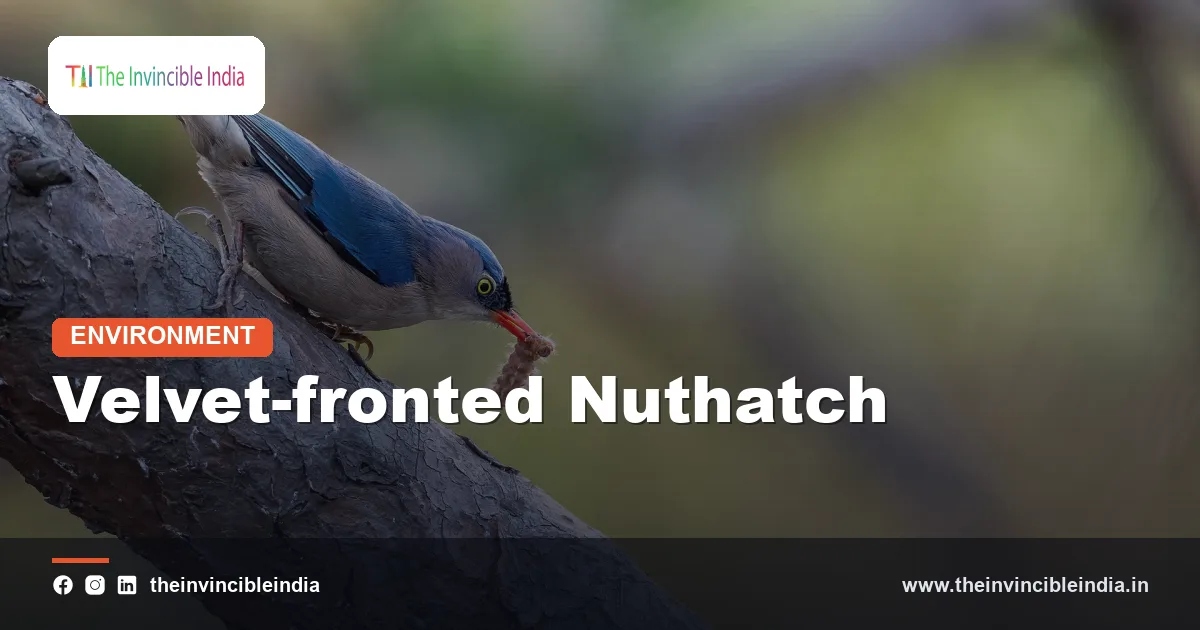
The velvet-fronted nuthatch (Sitta frontalis) is a small, violet-blue forest songbird of the family Sittidae that is known for creeping head-down along tree trunks and branches in search of insects. A resident of Indian woodland from the Himalayan foothills to the southern peninsula, the velvet-fronted nuthatch is easy to recognise by its coral-red bill, pale yellow eye and the black velvety patch on its forehead that gives the bird its name.
Although it measures only about a dozen centimetres, the velvet-fronted nuthatch is among the most active and confiding birds of a mixed forest flock. This article explains how to identify the species, where it lives in India, what it eats, how it nests and why a bird this small still matters to the health of a forest.
| Fact | Detail |
|---|---|
| Common name | Velvet-fronted nuthatch |
| Scientific name | Sitta frontalis |
| Family | Sittidae (nuthatches) |
| Size | About 10 to 12 cm long; a short, square tail and a compact body |
| Range and habitat in India | Moist and dry deciduous forest, evergreen forest edges, wooded hills and well-treed plantations in the Himalayan foothills, the northeast, the Western Ghats, the Eastern Ghats and peninsular India |
| Diet | Mainly insects, spiders and their eggs and larvae picked from bark; occasionally seeds and small fruit |
| Breeding | Nests in a tree cavity lined with soft material, mostly in spring and early summer; both parents feed the young |
| Conservation status | Least Concern on the IUCN Red List; protected under the Wildlife (Protection) Act, 1972 |
Key Takeaways
- The velvet-fronted nuthatch is a 10 to 12 cm songbird with violet-blue upperparts, a coral-red bill and a pale yellow eye.
- The black velvety forehead of the velvet-fronted nuthatch gives the species its name, and only the male also has a black stripe running above the eye.
- Unlike woodpeckers, the velvet-fronted nuthatch does not brace itself with its tail and can walk head-first down a vertical trunk.
- The velvet-fronted nuthatch feeds mainly on insects and spiders gleaned from bark crevices and is a regular member of mixed-species forest flocks.
- The velvet-fronted nuthatch nests in a tree hole and is listed as Least Concern by the IUCN because it occupies a very wide range.
- Loss of old trees with natural holes is the most practical threat to the velvet-fronted nuthatch, since the bird depends on cavities to breed.
What is the velvet-fronted nuthatch?
The velvet-fronted nuthatch is a small insect-eating forest bird belonging to the nuthatch family, Sittidae, and its scientific name is Sitta frontalis. The word “nuthatch” comes from the old habit, noted in European species, of wedging a nut into a crack and hacking it open with the bill. The Indian species is more insectivorous than nut-cracking, but it shares the same sturdy, chisel-like bill and strong feet.
The family is found across the Northern Hemisphere and into Southeast Asia, and India hosts several species, most of them in the Himalaya. The velvet-fronted nuthatch is the nuthatch most likely to be met by a birdwatcher in the peninsular and lowland forests of the country, which makes it the “everyday” nuthatch of Indian woodland.
The species is a true resident. It does not undertake long migrations and a pair usually remains within a familiar patch of forest through the year, moving only short distances with the seasons or with the availability of food.
Where does the name come from?
The name describes the forehead. In an adult, the feathers just above the bill are short, dense and glossy black, and they look like a patch of velvet against the surrounding blue. In the male, this black extends in a narrow band above and behind the eye, forming a thin stripe.
How can you identify the velvet-fronted nuthatch?
The velvet-fronted nuthatch can be identified by its violet-blue back, lilac-buff underparts, bright coral-red bill with a yellow tip, pale yellow eye and black forehead patch. No other small Indian forest bird combines a red bill with a blue body, so a clear view is usually enough for a confident identification.
The upperparts of an adult are a rich purplish or cobalt blue that can look almost violet in good light and slate in shade. The underparts are paler, a soft lilac-pink or buffy-lilac, and the throat is a lighter, whitish tone. The tail is short and square, and the bird has a compact, almost neckless shape.
How are males, females and young birds different?
The two sexes look alike except for the black stripe above the eye, which is present in the male and missing in the female. Young birds are duller, with a less saturated blue and a bill that is not yet the bright coral of an adult.
| Feature | Adult male | Adult female | Young bird |
|---|---|---|---|
| Forehead | Black velvety patch | Black velvety patch | Duller and less defined |
| Stripe above the eye | Present, black | Absent | Absent |
| Bill | Bright coral-red | Bright coral-red | Duller, less red |
| Upperparts | Violet-blue | Violet-blue | Paler, less glossy |
| Underparts | Lilac-buff | Lilac-buff | Dull buff |
Which birds can it be confused with?
The most useful comparison is with other nuthatches. The chestnut-bellied nuthatch is blue-grey above and warm chestnut below, so it lacks the lilac belly, the red bill and the black forehead. The white-tailed nuthatch of the Himalaya has a dark bill and a white patch at the base of the tail. Treecreepers and woodpeckers also work trunks, but they are brown or boldly patterned and they press their tails against the bark for support.
Where does the velvet-fronted nuthatch live in India?
The velvet-fronted nuthatch lives in forests across most of peninsular India, along the Himalayan foothills and in the northeast, and it is absent from the driest north-western regions. Within this range it favours broadleaved forest rather than open grassland or treeless farmland.
In the Western Ghats, the Eastern Ghats and the central Indian hills, the bird is a familiar sight in deciduous and semi-evergreen forest. In the north, it occurs in the lower hills and sal forests at the base of the Himalaya and ranges eastward into the hill forests of the northeast. Outside India, the species continues through Sri Lanka, Myanmar and the wider Southeast Asian forests, and it extends onto some Indonesian islands.
What kind of habitat does it prefer?
The velvet-fronted nuthatch prefers mature woodland with large trees that have rough, crevice-rich bark. It uses moist and dry deciduous forest, the edges of evergreen forest, forested hill slopes and sometimes well-wooded plantations or old orchards. Most records are from lower elevations, although the bird follows suitable forest up into the hills of the Himalayan foothills and the Western Ghats.
- Deciduous forest, including teak and sal forest, where tall trunks offer plenty of bark to search.
- Semi-evergreen and evergreen forest edges, where light reaches the trunks and insects are abundant.
- Wooded hill slopes and ravines with old, large trees.
- Large shade trees in old plantations and the better-wooded parts of village groves near forest.
How does the velvet-fronted nuthatch climb trees head-first?
The velvet-fronted nuthatch climbs by gripping the bark with long, strong toes and sharp claws, which lets it move up, down and sideways without using its tail as a prop. This is the main difference between a nuthatch and a woodpecker or a treecreeper, which are stiff-tailed climbers that normally move only upwards.
A nuthatch’s feet do the work. The toes are long and the hind toe is particularly large, and each claw is curved and sharp. When the bird descends a trunk it turns the body and places the feet ahead and below it, hanging by the claws as it inspects the bark. Because it looks at the trunk from the opposite direction to a bird moving upwards, it sees insects and eggs in crevices that a woodpecker or treecreeper may miss.
Why is head-first climbing useful?
Head-first climbing gives the velvet-fronted nuthatch access to food that other bark-foraging birds leave behind. Insects tend to hide in cracks that face downwards or sit on the underside of branches, and a bird that approaches from above and from below can search them both. The bird often moves in short, jerky hops, pauses to tap or probe a crevice and then continues along the trunk or out along a branch.
What does the velvet-fronted nuthatch eat?
The velvet-fronted nuthatch eats mostly small insects and spiders that it finds in the bark of trees. Beetles, ants, caterpillars, bugs, insect eggs and pupae are all taken, and the bird will sometimes feed on small seeds or soft fruit when animal prey is scarce.
The bill is short, straight and strong, and it is used both to probe crevices and to pry loose pieces of bark. A nuthatch may also tap a crack to flush out the occupant. In this way the species removes many insects that are otherwise hard for other birds to reach.
How does it forage with other birds?
The velvet-fronted nuthatch often joins mixed-species foraging flocks, which are loose groups of birds that move through the forest together. Such a flock may include tits, warblers, drongos, flycatchers, woodpeckers and babblers. The members use different levels of the forest and different search methods, so the flock covers more ground than a single bird could, and extra eyes help to notice predators. The nuthatch is an expert on the trunks and larger limbs, while its companions work the foliage, twigs and open air.
How does the velvet-fronted nuthatch breed?
The velvet-fronted nuthatch breeds in a hollow in a tree, usually in the spring and early summer, and both parents take part in raising the brood. The exact timing varies with region and rainfall, but the main season in much of India falls in the drier, warmer months before the monsoon.
The nest is placed in a natural hole, an abandoned woodpecker or barbet hole, or a cavity that the pair enlarges in soft, decaying wood. Nuthatches as a group are known for narrowing the entrance to the nest with mud so that larger birds and predators cannot enter, and the cavity is lined with soft material such as moss, fibres, feathers and fine bark. The eggs are small and pale, and the clutch is small, commonly four or five.
What is the nesting sequence?
- The pair selects a cavity in a trunk or a large branch, usually at a modest height above the ground.
- The nest chamber is padded with soft material, and the entrance may be reduced in size.
- The female incubates the eggs while the male brings food and defends the territory.
- After hatching, both parents carry insects to the nestlings until they are ready to leave the hole.
- Fledged young stay with their parents for a while and learn to forage along the trunks.
What does the velvet-fronted nuthatch sound like?
The velvet-fronted nuthatch has a sharp, ringing voice made up of short chirps and trilling notes, and it is often heard before it is seen. The most common call is a rapid, chittering trill that sounds like a quick string of metallic notes, along with a sharp, repeated “chit” that carries well through the trees.
Birdwatchers often find the species by following this call. Because the bird moves along trunks and branches, the sound tends to come from mid-height rather than from the canopy. During the breeding season, the pair keep in contact with soft calls, and the male may give a louder, more persistent song to advertise the territory.
Is the velvet-fronted nuthatch threatened?
The velvet-fronted nuthatch is not threatened globally and is classified as Least Concern by the International Union for Conservation of Nature (IUCN). The species has a very large range and is reasonably common in suitable forest, and in India it is also covered by the Wildlife (Protection) Act, 1972.
The bird still depends on the survival of mature trees. It needs cavities for nesting and rough bark for feeding, and so it is sensitive to logging of old trees, the clearing of forest for plantations and the removal of dead or hollow trunks. The practical lesson is that a single standing dead tree can be worth protecting, because it may offer a cavity to nuthatches, barbets, owls and other hole-nesting species.
Why does a small bird matter to a forest?
The velvet-fronted nuthatch matters because it controls bark-dwelling insects and acts as an indicator of mature woodland. A forest that supports nuthatches usually has old trees, a healthy insect community and cavities for other wildlife. The species is also a good teaching bird, since its head-first climbing and bright colours attract the attention of new birdwatchers.
Where and how can you see a velvet-fronted nuthatch?
The best way to see a velvet-fronted nuthatch is to walk slowly through a deciduous or semi-evergreen forest in the early morning and to scan tree trunks at mid-height. Listen for the metallic trill, look for a small blue bird moving along bark and check any mixed flock that passes through.
- Visit in the morning, when the birds are most active and forest flocks are moving.
- Scan the trunks and large limbs rather than the leaves; the bird spends little time in the open foliage.
- Use binoculars, because the bird is small and often high on a trunk.
- Follow mixed-species flocks, since the nuthatch usually travels with them.
- Stay quiet and keep movements slow; the species is fairly tolerant but will move off if approached suddenly.
Many of India’s national parks, wildlife sanctuaries and forested hill stations hold the species, and it is a good bird to look for on a forest walk in the Western Ghats, the central Indian forests and the lower Himalayan hills.
Bottom Line
The velvet-fronted nuthatch is a small, colourful and widely distributed forest resident of India that climbs trees head-first and feeds on bark insects. It is not threatened, but it relies on mature trees with cavities, so the protection of old woodland is the surest way to keep it common.
Frequently Asked Questions
What is a velvet-fronted nuthatch?
A velvet-fronted nuthatch is a small songbird, Sitta frontalis, that lives in the forests of India and Southeast Asia. It has a violet-blue back, a coral-red bill, a pale yellow eye and a black velvety forehead. It forages on tree trunks, often moving head-first down the bark.
How big is the velvet-fronted nuthatch?
The velvet-fronted nuthatch is about 10 to 12 cm long. It has a compact body and a short, square tail. Its small size is one reason it is easily missed unless the observer listens for its call.
How do I tell a male velvet-fronted nuthatch from a female?
The male has a black stripe above and behind the eye, and the female does not. Both sexes share the black forehead, the violet-blue back and the coral-red bill. Young birds are duller than either adult.
What does the velvet-fronted nuthatch eat?
The velvet-fronted nuthatch eats mainly insects and spiders gathered from tree bark. It takes beetles, ants, caterpillars, eggs and pupae, and it may also eat small seeds or soft fruit when insects are scarce. It often forages with other forest birds in mixed flocks.
Where is the velvet-fronted nuthatch found in India?
The velvet-fronted nuthatch is found in forests across peninsular India, the Western and Eastern Ghats, the Himalayan foothills and the northeast. It avoids the driest north-western regions and treeless open country. Outside India it occurs in Sri Lanka and Southeast Asia.
Is the velvet-fronted nuthatch endangered?
No, the velvet-fronted nuthatch is not endangered and is classified as Least Concern by the IUCN. It has a large range and is fairly common in suitable forest. It still needs old trees with cavities, so loss of mature woodland is the main long-term concern.
{“@context”:”https://schema.org”,”@graph”:[{“@type”:”FAQPage”,”mainEntity”:[{“@type”:”Question”,”name”:”What is a velvet-fronted nuthatch?”,”acceptedAnswer”:{“@type”:”Answer”,”text”:”A velvet-fronted nuthatch is a small songbird, Sitta frontalis, that lives in the forests of India and Southeast Asia. It has a violet-blue back, a coral-red bill, a pale yellow eye and a black velvety forehead. It forages on tree trunks, often moving head-first down the bark.”}},{“@type”:”Question”,”name”:”How big is the velvet-fronted nuthatch?”,”acceptedAnswer”:{“@type”:”Answer”,”text”:”The velvet-fronted nuthatch is about 10 to 12 cm long. It has a compact body and a short, square tail. Its small size is one reason it is easily missed unless the observer listens for its call.”}},{“@type”:”Question”,”name”:”How do I tell a male velvet-fronted nuthatch from a female?”,”acceptedAnswer”:{“@type”:”Answer”,”text”:”The male has a black stripe above and behind the eye, and the female does not. Both sexes share the black forehead, the violet-blue back and the coral-red bill. Young birds are duller than either adult.”}},{“@type”:”Question”,”name”:”What does the velvet-fronted nuthatch eat?”,”acceptedAnswer”:{“@type”:”Answer”,”text”:”The velvet-fronted nuthatch eats mainly insects and spiders gathered from tree bark. It takes beetles, ants, caterpillars, eggs and pupae, and it may also eat small seeds or soft fruit when insects are scarce. It often forages with other forest birds in mixed flocks.”}},{“@type”:”Question”,”name”:”Where is the velvet-fronted nuthatch found in India?”,”acceptedAnswer”:{“@type”:”Answer”,”text”:”The velvet-fronted nuthatch is found in forests across peninsular India, the Western and Eastern Ghats, the Himalayan foothills and the northeast. It avoids the driest north-western regions and treeless open country. Outside India it occurs in Sri Lanka and Southeast Asia.”}},{“@type”:”Question”,”name”:”Is the velvet-fronted nuthatch endangered?”,”acceptedAnswer”:{“@type”:”Answer”,”text”:”No, the velvet-fronted nuthatch is not endangered and is classified as Least Concern by the IUCN. It has a large range and is fairly common in suitable forest. It still needs old trees with cavities, so loss of mature woodland is the main long-term concern.”}}]}]}


