

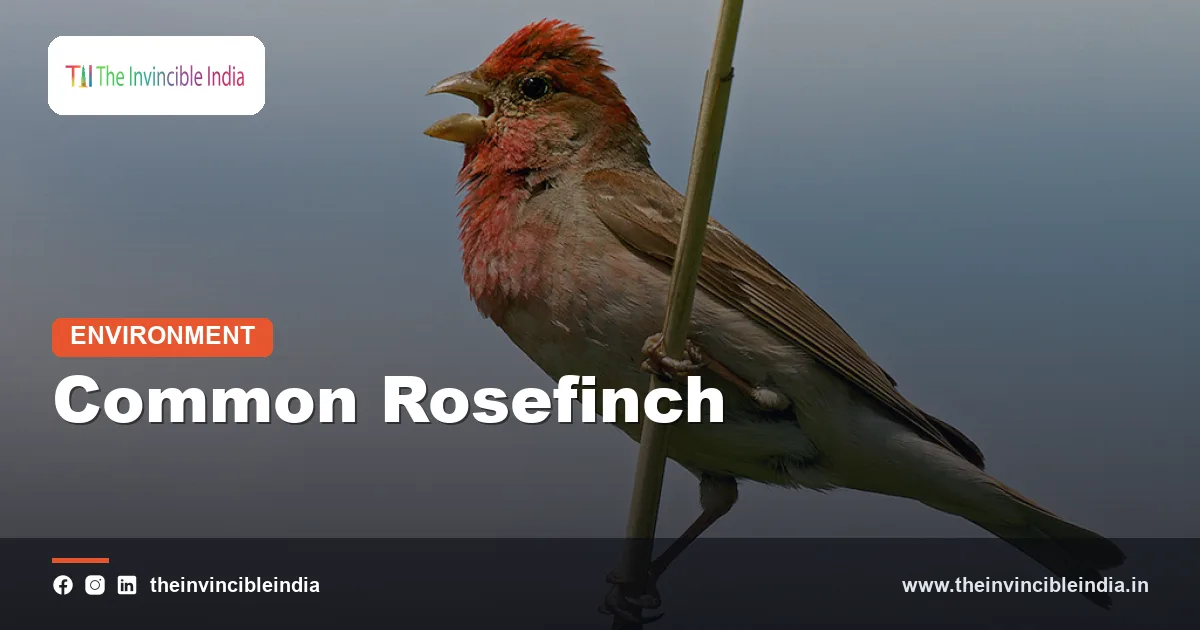
The common rosefinch (Carpodacus erythrinus) is a small, seed-eating finch of the family Fringillidae that visits India in winter, in which breeding-age males are washed with rose-red on the head, breast and rump while females and young birds are plain streaky brown. Across the Indian plains it is usually met as a flock of unremarkable brownish finches feeding on grass seed, crop stubble and flowering shrubs, with only a few bright red males among them.
Because most birds in a winter flock look brown, the common rosefinch is often overlooked or mistaken for a female sparrow. Understanding why so few of the birds are red, where they come from and what they eat makes this finch one of the easier migrants to appreciate once its features are known.
Common Rosefinch Quick Facts
| Attribute | Detail |
|---|---|
| Common name | Common rosefinch (also called scarlet rosefinch) |
| Scientific name | Carpodacus erythrinus |
| Family | Fringillidae (finches) |
| Size | About 14 to 15 cm, a little smaller than a house sparrow in build but stockier in the bill |
| Range in India | Winter visitor across most of the country; breeds in the Himalaya at higher elevations |
| Habitat | Scrub, thickets, hedgerows, farmland edges, gardens and reed or bamboo patches |
| Diet | Seeds, buds, flowers, berries and other soft plant matter, with some insects when feeding young |
| Migration and breeding | Arrives in autumn and leaves in spring; nests in shrubs and low trees in the northern breeding range |
| Conservation status | Least Concern on the IUCN Red List |
Key Takeaways
- The common rosefinch is a small finch, about 14 to 15 cm long, that belongs to the family Fringillidae and has the scientific name Carpodacus erythrinus.
- Only fully mature male common rosefinches show rose-red plumage; females and first-year males are streaky olive-brown with a plain face and a dark eye.
- The common rosefinch is mostly a winter visitor to India, arriving from about October and leaving by April or May, although a Himalayan population also breeds in the mountains.
- The common rosefinch feeds mainly on seeds, buds, flowers and fruit, and it often forages in loose flocks on farmland edges, scrub and gardens.
- The red colour of the male common rosefinch comes from carotenoid pigments taken in through food, so the depth of red reflects diet and condition.
- The IUCN lists the common rosefinch as Least Concern because of its enormous breeding range across Europe and Asia.
What is the common rosefinch?
The common rosefinch is a small songbird in the finch family, found across a vast belt of Eurasia from northern Europe to eastern Siberia and south into the Himalaya. It is called “common” because it is the most widespread of the rosefinches, a group of reddish finches that includes several mountain species found in the Indian Himalaya.
The bird has a short, thick, conical bill suited to cracking seeds, a rounded head and a notched tail. Its genus, Carpodacus, contains most of the rosefinches, although some recent classifications place this species in a genus of its own because of its genetic distance from the mountain rosefinches. The name erythrinus comes from a Greek word meaning “red”.
In India the common rosefinch is mainly a non-breeding visitor. Birds that arrive for the winter breed far to the north, in Siberia and Central Asia, while a separate Himalayan form, often called roseatus, nests in the Indian mountains in summer. Both groups belong to one species and look broadly similar.
What does the common rosefinch look like?
An adult male common rosefinch in breeding colour has a rose-red to crimson head, throat, breast and rump, a brownish back and wings, and a whitish or pale pinkish belly. The red is richest on the head and breast, and the wings carry two faint pale bars.
The male
The red varies considerably between individuals, from a pale pinkish tone to a deep raspberry. Himalayan breeding males tend to be a deeper, more crimson shade, while many males seen in the plains look duller, as their red is partly hidden by brownish feather edges that wear away by spring.
The female and young birds
The female common rosefinch is a uniform olive-brown bird, finely streaked on the breast and flanks, with two pale wing bars and a plain, expressionless face. The large, dark eye stands out against the blank face, and this beady look is one of the best field marks.
First-year males look like females. Because most flocks contain many young birds and females, a typical winter group in India may show only one or two reddish birds among a majority of brown ones.
Size and shape
The common rosefinch is about 14 to 15 cm long. It appears plump and short-tailed, with a stout bill that looks slightly swollen at the base. The bill is greyish-brown and lacks the black bib or white outer tail feathers of birds such as sparrows or buntings.
Why do so many rosefinches in India look brown instead of red?
Most common rosefinches in India look brown because male birds do not acquire red plumage until their second year, and females never do. A young male that hatched the previous summer therefore resembles a female in its first winter and only turns red after the next breeding season.
This delayed maturation of colour is well known among rosefinches and some related finches. First-year males can still breed in their brown plumage, and some even sing and hold territories while looking like females. The pattern may reduce conflict with older, redder males.
The red pigments in the male are carotenoids, which birds cannot make themselves and must obtain from food such as seeds, flowers and fruit. For this reason, the intensity of red can reflect a male’s health and the quality of the food available to him. In captivity, without carotenoid-rich foods, red finches often fade to yellow or orange.
- First-year male: streaky brown, resembling the female.
- Second-year and older male: red on head, breast and rump.
- Female at any age: olive-brown, streaked, plain face.
Where is the common rosefinch found in India?
The common rosefinch is found across most of India in winter, from the foothills of the Himalaya through the Gangetic plains and central India to the southern peninsula, wherever scrub, crops and thickets provide seed and cover. It is less common in true desert and in dense evergreen forest.
The bird favours disturbed and semi-open country rather than closed forest. Typical places include:
- Hedgerows and thorn scrub at the edge of fields.
- Gardens and orchards with flowering shrubs and fruit trees.
- Stubble, millet and sorghum fields, and weedy waste ground.
- Bamboo clumps, reed patches and thickets along streams and canals.
- Forest clearings and open woodland in hill country.
In summer, the Himalayan breeding population occupies higher ground, roughly between the subtropical foothills and the tree line, nesting in juniper and rhododendron scrub, bushes along streams and open alpine meadows with shrubs. Outside India, the common rosefinch also winters in Nepal, Bangladesh, Pakistan, Sri Lanka and mainland Southeast Asia.
When does the common rosefinch arrive and leave India?
The common rosefinch generally reaches India in autumn, from about October, and most birds have left by April or May. The exact dates vary from year to year and from region to region, with birds often reaching the north-west a little earlier than the south.
The winter birds travel from breeding grounds in Siberia and Central Asia, crossing high mountain ranges on the way. Migration is mainly at night, and flocks that settle in the morning can seem to appear suddenly in a garden or field where none were present the day before.
During the winter months, the birds move locally in response to the ripening of seeds and the flowering of trees and shrubs. Before leaving in spring, many males moult into brighter plumage, so the proportion of red birds in a flock often rises in March and April.
| Season | Where the common rosefinch is | What it is doing |
|---|---|---|
| Autumn (October onward) | Arriving in northern and central India | Migrating south and settling in scrub and farmland |
| Winter (November to February) | Plains, foothills and peninsular India | Feeding in loose flocks on seeds, buds and fruit |
| Spring (March to April) | Across India, then moving north | Moulting, singing males, departure for breeding grounds |
| Summer (May to July) | Himalaya and far northern Asia | Nesting and raising young |
What does the common rosefinch eat?
The common rosefinch eats mainly seeds, buds, flowers and fruit, supplemented by a few insects during the breeding season. It is a mostly vegetarian bird whose short, strong bill is well suited to husking small seeds.
In India, the foods commonly taken include the seeds of grasses and weeds, millet and sorghum grains left in fields, the buds and petals of flowering shrubs, small berries and soft fruit. Birds are often seen clambering through bushes, plucking flower buds and tender shoots, and they sometimes hang upside down to reach food.
Insects, including small caterpillars and beetles, are taken in modest quantities and are particularly important for feeding nestlings. Adults also drink regularly, so flocks often gather at water sources in the morning and late afternoon.
The bird is generally considered a minor crop feeder rather than a serious pest, since it takes small amounts of grain and weed seed. Its feeding on weed seeds may even be of some benefit in field margins.
How does the common rosefinch breed?
The common rosefinch breeds in summer on its northern grounds, building a small cup nest in a bush or low tree and laying about three to six blue-green eggs speckled with dark markings. Breeding in India is limited to the Himalayan population, as winter visitors do not nest in the plains.
The female builds the nest from grass stems, roots and plant fibres, usually concealed at a modest height in dense shrubs or thickets. She incubates the eggs for roughly two weeks while the male sings from a nearby perch. The young leave the nest a little under two weeks after hatching, and both parents feed them, often with a mix of seeds and insects.
Males defend small territories with a bright, whistled song. The song is a short, clear, rising phrase, often rendered in English as “pleased to meet you”, which helps many birders learn the species in the Himalaya. Birds in the plains are normally silent or give only a soft, upward-inflected call note.
How can the common rosefinch be told from similar birds?
The common rosefinch can be told from similar birds by its plain, unmarked face with a large dark eye, its stout greyish bill, and the lack of any bold head pattern or bib. These features separate it from the female house sparrow and from other finches seen in the same habitat.
| Species | How it differs from the common rosefinch |
|---|---|
| Female house sparrow | Has a pale eyestripe behind the eye and a plainer, unstreaked breast |
| Pink-browed rosefinch | A Himalayan species with a pink eyebrow and a more streaked back; typically stays in the hills |
| Himalayan beautiful rosefinch | A high-altitude finch with a pink-streaked head, found mainly in the mountains |
| Scarlet finch | A more strongly coloured red finch of eastern Himalayan forests, bright scarlet in the male |
| Buntings (female) | Have a more slender bill and white outer tail feathers or a distinct head pattern |
A rosefinch in a mixed flock will often be the one that sits upright and still, with a rounded head and short tail, while sparrows are more active and noisy. A careful look at the face and the bill usually settles the identification.
Is the common rosefinch threatened?
The common rosefinch is not threatened and is classified as Least Concern on the IUCN Red List. Its range spans much of Europe and Asia, and its population is large and, in many areas, stable or increasing.
In Europe, the species has expanded westward during the twentieth century, reaching countries where it was once unknown. In India the main concerns are indirect ones, such as the loss of scrub and hedgerows, heavy pesticide use on farmland, and the clearing of thickets for development, all of which can reduce food and cover for small seed-eating birds.
Because the birds are small and unremarkable, they are rarely trapped or hunted in India, though cage-bird trapping of small finches has been a problem elsewhere. Protecting field edges and native shrubs benefits the common rosefinch together with a wide range of other farmland birds.
Where and how can the common rosefinch be watched?
The common rosefinch is best watched in the cooler months, in scrub, weedy fields and gardens with flowering shrubs, ideally in the early morning when flocks feed actively. Patience and a good look at the face and bill are the key requirements.
- Scan finch and sparrow flocks for birds with a plain face and a dark, round eye.
- Look in flowering shrubs, where birds feed on buds and petals.
- Visit water sources at dawn and dusk when flocks come to drink.
- Listen for the soft, rising call, and in the hills, for the whistled song in summer.
- Check again in March and April, when males start to turn brighter red before leaving.
Sikkim, Uttarakhand, Himachal Pradesh and Jammu and Kashmir are good areas for seeing breeding males in summer, while wintering birds are widely spread through the plains and can turn up in city parks.
Bottom Line
The common rosefinch is a small, widespread finch that visits India in winter, with only mature males showing the rose-red colour that gives it its name. It feeds on seeds, buds and fruit, is not at risk, and can be found in scrub and farmland edges across the country.
Frequently Asked Questions
What is a common rosefinch?
The common rosefinch is a small finch, scientifically called Carpodacus erythrinus, that breeds across Eurasia and winters in India and South Asia. Males are rose-red on the head, breast and rump, while females and young birds are streaky olive-brown. It is classified in the family Fringillidae.
Why are most common rosefinches in India not red?
Most common rosefinches in India are not red because only males older than one year develop red plumage. Females stay brown for life, and first-year males look like females. A typical winter flock therefore contains many brown birds and only a few red ones.
When can the common rosefinch be seen in India?
The common rosefinch can be seen in India mainly from October to April, when migrants from northern Asia spend the winter in the plains. A Himalayan population is present in the mountains in summer. Sightings of red males rise toward spring as they moult into brighter colour.
What does the common rosefinch eat?
The common rosefinch eats mainly seeds, flower buds, petals, berries and other soft plant parts. It also takes a few insects, especially when feeding young. It forages in scrub, hedgerows and farm edges, often in small flocks.
Does the common rosefinch breed in India?
The common rosefinch breeds in India only in the Himalaya, where a mountain population nests in summer in shrubs at higher elevations. The winter visitors in the plains breed far to the north in Siberia and Central Asia. Females lay about three to six blue-green speckled eggs in a cup nest.
Is the common rosefinch endangered?
The common rosefinch is not endangered. The IUCN lists it as Least Concern because it has a very large range across Europe and Asia and a large population. Local declines in India are linked to the loss of scrub and hedgerows rather than to any direct threat.
{“@context”:”https://schema.org”,”@graph”:[{“@type”:”FAQPage”,”mainEntity”:[{“@type”:”Question”,”name”:”What is a common rosefinch?”,”acceptedAnswer”:{“@type”:”Answer”,”text”:”The common rosefinch is a small finch, scientifically called Carpodacus erythrinus, that breeds across Eurasia and winters in India and South Asia. Males are rose-red on the head, breast and rump, while females and young birds are streaky olive-brown. It is classified in the family Fringillidae.”}},{“@type”:”Question”,”name”:”Why are most common rosefinches in India not red?”,”acceptedAnswer”:{“@type”:”Answer”,”text”:”Most common rosefinches in India are not red because only males older than one year develop red plumage. Females stay brown for life, and first-year males look like females. A typical winter flock therefore contains many brown birds and only a few red ones.”}},{“@type”:”Question”,”name”:”When can the common rosefinch be seen in India?”,”acceptedAnswer”:{“@type”:”Answer”,”text”:”The common rosefinch can be seen in India mainly from October to April, when migrants from northern Asia spend the winter in the plains. A Himalayan population is present in the mountains in summer. Sightings of red males rise toward spring as they moult into brighter colour.”}},{“@type”:”Question”,”name”:”What does the common rosefinch eat?”,”acceptedAnswer”:{“@type”:”Answer”,”text”:”The common rosefinch eats mainly seeds, flower buds, petals, berries and other soft plant parts. It also takes a few insects, especially when feeding young. It forages in scrub, hedgerows and farm edges, often in small flocks.”}},{“@type”:”Question”,”name”:”Does the common rosefinch breed in India?”,”acceptedAnswer”:{“@type”:”Answer”,”text”:”The common rosefinch breeds in India only in the Himalaya, where a mountain population nests in summer in shrubs at higher elevations. The winter visitors in the plains breed far to the north in Siberia and Central Asia. Females lay about three to six blue-green speckled eggs in a cup nest.”}},{“@type”:”Question”,”name”:”Is the common rosefinch endangered?”,”acceptedAnswer”:{“@type”:”Answer”,”text”:”The common rosefinch is not endangered. The IUCN lists it as Least Concern because it has a very large range across Europe and Asia and a large population. Local declines in India are linked to the loss of scrub and hedgerows rather than to any direct threat.”}}]}]}


