

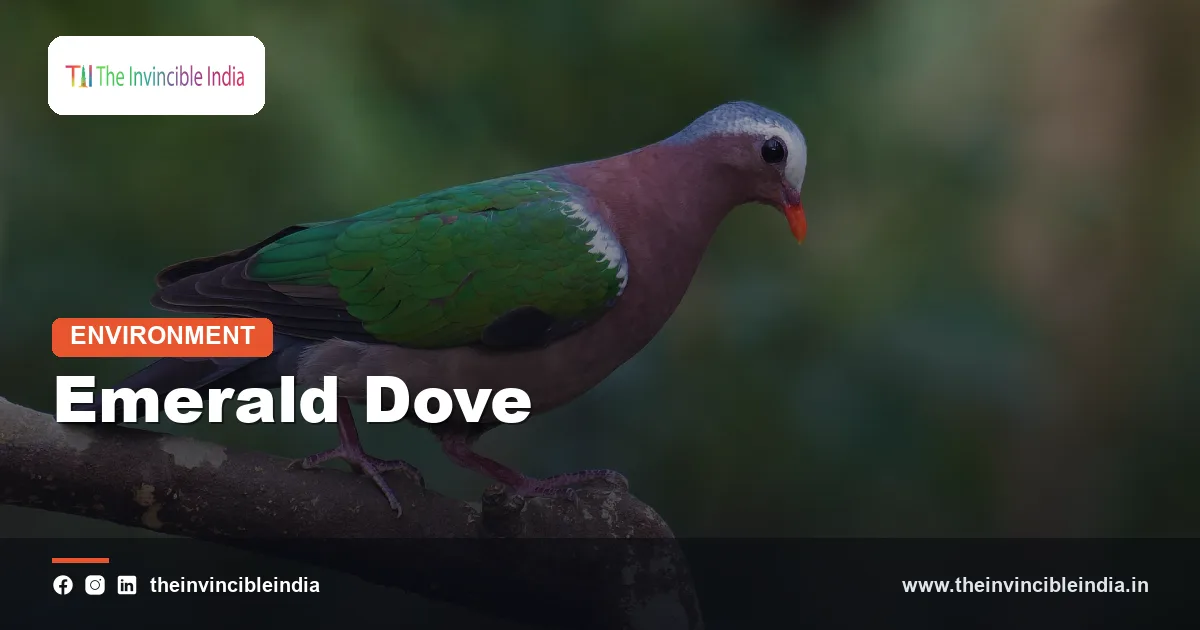
The emerald dove (Chalcophaps indica) is a plump, ground-dwelling forest dove with glossy emerald-green wings, a pinkish-brown body and a soft, low cooing call, found in moist forests, plantations and wooded streams across India. Also called the Asian emerald dove or green-winged pigeon, it is one of the most beautiful members of the pigeon family, yet it is easily overlooked because it stays in shaded undergrowth and bursts away at speed when disturbed.
The emerald dove is the state bird of Tamil Nadu, which has helped make it widely known in India. This guide explains what the emerald dove is, how to recognise it, where it lives, what it eats, how it breeds and how it is faring.
Quick Facts
| Common name | Emerald dove (also Asian emerald dove, common emerald dove, green-winged pigeon) |
|---|---|
| Scientific name | Chalcophaps indica |
| Family and order | Columbidae (pigeons and doves); order Columbiformes |
| Size | About 23 to 28 cm in length |
| Range and habitat in India | Moist evergreen and deciduous forest, plantations and wooded streams in the Western Ghats, the Himalayan foothills, the north-east, the east coast and the Andaman and Nicobar Islands |
| Diet | Fallen fruits, seeds, buds and small invertebrates such as termites, picked up from the forest floor |
| Breeding | Flimsy twig platform low in a bush or tree; usually 2 eggs; both parents incubate |
| Movement | Mostly resident, with some local movements linked to fruiting and rainfall |
| Conservation status | Least Concern on the IUCN Red List; state bird of Tamil Nadu |
Key Takeaways
- The emerald dove is a forest-floor dove with bright emerald-green wing feathers, a grey crown and a pinkish-vinous body.
- The adult male emerald dove shows a white patch on the shoulder and a grey cap, while the female is plainer and browner.
- The emerald dove feeds mainly on the ground, taking fallen fruit, seeds and small invertebrates such as termites.
- The emerald dove builds a thin platform of twigs only a short distance above the ground and typically lays two eggs.
- The emerald dove has been adopted as the state bird of Tamil Nadu, and it is classified as Least Concern by the IUCN.
- The emerald dove is shy and often detected first by its low, mournful “hoon” call or by a dash of green and brown flying low through the trees.
What is the emerald dove?
The emerald dove is a medium-sized dove of the family Columbidae that lives in forests of southern and south-eastern Asia and northern Australia, and in India it is a widespread resident of wooded hill and lowland regions. It is considered a “true” ground dove in behaviour, because it walks and feeds on the forest floor and flies up only when it is startled or heading to a roost.
The scientific name Chalcophaps is formed from Greek words that refer to a bronze or copper-coloured dove, a nod to the metallic sheen of the wings. The species name indica reflects that the bird was first described from India. Several subspecies are recognised across its wide range, differing in the strength of the colour of the head, shoulders and underparts.
Is it a pigeon or a dove?
There is no true scientific difference between pigeons and doves, since both belong to the family Columbidae. In everyday use, “dove” tends to be applied to smaller, more delicate species and “pigeon” to larger ones. The emerald dove, with its slim build and gentle manner, is called a dove, though some older Indian texts used the name green-winged pigeon.
How can you identify an emerald dove?
An emerald dove can be identified by its brilliant metallic green wings and back, a pinkish-brown head and breast, a short body and a pair of pale bars across the lower back that show clearly in flight. The bird is smaller than a rock pigeon and rounder in outline, with a short tail and short red legs.
Male and female
- Adult male: grey crown and nape, a clear white patch on the bend of the wing, a white forehead and eyebrow, and deep wine-pink underparts.
- Adult female: duller brown on the head, lacking the white shoulder patch and the grey cap, with more brownish tones to the body.
- Juvenile: browner overall with barred feathers and less green on the wings.
- Bill and legs: the bill is bright orange-red with a dark tip, and the legs are reddish.
In the dim light of a forest floor, the green wings can look almost black, and the best views often come when the bird steps into a patch of sun. The two pale bars on the lower back, known as back bars, are a useful clue when the bird flies off, because the contrast with the dark rump is striking.
Where is the emerald dove found in India?
The emerald dove is found in moist forest across much of India, including the Western Ghats, the foothills of the Himalaya, the north-eastern states, the eastern coast and the Andaman and Nicobar Islands. It is a bird of damp, shady habitats with a fairly open floor, and it is largely absent from dry scrub, open farmland and the driest parts of the north-west.
The species also lives in Sri Lanka, Bangladesh, Myanmar, south-east Asia and the island groups to the east, reaching northern and eastern Australia. In India it occupies a broad altitude range, from the coast to the lower and middle hills.
Preferred habitats
- Evergreen and semi-evergreen forest with leaf litter and a shaded floor.
- Moist deciduous forest, bamboo and secondary growth.
- Coffee, tea, cardamom and rubber plantations that keep a canopy and moist undergrowth.
- Wooded stream banks, forest tracks and the edges of mangroves in some coastal areas.
Open country with little cover is generally avoided, which makes the emerald dove a fair indicator of healthy forest cover where it occurs. It is often seen walking along forest paths, a habit that gives birdwatchers a good chance of a view at dawn and dusk.
What does the emerald dove eat?
The emerald dove eats mainly fallen fruits and seeds that it finds on the forest floor, with additional buds, small invertebrates and termites that provide protein. It forages by walking slowly with a bobbing head, turning over leaf litter and picking items from the ground.
The diet changes with the forest calendar. When figs and other fruits ripen, doves gather beneath fruiting trees to pick up what the monkeys, hornbills and other birds drop. In this way the emerald dove takes advantage of the food that canopy feeders spill, and it may act as a seed disperser or a seed predator depending on how it handles the seed.
How do doves drink?
Doves are unusual among birds because they can suck water in a continuous draught, using the bill like a straw, rather than lifting the head back after each sip. The emerald dove visits streams, puddles and wet patches in the forest to drink, especially in the dry season, and its predictable habits make water points good places to wait and watch.
What does the emerald dove sound like?
The emerald dove has a low, mournful call, a series of soft, deep “hoon” notes that start slowly and run together, usually repeated many times from a low perch or from the ground. The call is heard at dawn and dusk, and it carries well through dense forest, though it can be hard to pinpoint.
The voice often reveals the bird long before it is seen. A listener in a quiet patch of forest may hear the sound for several minutes before spotting the dove walking through the leaf litter. In flight, the wings make a clapping or whirring sound as the bird bursts off at speed, which is a common way for the dove to announce itself.
How does the emerald dove breed?
The emerald dove breeds by building a thin platform of twigs low in a shrub, sapling or small tree, typically between one and three metres above the ground, and laying two cream or buff-coloured eggs. The nest is so loose that eggs can be visible from below, a trait shared by many doves.
Both parents take turns to incubate, which lasts about two weeks, and both feed the young. The chicks are fed with “crop milk”, a nutritious secretion produced in the lining of the crop of both male and female pigeons and doves. This substance is rich in protein and fat, and it allows the young to grow quickly even when seeds are of low quality.
The breeding season varies across India, and in many areas it falls between the late dry season and the rains, when food and cover are plentiful. The young leave the nest after about two weeks, long before they can fly well, and they spend a short period hiding in the undergrowth under the care of their parents.
How does the emerald dove behave?
The emerald dove is a shy, solitary or paired bird that walks quietly through the forest, freezes when it senses danger and flies off low and fast between the tree trunks if approached. It is much less social than the rock pigeon or the spotted dove, and it is rarely seen in flocks, apart from small groups at fruiting trees or water.
When disturbed, the bird often flies a short distance and then lands again, giving a brief view of its green wings and the pale back bars. It roosts in trees at night, moving up from the ground at dusk. Courtship includes bowing and bobbing displays by the male, who may fan the tail and spread the wings to show off the emerald colour.
How is the emerald dove different from similar Indian doves?
The emerald dove differs from other Indian doves in its metallic green wings, its habit of foraging in forest rather than open ground and its dark, shaded habitat. Most other doves are greyer or browner and live near fields, villages or open scrub.
| Bird | Colour | Habitat | Notable feature |
|---|---|---|---|
| Emerald dove | Pinkish-brown body, green wings | Moist forest and plantations | Pale bars across the lower back in flight |
| Spotted dove | Pinkish-brown with a spotted collar | Gardens, villages, open woodland | Black collar patch with white spots |
| Laughing dove | Pinkish-brown with spotted chest | Dry scrub, towns, farmland | Chequered patch on the neck |
| Rock pigeon | Blue-grey with iridescent neck | Cities, cliffs, farmland | Two black wing bars |
| Green imperial pigeon | Grey and green, large | Canopy of evergreen forest | Much larger; feeds in the treetops |
The most reliable single clue for the emerald dove is its habit of walking on the forest floor and flying off low through the undergrowth. Other doves usually flush to a tree branch or an open perch, whereas the emerald dove tends to vanish between trunks.
Is the emerald dove threatened?
The emerald dove is not threatened and is classified as Least Concern on the IUCN Red List, because it has a very large range and is considered common in many forested areas. It is, however, a bird of forest and so it can be affected by the loss of habitat, fragmentation and hunting in some regions.
Possible pressures include:
- Clearing of moist forest and conversion to other land uses, which reduces the shaded ground cover the dove needs.
- Hunting and trapping for food in parts of its range, since doves have long been shot or snared.
- Disturbance of nests in low shrubs by people and by livestock.
- Loss of fruiting trees that supply food during the dry season.
Protected areas such as national parks and wildlife sanctuaries in the Western Ghats, the Himalayan foothills and the north-east provide strongholds for the species. Maintaining a natural leaf-litter floor, rather than clearing undergrowth for tidiness, helps keep the habitat usable for the dove and for other ground-feeding forest birds.
Why is the emerald dove the state bird of Tamil Nadu?
The emerald dove was chosen as the state bird of Tamil Nadu because it is a beautiful, native forest bird that is found in the state’s hills and wooded areas, particularly the Western Ghats, and it symbolises the natural heritage of the region. The choice puts a relatively quiet and unobtrusive species in the public eye.
State birds across India are selected to draw attention to local biodiversity and to encourage conservation awareness. For many residents, the emerald dove is their introduction to the idea that forest birds are part of the identity of a state, and the symbolism has helped raise interest in birding among students and nature clubs.
How can you watch emerald doves in the wild?
Emerald doves are best watched by walking quietly along shaded forest trails and plantation roads at dawn or dusk, scanning the ground ahead for a small, rounded bird walking among the leaves. Patience and silence matter more than equipment, as the bird freezes or flies at the first sign of noise.
- Visit evergreen and moist deciduous forest, tea or coffee estates, and wooded streams.
- Walk slowly and stop frequently to listen for the low “hoon” call.
- Watch shaded puddles, springs and fruiting trees where doves gather to drink and feed.
- Use binoculars, since the metallic green is easier to see at a distance in a patch of light.
- Keep away from low nests, and do not play recordings of calls repeatedly near breeding birds.
Photographers often find the emerald dove challenging because of the low light and its quick departures, but a quiet approach and a patch of forest road with dappled sun can yield excellent images.
Bottom Line
The emerald dove is a shy, jewel-winged ground dove of Indian forests, noted for its green wings, low cooing call and low twig nest. Common and secure across its range, it depends on shaded forest floors, so protecting moist woodland and plantation cover is the best way to keep it a familiar presence.
Frequently Asked Questions
What is an emerald dove?
An emerald dove is a plump forest dove, Chalcophaps indica, with metallic green wings and a pinkish-brown body. It walks on the forest floor and feeds on fallen fruits, seeds and small invertebrates. It is widespread in the moist forests of India and is the state bird of Tamil Nadu.
Where can you see an emerald dove in India?
You can see an emerald dove in moist forests and plantations across India, especially in the Western Ghats, the Himalayan foothills, the north-east and the Andaman and Nicobar Islands. Shaded forest trails, wooded streams and tea or coffee estates are good places to look. The bird is most active in the early morning and late afternoon.
How do you tell a male emerald dove from a female?
You can tell a male emerald dove from a female by the grey crown and the clear white patch on the shoulder of the male. The female lacks these marks and looks plainer and browner, particularly on the head and body. Both sexes show glossy green wings and pale bars on the lower back in flight.
What does an emerald dove eat?
An emerald dove eats mostly fallen fruit and seeds found on the forest floor, along with buds, termites and other small invertebrates. It forages by walking slowly and picking food from the leaf litter. It often gathers under fruiting trees to eat what other animals have dropped.
How many eggs does an emerald dove lay?
An emerald dove usually lays two eggs, which are cream or buff in colour, on a flimsy platform of twigs low in a shrub or small tree. Both parents incubate the eggs for about two weeks. The chicks are fed on crop milk, a nutritious secretion produced by both parents.
Is the emerald dove the state bird of Tamil Nadu?
Yes, the emerald dove is the state bird of Tamil Nadu. It was chosen as a representative forest bird of the state, found in the hills and woodland of the Western Ghats. The bird is also classified as Least Concern by the IUCN.
{“@context”:”https://schema.org”,”@graph”:[{“@type”:”FAQPage”,”mainEntity”:[{“@type”:”Question”,”name”:”What is an emerald dove?”,”acceptedAnswer”:{“@type”:”Answer”,”text”:”An emerald dove is a plump forest dove, Chalcophaps indica, with metallic green wings and a pinkish-brown body. It walks on the forest floor and feeds on fallen fruits, seeds and small invertebrates. It is widespread in the moist forests of India and is the state bird of Tamil Nadu.”}},{“@type”:”Question”,”name”:”Where can you see an emerald dove in India?”,”acceptedAnswer”:{“@type”:”Answer”,”text”:”You can see an emerald dove in moist forests and plantations across India, especially in the Western Ghats, the Himalayan foothills, the north-east and the Andaman and Nicobar Islands. Shaded forest trails, wooded streams and tea or coffee estates are good places to look. The bird is most active in the early morning and late afternoon.”}},{“@type”:”Question”,”name”:”How do you tell a male emerald dove from a female?”,”acceptedAnswer”:{“@type”:”Answer”,”text”:”You can tell a male emerald dove from a female by the grey crown and the clear white patch on the shoulder of the male. The female lacks these marks and looks plainer and browner, particularly on the head and body. Both sexes show glossy green wings and pale bars on the lower back in flight.”}},{“@type”:”Question”,”name”:”What does an emerald dove eat?”,”acceptedAnswer”:{“@type”:”Answer”,”text”:”An emerald dove eats mostly fallen fruit and seeds found on the forest floor, along with buds, termites and other small invertebrates. It forages by walking slowly and picking food from the leaf litter. It often gathers under fruiting trees to eat what other animals have dropped.”}},{“@type”:”Question”,”name”:”How many eggs does an emerald dove lay?”,”acceptedAnswer”:{“@type”:”Answer”,”text”:”An emerald dove usually lays two eggs, which are cream or buff in colour, on a flimsy platform of twigs low in a shrub or small tree. Both parents incubate the eggs for about two weeks. The chicks are fed on crop milk, a nutritious secretion produced by both parents.”}},{“@type”:”Question”,”name”:”Is the emerald dove the state bird of Tamil Nadu?”,”acceptedAnswer”:{“@type”:”Answer”,”text”:”Yes, the emerald dove is the state bird of Tamil Nadu. It was chosen as a representative forest bird of the state, found in the hills and woodland of the Western Ghats. The bird is also classified as Least Concern by the IUCN.”}}]}]}


