

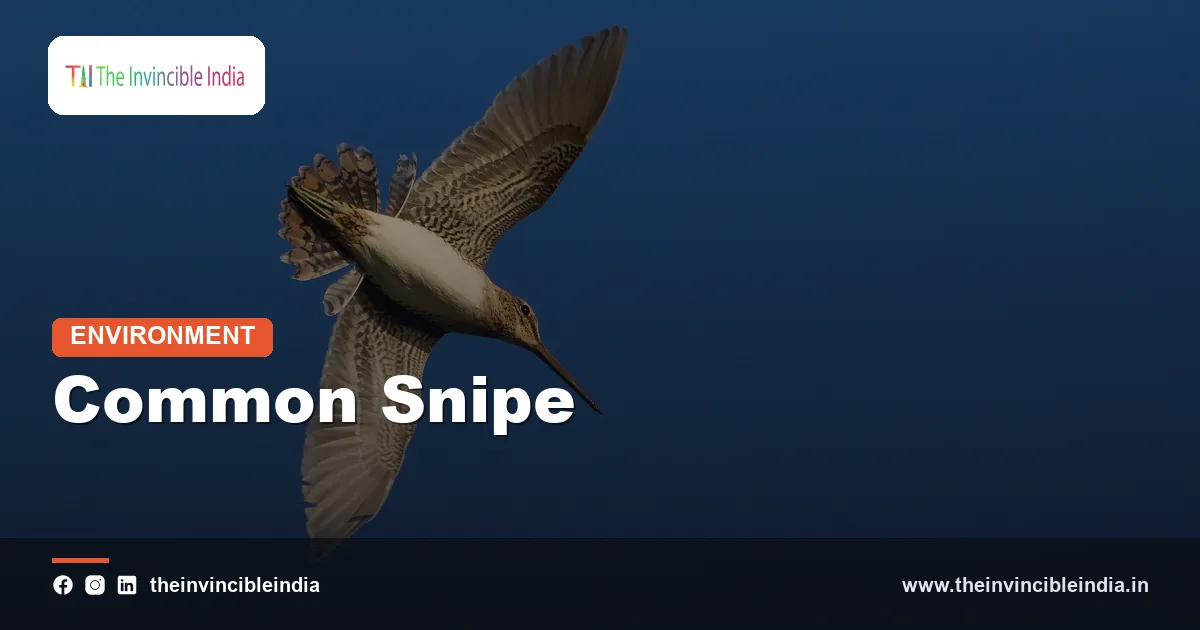
The common snipe (Gallinago gallinago) is a plump, cryptically patterned wader with a very long straight bill that winters in marshes, wet paddy fields and the edges of ponds across India, where it probes soft mud for worms and insects and zigzags away with a harsh call when flushed. Known in older Indian field guides as the fantail snipe and called the Eurasian snipe in some modern lists, the bird is one of the most widespread winter visitors to the subcontinent’s wetlands.
Because the common snipe hides in dense vegetation and relies on camouflage, most people encounter it only when it explodes from underfoot. This guide explains what the common snipe is, how to identify it, where it lives in India, what it eats, how it breeds on its far-northern grounds and how it differs from similar snipes.
Quick Facts
| Common name | Common snipe (also fantail snipe, Eurasian snipe) |
|---|---|
| Scientific name | Gallinago gallinago |
| Family and order | Scolopacidae (sandpipers and allies); order Charadriiformes |
| Size | About 25 to 27 cm in length, with a bill of around 6 to 7 cm |
| Range and habitat in India | Marshes, wet meadows, paddy fields and pond and lake margins, from the plains to the lower hills, across most of the country in winter |
| Diet | Earthworms, insect larvae, small crustaceans and molluscs, with some seeds |
| Breeding and movement | Breeds in northern Eurasia; reaches India as a winter visitor, roughly from autumn to spring |
| Nest and eggs | Well-hidden ground nest in damp vegetation; usually 4 eggs, laid on the breeding grounds |
| Conservation status | Least Concern on the IUCN Red List |
Key Takeaways
- The common snipe is a stocky, long-billed wader with a striped head and a cryptic brown, buff and black plumage that hides it in wet vegetation.
- The common snipe breeds across northern Eurasia and reaches India as a winter visitor, arriving from autumn and leaving by spring.
- The common snipe probes soft mud with its flexible-tipped bill to feel for earthworms, insect larvae and other invertebrates.
- The common snipe flushes with a rasping “scaap” call and a fast, zigzag flight before climbing and often dropping back into cover.
- The common snipe can be confused with the pintail snipe and Swinhoe’s snipe, which share Indian wetlands in winter and are best separated by tail feathers and calls.
- The common snipe is classified as Least Concern by the IUCN, although drainage of wetlands and hunting pressure can affect local numbers.
What is the common snipe?
The common snipe is a medium-sized wading bird in the sandpiper family, Scolopacidae, which is built for probing soft ground with a long, sensitive bill. It belongs to the genus Gallinago, a group of snipes found on most continents, and it is the best-known snipe of Europe and northern Asia.
The family Scolopacidae includes sandpipers, curlews, godwits, dunlins and woodcocks. Snipes are the most secretive of these, because they favour wet vegetation rather than open shorelines and mudflats. Their patterns of buff stripes and dark bars blend perfectly with dead reeds and grass, so a bird can remain unseen at a distance of a few metres.
What is the origin of the word “snipe”?
The word “snipe” is old English for the bird, and the term “sniper” is widely said to have arisen from the skill needed to shoot snipe in the late eighteenth century, including by British sportsmen and soldiers in India. A bird that flushes suddenly and flies erratically is hard to hit, so a person who could shoot snipe regularly was considered an excellent marksman. The origin is commonly cited by language historians, though the details are a matter of tradition.
How can you identify a common snipe?
A common snipe can be identified by its long, straight bill, short legs, plump body and dark brown plumage striped with buff lines on the head, back and shoulders. The crown has a pale central stripe, with dark bands on each side, and a dark line runs through the eye, which sits high on the head.
Distinguishing features
- Bill: long, straight and slightly drooped at the tip, pale at the base and darker towards the end.
- Head: striped, with a pale central crown stripe and a dark eye-stripe; the eyes are set high and far back.
- Back: dark brown with buff and cream stripes forming “braces” along the back.
- Underparts: pale belly, with barring on the flanks.
- Wings in flight: a thin white trailing edge to the wing, a feature useful in separating it from some other snipes.
- Tail: a rusty-orange band near the tip in many birds.
The high-set eyes give the bird nearly all-round vision, so it can watch for predators while its head is lowered and its bill is buried in mud. Male and female look alike, though the female is slightly larger.
Where is the common snipe found in India?
The common snipe is found across most of India during the non-breeding season, in marshes, paddy fields, wet meadows, village ponds and the margins of lakes and rivers. It is one of the most frequently encountered snipes in the north and the plains, and it also reaches the south of the peninsula in suitable wet habitats.
Globally the species breeds widely across northern Europe and Asia and in North America under related names, with winter quarters in southern Europe, Africa and southern Asia. The birds that reach India breed mainly in northern and central Asia and fly south ahead of the cold. Arrival typically begins in late summer or autumn, with numbers peaking in the cold months and departure in spring.
Where does it stay in winter?
- Flooded or damp paddy fields, especially after harvest when stubble and moist soil remain.
- Reed-edged jheels, ponds, canals and the margins of lakes and reservoirs.
- Marshy grassland and wet meadows in river floodplains.
- Protected wetlands such as Keoladeo National Park in Rajasthan, where winter waterbirds gather in large numbers.
The bird needs soft, damp ground where its bill can penetrate. It generally avoids deep open water and bare dry fields, preferring edges with a mix of low cover and shallow water.
What does the common snipe eat?
The common snipe eats mainly earthworms, insect larvae, small crustaceans and molluscs, which it finds by probing the soft ground, together with some plant seeds. Its long bill is pushed repeatedly into mud, often up to the base, in a rapid sewing-machine action while the bird walks slowly forward.
The tip of the bill is rich in sensory nerve endings (Herbst corpuscles) that detect vibrations and touch, which allows the bird to feel prey it cannot see. The upper bill tip is also flexible and can be opened below the surface, a feature known as rhynchokinesis, so the snipe can seize a worm while the rest of the bill remains closed.
When does it feed?
The common snipe feeds at dawn, dusk and often at night, especially in places where it is disturbed during the day. Much of the day may be spent resting in cover, motionless and well camouflaged. Feeding birds are generally solitary or found in loose groups, and they may gather in numbers in the best marshes.
How does the common snipe fly and call?
The common snipe flies with a fast, jinking zigzag when flushed, giving a harsh, rasping “scaap” call before climbing steeply and usually dropping back into cover some distance away. The sudden burst of flight and the erratic path make it difficult for predators, and for hunters, to follow.
When a snipe flushes, it typically rises almost vertically from the vegetation and then levels out into a twisting flight, showing the long bill, pointed wings and short tail. Experienced birdwatchers learn to judge the species by the call and by the pattern of the flight as much as by the plumage.
What is snipe drumming?
On the breeding grounds, the male common snipe performs a display flight in which it dives, causing the outer tail feathers to vibrate and produce a throbbing, humming sound known as drumming or winnowing. The sound is not made by the voice. It carries over marshland and is a feature of spring and summer in northern Europe and Asia, so it is rarely heard in India during winter.
How does the common snipe breed?
The common snipe breeds in wet meadows, bogs and marshy ground in northern Eurasia, building a small, well-hidden scrape lined with grass among tussocks and laying about four pear-shaped, olive-brown eggs. The breeding season takes place in the northern summer, far from India.
The female does most of the incubation, which lasts around three weeks. The chicks are downy and leave the nest soon after hatching, feeding themselves under the care of the parents. They are fed by the adults at first and can fly after a few weeks. Because the breeding takes place outside India, Indian observers see only the winter side of the species’ life.
How is the common snipe different from other snipes in India?
The common snipe is difficult to separate from several related snipes that share Indian wetlands in winter, and the most reliable differences are in the tail, the wings in flight and the voice. The main look-alikes are the pintail snipe, Swinhoe’s snipe, the jack snipe and the painted snipe.
| Bird | Size and bill | Key difference | Status in India |
|---|---|---|---|
| Common snipe | Medium; long bill | Pale trailing edge to wing; rasping call; typically 14 tail feathers | Common winter visitor |
| Pintail snipe | Similar; slightly shorter bill | No clear pale wing edge; many narrow outer tail feathers; call is softer | Winter visitor, widespread |
| Swinhoe’s snipe | Similar to pintail | Very hard to separate from pintail; more tail feathers | Scarce winter visitor in the east and south |
| Jack snipe | Smaller, short bill | Does not call or zigzag; flushes late and flies short | Uncommon winter visitor |
| Greater painted-snipe | Medium; slightly drooped bill | Female brighter than male; role-reversed breeding | Resident, not closely related |
Separating the pintail and Swinhoe’s snipes from the common snipe usually requires a close look at the tail feathers in the hand or very good photographs, so many birdwatchers record such birds simply as “snipe sp.” when they cannot be sure.
Is the common snipe threatened?
The common snipe is not globally threatened and is classified as Least Concern on the IUCN Red List, because it has an extremely large range and a large population. Its numbers in some regions have declined where wetlands have been drained or changed, so local conservation concerns exist.
- Drainage and conversion of marshes, floodplains and wet meadows for farming or construction.
- Pollution and pesticide use in wetlands, which can reduce the invertebrate food supply.
- Hunting, since snipes have long been game birds in many countries.
- Disturbance of roosting and feeding sites in winter.
- Changes in water management in paddy areas that reduce the shallow, damp conditions snipes prefer.
Conservation for the common snipe therefore means protecting wetlands as a whole. The same marshes and paddy fields that support snipe also support herons, ducks, rails and many other birds, and they provide benefits such as groundwater recharge and flood control.
Why do wetlands matter for the common snipe?
Wetlands matter for the common snipe because the bird depends on soft, damp ground to feed, and it cannot survive the winter without suitable marsh or flooded field habitat. Even a small patch of wet vegetation can hold a few snipes, and many such patches together form a network that supports the bird during migration.
India lies along the Central Asian Flyway, one of the major routes used by migratory waterbirds travelling between breeding grounds in Siberia and wintering areas in South Asia. A decline of wetlands along the route affects migrants such as the common snipe. For that reason, national and international efforts to conserve migratory birds stress the protection of stopover and wintering wetlands.
How can you watch common snipes?
Common snipes are best watched from a distance at the edge of a marsh or flooded field in the early morning or evening, when they come out of cover to probe the mud. Because the bird freezes and relies on camouflage, a careful, slow approach is needed.
- Visit the margins of jheels and paddy fields from October to March, when winter visitors are present.
- Scan muddy patches near reeds with binoculars rather than walking into the vegetation.
- Stand still and watch for the characteristic rapid probing movement.
- Avoid flushing birds repeatedly, since it wastes their energy in cold weather.
- Note the tail and wing pattern if the bird flies, as these help in identification.
Birdwatchers in India often record snipes during winter bird counts, and such records add to long-term understanding of numbers and distribution.
Bottom Line
The common snipe is a well-camouflaged, long-billed wader that spends the northern summer breeding in the far north and winters in India’s marshes and paddies. It is secure as a species, but it depends on soft, damp wetland ground that is easily lost to drainage and development.
Frequently Asked Questions
What is a common snipe?
A common snipe is a plump wading bird, Gallinago gallinago, with a very long straight bill and striped brown plumage. It lives in marshes and wet fields and probes the mud for worms and insects. In India it is a widespread winter visitor from northern Eurasia.
When does the common snipe come to India?
The common snipe comes to India as a winter visitor, arriving from late summer or autumn and leaving by spring. Numbers are highest in the cold months, from about November to February. The birds spend the northern summer breeding in northern Eurasia.
What does the common snipe eat?
The common snipe eats earthworms, insect larvae, small crustaceans and molluscs, along with some seeds. It finds food by pushing its long bill into soft mud and feeling for prey with the sensitive tip. It usually feeds at dawn, dusk and during the night.
How do you tell a common snipe from a pintail snipe?
You can tell a common snipe from a pintail snipe mainly by the wing, the tail and the call. The common snipe shows a pale trailing edge to the wing, has about fourteen tail feathers and gives a harsh rasping call when flushed. The pintail snipe lacks the clear pale wing edge and has many narrow outer tail feathers, so close views are often needed.
Why does the common snipe fly in a zigzag?
The common snipe flies in a zigzag when flushed because the erratic path makes it harder for predators to catch. The bird bursts from cover with a rasping call, twists and turns, and then often drops back into vegetation some distance away. The same behaviour makes it a difficult target for hunters.
Is the common snipe protected in India?
The common snipe is classified as Least Concern globally, but it relies on wetlands that are under pressure in many parts of India. Its habitat benefits from the protection of wetlands, national parks and sanctuaries where waterbirds gather in winter. Readers who want the exact legal status should check the current schedules of the Wildlife (Protection) Act, 1972, since lists are revised from time to time.
{“@context”:”https://schema.org”,”@graph”:[{“@type”:”FAQPage”,”mainEntity”:[{“@type”:”Question”,”name”:”What is a common snipe?”,”acceptedAnswer”:{“@type”:”Answer”,”text”:”A common snipe is a plump wading bird, Gallinago gallinago, with a very long straight bill and striped brown plumage. It lives in marshes and wet fields and probes the mud for worms and insects. In India it is a widespread winter visitor from northern Eurasia.”}},{“@type”:”Question”,”name”:”When does the common snipe come to India?”,”acceptedAnswer”:{“@type”:”Answer”,”text”:”The common snipe comes to India as a winter visitor, arriving from late summer or autumn and leaving by spring. Numbers are highest in the cold months, from about November to February. The birds spend the northern summer breeding in northern Eurasia.”}},{“@type”:”Question”,”name”:”What does the common snipe eat?”,”acceptedAnswer”:{“@type”:”Answer”,”text”:”The common snipe eats earthworms, insect larvae, small crustaceans and molluscs, along with some seeds. It finds food by pushing its long bill into soft mud and feeling for prey with the sensitive tip. It usually feeds at dawn, dusk and during the night.”}},{“@type”:”Question”,”name”:”How do you tell a common snipe from a pintail snipe?”,”acceptedAnswer”:{“@type”:”Answer”,”text”:”You can tell a common snipe from a pintail snipe mainly by the wing, the tail and the call. The common snipe shows a pale trailing edge to the wing, has about fourteen tail feathers and gives a harsh rasping call when flushed. The pintail snipe lacks the clear pale wing edge and has many narrow outer tail feathers, so close views are often needed.”}},{“@type”:”Question”,”name”:”Why does the common snipe fly in a zigzag?”,”acceptedAnswer”:{“@type”:”Answer”,”text”:”The common snipe flies in a zigzag when flushed because the erratic path makes it harder for predators to catch. The bird bursts from cover with a rasping call, twists and turns, and then often drops back into vegetation some distance away. The same behaviour makes it a difficult target for hunters.”}},{“@type”:”Question”,”name”:”Is the common snipe protected in India?”,”acceptedAnswer”:{“@type”:”Answer”,”text”:”The common snipe is classified as Least Concern globally, but it relies on wetlands that are under pressure in many parts of India. Its habitat benefits from the protection of wetlands, national parks and sanctuaries where waterbirds gather in winter. Readers who want the exact legal status should check the current schedules of the Wildlife (Protection) Act, 1972, since lists are revised from time to time.”}}]}]}


