

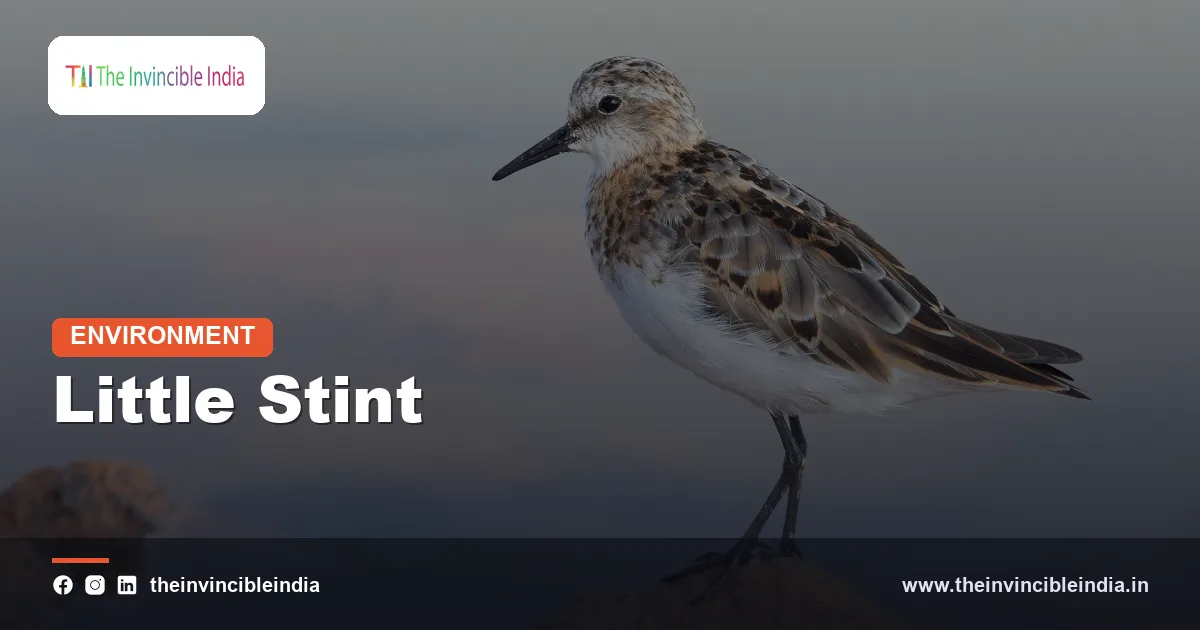
The little stint (Calidris minuta) is one of the smallest wading birds in the world, a sparrow-sized shorebird that breeds on the Arctic tundra and spends the winter in flocks on the mudflats, lagoons and wetlands of India. Weighing only a few tens of grams, the little stint travels thousands of kilometres each year along the Central Asian Flyway, and it is among the most abundant small waders that visitors see on Indian coasts and lakes between autumn and spring.
Because it is tiny, fast-moving and easily lost among other sandpipers, the little stint is often a challenge for beginners. This guide explains what the little stint is, how to identify it, where it winters in India, what it eats, how it breeds in the far north and how it differs from similar small waders.
Quick Facts
| Common name | Little stint |
|---|---|
| Scientific name | Calidris minuta |
| Family and order | Scolopacidae (sandpipers and allies); order Charadriiformes |
| Size | About 12 to 14 cm in length; weight roughly 20 to 30 g |
| Range and habitat in India | Mudflats, saltpans, lagoons, estuaries, lake shores and marshes, on the coast and inland, in winter |
| Diet | Small insects, crustaceans, molluscs and worms picked from mud and shallow water |
| Breeding and movement | Breeds on the Arctic tundra of northern Europe and Siberia; a long-distance migrant and winter visitor to India |
| Nest and eggs | Shallow scrape on open tundra; usually 4 eggs |
| Conservation status | Least Concern on the IUCN Red List |
Key Takeaways
- The little stint is a tiny sandpiper about the size of a sparrow, with a short black bill, black legs and pale underparts in winter.
- The little stint breeds on the Arctic tundra and reaches India as a winter visitor, appearing mainly from autumn to spring.
- The little stint feeds by picking small invertebrates from the surface of mud and shallow water, moving rapidly in tight flocks.
- The little stint is separated from the similar Temminck’s stint by its black legs, whereas Temminck’s stint has pale greenish-yellow legs.
- The little stint depends on coastal and inland wetlands such as mudflats, lagoons and saltpans, which are used as wintering and stopover sites.
- The little stint is classified as Least Concern by the IUCN, but loss of tidal flats and wetlands along its flyway is a long-term concern.
What is the little stint?
The little stint is a very small wader in the sandpiper family, Scolopacidae, belonging to the genus Calidris, a large group of mostly Arctic-breeding shorebirds that includes sanderlings, dunlins, knots and the curlew sandpiper. “Stint” is the name given to the smallest members of the group, which are sometimes called “peeps” in other countries.
Like other waders, the little stint is a bird of open shores, with long legs for its size and a short bill for picking up tiny prey. Its small size and quick movements give it a busy, mouse-like appearance when it runs across the mud.
What does “stint” mean?
The word “stint” is an old English term applied to small sandpipers, and its exact origin is uncertain. In birdwatching it refers to a group of tiny Calidris species including the little stint, Temminck’s stint, the long-toed stint and the red-necked stint. These species look alike and are sometimes difficult to separate, particularly in flocks.
How can you identify a little stint?
A little stint can be identified by its very small size, short straight black bill, black legs and, in winter, pale grey upperparts with a white underside. In the breeding plumage seen in spring and autumn, the back is brighter, with rufous and black feathers, and pale lines on the mantle form a V-shaped pattern.
Winter and breeding plumage
- Winter (non-breeding): plain grey-brown upperparts with dark feather centres, a clean white underside and a white eyebrow.
- Breeding: rusty-orange tones on the face, crown and back, a pale V on the mantle and a spotted breast.
- Juvenile: neat, scaled upperparts with rufous and white edges and clear white lines on the back, giving a striking pattern in autumn.
- Bill: short, fine and straight, slightly thick at the tip; black.
- Legs: black, a useful clue when separating it from Temminck’s stint.
The little stint stands horizontally, with a rounded back and a head held low, and it moves in a quick, rapid-pecking manner. In flight it shows a narrow white wing-bar and white sides to the rump, with a dark central line down the tail.
Where is the little stint found in India?
The little stint is found in India as a winter visitor to coastal and inland wetlands, including mudflats, estuaries, lagoons, saltpans, reservoirs and the muddy margins of lakes and rivers. It is common along both coasts, on large lakes such as Chilika in Odisha and Pulicat on the Tamil Nadu and Andhra Pradesh border, and in the Rann of Kutch and the Gulf of Khambhat.
The bird is also found at inland sites, including reservoirs, sewage ponds and seasonal pools, especially during passage. It arrives from late summer, with many birds appearing in autumn, and most leave in spring, although some immature birds may remain over the summer.
Typical wintering habitats
- Tidal mudflats and estuaries on the east and west coasts.
- Coastal saltpans and shallow lagoons, such as those of the Gujarat and Tamil Nadu coasts.
- Shallow edges of jheels, reservoirs and lakes in the interior.
- Damp fallow fields and the margins of wetlands, including Point Calimere in Tamil Nadu.
The little stint avoids deep water and steep banks. It needs gently sloping shores where shallow water and soft mud expose invertebrates, and so it benefits when water levels fall and expose fresh mud.
What does the little stint eat?
The little stint eats small invertebrates, including insects, tiny crustaceans, molluscs, worms and the larvae of flies, which it picks from the mud surface or from shallow water. Unlike larger waders, which probe deeply, the stint mostly pecks at the surface in a quick, running, almost sewing-machine action.
Food varies with the habitat. On saltpans the birds eat brine flies and small crustaceans that thrive in saline water. On freshwater shores they take midge larvae and other aquatic insects. Feeding is intense and can occupy much of the daylight, since the bird has a high metabolic rate and needs a good deal of food to maintain body heat and fuel its migrations.
How do flocks behave?
Little stints usually feed in flocks, often mixed with other small waders such as sanderlings, dunlins, curlew sandpipers and plovers. When disturbed, the flock rises together and twists and turns in unison before settling again. Flocking offers protection, since many eyes help detect predators such as falcons, which regularly hunt wader flocks.
How does the little stint breed?
The little stint breeds on the Arctic tundra of northern Scandinavia and Siberia, nesting in a shallow scrape on dry, open ground with sparse low vegetation, and laying usually four eggs in the short northern summer. The breeding season is brief, typically in June and July, which means that the adults must complete nesting rapidly.
Breeding success in the Arctic is strongly linked to the abundance of insects, which emerge for just a few weeks, and to the number of predators such as foxes and gulls. In some years, lemming populations affect nest losses, because predators switch to eggs when lemmings are scarce. The parental roles vary, and in some cases one parent, often the male, takes the major share of incubation and care of the chicks. The chicks are downy and leave the nest soon after hatching to feed themselves.
After breeding, adults and then juveniles begin the southward migration. The adults leave first, and the young follow later, finding their way to wintering areas that they have never visited before.
How far does the little stint migrate?
The little stint migrates several thousand kilometres between the Arctic tundra and its wintering areas in Africa and South Asia, with birds that winter in India travelling along the Central Asian Flyway. Some populations winter in Africa, while the ones that breed further east in Siberia head to South Asia, including India.
During migration, stints rely on a chain of stopover sites where they feed and refuel, such as inland lakes, coastal lagoons and the shores of large rivers. If these sites are degraded, the birds may arrive on their wintering grounds in poor condition. Migration is therefore a key reason why protection of wetlands at several points along the route is considered essential.
How is the little stint different from similar small waders?
The little stint differs from similar small waders mainly in its black legs, short black bill and slightly brighter plumage, while Temminck’s stint has pale greenish-yellow legs and a greyer, more uniform colour. Other small waders are separated by size, bill shape and habit.
| Bird | Size and bill | Legs | Key difference |
|---|---|---|---|
| Little stint | Very small; short, fine bill | Black | Pale V on back; brighter in juvenile and breeding plumage |
| Temminck’s stint | Very small; short bill | Pale yellow-green | Plain grey-brown; white outer tail; skulks near cover |
| Long-toed stint | Very small; slightly longer neck | Yellowish | Upright stance; very long toes; prefers vegetated edges |
| Red-necked stint | Very small | Black | Closely resembles little stint; mainly an East Asian species, rarely recorded in India |
| Sanderling | Larger; stout black bill | Black | Very pale in winter; runs along the surf line on sandy beaches |
| Dunlin | Larger; slightly drooped bill | Black | Longer bill; grey-brown; scarcer in India |
The little stint is often confused with the red-necked stint, which is nearly identical in winter plumage, and a conclusive identification may need good photographs and an expert opinion. For ordinary birdwatching, the combination of black legs and tiny size usually identifies the bird as a little stint if other features agree.
Is the little stint threatened?
The little stint is not considered threatened and is classified as Least Concern on the IUCN Red List, because it has a very large range and a large population. However, shorebirds as a group are declining in many parts of the world, and the loss of intertidal habitats and wetlands affects species such as the little stint.
- Reclamation of tidal flats and coastal wetlands for ports, industry, aquaculture and housing.
- Pollution of estuaries and lakes, which can reduce invertebrate food.
- Disturbance by people, dogs and vehicles at roosts and feeding sites.
- Changes in water management that remove the shallow muddy edges the birds use.
- Climate change affecting Arctic breeding conditions and sea levels.
Much of India’s wader conservation depends on protecting key wetlands, many of which are designated as Ramsar sites, Important Bird and Biodiversity Areas or protected areas. India has also adopted a national action plan for the conservation of migratory birds along the Central Asian Flyway, reflecting recognition that migratory species cannot be protected by one country alone.
Why does the little stint matter?
The little stint matters because it links ecosystems across continents, serving as an indicator of the health of wetlands from the Arctic to the tropics and playing a role in the food web as a consumer of small invertebrates and prey of raptors. The presence of healthy flocks signals that mudflats and shallow wetlands still produce enough food.
Because waders are easy to count in open habitats, they are used in long-term monitoring programmes, such as the Asian Waterbird Census, to track changes in wetland quality. Records of little stints, along with other waders, help conservationists identify places that deserve protection.
How can you watch little stints?
Little stints are best watched from a distance at the edge of tidal flats or lagoons, preferably in the hours around high tide, when waders are pushed close to shore and gather at roosts. A spotting scope or good binoculars help, since the birds are tiny and often far from the observer.
- Visit coasts, saltpans and large wetlands between October and March.
- Time the visit to the rising tide so flocks are concentrated and closer.
- Scan flocks slowly for the smallest birds, and then check the leg colour and bill shape.
- Stay behind a bank or hide, and avoid walking toward flocks, since flushing wastes the birds’ energy.
- Photograph the bird in good light to confirm identification later, particularly if other stints are present.
Observers who report sightings to citizen-science platforms add to a better understanding of wader numbers and movements in India.
Bottom Line
The little stint is a tiny Arctic-breeding sandpiper that winters in large numbers on Indian mudflats, lagoons and wetlands. Although it is not threatened as a species, it relies on a chain of healthy shore habitats, which makes the protection of India’s coastal and inland wetlands important for its future.
Frequently Asked Questions
What is a little stint?
A little stint is a very small wading bird, Calidris minuta, about the size of a sparrow. It breeds on the Arctic tundra and winters on mudflats and wetlands in India. It has a short black bill and black legs.
When does the little stint visit India?
The little stint visits India as a winter migrant, arriving from late summer or autumn and leaving by spring. It is most numerous between October and March. Some young birds may remain through the summer.
What does the little stint eat?
The little stint eats small insects, crustaceans, molluscs and worms that it picks from mud and shallow water. It feeds with quick pecking movements, mostly at the surface rather than by deep probing. It often feeds in flocks alongside other small waders.
How do you tell a little stint from a Temminck’s stint?
You can tell a little stint from a Temminck’s stint mainly by leg colour and overall tone. The little stint has black legs and a slightly brighter, patterned look, while Temminck’s stint has pale greenish-yellow legs and a plain grey-brown plumage. Temminck’s stint also tends to stay near cover and often has white outer tail feathers.
Where does the little stint breed?
The little stint breeds on the Arctic tundra of northern Europe and Siberia. It nests in a shallow scrape on open ground and usually lays four eggs. The birds that winter in India travel south along the Central Asian Flyway after breeding.
Is the little stint endangered?
No, the little stint is not endangered and is classified as Least Concern by the IUCN. It has a very large range and population. However, the loss of mudflats, lagoons and other wetlands along its migration route is a long-term concern.
{“@context”:”https://schema.org”,”@graph”:[{“@type”:”FAQPage”,”mainEntity”:[{“@type”:”Question”,”name”:”What is a little stint?”,”acceptedAnswer”:{“@type”:”Answer”,”text”:”A little stint is a very small wading bird, Calidris minuta, about the size of a sparrow. It breeds on the Arctic tundra and winters on mudflats and wetlands in India. It has a short black bill and black legs.”}},{“@type”:”Question”,”name”:”When does the little stint visit India?”,”acceptedAnswer”:{“@type”:”Answer”,”text”:”The little stint visits India as a winter migrant, arriving from late summer or autumn and leaving by spring. It is most numerous between October and March. Some young birds may remain through the summer.”}},{“@type”:”Question”,”name”:”What does the little stint eat?”,”acceptedAnswer”:{“@type”:”Answer”,”text”:”The little stint eats small insects, crustaceans, molluscs and worms that it picks from mud and shallow water. It feeds with quick pecking movements, mostly at the surface rather than by deep probing. It often feeds in flocks alongside other small waders.”}},{“@type”:”Question”,”name”:”How do you tell a little stint from a Temminck’s stint?”,”acceptedAnswer”:{“@type”:”Answer”,”text”:”You can tell a little stint from a Temminck’s stint mainly by leg colour and overall tone. The little stint has black legs and a slightly brighter, patterned look, while Temminck’s stint has pale greenish-yellow legs and a plain grey-brown plumage. Temminck’s stint also tends to stay near cover and often has white outer tail feathers.”}},{“@type”:”Question”,”name”:”Where does the little stint breed?”,”acceptedAnswer”:{“@type”:”Answer”,”text”:”The little stint breeds on the Arctic tundra of northern Europe and Siberia. It nests in a shallow scrape on open ground and usually lays four eggs. The birds that winter in India travel south along the Central Asian Flyway after breeding.”}},{“@type”:”Question”,”name”:”Is the little stint endangered?”,”acceptedAnswer”:{“@type”:”Answer”,”text”:”No, the little stint is not endangered and is classified as Least Concern by the IUCN. It has a very large range and population. However, the loss of mudflats, lagoons and other wetlands along its migration route is a long-term concern.”}}]}]}


