

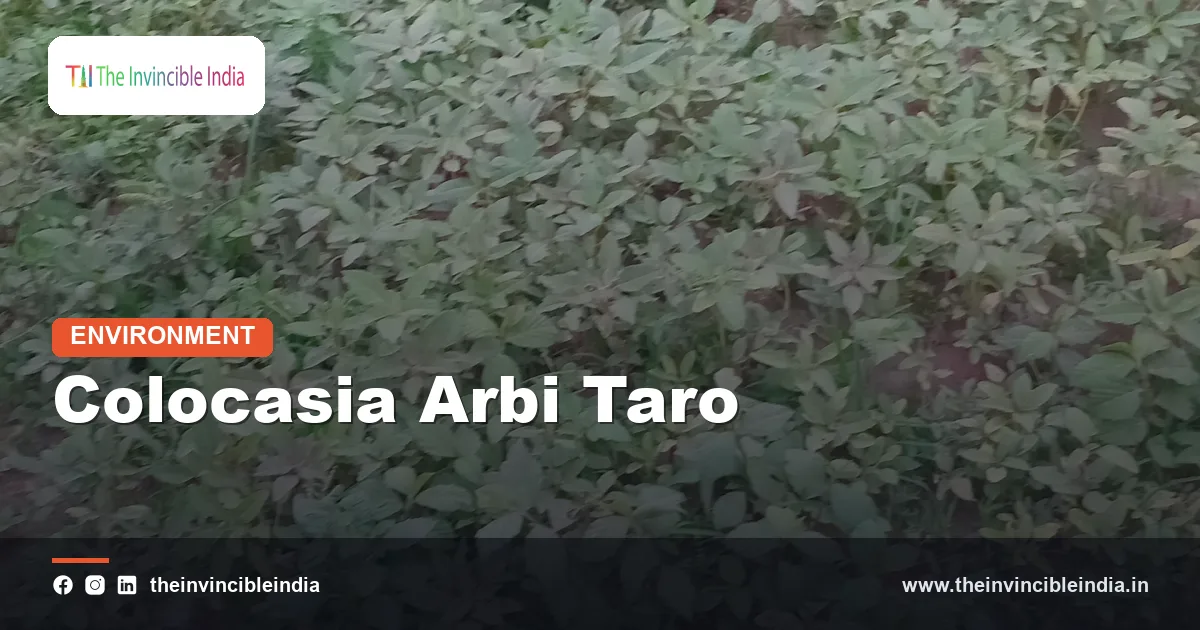
Colocasia is a tropical perennial plant, Colocasia esculenta, grown across India for its starchy underground corms and its heart-shaped leaves, and it is known in Hindi as arbi and in English as taro. Both the corm and the leaf are eaten only after thorough cooking, because the raw plant contains calcium oxalate crystals that irritate the mouth and throat. Colocasia is one of the oldest cultivated root crops in the Indian subcontinent and appears in home kitchens from Punjab to Kerala under many regional names.
For most Indian households, colocasia means a simple dry arbi fry, a tangy gravy or a pot of steamed leaf rolls. This article explains what colocasia is, how it grows, why it must be cooked, how it is used in different regions, and how it differs from similar-looking tubers.
| Attribute | Detail |
|---|---|
| Scientific name | Colocasia esculenta (L.) Schott |
| Common names | Arbi, arvi, taro, dasheen, eddoe (small-cormel types); kachu in Bengali, seppankizhangu in Tamil, chembu in Malayalam, alu in Marathi |
| Family | Araceae (the arum family) |
| Where grown in India | Uttar Pradesh, Bihar, West Bengal, Odisha, Assam and the north-east, Kerala, Tamil Nadu, Andhra Pradesh, Maharashtra and many hill districts |
| Season | Planted with the monsoon or in spring; harvested roughly five to seven months later, with most arbi sold between late monsoon and winter |
| Part used | Corms and cormels, leaves, leaf stalks (petioles) and, in some places, young shoots |
| Uses | Vegetable, snack, steamed leaf rolls, traditional dishes, starch source; a few varieties are also grown as ornamentals |
| Notable facts | Contains calcium oxalate and must be cooked; native to wetlands of South and South-East Asia; grows well in waterlogged, warm soil |
Key Takeaways
- Colocasia (Colocasia esculenta) is the botanical source of arbi, the starchy corm sold in Indian vegetable markets and cooked in most regions of the country.
- Raw colocasia contains needle-like calcium oxalate crystals, so the corm and leaves must always be cooked thoroughly before eating.
- Colocasia belongs to the arum family, Araceae, and is grown mainly as a warm-season, moisture-loving crop that thrives in the monsoon.
- Both the corm and the leaf of colocasia are eaten in India, in dishes such as arbi fry, patra, patrode and kachur shaak.
- Colocasia is a source of starch and dietary fibre, and its leaves are a source of vitamin A precursors and iron, but its nutritional value depends on preparation.
- Colocasia is different from elephant foot yam and from true yams, even though all three are underground storage organs used as vegetables.
What is colocasia?
Colocasia is a herbaceous plant of the arum family that produces a central starchy corm, smaller side cormels and a crown of large, broad leaves on long stalks. The plant grows to roughly one to two metres in height depending on variety and conditions, and its leaves are often compared to an elephant’s ear. The species name esculenta simply means edible.
The part sold as arbi in markets is the cormel, a small egg-shaped or finger-shaped side tuber with a brown, hairy or ringed skin and white to cream, sometimes purple-flecked flesh. The large central corm, known as the mother corm, is also eaten in some regions, and dasheen-type varieties are grown mainly for it. Smaller-cormel types are often called eddoe in international trade.
Where does colocasia come from and how did it reach India?
Colocasia is believed to have originated in the wetlands of South and South-East Asia, and it has been cultivated on the Indian subcontinent for a very long time. Botanists regard the region from eastern India to Indonesia as part of its original range. From there, early farmers carried it across the Pacific, and it later spread to Africa and the Caribbean, where it is also called taro or cocoyam.
In India, colocasia has long been a staple of village gardens, field edges and wet corners. Its ability to grow in standing water made it useful where cereals struggled, and it became a regular food among many tribal and rural communities, especially in eastern and north-eastern India. Wild and semi-wild forms still grow in streams and marshy patches in several states.
How is colocasia grown in India?
Colocasia is grown from small cormels or pieces of corm planted in well-drained but moisture-rich soil, usually at the start of the rains or in spring. The crop prefers warm temperatures, high humidity and fertile loam, and it tolerates temporary waterlogging better than most vegetables. Rain-fed, upland and paddy-style wetland systems are all used, depending on the region.
A typical crop cycle runs through the following stages.
- Planting: Healthy cormels are planted on ridges or in pits, with a spacing that lets the broad leaves spread without overcrowding.
- Earthing up: Soil is drawn up around the base of the plants once or twice so that new cormels form under the soil and do not turn green in the light.
- Moisture management: Regular irrigation or monsoon rain keeps the soil moist, since dry spells reduce cormel size.
- Harvest: The crop is ready when the leaves begin to yellow and dry, typically five to seven months after planting.
Leaf blight caused by a fungus-like organism, Phytophthora colocasiae, is a well-known disease of the crop in humid conditions, so farmers rely on tolerant varieties, good drainage and careful crop rotation. Several state agricultural universities and research institutes maintain improved varieties for different regions.
Why must colocasia be cooked before eating?
Colocasia must be cooked because its raw tissues contain calcium oxalate, which forms microscopic needle-shaped crystals called raphides that cause itching, burning and swelling in the mouth and throat. The crystals are present in the corm, the leaves and the stalks, and the effect is the reason that raw or under-cooked arbi can leave the tongue and lips tingling or irritated.
Cooking, especially boiling, steaming or deep frying after boiling, largely reduces this irritant effect. Traditional kitchens add a souring agent such as tamarind, amchur (dry mango powder), kokum or curd to the leaf preparations, and this practice is also thought to help reduce the itch. Cooks often handle raw arbi with oiled hands, since the sap can irritate the skin of some people.
People who are prone to kidney stones made of calcium oxalate are generally advised by doctors to be cautious with oxalate-rich foods, and colocasia leaves are among them. Anyone with a medical condition should seek a doctor’s advice rather than rely on general information.
How is colocasia eaten across India?
Colocasia is eaten across India as a dry fry, as a spiced gravy, as a steamed leaf snack and as a vegetable in mixed pots and lentil dishes. The cooking method usually starts with boiling or pressure-cooking the cormels, peeling them and then frying or simmering them with spices.
Regional dishes illustrate the range of uses.
- North India: Arbi is boiled, lightly pressed and shallow-fried with ajwain (carom seeds), amchur and chilli, or cooked in a yoghurt or tomato-onion gravy.
- Gujarat and Maharashtra: Colocasia leaves are rolled with a spiced gram-flour paste, steamed and then tempered. These are known as patra in Gujarat and alu vadi or patrode in Maharashtra and Karnataka.
- Bengal and Odisha: Kochu, the stalks and the cormels, appear in dishes such as kochur loti (the stolons or side shoots), kochur shaak and mustard-based preparations.
- Kerala and Tamil Nadu: Chembu or seppankizhangu is cooked in coconut-based curries, fried as crisp chips or added to sambar-style stews.
- North-east India: Cormels and leaves are used in boiled preparations, fermented bamboo shoot dishes and simple hill-style stews.
The variety of dishes comes partly from the plant’s mild, slightly nutty taste and its soft, creamy texture when cooked. Because the starch is fine-grained, cooked colocasia becomes sticky if it is overboiled, which is why many recipes fry it afterwards to give it a crisp outer layer.
What is the nutritional value of colocasia?
Colocasia is chiefly a source of carbohydrate in the form of starch, with a moderate amount of dietary fibre and small amounts of protein, potassium and other minerals. It contains very little fat, which is why the final dish depends heavily on the oil used in cooking. The corm gives a steady energy supply and was historically valued as a filling food.
The leaves are nutritionally different from the corm. Young colocasia leaves are a source of beta-carotene (a precursor of vitamin A), iron, calcium and fibre, and they are eaten as a leafy vegetable in several regions. Nutrient content varies with variety, soil, maturity and cooking method, so exact figures differ between food composition tables.
| Part of plant | Main contribution | Common preparation |
|---|---|---|
| Corm / cormel (arbi) | Starch and some fibre | Boiled and fried, gravies, chips |
| Leaf (patra) | Beta-carotene, iron, fibre | Steamed rolls, leaf curries |
| Leaf stalk (petiole) | Fibre and water | Mustard or coconut curries |
| Young shoot | Tender plant matter | Local stews and pickles |
What are the main types of colocasia?
The two broad types of colocasia are the dasheen type, which produces one large central corm, and the eddoe type, which produces many small side cormels around a small central corm. Indian arbi is mostly of the eddoe type, which is why markets sell small, egg-sized tubers.
Within these types, farmers recognise dozens of local lines that differ in skin colour, flesh colour, stalk colour and cooking quality. Some are white-fleshed and mild, while some have purple stalks or pink-flecked flesh. Research institutes such as the Central Tuber Crops Research Institute (CTCRI) in Thiruvananthapuram, which works on tropical root and tuber crops, maintain collections of colocasia germplasm and develop improved varieties.
How is colocasia different from elephant foot yam and other tubers?
Colocasia differs from elephant foot yam in being a smaller, moisture-loving plant in the genus Colocasia, while elephant foot yam is Amorphophallus paeoniifolius and forms a very large, flattened corm. Both belong to the arum family and both contain calcium oxalate, so both need careful cooking, but they are separate species with different growth habits and kitchen uses.
True yams, belonging to the genus Dioscorea, are a different family altogether, the Dioscoreaceae. Sweet potato, belonging to the morning-glory family, and potato, belonging to the nightshade family, are also unrelated to colocasia. The following list summarises the differences.
- Colocasia (arbi): Arum family, small to medium cormels, heart-shaped leaves with the stalk attached near the centre of the blade.
- Elephant foot yam (suran): Arum family, a very large single corm, and a single deeply divided leaf.
- True yam (Dioscorea): Yam family, climbing vines, often long or irregular tubers.
- Sweet potato: Morning-glory family, trailing vine with sweet, orange or purple tubers.
How should colocasia be selected, stored and prepared?
Colocasia should be chosen firm and heavy for its size, with an intact skin and no soft, mouldy or sprouting patches. The corms keep best in a cool, dry and well-ventilated place and can stay in good condition for a few weeks, but they spoil quickly if they stay damp.
The following steps are traditionally used for preparation.
- Wash the cormels well and boil or pressure-cook them in their skin until a knife slides in easily.
- Cool them slightly, peel the skin and, if required, press each piece lightly to flatten it.
- Fry, roast or simmer them with spices, adding a souring agent where the recipe calls for one.
- For leaves, wash well, remove the thick veins, add a tangy paste and cook thoroughly by steaming or simmering.
Cooks avoid using the water in which raw colocasia was boiled for another dish, and they take care to cook the leaves fully, since an undercooked leaf will still make the throat itch.
Why does colocasia matter in Indian food and farming?
Colocasia matters because it is a reliable, low-input food crop that grows in wet and shaded corners where many other vegetables fail, and it supplies both a staple starch and a leafy vegetable from one plant. In smallholder and tribal farming systems it gives food security during the monsoon months, when other fresh produce can be scarce.
It also holds cultural importance. Colocasia dishes appear in festival and ritual meals in several communities, and regional recipes pass down through families. Its demand in urban markets gives farmers in states such as Uttar Pradesh, West Bengal and Kerala a modest but steady cash crop.
Bottom Line
Colocasia is a hardy, versatile arum-family crop whose corms and leaves feed millions across India, provided they are cooked properly to remove the calcium oxalate irritant. Once prepared well, arbi is a mild, creamy and adaptable vegetable that suits both everyday meals and regional specialities.
Frequently Asked Questions
Is colocasia the same as arbi and taro?
Yes, colocasia, arbi and taro all refer to Colocasia esculenta, and the three names are used interchangeably depending on the region and language. Arbi is the common Hindi name, while taro is the international English name. In India the plant also carries many local names such as kachu, chembu and seppankizhangu.
Why does raw colocasia make the throat itch?
Raw colocasia makes the throat itch because it contains needle-shaped calcium oxalate crystals that irritate the skin and mucous membranes. The effect is stronger in leaves and in under-cooked corms. Thorough boiling, steaming or frying greatly reduces the itch, and tangy ingredients are traditionally added to help.
Can colocasia leaves be eaten?
Yes, colocasia leaves are eaten in many parts of India, but only after thorough cooking. They are used for steamed rolls such as patra and for curries in Bengal, Kerala and the north-east. Young, tender leaves are preferred because they are less irritating and more tender.
When is colocasia in season in India?
Colocasia is usually planted with the monsoon or in spring and harvested five to seven months later, so fresh arbi is most plentiful from late monsoon through winter. In warm southern regions the crop can be grown over a longer period. Markets in many cities stock arbi for most of the year.
Is colocasia a root or a stem?
Colocasia is a corm, which is a short, swollen underground stem, and not a true root. The small side tubers sold as arbi are cormels. Botanically this makes it different from carrot or radish, which are true taproots.
How is colocasia different from elephant foot yam?
Colocasia is a smaller, moisture-loving arum-family plant with small cormels, while elephant foot yam is a different species that forms a single very large corm. Both contain calcium oxalate and need careful cooking. They are separate crops with different growth habits and dishes.
{“@context”:”https://schema.org”,”@graph”:[{“@type”:”FAQPage”,”mainEntity”:[{“@type”:”Question”,”name”:”Is colocasia the same as arbi and taro?”,”acceptedAnswer”:{“@type”:”Answer”,”text”:”Yes, colocasia, arbi and taro all refer to Colocasia esculenta, and the three names are used interchangeably depending on the region and language. Arbi is the common Hindi name, while taro is the international English name. In India the plant also carries many local names such as kachu, chembu and seppankizhangu.”}},{“@type”:”Question”,”name”:”Why does raw colocasia make the throat itch?”,”acceptedAnswer”:{“@type”:”Answer”,”text”:”Raw colocasia makes the throat itch because it contains needle-shaped calcium oxalate crystals that irritate the skin and mucous membranes. The effect is stronger in leaves and in under-cooked corms. Thorough boiling, steaming or frying greatly reduces the itch, and tangy ingredients are traditionally added to help.”}},{“@type”:”Question”,”name”:”Can colocasia leaves be eaten?”,”acceptedAnswer”:{“@type”:”Answer”,”text”:”Yes, colocasia leaves are eaten in many parts of India, but only after thorough cooking. They are used for steamed rolls such as patra and for curries in Bengal, Kerala and the north-east. Young, tender leaves are preferred because they are less irritating and more tender.”}},{“@type”:”Question”,”name”:”When is colocasia in season in India?”,”acceptedAnswer”:{“@type”:”Answer”,”text”:”Colocasia is usually planted with the monsoon or in spring and harvested five to seven months later, so fresh arbi is most plentiful from late monsoon through winter. In warm southern regions the crop can be grown over a longer period. Markets in many cities stock arbi for most of the year.”}},{“@type”:”Question”,”name”:”Is colocasia a root or a stem?”,”acceptedAnswer”:{“@type”:”Answer”,”text”:”Colocasia is a corm, which is a short, swollen underground stem, and not a true root. The small side tubers sold as arbi are cormels. Botanically this makes it different from carrot or radish, which are true taproots.”}},{“@type”:”Question”,”name”:”How is colocasia different from elephant foot yam?”,”acceptedAnswer”:{“@type”:”Answer”,”text”:”Colocasia is a smaller, moisture-loving arum-family plant with small cormels, while elephant foot yam is a different species that forms a single very large corm. Both contain calcium oxalate and need careful cooking. They are separate crops with different growth habits and dishes.”}}]}]}


