

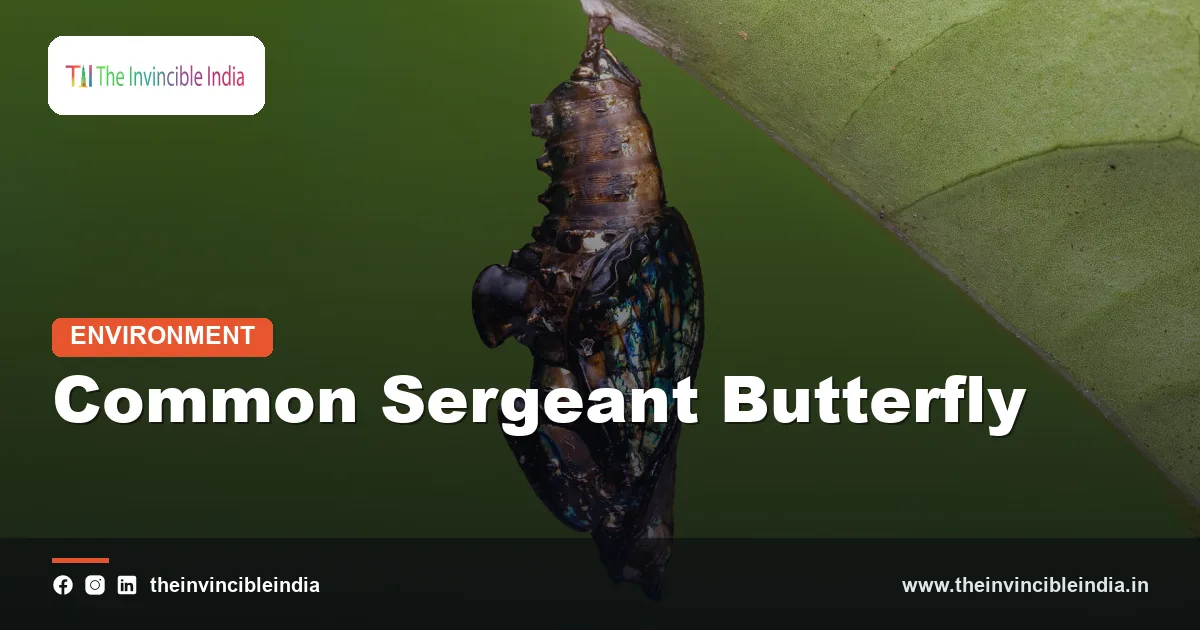
The common sergeant (Athyma perius) is a medium-sized black butterfly with bold white bands across its wings, found in the forests, forest edges and wooded gardens of India, and it is known for gliding on flattened wings between short bursts of flapping. The common sergeant belongs to the brush-footed butterfly family Nymphalidae and is one of the most frequently recorded sergeants in the country, from the Western Ghats and the Himalayan foothills to the north-east.
Many people first notice the common sergeant as a dark, banded butterfly basking on a leaf in a patch of sunlight, wings spread flat, before it drops into a glide and disappears into the shade. This article explains how to identify the common sergeant, where it lives, what its caterpillars eat, how it behaves and why this unassuming forest butterfly deserves attention.
| Quick Facts: Common Sergeant | |
|---|---|
| Common name | Common sergeant |
| Scientific name | Athyma perius |
| Family | Nymphalidae (brush-footed butterflies), subfamily Limenitidinae |
| Wingspan | Roughly 55 to 70 mm |
| Caterpillar host plants | Shrubs and small trees of the spurge-leaf family Phyllanthaceae, notably Glochidion species |
| Range and habitat in India | Peninsular India, the Western Ghats, the Himalayan foothills and the north-east; moist deciduous and evergreen forest, forest edges, shaded gardens and plantations |
| Flight season and broods | Seen through much of the year where the climate is mild; several overlapping broods, with numbers usually higher during and after the monsoon |
| Notable features | Black upperside with broad white bands; orange-brown underside with white bands; flat-winged gliding flight; frequent sunlit basking |
| Conservation status in India | Common and widespread; not a species of special concern |
Key Takeaways
- The common sergeant (Athyma perius) is a black butterfly with bold white bands, found in forests and wooded areas across India.
- The common sergeant glides on flattened wings with brief bursts of fast wingbeats, a habit shared by sergeants and sailers in the subfamily Limenitidinae.
- Caterpillars of the common sergeant feed on Glochidion and related shrubs in the Phyllanthaceae family, so the butterfly is closely tied to wooded habitat.
- The upperside of the common sergeant is dark with white bands, while the underside is orange-brown with white bands, which helps in telling it apart from similar sailers.
- The common sergeant is widespread and not considered threatened in India, but it depends on healthy forest edges and native shrubs.
- The best way to find a common sergeant is to look for a dark banded butterfly basking on a sunlit leaf along a shaded forest path.
What is the common sergeant butterfly?
The common sergeant is a woodland butterfly of the genus Athyma, whose members are called sergeants because of the bands across their wings that recall a uniform stripe. The species Athyma perius occurs across southern and south-eastern Asia and extends to parts of Australasia, and in India it is among the most familiar members of the group.
The common sergeant is classed in the family Nymphalidae, the largest butterfly family, whose members are often called brush-footed butterflies because the forelegs of adults are small and brush-like and are not used for walking. Within this family, the sergeants and the sailers (genus Neptis) share a subfamily, Limenitidinae, and a similar way of flying and resting.
The English name "common" is relative. The butterfly is common compared with other sergeants such as the colour sergeant or the studded sergeant, which are more local or more restricted to hill forests. A visitor to a well-wooded area in peninsular India has a good chance of meeting a common sergeant on any warm day.
How can you identify a common sergeant?
A common sergeant can be identified by its black or very dark brown upperside crossed by broad white bands, together with an orange-brown underside that carries white bands edged in black. The pattern is bold and high-contrast, which makes the butterfly easy to spot against green foliage.
Upperside pattern
On the upperside, the forewing has a white band that breaks into separate patches, and the hindwing has a continuous white band running across the middle. A small row of faint markings may be visible near the outer margin. The overall impression is of a dark butterfly with a bright white stripe, held open and flat while it basks.
Underside pattern
The underside is the quickest feature for confirming the identification. The ground colour is a warm orange-brown, and the white bands from the upperside show through as cleaner, more sharply outlined stripes. The body also carries pale underparts. When the butterfly closes its wings at rest, only this orange-and-white pattern is visible.
Size and sex differences
The common sergeant is medium-sized, with a wingspan that is typically in the range of about 55 to 70 mm. The sexes look broadly alike, although females tend to be a little larger with somewhat broader, rounder wings. Because the differences are subtle, most observers identify the butterfly by pattern and flight rather than by sex.
Where does the common sergeant live in India?
The common sergeant lives in forest and forest-edge habitat across much of India, including the Western Ghats, the Eastern Ghats, central India, the Himalayan foothills and the north-eastern states. Its preference is for moist, wooded country with plenty of shade and some open sunlit patches.
The butterfly is most often found in the following settings:
- Moist deciduous and evergreen forests, where it patrols forest paths and clearings.
- Forest edges and stream banks, where shrubs of the host plant family grow in partial shade.
- Coffee, tea and other shaded plantations that retain native shrubs and trees.
- Larger gardens, parks and campuses with mature trees, particularly near wooded hills.
Beyond India, the common sergeant ranges through Sri Lanka and the countries of South-east Asia to the Australasian region. This wide distribution reflects the adaptability of the species, although within any one region it is tied to wooded vegetation rather than to open grassland or dry scrub.
What does the common sergeant caterpillar eat?
The caterpillar of the common sergeant eats the leaves of shrubs and small trees in the Phyllanthaceae family, with Glochidion species being the best-known hosts. Glochidion plants are common in the understorey of tropical and subtropical forests in India and are often found along stream sides and forest margins.
Butterflies in the genus Athyma generally show a degree of host specialisation. The mother butterfly lays eggs singly on the leaves of the host plant, usually on the upper surface near the leaf tip or edge, choosing leaves that are in partial shade. This selective egg-laying is one reason the common sergeant is found where the right understorey shrubs survive.
Because the host plants are native forest shrubs, the abundance of common sergeants can serve as a loose indicator of habitat quality. When a forest edge is cleared, burnt or turned into a monoculture, the shrub layer is lost and the butterfly disappears from that patch, even though adults may still fly through occasionally.
How does the common sergeant fly and behave?
The common sergeant flies with a characteristic pattern of a few quick wingbeats followed by a long, level glide on wings held flat, a style often called gliding or sailing flight. This energy-saving technique lets the butterfly cover distance along forest paths with little effort.
Several habits help observers recognise the species:
- Basking: The butterfly often rests on a leaf in a sunbeam with wings spread flat, absorbing warmth before flying.
- Territorial perching: Males commonly choose a favourite perch and return to it repeatedly, chasing away other butterflies that enter the patch.
- Visiting moisture: Like many forest butterflies, the common sergeant may settle on damp ground, stream banks or animal droppings to take up salts and minerals.
- Using rotting fruit: Sergeants are more attracted to fermenting fruit and sap than to flowers, although flower visits are also recorded.
- Leaf-top resting: When disturbed, the butterfly usually flies a short distance and lands again on another leaf, rather than leaving the area.
What is the life cycle of the common sergeant?
The common sergeant passes through the four standard butterfly stages of egg, caterpillar (larva), chrysalis (pupa) and adult, completing the full cycle in roughly a month or somewhat more in warm weather. The exact duration depends on temperature, humidity and the quality of the host plant.
| Stage | What happens |
|---|---|
| Egg | Laid singly on a leaf of the host plant; hatches in a few days |
| Caterpillar | Feeds on host leaves, grows through several moults and is camouflaged green, with fleshy projections along the body |
| Chrysalis | Hangs from a leaf or twig, with a shape and colour that blend in with foliage |
| Adult | Emerges, dries its wings, mates and begins egg-laying; lives for a few weeks |
Caterpillars of sergeants and sailers rest on the host plant in a way that mimics a leaf, often sitting along the midrib or a leaf edge. The chrysalis is attached by the tail end and by a silk girdle or hangs freely, depending on the group. In a mild climate the common sergeant produces several overlapping broods in a year, so adults may be seen in most months.
How does the common sergeant differ from similar butterflies?
The common sergeant differs from similar black-and-white butterflies mainly in its broader white bands, its orange-brown underside and the way it holds its wings flat when basking. Several sailers and other sergeants look similar at a quick glance, so a careful look at the pattern helps.
| Butterfly | Group | Distinguishing clue |
|---|---|---|
| Common sergeant | Sergeant (Athyma) | Black with broad white bands; orange-brown underside with white bands |
| Common sailer | Sailer (Neptis) | Smaller; narrower white streaks and bands; gliding flight |
| Chestnut-streaked sailer | Sailer (Neptis) | Chestnut streaks on the underside and a bolder white pattern |
| Colour sergeant | Sergeant (Athyma) | More restricted to hill forests; different band shape and colour |
| Staff sergeant | Sergeant (Athyma) | Distinct band arrangement; tied to wooded country |
For beginners, the safest approach is to photograph the butterfly from above and from the side, so that both the upperside bands and the underside colour can be compared with a field guide or an India butterfly checklist. Sailers are generally narrower-banded, whereas the common sergeant shows wider, cleaner bands.
Why does the common sergeant matter to forest ecosystems?
The common sergeant matters because it is both a consumer and a food source within the forest, and because its dependence on native shrubs makes it a useful indicator of habitat quality. Each stage of its life links to other organisms.
- Caterpillars and chrysalises are eaten by birds, lizards, spiders and predatory insects, which transfers energy up the food chain.
- Adults take up nutrients from fruit, sap and damp soil, returning minerals to the cycle of the forest floor.
- Visits to flowers, although less frequent than in other butterflies, can contribute to pollination.
- The presence of the butterfly signals that the understorey shrubs it needs are still present.
Butterflies as a group are widely used in biodiversity monitoring because they are conspicuous, easy to survey and quick to respond to changes in vegetation and climate. A species like the common sergeant, which is common enough to record often, helps citizen scientists track changes over time.
Is the common sergeant threatened, and how can it be protected?
The common sergeant is not considered threatened in India and is regarded as a common, widespread species, but its numbers can fall locally when forest edges and native shrubs are removed. Habitat quality matters more than the legal protection status of the species itself.
Practical steps that help the butterfly include:
- Retaining native shrubs such as Glochidion along forest edges, stream banks and plantation borders.
- Avoiding blanket pesticide spraying in and near wooded gardens and plantations.
- Keeping some leaf litter, damp patches and fallen fruit, which adults use for nutrients.
- Supporting community butterfly counts and recording sightings on public biodiversity platforms.
Collecting butterflies from the wild is regulated under India’s wildlife laws for scheduled species, and in general it is better to watch and photograph. Responsible observation causes no harm and adds useful distribution data.
How and when can you watch a common sergeant?
The best way to watch a common sergeant is to walk slowly along a shaded forest path or wooded garden edge on a warm, bright morning and scan sunlit leaves at about knee to head height. The butterfly often returns to the same perch, so patience usually pays off.
Some tips for observers:
- Visit between mid-morning and early afternoon, when the butterfly is active and basking.
- Look near stream crossings, damp patches and fruiting trees, where adults gather.
- Move slowly and avoid sudden shadows, which cause the butterfly to leave its perch.
- Carry a camera with a telephoto or macro lens, and photograph both sides of the wings if possible.
- In peninsular India, the monsoon and post-monsoon months are often the most productive.
Bottom Line
The common sergeant is a black, white-banded forest butterfly of the Athyma genus that glides on flat wings and breeds on Glochidion and related shrubs. It is common in India’s wooded country, easy to learn and a good indicator of intact understorey vegetation.
Frequently Asked Questions
What is the scientific name of the common sergeant butterfly?
The scientific name of the common sergeant is Athyma perius. It belongs to the family Nymphalidae and the subfamily Limenitidinae, and it is grouped with the other sergeants in the genus Athyma.
What does a common sergeant butterfly look like?
A common sergeant looks like a black butterfly with broad white bands across its wings. The underside is orange-brown with clean white bands, and the wingspan is roughly 55 to 70 mm.
What do common sergeant caterpillars eat?
Common sergeant caterpillars eat the leaves of shrubs and small trees in the Phyllanthaceae family, especially Glochidion species. The female lays her eggs singly on these host leaves, which are usually in partial shade.
Where is the common sergeant found in India?
The common sergeant is found in forests and forest edges across India, including the Western Ghats, peninsular India, the Himalayan foothills and the north-east. It prefers moist, wooded habitat with shade and sunlit openings.
Why is it called a sergeant butterfly?
The butterfly is called a sergeant because the bold bands across its wings resemble the stripes of a sergeant’s uniform. Several related species in the genus Athyma share this naming pattern, such as the colour sergeant and the staff sergeant.
Is the common sergeant butterfly rare or endangered?
No, the common sergeant is not rare or endangered in India and is regarded as a widespread species. Local populations can still decline when forests, forest edges and native host shrubs are cleared.
{“@context”:”https://schema.org”,”@graph”:[{“@type”:”FAQPage”,”mainEntity”:[{“@type”:”Question”,”name”:”What is the scientific name of the common sergeant butterfly?”,”acceptedAnswer”:{“@type”:”Answer”,”text”:”The scientific name of the common sergeant is Athyma perius. It belongs to the family Nymphalidae and the subfamily Limenitidinae, and it is grouped with the other sergeants in the genus Athyma.”}},{“@type”:”Question”,”name”:”What does a common sergeant butterfly look like?”,”acceptedAnswer”:{“@type”:”Answer”,”text”:”A common sergeant looks like a black butterfly with broad white bands across its wings. The underside is orange-brown with clean white bands, and the wingspan is roughly 55 to 70 mm.”}},{“@type”:”Question”,”name”:”What do common sergeant caterpillars eat?”,”acceptedAnswer”:{“@type”:”Answer”,”text”:”Common sergeant caterpillars eat the leaves of shrubs and small trees in the Phyllanthaceae family, especially Glochidion species. The female lays her eggs singly on these host leaves, which are usually in partial shade.”}},{“@type”:”Question”,”name”:”Where is the common sergeant found in India?”,”acceptedAnswer”:{“@type”:”Answer”,”text”:”The common sergeant is found in forests and forest edges across India, including the Western Ghats, peninsular India, the Himalayan foothills and the north-east. It prefers moist, wooded habitat with shade and sunlit openings.”}},{“@type”:”Question”,”name”:”Why is it called a sergeant butterfly?”,”acceptedAnswer”:{“@type”:”Answer”,”text”:”The butterfly is called a sergeant because the bold bands across its wings resemble the stripes of a sergeant’s uniform. Several related species in the genus Athyma share this naming pattern, such as the colour sergeant and the staff sergeant.”}},{“@type”:”Question”,”name”:”Is the common sergeant butterfly rare or endangered?”,”acceptedAnswer”:{“@type”:”Answer”,”text”:”No, the common sergeant is not rare or endangered in India and is regarded as a widespread species. Local populations can still decline when forests, forest edges and native host shrubs are cleared.”}}]}]}


