

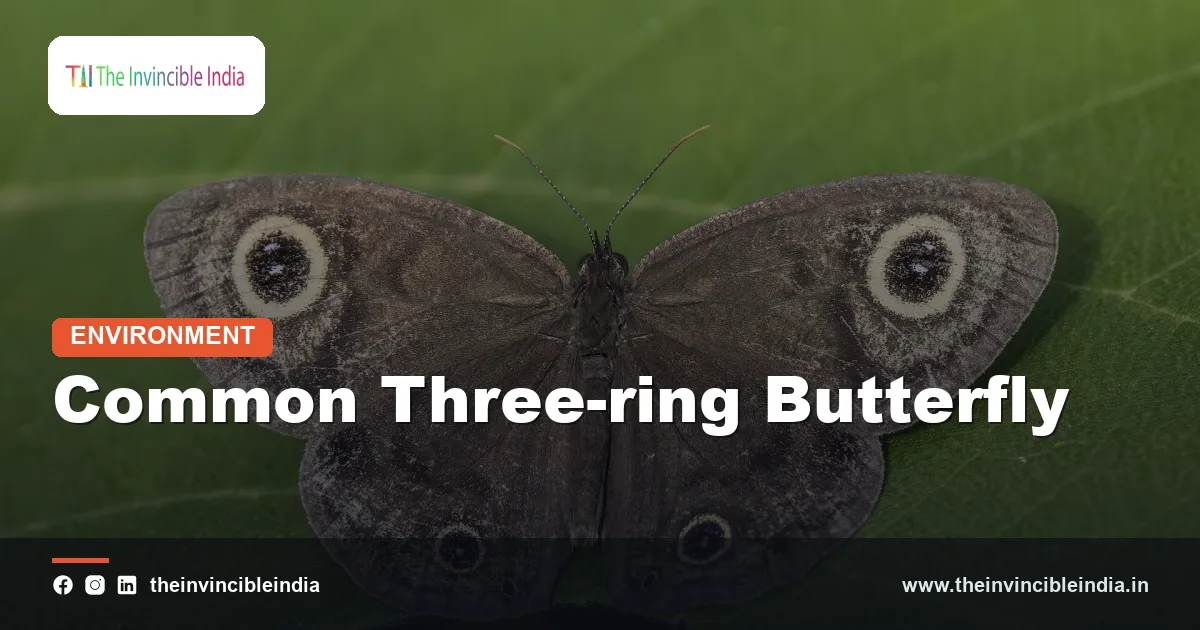
The common three-ring (Ypthima asterope) is a small, weak-flying brown butterfly of the family Nymphalidae that lives in shady grassy places and gardens across India and is named for the eyespot rings on the underside of its wings. It is one of several closely related “ring” butterflies, and it is among the most frequently encountered of them in towns, village outskirts and wooded edges.
Because the common three-ring is small, brown and unassuming, it is easy to overlook, yet it is a useful species for beginners to learn. It flies low, settles often and shows its patterned underside when it perches, which makes it a good subject for photography. This article explains how to identify it, what its caterpillars eat, how it breeds and why its eyespots matter.
| Quick Facts | Details |
|---|---|
| Common name | Common three-ring |
| Scientific name | Ypthima asterope (Klug, 1832) |
| Family and subfamily | Nymphalidae (brush-footed butterflies), subfamily Satyrinae (the satyrs or browns) |
| Wingspan | Roughly 30 to 40 mm |
| Larval host plants | Various grasses of the family Poaceae |
| Range and habitat in India | Widespread across much of the country in shaded grass, scrub edges, gardens and light woodland, in the plains and lower hills |
| Broods | Several overlapping generations through the year, with distinct wet-season and dry-season forms |
| Flight | Weak, bobbing and low over grass; frequently settles with wings closed |
Key Takeaways
- The common three-ring (Ypthima asterope) is a small brown satyrine butterfly with a wingspan of roughly 30 to 40 millimetres, found in grassy and lightly shaded places across India.
- The common three-ring is named for the three eyespot rings on the underside of its hindwing, which help to distinguish it from the common four-ring and common five-ring.
- Caterpillars of the common three-ring feed on grasses, so the butterfly thrives wherever grass is allowed to grow in partial shade.
- The eyespots of the common three-ring draw the attacks of predators towards the wing edges and away from the vital body, giving the butterfly a chance to escape.
- The common three-ring breeds in several overlapping generations a year and shows seasonal variation in its underside pattern.
- The common three-ring is widespread and not considered threatened, although mowing and pesticide use can reduce local populations.
What is the common three-ring butterfly?
The common three-ring butterfly is a small brown member of the subfamily Satyrinae, a group of butterflies known in India as the satyrs or browns, which are characterised by earthy colours and conspicuous eyespots. Its genus, Ypthima, contains many similar-looking butterflies in Asia and Africa, and several are known by names that count their rings.
The family Nymphalidae is often called the brush-footed family because most of its members have very small, hairy forelegs that are not used for walking. This gives the butterflies the odd appearance of having only four legs. The common three-ring shares this feature, although it is not easy to see without a close view.
Unlike the large, flashy butterflies that attract most attention, the common three-ring is a creature of the ground layer. It keeps close to grass and low shrubs, flutters in short flights and rarely visits flowers. Its calm, modest behaviour suits the quiet habitats it prefers.
How do you identify a common three-ring?
A common three-ring is identified by its small size, its brown colour and the set of eyespot rings on the underside, which include three rings on the hindwing. Observers usually see it perched with the wings closed, so the underside pattern is the key feature.
Upperside
The upperside is plain brown. There is usually a single prominent eyespot near the tip of the forewing and a smaller eyespot near the lower edge of the hindwing. The upperside is rarely seen at rest, as the butterfly keeps its wings folded.
Underside
The underside is paler brown or greyish-brown and is covered with fine, wavy, pencil-like lines, which give it a delicately striated look. The forewing carries a large eyespot with a pale ring, while the hindwing carries three eyespots of different sizes arranged near the margin. The rings are dark centres with a pale, yellowish halo and a darker outer ring.
Seasonal forms
As with many satyrs, the common three-ring comes in a wet-season form and a dry-season form. The wet-season form usually has clearer, better developed eyespots, while the dry-season form can be more muted. Observers should therefore not expect every individual to look identical.
Similar ring butterflies
The table below compares the ring butterflies that are most often confused with one another in Indian gardens and scrub.
| Butterfly | Scientific name | Distinguishing feature |
|---|---|---|
| Common three-ring | Ypthima asterope | Three rings on the hindwing underside and one large ring on the forewing |
| Common four-ring | Ypthima huebneri | Four rings on the hindwing underside |
| Common five-ring | Ypthima baldus | Five rings on the hindwing underside |
| Large three-ring | Ypthima nareda | Related three-ring species that is usually larger and more tied to wooded country |
Counting the rings accurately usually requires a good photograph, because the butterfly moves quickly and the spots are small. A single photo showing the full hindwing underside is normally enough for a reliable identification.
Where does the common three-ring live in India?
The common three-ring lives across much of India in shaded grassy places, including garden edges, scrub, light woodland, forest paths and the margins of fields. It is found in the plains and in the lower hills, and it is rarely seen in completely open, treeless country with no grass cover.
Its range is wide. Outside India, the species extends across southern Asia and, notably, into parts of Africa and the Middle East, which makes it one of the butterflies that link the faunas of the two continents. In India it is recorded from the north to the peninsula and in many hill regions.
The butterfly prefers places where tall grass meets shade. A path that runs through light woodland with grassy verges, or a garden with unmown corners beneath trees, offers the combination of cover and food that the species needs. In towns, it can be found in overgrown plots, parks and temple gardens.
Seasonally, the butterfly is more obvious after the rains, when grass grows thickly and the population builds up. In the dry season, individuals retreat to cooler, shadier spots near moisture and are harder to find.
What do common three-ring caterpillars eat?
Common three-ring caterpillars eat the leaves of grasses, which belong to the plant family Poaceae. Like other satyrine butterflies, the species is a grass specialist at the larval stage, and the caterpillars are rarely found on any other type of plant.
Many different grasses are likely to be used, including the soft, broad-bladed grasses of shady lawns and the finer grasses of scrub. Because grasses are among the commonest plants in India, host plants are seldom scarce, and this explains much of the butterfly’s success.
The caterpillar is typically green or brownish, with a body that tapers towards the rear and ends in a pair of small points. It feeds at night or at dusk and rests among the grass blades during the day, where its colour makes it hard to see. The shape and colour help it blend into the grass.
Adult common three-rings feed less on flower nectar than many butterflies. They are often seen feeding on rotting fruit, tree sap, bird droppings or moisture on the ground. This habit is common in satyrs and helps them find nutrients when flowers are scarce in shaded surroundings.
What is the life cycle of the common three-ring?
The life cycle of the common three-ring has four stages, egg, caterpillar, pupa and adult, and in warm conditions the entire cycle may be completed in about five to seven weeks. As with all butterflies, development is by complete metamorphosis.
Egg
The female lays small, rounded, pale eggs singly on grass blades or on nearby plants. The eggs are tiny and difficult to see. They hatch after several days, depending on temperature.
Caterpillar
The caterpillar eats its eggshell and then feeds on the grass. It grows through several moults and may turn from pale green to a darker green or brown in later stages. Its feeding does little visible damage, since a single caterpillar eats only a small amount of grass.
Pupa
The fully grown caterpillar forms a pupa, usually hanging from a fine silk pad on a grass stem, a leaf or a twig in the shade. The pupa is green or brown, which helps it blend in. The adult emerges after about a week or two in warm conditions.
Adult
The adult lives for a few weeks. During this time it feeds, mates and, in the case of females, lays eggs. Males often defend small territories in sunlit patches in the shade, flying out to investigate passing insects before returning to the same perch.
| Stage | Key features | Approximate duration in warm weather |
|---|---|---|
| Egg | Small, pale, laid singly near grass | About a week |
| Caterpillar | Green or brown, tapering rear with small points | About three weeks |
| Pupa | Hanging, green or brown | One to two weeks |
| Adult | Brown, with eyespot rings | A few weeks |
These timings are approximate and depend on temperature and food quality. Cooler weather lengthens each stage, and in some regions the dry season may be spent in a slow-growing state.
Why does the common three-ring have eyespots?
The common three-ring has eyespots because they redirect the attacks of predators away from the butterfly’s body and towards the edges of its wings. A bird or lizard that strikes at a conspicuous spot on the wing margin will often tear off only a small piece of wing, leaving the butterfly able to fly away.
This is a well-known defence in satyrine and other butterflies. The eyespots are placed near the wing margins, away from the head, where damage is least harmful. Some butterflies even show wing edges with small notches or tears that match the position of the spots, evidence that the strategy works in the real world.
The same eyespots may also help against some predators by acting as a startle device. When the butterfly suddenly opens or flicks its wings, the flash of spots can briefly confuse an attacker. The butterfly’s weak, bobbing flight is itself a form of evasion, since it is unpredictable and keeps the insect close to cover.
The fine striations on the underside, meanwhile, work as camouflage. With its wings closed on a patch of dry leaves and grass, the common three-ring can blend into its background so well that it is nearly invisible until it moves.
What is the ecological role of the common three-ring?
The common three-ring plays the role of a grass-feeding herbivore and a food source for insect-eating animals, which makes it a small but regular part of the food web in shaded grassland and garden habitats. It also acts as an indicator of the presence of undisturbed, partly shaded ground cover.
- Grass consumer: The caterpillars feed on grasses, though in amounts too small to harm lawns or crops in any meaningful way.
- Prey species: Spiders, lizards, birds, praying mantises and robber flies prey on the adults, while wasps and parasitoid insects attack caterpillars and pupae.
- Nutrient recycler: By feeding on rotting fruit and sap, adults take part in the breakdown of organic matter.
- Environmental indicator: Where mowing is constant and no shady, grassy margins remain, the butterfly often disappears.
The common three-ring is not an agricultural pest. Its caterpillars are not known to damage cereal crops in a serious way, which sets it apart from some other grass-feeding insects.
When is the best time to see the common three-ring?
The best time to see the common three-ring is on warm, bright mornings and late afternoons during and just after the monsoon, in shaded grassy spots. The butterfly is active through much of the year in warm regions, but sightings peak when the grass is lush.
Walk slowly along a shady path with grass on both sides and watch the ground at knee height. A brown butterfly that flies a short distance, drops back into the grass and folds its wings is likely to be a ring butterfly. If you stay still, it will often return to the same perch.
It helps to approach slowly and photograph the underside from a low angle. Do not trample the grass, as this destroys both eggs and caterpillars. Cloudy days and early mornings are good for close observation, since the butterflies are less active and easier to approach.
How can you protect the common three-ring?
You can protect the common three-ring by leaving patches of grass uncut in partial shade, avoiding pesticides and keeping gardens varied with trees, shrubs and unmown corners. These simple steps provide both host plants for the caterpillars and resting spots for the adults.
- Leave a strip of long grass beneath trees or along a boundary wall during the monsoon.
- Avoid spraying insecticides and herbicides on lawns and verges.
- Allow fallen fruit to rot in a corner, since adult satyrs feed on it.
- Keep a mix of sun and shade, as the butterfly prefers dappled light.
- Share photographs and dates of sightings with citizen-science platforms so that records of distribution and flight season accumulate.
Conservation of such common butterflies depends less on legal protection than on tolerance. A patch of ordinary grass and a few years without chemical sprays are often enough for a healthy population to return.
Bottom Line
The common three-ring is a modest brown butterfly, but its eyespot rings, grass-dependent life and shady habits make it an excellent introduction to the satyrs of India. It thrives where grass and shade coexist, and it declines where every blade is mown and sprayed. Recognising it is a simple way to start paying attention to the small wildlife that shares ordinary green spaces.
Frequently Asked Questions
What is the common three-ring butterfly?
The common three-ring is a small brown butterfly of the family Nymphalidae, scientifically named Ypthima asterope. It is found in shaded grassy places across India. It gets its name from the three eyespot rings on the underside of its hindwing.
What do common three-ring caterpillars eat?
Common three-ring caterpillars eat grasses of the family Poaceae. They feed mostly at dusk and night and rest on grass blades during the day. Adult butterflies feed mainly on rotting fruit, sap and moisture rather than flower nectar.
How is the common three-ring different from the common four-ring?
The common three-ring differs from the common four-ring mainly in the number of eyespot rings on the hindwing underside, which are three in the former and four in the latter. The two butterflies are otherwise similar in size and habits. A clear photograph of the underside of the hindwing is the most reliable way to tell them apart.
Why does the common three-ring fly so low and weakly?
The common three-ring flies low and weakly because its bobbing flight keeps it close to grass cover, where it can drop out of sight quickly. This unpredictable movement makes it harder for birds and other predators to follow. The butterfly saves energy and relies on camouflage and eyespots for defence.
Is the common three-ring found all over India?
The common three-ring is found across much of India, mainly in shaded grassy habitats in the plains and lower hills. It is common in gardens, scrub and light woodland. It is less often seen in open, treeless or heavily built-up areas.
Is the common three-ring a threatened species?
The common three-ring is not considered threatened, because it is widespread and adapts to gardens and disturbed ground. Local numbers can fall where grass is constantly mown or sprayed with chemicals. Leaving small shady grassy patches helps the butterfly persist.
{“@context”:”https://schema.org”,”@graph”:[{“@type”:”FAQPage”,”mainEntity”:[{“@type”:”Question”,”name”:”What is the common three-ring butterfly?”,”acceptedAnswer”:{“@type”:”Answer”,”text”:”The common three-ring is a small brown butterfly of the family Nymphalidae, scientifically named Ypthima asterope. It is found in shaded grassy places across India. It gets its name from the three eyespot rings on the underside of its hindwing.”}},{“@type”:”Question”,”name”:”What do common three-ring caterpillars eat?”,”acceptedAnswer”:{“@type”:”Answer”,”text”:”Common three-ring caterpillars eat grasses of the family Poaceae. They feed mostly at dusk and night and rest on grass blades during the day. Adult butterflies feed mainly on rotting fruit, sap and moisture rather than flower nectar.”}},{“@type”:”Question”,”name”:”How is the common three-ring different from the common four-ring?”,”acceptedAnswer”:{“@type”:”Answer”,”text”:”The common three-ring differs from the common four-ring mainly in the number of eyespot rings on the hindwing underside, which are three in the former and four in the latter. The two butterflies are otherwise similar in size and habits. A clear photograph of the underside of the hindwing is the most reliable way to tell them apart.”}},{“@type”:”Question”,”name”:”Why does the common three-ring fly so low and weakly?”,”acceptedAnswer”:{“@type”:”Answer”,”text”:”The common three-ring flies low and weakly because its bobbing flight keeps it close to grass cover, where it can drop out of sight quickly. This unpredictable movement makes it harder for birds and other predators to follow. The butterfly saves energy and relies on camouflage and eyespots for defence.”}},{“@type”:”Question”,”name”:”Is the common three-ring found all over India?”,”acceptedAnswer”:{“@type”:”Answer”,”text”:”The common three-ring is found across much of India, mainly in shaded grassy habitats in the plains and lower hills. It is common in gardens, scrub and light woodland. It is less often seen in open, treeless or heavily built-up areas.”}},{“@type”:”Question”,”name”:”Is the common three-ring a threatened species?”,”acceptedAnswer”:{“@type”:”Answer”,”text”:”The common three-ring is not considered threatened, because it is widespread and adapts to gardens and disturbed ground. Local numbers can fall where grass is constantly mown or sprayed with chemicals. Leaving small shady grassy patches helps the butterfly persist.”}}]}]}


