

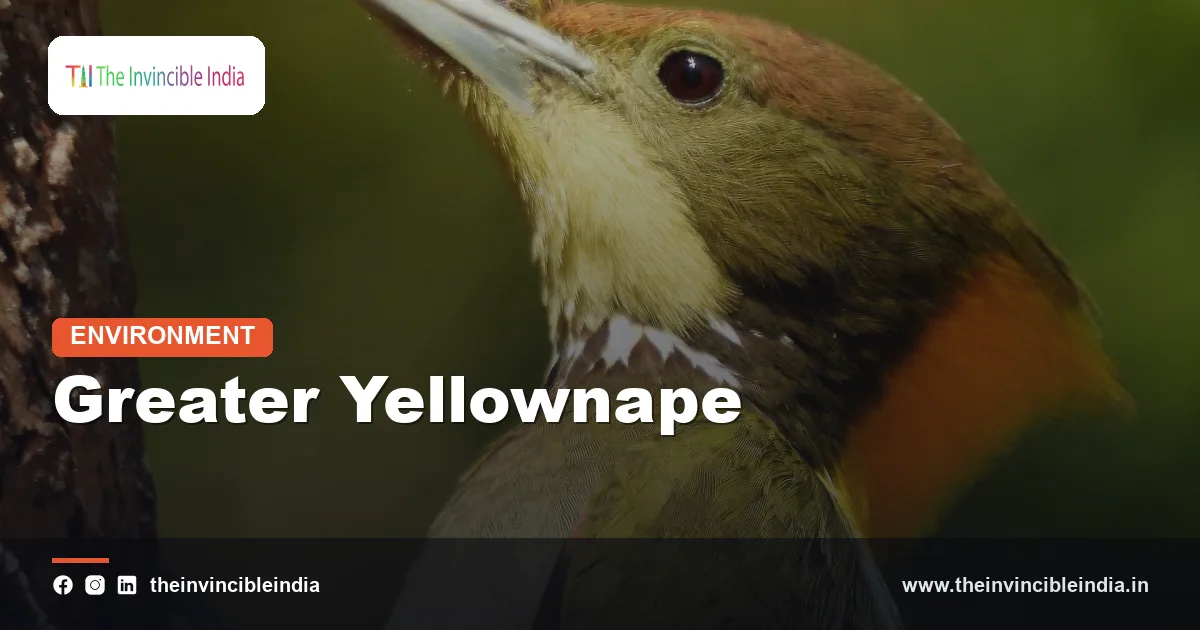
The greater yellownape (Chrysophlegma flavinucha) is a large green woodpecker with a bright yellow crest and nape, found in hill and moist forests of the Himalayan foothills, north-east India and the Western Ghats, where it probes bark and soil for ants, grubs and beetle larvae. Its loud, ringing call often announces the bird long before it is seen high in the canopy.
This guide explains how to recognise the greater yellownape, where it lives in India, what it eats, how it nests and why old forest trees matter to it. It sticks to stable, well-documented facts about the species.
Quick Facts
| Common name | Greater yellownape |
|---|---|
| Scientific name | Chrysophlegma flavinucha (formerly Picus flavinucha) |
| Family | Picidae (woodpeckers, piculets and wrynecks) |
| Size | About 32 to 35 cm long, one of the largest green woodpeckers in the region |
| Range and habitat in India | Moist deciduous and evergreen hill forests of the Himalayan foothills, north-east India and the Western Ghats, mostly in the foothills and lower hills |
| Diet | Ants, termites, beetle larvae and other insects, plus some fruit and nectar |
| Breeding | Excavates a nest hole in a tree trunk or large branch; lays a small clutch of white eggs in the spring months |
| Conservation status | Least Concern (IUCN); protected under the Wildlife (Protection) Act, 1972 |
Key Takeaways
- The greater yellownape is a large woodpecker in the family Picidae, recognised by its olive-green body and its conspicuous yellow crest and nape.
- The greater yellownape lives in moist forests of the Himalayan foothills, north-east India and the Western Ghats, and it is mostly found in the foothills and lower hills rather than at high altitude.
- A greater yellownape feeds mainly on ants, termites and beetle larvae, which it extracts from bark and rotting wood with a long, sticky tongue.
- Greater yellownapes have loud, far-carrying calls and are often located by sound before sight.
- The greater yellownape excavates its own nest cavity in a tree, and the abandoned holes are later used by many other forest animals.
- The greater yellownape is classed as Least Concern globally, but it depends on mature forest trees and is affected by logging and forest fragmentation.
What is the greater yellownape?
The greater yellownape is a large, mostly green woodpecker of the family Picidae, known for its yellow crest, rufous-barred wings and loud calls. Its scientific name is Chrysophlegma flavinucha, and the species name flavinucha means yellow-naped, a reference to the bright feathers at the back of its head.
Woodpeckers are a distinctive group of birds adapted to life on tree trunks. They have strong, chisel-shaped bills, stiff tail feathers that act as a prop, and feet with two toes pointing forwards and two backwards, which gives a secure grip on vertical bark. The greater yellownape shares all of these features.
The bird was previously placed in the genus Picus together with the green woodpeckers, but it is now generally treated in the genus Chrysophlegma along with several other South and South-East Asian woodpeckers. The change reflects genetic studies that grouped these forest species separately from the Eurasian green woodpeckers.
In India, the greater yellownape is one of the more impressive woodpeckers. It is much larger than the common flameback and the little pygmy woodpeckers, and it looks heavier in flight than the lesser yellownape, which is a smaller relative with a paler look.
How can you identify the greater yellownape?
The greater yellownape can be identified by its large size, olive-green back, bright yellow crest and nape, chestnut-rufous wings barred with black, and dark barred tail. Seen from below, the bird has a greyish-olive underside and a pale, often brighter throat.
Head and crest
The head is the main attraction. A long, loose yellow crest rises from the nape and may be raised when the bird is excited or calling. The face is greyish-olive with a pale throat, and the bill is large, straight and greyish with a dark tip. The sexes differ subtly in the colour of the throat and cheeks, and they can usually be told apart in a good view.
Wings and body
In flight, the rufous patches in the wings flash clearly against the green back, and the flight feathers look barred. The tail is black with fine bars, and the bird flies with the typical undulating, bounding pattern of woodpeckers, closing its wings between bursts of flapping.
Similar species
- Lesser yellownape: smaller, with a duller crest, a more olive look and different barring on the underparts.
- Common flameback: golden-yellow and black with a red crest and a different pattern on the back.
- Streak-throated woodpecker: smaller with a streaked throat and no obvious yellow crest.
Where does the greater yellownape live in India?
The greater yellownape lives in India in moist deciduous and evergreen forests of the Himalayan foothills, north-east India and the Western Ghats, usually in the foothills and lower hills where mature trees are plentiful. Beyond India, the species also occurs through the hill forests of South-East Asia.
In the Himalayan region it is found from the foothills eastwards, with the forests of Uttarakhand, the Terai region, Sikkim, West Bengal, Assam and the other north-eastern states among the places where it is regularly recorded. In peninsular India, a separate population lives in the Western Ghats, where it uses evergreen and moist deciduous forest and old plantations with tall trees.
The bird is a resident and does not undertake long migrations, although it may move short distances up or down hills according to the season and the availability of food. It is typically seen alone, in pairs or in small family groups, and it often joins mixed-species foraging flocks.
The greater yellownape usually keeps to the middle and upper levels of the forest, working along large trunks and thick limbs. It can be hard to see because it stays high and moves behind branches, but it will sometimes come lower in clearings, forest edges and areas with dead trees.
What does the greater yellownape eat?
The greater yellownape eats mainly ants, termites and the larvae of wood-boring beetles, which it finds on the bark of trees, in rotting timber and sometimes on the ground. It also takes other insects, spiders, fruits, berries and flower nectar, so its diet is more varied than many people expect.
How the feeding works
The woodpecker taps and probes crevices, strips loose bark and drives its bill into soft or decaying wood. A very long tongue, anchored by flexible bones that wrap around the skull, darts out to catch insects. The tip is barbed and coated with sticky saliva, which helps it pull ants and larvae from narrow tunnels.
Role in the forest
- Controls populations of wood-boring beetles and other insects that can damage trees.
- Opens up bark and decaying wood, which speeds decomposition and helps other organisms colonise it.
- Spreads seeds when it feeds on fruits and berries.
- Provides ready-made cavities for other animals after it abandons its nest holes.
Unlike the drumming woodpeckers that hammer loudly to proclaim territory, the greater yellownape does most of its work by quieter probing. It does, however, produce a loud, ringing call that carries a long distance through the forest.
How does the greater yellownape breed?
The greater yellownape breeds by excavating a nest hole in the trunk or a large branch of a tree, where a pair raises a small brood of young from white eggs. In India, nesting generally occurs in the spring and early summer months, though the exact timing varies with the region and altitude.
The pair chooses a tree that is dead or partly decayed so that the wood is soft enough to dig. Both birds take part in chiselling the cavity, which has a small round entrance and a deeper chamber below. The hole is often placed at a good height above the ground to reduce the risk from predators.
The female lays a small clutch of glossy white eggs on a bed of wood chips at the bottom of the chamber. Both parents incubate the eggs and later feed the chicks with insects, which they bring back in their bills and throats and regurgitate. The young stay in the hole until they are fully feathered and ready to fly.
Because the species needs a suitable dead or decaying tree each year, it is closely tied to forests that are allowed to age. Removal of snags and old trees for firewood or timber reduces the number of possible nest sites.
What does the greater yellownape sound like?
The greater yellownape has a loud, ringing, whistling call that is repeated and carries far through the forest, and it also makes sharper, chattering notes when alarmed or when chasing rivals. The call is one of the most reliable ways to find the bird, since it often stays hidden in dense leaves.
Like other woodpeckers, the species also uses its bill to tap on wood. This tapping, which differs from the rapid drumming of some other species, can be a sign that the bird is excavating or feeding. Observers who learn the call can locate a bird by sound, then scan the upper trunks and bare branches.
- Early morning is usually the best time to listen, when calling is most frequent.
- Calls often become more frequent in the breeding season, when pairs advertise their territory.
- A mixed flock moving through the canopy may include a yellownape, so noisy flocks are worth checking.
Calls help partners keep in touch and warn neighbouring woodpeckers to stay away. The calls of greater yellownape and its relatives differ in pitch and rhythm, a feature that experienced birders use to separate similar-looking species.
Why does the greater yellownape matter to forests?
The greater yellownape matters to forests because it controls wood-boring insects, creates tree cavities that many other animals reuse, and acts as an indicator of old, healthy forest with large trees. Woodpeckers are often called ecosystem engineers because their holes shape the animal community of a forest.
After a pair abandons a nest hole, it may be taken over by owls, hornbill relatives, parakeets, mynas, bats, squirrels and flying squirrels, or small carnivores. In forests where natural cavities are scarce, woodpecker-made holes can be the main nesting sites for these secondary users.
The species also serves as an indicator of forest condition. Large, mature trees and dead standing timber are essential for the greater yellownape, so a healthy population suggests a forest that has not been heavily logged or cleared. Its disappearance from a hill can be an early sign that old trees are being removed.
| Benefit | How the greater yellownape provides it |
|---|---|
| Pest control | Feeds on beetle larvae, ants and termites in trunks and logs |
| Habitat creation | Digs nest cavities later used by many other species |
| Seed dispersal | Eats fruits and berries and spreads seeds |
| Forest indicator | Needs mature, large trees and standing dead wood |
What threats does the greater yellownape face?
The greater yellownape faces threats mainly from the loss and fragmentation of mature hill forest, the removal of dead and decaying trees, and, in some places, hunting and trapping, although it is not considered globally threatened. It is protected in India under the Wildlife (Protection) Act, 1972.
- Logging and clearing: large trees with cavities are valuable to the bird and are often the first to be felled.
- Fragmentation: small, isolated forest patches cannot support a pair over the long term.
- Removal of snags: cutting dead standing trees for firewood eliminates nest and feeding sites.
- Pesticides and monoculture plantations: reduce the supply of insects and nesting trees.
The species is classed as Least Concern by the IUCN because it has a wide range through South and South-East Asia. Even so, local numbers can fall when forest quality declines. Conservation measures that help include protecting old-growth patches, keeping some standing dead trees in managed forests and maintaining connected forest corridors across hill landscapes.
Community forest management that leaves veteran trees untouched, as well as the careful regulation of timber extraction in protected areas, benefits the greater yellownape and the many species that share its habitat.
How can you watch the greater yellownape?
You can watch the greater yellownape by visiting moist hill forest in the cooler months, listening for its loud call at dawn, and scanning large trunks and bare upper branches with binoculars. Patience is important, since the bird moves around the far side of a trunk and is easily overlooked.
- Choose forest with tall trees and some dead wood, such as foothill sal and mixed deciduous forest, evergreen forest edges or old plantations.
- Listen first, then follow the call and look for a flash of yellow on the top of a trunk or in a fruiting tree.
- Check mixed-species flocks, which often include woodpeckers along with babblers, drongos and nuthatches.
- Keep a respectful distance from nest holes, avoid tapping or damaging trees, and do not play recorded calls to draw the bird out.
- Note the size, the yellow crest and the barred rufous wings to separate it from similar woodpeckers.
A morning walk along a forest trail, especially near a stand of tall trees, offers a good chance of seeing this striking woodpecker.
Bottom Line
The greater yellownape is a large green woodpecker with a yellow crest, an ant-and-grub diet and a ringing call, living in India’s moist hill forests. It is a useful guide to forest health, because it needs old trees and standing dead wood, and its nest holes help many other animals.
Frequently Asked Questions
What is a greater yellownape?
The greater yellownape is a large green woodpecker with a bright yellow crest and nape. It lives in moist hill forests of the Himalayan foothills, north-east India and the Western Ghats, and feeds mainly on ants, termites and beetle larvae.
Where is the greater yellownape found in India?
The greater yellownape is found in the Himalayan foothills, north-east India and the Western Ghats. It prefers moist deciduous and evergreen forest with large trees, mostly in the foothills and lower hills.
What does the greater yellownape eat?
The greater yellownape eats mainly ants, termites and wood-boring beetle larvae. It also takes other insects, spiders, fruits and nectar, and uses a long, sticky tongue to extract prey from bark and decaying wood.
How can I tell a greater yellownape from a lesser yellownape?
The greater yellownape is larger and heavier than the lesser yellownape and has a more striking yellow crest with rufous, barred wings. The lesser yellownape is smaller and duller, with a more olive overall look and different barring on the underparts.
Where does the greater yellownape nest?
The greater yellownape nests in a hole that it digs in a tree trunk or large branch, usually in dead or decaying wood. Both parents help dig the cavity, and the female lays a small clutch of white eggs inside.
Is the greater yellownape endangered?
No, the greater yellownape is classed as Least Concern by the IUCN because it has a wide range. In India it is protected under the Wildlife (Protection) Act, 1972, but it still depends on mature forest and can decline where old trees are removed.
{“@context”:”https://schema.org”,”@graph”:[{“@type”:”FAQPage”,”mainEntity”:[{“@type”:”Question”,”name”:”What is a greater yellownape?”,”acceptedAnswer”:{“@type”:”Answer”,”text”:”The greater yellownape is a large green woodpecker with a bright yellow crest and nape. It lives in moist hill forests of the Himalayan foothills, north-east India and the Western Ghats, and feeds mainly on ants, termites and beetle larvae.”}},{“@type”:”Question”,”name”:”Where is the greater yellownape found in India?”,”acceptedAnswer”:{“@type”:”Answer”,”text”:”The greater yellownape is found in the Himalayan foothills, north-east India and the Western Ghats. It prefers moist deciduous and evergreen forest with large trees, mostly in the foothills and lower hills.”}},{“@type”:”Question”,”name”:”What does the greater yellownape eat?”,”acceptedAnswer”:{“@type”:”Answer”,”text”:”The greater yellownape eats mainly ants, termites and wood-boring beetle larvae. It also takes other insects, spiders, fruits and nectar, and uses a long, sticky tongue to extract prey from bark and decaying wood.”}},{“@type”:”Question”,”name”:”How can I tell a greater yellownape from a lesser yellownape?”,”acceptedAnswer”:{“@type”:”Answer”,”text”:”The greater yellownape is larger and heavier than the lesser yellownape and has a more striking yellow crest with rufous, barred wings. The lesser yellownape is smaller and duller, with a more olive overall look and different barring on the underparts.”}},{“@type”:”Question”,”name”:”Where does the greater yellownape nest?”,”acceptedAnswer”:{“@type”:”Answer”,”text”:”The greater yellownape nests in a hole that it digs in a tree trunk or large branch, usually in dead or decaying wood. Both parents help dig the cavity, and the female lays a small clutch of white eggs inside.”}},{“@type”:”Question”,”name”:”Is the greater yellownape endangered?”,”acceptedAnswer”:{“@type”:”Answer”,”text”:”No, the greater yellownape is classed as Least Concern by the IUCN because it has a wide range. In India it is protected under the Wildlife (Protection) Act, 1972, but it still depends on mature forest and can decline where old trees are removed.”}}]}]}


