

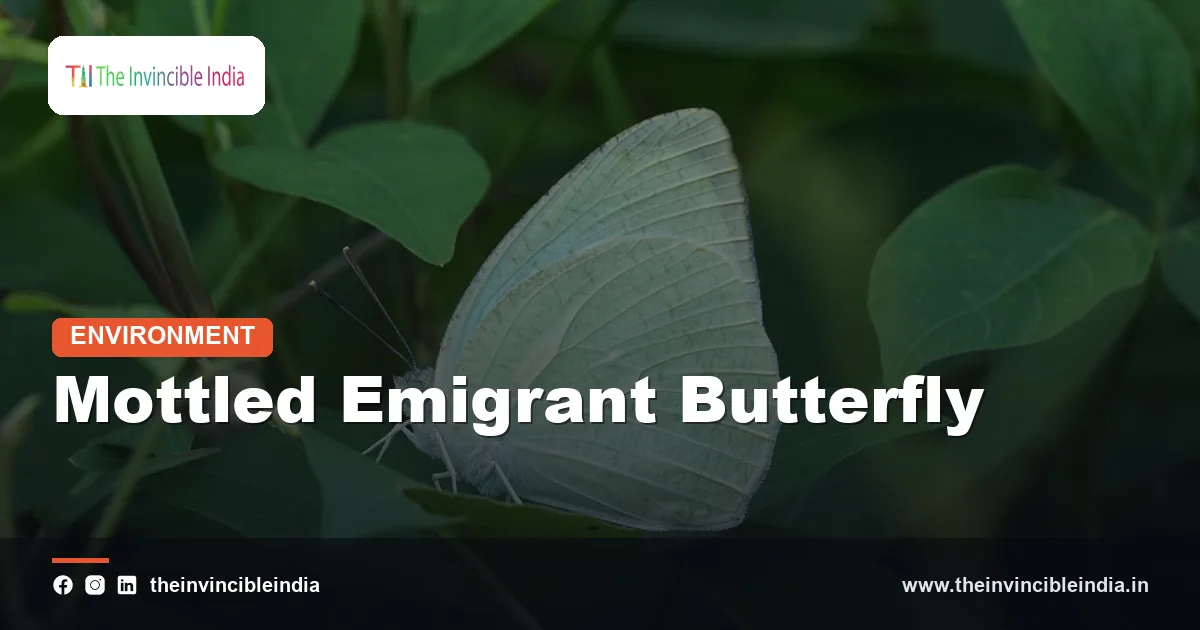
The mottled emigrant (Catopsilia pyranthe) is a pale greenish-white migratory butterfly of the family Pieridae, found in Indian gardens, scrub and open country and known for its fast, direct flight and its large movements in the rainy season. Its caterpillars feed on cassia and senna plants, which are common across India, and this link to a widespread host plant helps explain why the butterfly is so numerous.
The mottled emigrant is easy to notice because it is active, fond of damp ground and often seen in numbers. This explainer covers how to identify the mottled emigrant, where it lives, what its caterpillars eat, how it migrates, how it differs from the similar common emigrant and why it is a useful butterfly for beginners. It was last reviewed on 30 October 2026.
| Common name | Mottled emigrant |
|---|---|
| Scientific name | Catopsilia pyranthe |
| Family | Pieridae (whites and yellows), subfamily Coliadinae |
| Wingspan | Roughly 5 to 6.5 cm |
| Host plants | Cassia and senna plants (Senna and related genera of the family Fabaceae), including Senna occidentalis, Senna tora and the ornamental Senna siamea |
| Range and habitat in India | Gardens, scrub, farmland edges, light forest and open country across most of India, from the plains to the lower hills; extends to Sri Lanka and South-East Asia |
| Flight season and broods | Several broods through the year; peak numbers and migratory movements usually during and after the monsoon |
| Notable features | Pale greenish-white colour, strong fast flight, migratory habit, male mud-puddling, seasonal wing forms |
Key Takeaways
- The mottled emigrant (Catopsilia pyranthe) is a pale greenish-white to white butterfly in the family Pieridae, found in much of India.
- The mottled emigrant is a migratory butterfly that can move in large numbers in a common direction, particularly around the rainy season.
- Mottled emigrant caterpillars feed on cassia and senna plants in the pea family (Fabaceae), many of which are weeds or garden trees.
- Male mottled emigrants often gather in groups at damp sand and mud to take up water and minerals.
- The mottled emigrant is frequently confused with the common emigrant (Catopsilia pomona), but its markings are less variable and its underside is finely mottled.
- The mottled emigrant is widespread and common, and is not regarded as threatened.
What is the mottled emigrant butterfly?
The mottled emigrant is a medium-sized butterfly in the family Pieridae, the family of whites, yellows and sulphurs, and its scientific name is Catopsilia pyranthe. It belongs to the subfamily Coliadinae, which includes the yellows and emigrants, and it is one of several Catopsilia species in tropical Asia.
The word emigrant refers to the group’s habit of moving in large numbers from one region to another, particularly in the rainy season. The word mottled refers to the speckled or finely patterned underside of the wings, which distinguishes this species from its relatives.
The mottled emigrant is one of the butterflies most likely to be noticed in India, because it is active in open sunshine, patrols gardens and roadsides and often forms noticeable groups at water.
How do you identify a mottled emigrant?
A mottled emigrant is identified by its pale, greenish-white or whitish wings, fine dark edging on the forewing and its finely speckled underside. In flight it looks like a pale, fast-moving butterfly with a slight yellowish-green tint.
Upperside
The upperside in males is typically pale greenish-white with a narrow dark border at the forewing tip and along the outer edge. Females are similar but usually show more dark markings, such as a broader border and spots on the forewing, and they can have a more yellowish cast.
Underside
The underside is pale and covered with fine, speckled markings that give the species its name. The forewing often has a small marking near the centre, and the hindwing shows a fine, mottled pattern. When the butterfly perches with its wings closed, it looks like a pale leaf or a petal.
Size and shape
The wingspan is around 5 to 6.5 cm, so it is a medium-sized butterfly. The forewings are somewhat pointed, which suits its fast flight, and the body is strong and slim. Its seasonal forms can vary a little in depth of colour and in the intensity of markings.
Where does the mottled emigrant live in India?
The mottled emigrant lives across most of India, in gardens, scrub, farmland edges, open woodland and roadsides, from the plains to the lower hills, and the species also occurs in Sri Lanka and South-East Asia. It is a butterfly of open, sunny and disturbed country as much as of forest.
It is most easily found in places such as:
- Gardens and parks that include senna or cassia plants
- Waste ground and roadsides where weedy senna species grow
- Edges of fields, scrub and light woodland
- River banks, tank edges and damp sandy patches
The mottled emigrant is less common in dense, closed forest and in high mountain zones. Its presence in both villages and cities shows how well it adapts to human-modified landscapes, as long as host plants and open sunlight are available.
What do mottled emigrant caterpillars eat?
Mottled emigrant caterpillars eat the leaves of cassia and senna plants in the pea family (Fabaceae). Common host plants include the weedy Senna occidentalis and Senna tora, as well as ornamental trees such as Senna siamea, which is often planted along Indian streets.
A host plant is the plant that a butterfly’s caterpillars feed on and develop in. Because cassia and senna species are abundant weeds and garden plants in India, the mottled emigrant has plentiful breeding places. This abundance helps explain why large numbers can appear after rain, when new leaf growth is rich.
The caterpillars are usually green, matching the leaves, and they feed on the foliage and rest along the leaf. When many butterflies breed on a single stand of senna, the plants can be noticeably chewed, though they usually recover.
Is the mottled emigrant really a migratory butterfly?
The mottled emigrant is a migratory butterfly, because large numbers of individuals sometimes travel together in the same direction over considerable distances, especially during the rainy season. The movement is a recognised feature of the genus Catopsilia and is one reason for the English name emigrant.
Observers in India have long reported streams of pale butterflies moving steadily across roads, fields and rivers, often at a low height and with a steady direction. The exact direction and timing differ from region to region and from year to year, and they are linked to rainfall and the growth of host plants.
Scientists studying insect migration see these movements as a way for the butterflies to reach fresh host plants and areas with suitable conditions for breeding. Unlike the long, repeated round-trip journeys of some other insects, the mottled emigrant’s movement is irregular, and it should be described in general terms rather than as a fixed, predictable route.
How does the mottled emigrant fly and behave?
The mottled emigrant flies fast and directly, usually at a modest height, and it does not linger at flowers for long. Its strong flight lets it cover a lot of ground quickly, and it frequently passes through a garden or along a roadside in a single swift pass.
Mud-puddling
Males commonly gather at damp sand, mud and the edges of puddles and streams. This behaviour is called mud-puddling, and it allows butterflies to take in water and dissolved minerals. Groups of mottled emigrants at a wet patch can include dozens of individuals, sometimes mixed with other species.
Flower visits
Adults visit a range of flowers for nectar, including garden plants such as lantana, but they usually keep their wings partly open or beating while feeding. They are alert and quickly take off if disturbed.
Resting
At rest, the mottled emigrant folds its wings above its back, and the pale underside makes it resemble a leaf or a pale flower. At night and in cool weather, it roosts on vegetation in shade.
What is the life cycle of the mottled emigrant?
The mottled emigrant passes through egg, caterpillar, pupa and adult stages, as all butterflies do. The female lays eggs singly on the leaves of cassia or senna, the caterpillars feed and moult several times, and the full-grown caterpillar attaches itself to a stem or leaf and forms a pupa, from which the adult emerges.
- Egg: small, pale and laid on young leaves of the host plant
- Caterpillar: green and feeds on senna or cassia foliage
- Pupa: a chrysalis attached to the plant and held in place by a silken girdle, usually green or whitish
- Adult: a fast-flying stage that mates, feeds and lays the next generation
In warm parts of India the mottled emigrant can produce several broods in a year. Wet-season and dry-season forms can differ slightly in the depth of colour and in the strength of the markings.
When is the best time to see the mottled emigrant?
The best time to see the mottled emigrant is during and just after the monsoon, when host plants are growing quickly and numbers rise sharply. In many parts of India it can also be seen in other months, though it is less abundant in the driest or coldest weeks.
Sunny mornings and early afternoons are the best part of the day. Damp sandy banks, tank edges and puddles on warm days are the most reliable spots for finding groups of males, and gardens with senna or cassia plants offer a good chance of seeing egg-laying females.
How is the mottled emigrant different from the common emigrant?
The mottled emigrant differs from the common emigrant (Catopsilia pomona) mainly in its finely speckled underside, its more uniform appearance and its less variable colour forms. The common emigrant is more variable and occurs in several forms, including a yellowish form and a form with a distinct rust-coloured streak on the underside.
| Feature | Mottled emigrant | Common emigrant |
|---|---|---|
| Scientific name | Catopsilia pyranthe | Catopsilia pomona |
| Colour forms | Fairly uniform pale greenish-white | Several forms, including lemon-yellow and white |
| Underside | Finely speckled or mottled | Often smoother, with a marked spot or streak in some forms |
| Host plants | Cassia and senna | Cassia and senna |
| Behaviour | Fast flier, migratory, mud-puddles | Fast flier, migratory, mud-puddles |
Since the two species often fly together and share host plants, a close photograph of the underside is the most reliable way to separate them.
Is the mottled emigrant butterfly threatened?
The mottled emigrant is not regarded as a threatened butterfly, since it is widespread, adaptable and uses abundant host plants. Local numbers can fall when weedy senna is cleared, when pesticides are used heavily or when open ground is entirely built over.
The species is useful for beginners and for citizen-science projects because it is common, easy to see and linked to well-known plants. Recording the date, place and number of butterflies seen, especially during migratory movements, adds to what is known about seasonal patterns. In India, wild butterflies are covered by wildlife protection rules, so photography and observation are the right approaches, rather than collecting.
How can you attract mottled emigrants to a garden?
You can attract mottled emigrants to a garden by growing cassia or senna plants for the caterpillars, providing nectar flowers and keeping a damp, sandy patch for the adults. Senna plants should be grown where some leaf damage from caterpillars is acceptable.
- Plant native or non-invasive cassia and senna species as breeding plants.
- Grow nectar sources such as lantana and other flowering shrubs in a sunny spot.
- Keep a shallow tray of damp sand or soil for mud-puddling.
- Avoid insecticides, which kill caterpillars and adults alike.
Bottom Line
The mottled emigrant is a pale, fast-flying, migratory butterfly of Indian gardens, scrub and open country, closely tied to cassia and senna plants. It is common, easy to watch at damp ground and a good species for learning how butterflies breed, feed and move across the landscape.
Frequently Asked Questions
What is the mottled emigrant butterfly?
The mottled emigrant butterfly is a pale greenish-white butterfly, Catopsilia pyranthe, of the family Pieridae. It is common in Indian gardens, scrub and open country. It is known for its fast flight, mud-puddling and migratory movements.
What do mottled emigrant caterpillars eat?
Mottled emigrant caterpillars eat the leaves of cassia and senna plants in the pea family. Examples include Senna occidentalis, Senna tora and the street tree Senna siamea. These plants are common in India, which supports large numbers of the butterfly.
Why is it called an emigrant?
It is called an emigrant because butterflies of this group often travel in large numbers in a common direction, especially around the rainy season. The movements are irregular rather than fixed routes. The word mottled refers to the speckled underside of the wings.
How can you tell a mottled emigrant from a common emigrant?
You can tell a mottled emigrant from a common emigrant by its finely speckled underside and its more uniform pale greenish-white colour. The common emigrant is more variable and has forms with yellow or with a clear spot or streak. A close photograph of the underside is the best check.
Why do mottled emigrants gather at mud?
Mottled emigrants gather at mud because they are taking in water and dissolved minerals, a behaviour called mud-puddling. It is mostly done by males. The minerals are scarce in nectar and are useful to the butterfly’s body and reproduction.
Is the mottled emigrant butterfly common in India?
The mottled emigrant butterfly is common across most of India and is not regarded as threatened. It thrives in gardens, farmland edges and open country with cassia or senna plants. Numbers are usually highest during and after the monsoon.
{“@context”:”https://schema.org”,”@graph”:[{“@type”:”FAQPage”,”mainEntity”:[{“@type”:”Question”,”name”:”What is the mottled emigrant butterfly?”,”acceptedAnswer”:{“@type”:”Answer”,”text”:”The mottled emigrant butterfly is a pale greenish-white butterfly, Catopsilia pyranthe, of the family Pieridae. It is common in Indian gardens, scrub and open country. It is known for its fast flight, mud-puddling and migratory movements.”}},{“@type”:”Question”,”name”:”What do mottled emigrant caterpillars eat?”,”acceptedAnswer”:{“@type”:”Answer”,”text”:”Mottled emigrant caterpillars eat the leaves of cassia and senna plants in the pea family. Examples include Senna occidentalis, Senna tora and the street tree Senna siamea. These plants are common in India, which supports large numbers of the butterfly.”}},{“@type”:”Question”,”name”:”Why is it called an emigrant?”,”acceptedAnswer”:{“@type”:”Answer”,”text”:”It is called an emigrant because butterflies of this group often travel in large numbers in a common direction, especially around the rainy season. The movements are irregular rather than fixed routes. The word mottled refers to the speckled underside of the wings.”}},{“@type”:”Question”,”name”:”How can you tell a mottled emigrant from a common emigrant?”,”acceptedAnswer”:{“@type”:”Answer”,”text”:”You can tell a mottled emigrant from a common emigrant by its finely speckled underside and its more uniform pale greenish-white colour. The common emigrant is more variable and has forms with yellow or with a clear spot or streak. A close photograph of the underside is the best check.”}},{“@type”:”Question”,”name”:”Why do mottled emigrants gather at mud?”,”acceptedAnswer”:{“@type”:”Answer”,”text”:”Mottled emigrants gather at mud because they are taking in water and dissolved minerals, a behaviour called mud-puddling. It is mostly done by males. The minerals are scarce in nectar and are useful to the butterfly’s body and reproduction.”}},{“@type”:”Question”,”name”:”Is the mottled emigrant butterfly common in India?”,”acceptedAnswer”:{“@type”:”Answer”,”text”:”The mottled emigrant butterfly is common across most of India and is not regarded as threatened. It thrives in gardens, farmland edges and open country with cassia or senna plants. Numbers are usually highest during and after the monsoon.”}}]}]}


