

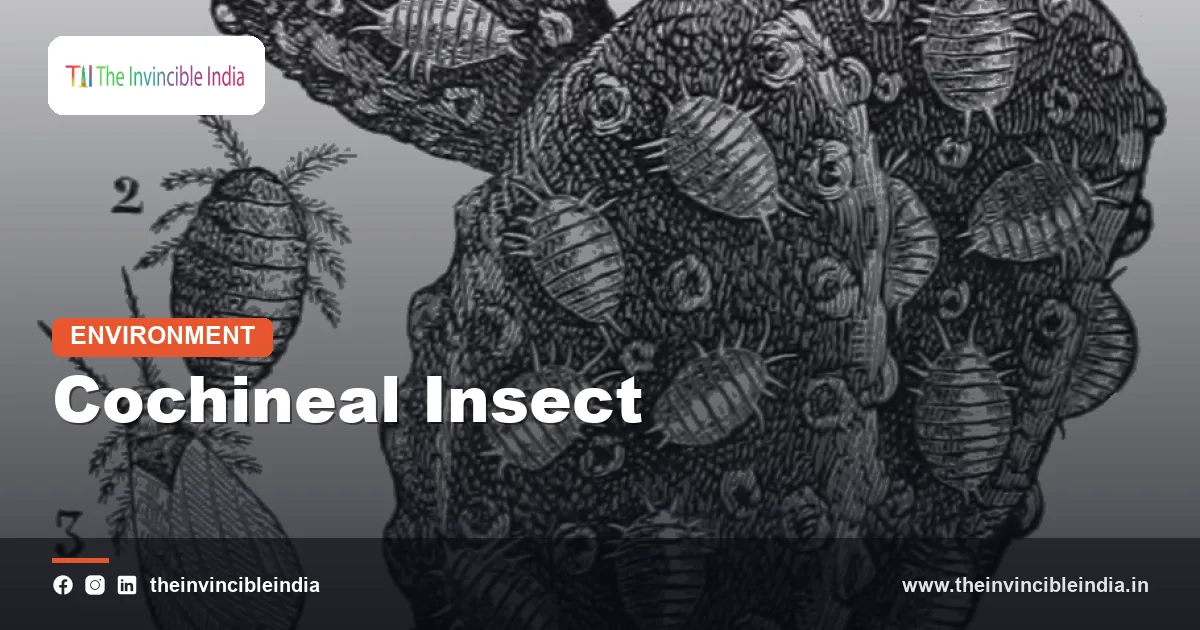
The cochineal insect (Dactylopius coccus) is a tiny scale insect that lives on prickly-pear cactus and yields carminic acid, the source of the crimson dye known as carmine. Native to the Americas, the cochineal insect and its close relatives are also found in India, where they have mainly been important as natural enemies of invasive prickly pear rather than as a dye industry. The insect is one of the oldest and best-known sources of natural red colouring in the world.
This guide explains what the cochineal insect is, how it lives on cactus, how the dye is made, how cochineal reached India, and why the insect was used to control prickly pear. It also covers modern uses, labelling and the difference between cochineal and India’s own red insect product, lac.
| Attribute | Details |
|---|---|
| Scientific name | Dactylopius coccus Costa, 1835 (dye species); related species include D. ceylonicus and D. opuntiae |
| Family and order | Dactylopiidae; order Hemiptera (true bugs), scale insects |
| Size | Adult females about 5 mm long; males much smaller, winged and short-lived |
| Habitat in India | Prickly-pear (Opuntia) stands in dry and semi-arid scrub, wastelands, hedges and field margins |
| Diet and host | Sap of Opuntia cactus pads (prickly pear); the insect feeds by sucking juice from the plant |
| Life cycle | Egg, mobile nymph (crawler), settled nymph, adult; females stay fixed, males fly; several generations a year in warm climates |
| Active substance | Carminic acid, forming roughly a fifth of the dried body weight in good material |
| Role and use | Source of carmine dye (E120); biological control of invasive prickly pear in India |
Key Takeaways
- The cochineal insect (Dactylopius coccus) is a scale insect that feeds on prickly-pear cactus and produces carminic acid, which gives carmine its deep red colour.
- A cochineal insect has a soft, wingless female that remains fixed on a cactus pad under a white waxy covering, while the tiny male is winged and lives only briefly.
- Carmine from the cochineal insect is used as the food, cosmetic and textile colour known as E120 or Natural Red 4.
- Cochineal species were introduced to India, and Dactylopius insects became textbook examples of biological control against invasive prickly pear (Opuntia).
- India’s own red insect product is lac, produced by a different insect, Kerria lacca, which should not be confused with cochineal.
- Because cochineal dye is made from insects, products containing carmine are not suitable for vegetarians and vegans, and ingredient labels help consumers identify it.
What is the cochineal insect?
The cochineal insect is a small, sap-sucking scale insect of the genus Dactylopius that lives on cactus and makes a red pigment to protect itself from predators. The dye species, Dactylopius coccus, belongs to the family Dactylopiidae within the order Hemiptera, the group that also includes aphids, cicadas and bugs.
Scale insects are among the most unusual insects. The adult female has no wings, little visible leg movement and a body that looks more like a small blister or seed than an animal. She settles on a cactus pad, inserts her mouthparts into the plant and stays there for life, often covered by a white, fluffy, waxy coating.
Cochineal is native to tropical and subtropical parts of the Americas, notably Mexico and the Andean region of South America, where prickly-pear cactus (nopal) is native. The word cochineal is generally traced to Spanish and Latin words for the insect and its red colour.
How does the cochineal insect live on cactus?
The cochineal insect lives on cactus by settling on the pads of prickly pear, piercing the plant tissue with needle-like mouthparts and drinking the sap for the rest of its life. The insect is highly specialised to Opuntia and related cacti.
The red colour of the insect comes from carminic acid, a chemical that deters ants and other predators. The insect makes it as a defence, and it accumulates in the body and in the eggs. When a cochineal is crushed, the body releases a bright red stain, which is how the colour is easily seen even by a casual observer.
The white waxy coat that covers colonies on cactus is a second line of defence. It sheds water, reduces water loss and gives some protection from sun and predators. A heavily infested prickly pear can look as though it has been dusted with cotton fluff, and wiping a patch reveals a red-purple smear.
- Settled females: remain in one spot, feeding and producing eggs.
- Mobile crawlers: the first-stage nymphs that walk and disperse.
- Males: tiny winged insects that do not feed and live for a very short time.
What is the life cycle of the cochineal insect?
The cochineal insect passes through the egg, nymph and adult stages, with the female developing by gradual change and the male undergoing a more complete transformation. In warm climates, a generation may take around two to three months, so there can be several generations in a year.
Female development
The female gives birth to or hatches tiny, six-legged nymphs known as crawlers. The crawlers walk over the cactus, and many produce a thread of wax that allows the wind to carry them to other plants. Once a crawler finds a suitable place, it settles, loses its mobility and grows into an adult female, which then reproduces.
Male development
Males develop through a short pupa-like stage and emerge as small, winged insects with no functioning mouthparts. Their only purpose is to mate.
Dispersal
Dispersal is mostly by wind-blown crawlers, which float on air currents, but also by contact with animals, people and cactus pads moved from one place to another. This is how a small colony can spread across a stand of cactus quickly.
| Stage | Mobility | Key feature |
|---|---|---|
| Egg and newborn crawler | Mobile | Tiny; disperses by crawling and by wind |
| Settled nymph | Fixed | Begins to produce wax and carminic acid |
| Adult female | Fixed | About 5 mm; largest and most colour-rich stage |
| Adult male | Flies briefly | Winged, tiny and short-lived |
How is cochineal dye made?
Cochineal dye is made by collecting adult female insects from cactus, killing and drying them, and then extracting the carminic acid, which is turned into carmine by chemical processing. The process requires a very large number of insects for a small amount of dye.
- Cultivation: insects are raised on cultivated prickly pear, often in plantations or on cactus pads kept in protected places.
- Harvesting: mature females are brushed or scraped off the cactus pads by hand.
- Killing and drying: the insects are killed by heat, sun-drying or steam and then dried until they look like small, dark, wrinkled grains.
- Extraction: carminic acid is dissolved from the dried bodies in water or alcohol-based solutions.
- Processing: the extract is treated with metal salts, often aluminium, to make the stable red pigment called carmine, or it is used as a cochineal extract.
The yield is small. Dried cochineal contains roughly one fifth carminic acid by weight in good material, and it takes tens of thousands of insects to make a kilogram of dried product. The exact colour depends on the mordant, the metal salt used to fix the dye, and on the acidity of the solution. It can range from scarlet and crimson to pink, violet and purple.
Why was cochineal so valuable in history?
Cochineal was valuable in history because it produced a brilliant, long-lasting red that was far more intense than most plant dyes. It was used by the Aztec and Maya peoples and by Andean cultures, and after the Spanish conquest of Mexico it became one of the most valuable exports from the Americas to Europe.
For centuries European cloth makers, painters and royal courts prized cochineal red, which was used for the scarlet coats of soldiers, cardinals’ robes and fine tapestries. The trade was tightly controlled, and the true nature of the dye, whether a plant or an animal, was debated in Europe for some time. Many other countries tried to establish their own cochineal production in the eighteenth century in order to break the monopoly.
The invention of synthetic dyes in the nineteenth century reduced demand sharply. Cochineal declined but never disappeared, and it has returned to prominence because of the preference for natural colourants in food and cosmetics.
How did cochineal reach India?
Cochineal reached India in the late eighteenth century, when cochineal-bearing prickly pear was brought from the Americas under the British East India Company in an attempt to start a dye industry. The attempt did not become a lasting commercial industry, but it left a legacy in Indian ecology.
The prickly pear was itself introduced to India, and it spread rapidly across dry regions, forming dense thickets on waste ground, field boundaries and rocky hills. Because the plant was spiny, tough and fast-growing, it became an invasive weed in several parts of peninsular India. Cochineal insects that came with the cactus attacked the plants, and in time the relationship between these insects and the cactus became a subject of study.
The species most often associated with wild prickly pear in India are not the high-grade dye insect itself but close relatives such as Dactylopius ceylonicus and Dactylopius opuntiae. These produce carminic acid too, but they are generally less valued for dye production than Dactylopius coccus.
How was the cochineal insect used to control prickly pear in India?
The cochineal insect was used as a biological control agent by releasing Dactylopius species onto invasive prickly-pear stands, where they weakened and killed the cactus by draining its sap. This is regarded as one of the early examples of weed biocontrol using an insect.
In the first half of the twentieth century, Dactylopius insects were deliberately spread to prickly-pear infestations in southern and western India, and in several places they reduced dense thickets enough to allow land to be returned to use. Similar programmes were carried out in other countries, such as Sri Lanka, South Africa and Australia, where a different insect, the cactus moth Cactoblastis cactorum, later became famous for controlling prickly pear.
- How it works: large colonies drain sap, weaken pads and make the plant more open to rot and disease.
- Selectivity: cochineal species feed only on cactus, so they do not attack crops.
- Limits: control is slower in cool, wet or shaded places, and some cactus species resist particular cochineal species.
- Trade-off: the same insect can harm cactus that people grow deliberately for fruit or fodder.
In recent years, Dactylopius opuntiae has been reported attacking cultivated cactus pear in several countries, which shows that a biocontrol agent can also become a pest when the host plant is valued. This is a useful reminder that the role of an insect depends on human goals.
What is cochineal used for today?
Cochineal is used today as a natural red colour in food, drinks, cosmetics, medicines and textiles. It is valued because it is stable to light, heat and ageing and gives a wide range of reds and pinks.
- Food and drink: sweets, yoghurts, juices, sausages and some alcoholic drinks.
- Cosmetics: lipsticks, blushes and other make-up.
- Pharmaceuticals: coatings of tablets and syrups.
- Textiles and crafts: natural dyeing of wool, silk and cotton.
- Science: biological stains used in microscopy.
Today most of the world’s cochineal comes from South America and the Canary Islands, with Peru as the leading producer, and the insects are raised on cultivated cactus. India produces and consumes only small amounts, although interest in natural dyes occasionally leads to small-scale trials.
Is carmine vegetarian, and how is it labelled?
Carmine is not vegetarian, because it is made from the bodies of insects. Products that contain it are therefore unsuitable for vegetarians and vegans, and many consumers look for it on ingredient lists.
On labels, carmine and cochineal can appear under several names, including cochineal, cochineal extract, carmine, carminic acid, Natural Red 4, and the European food additive number E120. In the Indian food-labelling system, ingredients derived from animal sources, including insects, are generally treated as non-vegetarian, so consumers should read the ingredients and the vegetarian or non-vegetarian symbol on the pack. Some people can also have allergic reactions to carmine, which is another reason clear labelling matters.
Alternatives include plant-based reds, such as those from beetroot, anthocyanin-rich fruits and vegetables, lycopene from tomatoes, and synthetic colours. Each has different stability, cost and colour range.
How is cochineal different from lac?
Cochineal differs from lac in the insect that makes it, its region of origin and its chemistry. Both come from scale insects and both give red colours, but lac is India’s own insect resin and cochineal is an American dye insect.
| Feature | Cochineal | Lac |
|---|---|---|
| Insect | Dactylopius coccus | Kerria lacca |
| Host | Prickly-pear cactus (Opuntia) | Trees such as palash, kusum and ber |
| Native region | Americas | South and Southeast Asia, including India |
| Main product | Carminic acid; carmine dye | Lac resin (shellac) and lac dye |
| Main uses | Food, cosmetics, textiles | Shellac, lacquerware, bangles, polishes, coatings |
India is one of the world’s major producers of lac, particularly in Jharkhand, Chhattisgarh and other central and eastern states, where it supports many tribal and rural families. The two insects are related only distantly within the scale insects, and their products are not interchangeable.
Bottom Line
The cochineal insect is a small cactus-feeding scale insect that has shaped world trade in red dye and, in India, helped to tame an invasive weed. Whether it is a source of colour, a biocontrol agent or a pest depends on the species, the plant and the purpose.
Frequently Asked Questions
What is the cochineal insect?
The cochineal insect is a small scale insect, Dactylopius coccus, that lives on prickly-pear cactus. It produces carminic acid, which gives the crimson dye called carmine. It is native to the Americas but related species occur in India.
Where does the cochineal insect live?
The cochineal insect lives on prickly-pear cactus (Opuntia), feeding on the sap of the pads. In India it is found wherever prickly pear grows, mainly in dry and semi-arid areas. Its commercial production is centred in Peru and the Canary Islands.
How is carmine dye made from cochineal?
Carmine dye is made by drying adult female cochineal insects and extracting carminic acid from them. The acid is then treated with metal salts to form the stable red pigment. It takes tens of thousands of insects to make a kilogram of dried cochineal.
Was the cochineal insect used to control prickly pear in India?
Yes, Dactylopius cochineal insects were used to control invasive prickly pear in India. They feed only on cactus and drain its sap, which weakens and kills the plants. The programme is regarded as an early success of insect biocontrol of a weed.
Is cochineal vegetarian?
No, cochineal is not vegetarian, because the dye comes from the bodies of insects. It appears on labels as cochineal, carmine, carminic acid, Natural Red 4 or E120. Vegetarians and vegans should check ingredient lists for these names.
Is cochineal the same as lac?
No, cochineal and lac are different products from different scale insects. Cochineal comes from Dactylopius coccus on prickly pear and gives red dye, while lac comes from Kerria lacca on host trees and gives shellac resin and lac dye. India is a major producer of lac, not of cochineal.
{“@context”:”https://schema.org”,”@graph”:[{“@type”:”FAQPage”,”mainEntity”:[{“@type”:”Question”,”name”:”What is the cochineal insect?”,”acceptedAnswer”:{“@type”:”Answer”,”text”:”The cochineal insect is a small scale insect, Dactylopius coccus, that lives on prickly-pear cactus. It produces carminic acid, which gives the crimson dye called carmine. It is native to the Americas but related species occur in India.”}},{“@type”:”Question”,”name”:”Where does the cochineal insect live?”,”acceptedAnswer”:{“@type”:”Answer”,”text”:”The cochineal insect lives on prickly-pear cactus (Opuntia), feeding on the sap of the pads. In India it is found wherever prickly pear grows, mainly in dry and semi-arid areas. Its commercial production is centred in Peru and the Canary Islands.”}},{“@type”:”Question”,”name”:”How is carmine dye made from cochineal?”,”acceptedAnswer”:{“@type”:”Answer”,”text”:”Carmine dye is made by drying adult female cochineal insects and extracting carminic acid from them. The acid is then treated with metal salts to form the stable red pigment. It takes tens of thousands of insects to make a kilogram of dried cochineal.”}},{“@type”:”Question”,”name”:”Was the cochineal insect used to control prickly pear in India?”,”acceptedAnswer”:{“@type”:”Answer”,”text”:”Yes, Dactylopius cochineal insects were used to control invasive prickly pear in India. They feed only on cactus and drain its sap, which weakens and kills the plants. The programme is regarded as an early success of insect biocontrol of a weed.”}},{“@type”:”Question”,”name”:”Is cochineal vegetarian?”,”acceptedAnswer”:{“@type”:”Answer”,”text”:”No, cochineal is not vegetarian, because the dye comes from the bodies of insects. It appears on labels as cochineal, carmine, carminic acid, Natural Red 4 or E120. Vegetarians and vegans should check ingredient lists for these names.”}},{“@type”:”Question”,”name”:”Is cochineal the same as lac?”,”acceptedAnswer”:{“@type”:”Answer”,”text”:”No, cochineal and lac are different products from different scale insects. Cochineal comes from Dactylopius coccus on prickly pear and gives red dye, while lac comes from Kerria lacca on host trees and gives shellac resin and lac dye. India is a major producer of lac, not of cochineal.”}}]}]}


