

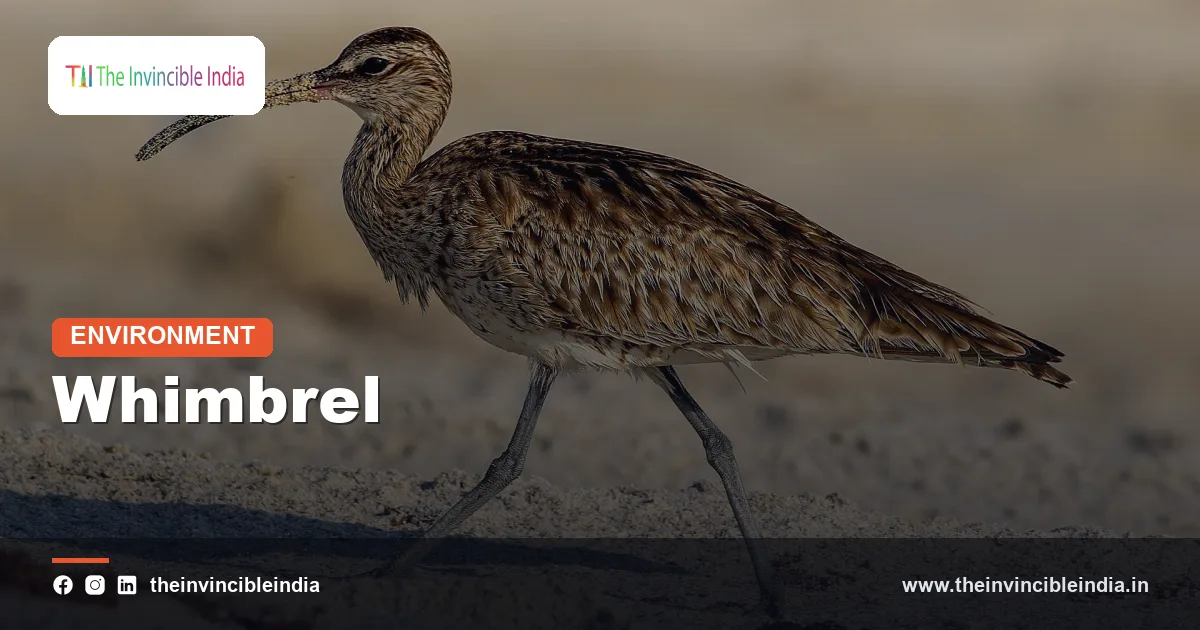
The whimbrel (Numenius phaeopus) is a large brown wader with a long, down-curved bill and a boldly striped head that winters on Indian coasts, estuaries and mudflats, where it specialises in catching crabs. A smaller and shorter-billed relative of the Eurasian curlew, the whimbrel is a long-distance migrant that breeds in the sub-Arctic and visits India between roughly August and May.
In India the whimbrel is a widespread but thinly spread coastal visitor, usually found singly or in small groups on tidal flats, mangroves and lagoons. This article explains how to identify the whimbrel, where it lives, what it eats, how it migrates and how it differs from the curlews with which it is often confused.
| Attribute | Details |
|---|---|
| Common name | Whimbrel |
| Scientific name | Numenius phaeopus |
| Family | Scolopacidae (sandpipers, curlews, snipes and relatives) |
| Size | About 40 to 46 cm long, with a wingspan of roughly 80 to 90 cm |
| Range and habitat in India | Winter visitor and passage migrant mainly along the coast; tidal mudflats, estuaries, mangroves, lagoons and rocky shores, plus the islands |
| Diet | Crabs (especially fiddler crabs), other crustaceans, worms, molluscs and insects; berries on the breeding grounds |
| Breeding and migration | Breeds on sub-Arctic moorland and tundra in Eurasia and North America; long-distance migrant to the tropics and southern hemisphere |
| Conservation status | Least Concern on the IUCN Red List, with a very large global range |
Key Takeaways
- The whimbrel is a large wader of the family Scolopacidae, recognised by its long down-curved bill and a head marked with dark side stripes and a pale central crown stripe.
- The whimbrel is noticeably smaller and shorter-billed than the Eurasian curlew, and the two species are often seen on the same Indian shores.
- Whimbrels breed on sub-Arctic moorland and tundra and winter on the coasts of Africa, South Asia, Southeast Asia and Australasia, including India.
- In India the whimbrel feeds on tidal flats and in mangroves, using its curved bill to probe burrows and extract crabs.
- The whimbrel gives a distinctive rippling call of about seven quick, whistled notes, which is the easiest way to separate it from the curlew.
- The whimbrel is classified as Least Concern globally, but coastal development and loss of intertidal habitat threaten the places where it winters and rests.
What is a whimbrel?
A whimbrel is a large wader in the genus Numenius, the group of curlews, characterised by long, downward-curving bills and mottled brown plumage. The word whimbrel is thought to echo the bird’s whinnying, tittering call, and the Latin species name phaeopus means dusky-footed.
The whimbrel is about the size of a small crow on long legs. It is usually described as a half-sized version of the Eurasian curlew, though its proportions are slightly different, with a shorter bill, shorter legs and a more compact body. The species has a very wide global distribution and appears on coasts on every continent except Antarctica.
Several subspecies are recognised, which differ mainly in the amount of white on the back and rump. The birds reaching India breed in northern Eurasia and are part of the Old World group, not the New World population that breeds in northern North America.
How do you identify a whimbrel?
A whimbrel is identified by its large size, streaky brown plumage, a bill that is long and bends downwards, and a head with a pale central stripe between two dark stripes. The striped crown is the single most useful feature to separate it from a curlew.
Key field marks include:
- Head pattern: pale median crown stripe, dark side stripes and a pale eyebrow stripe.
- Bill: long, dark and decurved, with a sharper bend near the middle than the curlew’s smoothly curved bill, and a pinkish base on the lower half.
- Size: clearly smaller than a Eurasian curlew when the two stand together.
- Legs: greyish-blue, fairly long and sturdy.
- Flight: brown wings, with a white wedge up the back and rump in some subspecies.
In flight, the whimbrel is a strong, direct flier with quick, fluid wingbeats. A calling flock often forms a loose line, a V-shape or a staggered group as it moves along the shore between feeding and roosting sites.
Where does the whimbrel live in India?
The whimbrel lives mainly on India’s coasts during winter, using tidal mudflats, estuaries, mangroves, coastal lagoons, creeks and rocky shores. It is widespread along both the east and west coasts and on island groups such as the Andaman and Nicobar Islands and Lakshadweep.
Typical Indian habitats include:
- Mangrove mudflats of the Sundarbans, Bhitarkanika and Goa estuaries
- Tidal creeks and lagoons along the Gujarat and Maharashtra coast
- Backwaters of Kerala and the east-coast lagoons such as Chilika and Pulicat
- Coral-island shores and sandy beaches with rock pools
The whimbrel is much less common inland than on the coast, although migrants may occasionally stop at large lakes or river banks during passage. It generally avoids dry or heavily vegetated ground, and a bird on a quiet beach, a stretch of mud or an estuary bank is the typical sighting.
What does the whimbrel eat?
The whimbrel eats crabs, particularly fiddler crabs, together with other crustaceans, marine worms, small molluscs and insects. The long curved bill is designed to reach into burrows and probe deep into soft mud to extract prey that other waders cannot reach.
A whimbrel often feeds by walking slowly over a mudflat, pausing and then thrusting its bill into a crab burrow. When it catches a crab, it may carry it to the water, wash it and then manipulate the animal until it can swallow it, sometimes removing the claws or legs first. The bird may also pick insects and small items from the surface of the mud.
On the breeding grounds the diet is quite different. Whimbrels feed heavily on berries, such as crowberries and bilberries, along with insects, spiders and snails. This seasonal shift between animal food on the coast and berries on the tundra is typical of many northern breeding waders.
How does the whimbrel migrate?
The whimbrel migrates thousands of kilometres from its northern breeding grounds to tropical and southern coasts, arriving in India from about August and leaving by April or May. The journey follows major flyways, with birds that reach India using the Central Asian Flyway and neighbouring routes.
Whimbrels are impressive long-distance fliers, and some individuals complete extraordinary non-stop flights across seas and deserts. Satellite tracking has shown that whimbrels from some populations can cross oceans without landing, though most make regular stopovers on coasts and estuaries. Reliable stopover sites are important because they allow the birds to refuel and recover.
Not all whimbrels leave India in the northern summer. First-year birds and some non-breeders may remain on the coast through the summer months. This pattern is also seen in other large waders.
Where and how does the whimbrel breed?
The whimbrel breeds on open moorland, tundra and boggy ground in the sub-Arctic and Arctic belts of Eurasia and North America, and it does not breed in India. In Europe, breeding populations are found in places such as Iceland, northern Scotland and Scandinavia, while the species extends eastward across northern Russia.
The nest is a shallow scrape on the ground, lined with grass, moss or lichen, usually on a slight rise with a good view of the surroundings. The female lays about four eggs, and both parents incubate and guard the chicks. The parents are vigilant and noisy, calling loudly and mobbing predators near the nest.
The chicks leave the nest soon after hatching and feed themselves under the parents’ watch. They fledge in about five weeks. Because the nesting season is short, the birds depart for the south in mid to late summer, often before the chicks have finished growing.
How is the whimbrel different from the Eurasian curlew?
The whimbrel differs from the Eurasian curlew mainly in size, bill length and head pattern: it is smaller, has a shorter bill and shows a striped crown. The table below compares the two species, which can occur on the same Indian shores.
| Feature | Whimbrel | Eurasian curlew |
|---|---|---|
| Size | About 40 to 46 cm | About 50 to 60 cm |
| Bill | Shorter, with a distinct bend | Very long, smoothly curved |
| Head | Dark side stripes with a pale central crown stripe | Plain streaky head |
| Call | Rapid series of about seven whistled notes | Loud, bubbling, rising “cur-lee” |
| Typical Indian habitat | Coastal flats and mangroves | Coast and some inland wetlands |
A reliable sign is the head: a whimbrel looks as if it is wearing a striped cap, while a curlew looks plain-headed. The smaller size and shorter bill support the identification.
What does the whimbrel sound like?
The whimbrel sounds like a rapid, rippling whistle, usually a string of about seven notes of equal pitch that run together into a trill. This call is easily the best way to identify the bird when it is flying over or when a flock moves along a shore.
The call is often written as “ti-ti-ti-ti-ti-ti-ti” and is far more even and rapid than the slower, bubbling call of the curlew. Whimbrels call frequently in flight and when they are alarmed, and the sound can carry long distances across open mud and water.
On the breeding grounds, males give a longer, bubbling, trilling song during display flights over the nesting area. Visitors in India rarely hear this, but the flight call is a regular feature of any coastal bird walk.
How does the whimbrel behave on Indian shores?
The whimbrel behaves as a wary, solitary or loosely social feeder on Indian shores, spending the low-tide hours foraging and the high-tide hours resting at a roost. Unlike many small sandpipers, the whimbrel rarely forms dense flocks in India, and a typical sighting is of one to a few birds spread across a mudflat.
At rising tide, whimbrels move to roost sites such as sandbars, rocky outcrops, saltpans, mangrove edges or quiet beaches, often joining other large waders such as curlews, godwits and Eurasian oystercatchers. They stand upright with the bill tucked into the back feathers, but they remain alert and take flight at the first sign of danger.
The bird is usually faithful to a feeding area, and individual whimbrels can return to the same stretch of coast in successive winters. This site fidelity makes them useful subjects for ringing and tracking studies, which show how important a small number of coastal sites are to the whole population.
How can you watch whimbrels without disturbing them?
You can watch whimbrels without disturbing them by keeping a good distance, moving slowly and using binoculars or a telescope from cover. The whimbrel is shy, and a bird that is repeatedly flushed spends energy that it needs for feeding and migration.
- Visit a mudflat or estuary around mid-tide, when the birds are feeding on exposed ground.
- Listen for the rippling seven-note call, which often announces the bird before it is seen.
- Check the head pattern and bill length to separate the whimbrel from the larger curlew.
- Avoid walking onto roosts at high tide, because many shorebirds depend on these quiet spots.
The best months are from October to March, although passage birds may appear earlier and later. Recording the date and place of each sighting on a citizen-science platform adds useful data to national bird records.
Is the whimbrel under threat?
The whimbrel is not threatened globally, and the IUCN lists it as Least Concern, but the species faces pressure from the degradation of coastal habitats along its migration routes. Because it often feeds in low densities, declines may be less visible than those of species that gather in dense flocks.
Threats to wintering and stopover habitat include:
- Reclamation of tidal flats for ports, industry and housing
- Clearing of mangroves for aquaculture and development
- Pollution from oil, plastics and untreated waste
- Disturbance from vehicles, dogs and crowds on beaches
- Collection or overharvesting of crabs in some areas
Protected areas, Ramsar sites and mangrove conservation all help the whimbrel. Citizen scientists contribute by recording sightings, which add to the long-term picture of how the species is faring across the Indian coastline.
Bottom Line
The whimbrel is a handsome, crab-eating coastal wader whose striped head and rippling call set it apart from the larger curlew. Looking after India’s estuaries, mudflats and mangroves keeps the winter home of the whimbrel intact and supports the many other birds that share it.
Frequently Asked Questions
What is a whimbrel?
A whimbrel is a large wader of the curlew genus Numenius with a long, down-curved bill and a striped head. It breeds in the sub-Arctic and winters on coasts across Africa, South Asia, Southeast Asia and Australasia, including India.
How can I tell a whimbrel from a curlew?
The whimbrel is smaller than the Eurasian curlew, has a shorter bill and shows a pale central stripe between dark side stripes on the head. Its call is a quick series of about seven even whistles, unlike the curlew’s slower, bubbling cry.
Where can I see whimbrels in India?
Whimbrels can be seen on coastal mudflats, estuaries, mangroves and lagoons, including the Sundarbans, Bhitarkanika, Chilika and the Gujarat and Kerala coasts. They also occur on the Andaman and Nicobar Islands and Lakshadweep.
What do whimbrels eat?
Whimbrels eat mainly crabs, especially fiddler crabs, along with other crustaceans, worms, molluscs and insects. On their northern breeding grounds they also eat berries and insects.
When do whimbrels visit India?
Whimbrels visit India mainly from about August to May. Most arrive in autumn, spend the winter on the coast and leave in spring, although some young birds stay through the summer.
Is the whimbrel an endangered species?
No, the whimbrel is not endangered and is listed as Least Concern by the IUCN. It nevertheless depends on coastal mudflats and mangroves that are under pressure from development, so protecting these habitats remains important.
{“@context”:”https://schema.org”,”@graph”:[{“@type”:”FAQPage”,”mainEntity”:[{“@type”:”Question”,”name”:”What is a whimbrel?”,”acceptedAnswer”:{“@type”:”Answer”,”text”:”A whimbrel is a large wader of the curlew genus Numenius with a long, down-curved bill and a striped head. It breeds in the sub-Arctic and winters on coasts across Africa, South Asia, Southeast Asia and Australasia, including India.”}},{“@type”:”Question”,”name”:”How can I tell a whimbrel from a curlew?”,”acceptedAnswer”:{“@type”:”Answer”,”text”:”The whimbrel is smaller than the Eurasian curlew, has a shorter bill and shows a pale central stripe between dark side stripes on the head. Its call is a quick series of about seven even whistles, unlike the curlew’s slower, bubbling cry.”}},{“@type”:”Question”,”name”:”Where can I see whimbrels in India?”,”acceptedAnswer”:{“@type”:”Answer”,”text”:”Whimbrels can be seen on coastal mudflats, estuaries, mangroves and lagoons, including the Sundarbans, Bhitarkanika, Chilika and the Gujarat and Kerala coasts. They also occur on the Andaman and Nicobar Islands and Lakshadweep.”}},{“@type”:”Question”,”name”:”What do whimbrels eat?”,”acceptedAnswer”:{“@type”:”Answer”,”text”:”Whimbrels eat mainly crabs, especially fiddler crabs, along with other crustaceans, worms, molluscs and insects. On their northern breeding grounds they also eat berries and insects.”}},{“@type”:”Question”,”name”:”When do whimbrels visit India?”,”acceptedAnswer”:{“@type”:”Answer”,”text”:”Whimbrels visit India mainly from about August to May. Most arrive in autumn, spend the winter on the coast and leave in spring, although some young birds stay through the summer.”}},{“@type”:”Question”,”name”:”Is the whimbrel an endangered species?”,”acceptedAnswer”:{“@type”:”Answer”,”text”:”No, the whimbrel is not endangered and is listed as Least Concern by the IUCN. It nevertheless depends on coastal mudflats and mangroves that are under pressure from development, so protecting these habitats remains important.”}}]}]}


