

The Eurasian sparrowhawk (Accipiter nisus) is a small, fast, short-winged hawk that hunts other small birds by dashing out of cover in a sudden surprise attack, and in India it is seen mainly as a winter visitor, with a breeding population in the Himalaya. The species belongs to the family Accipitridae, the same large family that includes eagles, kites and buzzards, and it is one of the classic “bird hawks” built for twisting flight through trees, hedges and gardens rather than for long soaring.
Because a Eurasian sparrowhawk spends most of its time hidden or flying low, it is far more often glimpsed than studied: a grey or brown blur shooting across a garden, a panicked flock of sparrows, a scatter of feathers on a lawn. This explainer describes how to recognise the bird, where it occurs in India, how it hunts, how it breeds and how it differs from the other small hawks that share its range.
| Scientific name | Accipiter nisus |
|---|---|
| Family | Accipitridae (hawks, eagles, kites and allies) |
| Size | About 28 to 38 cm long, with a wingspan of roughly 58 to 80 cm; females are clearly larger than males |
| Range in India | Winter visitor across northern and central India and the foothills; breeds in the Himalaya; occasional further south in winter |
| Habitat | Woodland, orchards, plantations, hedged farmland, gardens and the edges of towns |
| Diet | Almost entirely small and medium-sized birds, caught in flight; occasionally small mammals and large insects |
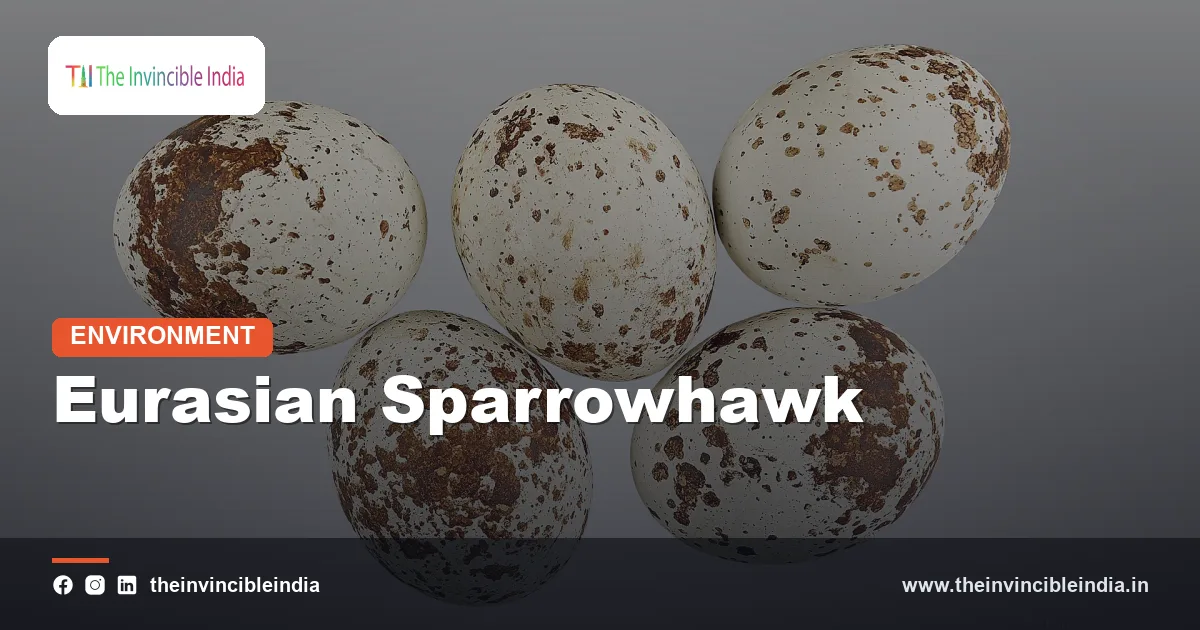
| Breeding | Stick nest high in a tree; typically four to six whitish, blotched eggs; female incubates while the male provides food |
| Conservation status | Least Concern on the IUCN Red List; protected as a bird of prey in India |
Key Takeaways
- The Eurasian sparrowhawk is a small woodland hawk with short rounded wings and a long tail that specialises in catching small birds in flight.
- Female Eurasian sparrowhawks are noticeably larger than males, so the two sexes hunt prey of different sizes, from sparrow-sized birds to those as big as a pigeon or thrush.
- In India the Eurasian sparrowhawk is chiefly a winter visitor and passage migrant, while a resident Himalayan population breeds in forested hills.
- Adult males are slate-blue above with orange-barred underparts, while females and young birds are brown above with grey-brown barring below and a pale stripe above the eye.
- The Eurasian sparrowhawk hunts by surprise, using hedges, walls and trees as cover and relying on a quick burst of speed rather than a long chase.
- The Eurasian sparrowhawk is assessed as Least Concern globally, and its populations recovered in Europe after the pesticide DDT was restricted.
How Do You Identify a Eurasian Sparrowhawk in India?
A Eurasian sparrowhawk can be identified by its small size, short rounded wings, long barred tail, thin yellow legs and a hunting style that involves quick low flight between cover. Seen perched, the bird has an upright posture, a small head with a fierce, forward-facing look, and a bright eye that ranges from yellow in young birds to orange in adult males.
The sexes look very different, and recognising this removes much of the confusion around the species.
Adult male
The adult male Eurasian sparrowhawk is slate-blue or blue-grey above, with a darker cap and often a faint pale patch on the nape. The underparts are finely barred with warm orange-rufous, and the cheeks are often washed with the same orange tone. The tail carries several dark bands, and the eye is orange.
Adult female and juvenile
The adult female is larger and browner. Her upperparts are grey-brown rather than blue, her underparts are barred with grey-brown instead of orange, and she often shows a distinct pale stripe, or supercilium, above the eye. Her eye is yellow. Juvenile birds resemble females but have more coarsely barred or spotted underparts and warm brown edges to the feathers above.
Shape and flight
In flight the Eurasian sparrowhawk shows short, broad, rounded wings and a long tail, a combination that gives manoeuvrability among branches. Its typical flight is a few fast wingbeats followed by a glide, and in open sky it may also circle briefly in a thermal. The long middle toe on each thin leg is a hunting tool, used for snatching and holding small birds.
Where Does the Eurasian Sparrowhawk Live in India?
The Eurasian sparrowhawk lives in India mainly as a winter visitor to woodland, orchards and well-wooded countryside across the north and centre of the country, together with a breeding population that lives in the Himalayan forests. The species has an enormous global range across Europe, parts of North Africa and much of temperate Asia, and the birds that reach India include both local Himalayan residents and migrants from the north.
In the Himalaya, the Indian race breeds in forested slopes, often among conifers and mixed woodland, and in winter many birds move down to lower altitudes. In the plains, wintering sparrowhawks turn up in any place with enough small birds and enough cover from which to hunt. Their numbers are generally low, because each hawk needs a substantial hunting territory.
Typical habitats
- Mixed and deciduous woodland, especially along the Himalayan foothills.
- Mango and other orchards, which hold many small birds.
- Large gardens, campuses and parks in cities that have mature trees and bushes.
- Farmland with hedgerows, shelterbelts and scattered trees.
- Edges of wetlands and rivers where reeds and bushes bring in flocks of finches and munias.
The bird does not need wilderness. A well-planted town garden that attracts sparrows, mynas, bulbuls and doves can be as productive a hunting ground for a Eurasian sparrowhawk as a forest, which is why the species is sometimes recorded in suburbs.
How Does the Eurasian Sparrowhawk Hunt?
The Eurasian sparrowhawk hunts by ambush: it waits or glides low behind cover, then bursts into the open to seize a small bird before the prey has time to react. This style is called contour hunting, because the hawk follows the shape of hedges, walls, house fronts or tree lines to hide its approach.
Several features make this technique effective.
- Short wings and a long tail: these give a tight turning circle, so the hawk can pursue a bird through twigs and around corners.
- Acceleration over endurance: the sparrowhawk is built for a short, explosive chase of a few seconds, and it often gives up if the prey escapes into dense cover.
- Long toes and talons: the extended middle toe helps the hawk grip a small bird and hold it against the force of the struggle.
- Sharp eyesight: the forward-facing eyes judge distance accurately during the final strike.
Hunting success per attempt is modest, and most chases end without a kill. A hawk may therefore make many attempts across a day. Small birds respond with alarm calls and by diving into thick bushes, and the sudden silence of a garden is often the first sign that a sparrowhawk is nearby.
After a kill, the hawk typically carries the prey to a regular plucking post, such as a stump, fence post or low branch, and removes the feathers before eating. Fresh feather piles in the same spot can reveal the presence of a hunting hawk even when the bird itself is never seen.
What Does the Eurasian Sparrowhawk Eat?
The Eurasian sparrowhawk eats mainly small and medium-sized birds, catching them in flight or sometimes flushing them from vegetation. In the Indian context the prey list includes house sparrows, munias, finches, bulbuls, babblers, mynas, warblers, wagtails and, for the larger females, doves, thrushes and small pigeons.
Because the species is sexually dimorphic in size, males and females effectively divide up the available prey. This reduces competition inside a pair and lets the two birds draw on a wider variety of species across their shared territory.
| Hawk | Typical prey size | Examples of prey |
|---|---|---|
| Male Eurasian sparrowhawk (smaller) | Very small to small birds | Sparrows, munias, small finches, warblers |
| Female Eurasian sparrowhawk (larger) | Small to medium birds | Mynas, bulbuls, doves, thrushes, small pigeons |
| Both sexes (occasional) | Non-bird prey | Bats, small rodents, large insects |
The hawk takes live prey, which means it is a predator and not a scavenger. In balanced ecosystems, predators such as the Eurasian sparrowhawk tend to remove weak, sick or inattentive individuals, and they are part of the natural pressure that keeps small-bird populations alert and healthy.
Why Is the Female Eurasian Sparrowhawk Larger Than the Male?
The female Eurasian sparrowhawk is larger than the male because reversed size dimorphism is common among bird-eating hawks, and a larger female can defend the nest, produce and incubate eggs, and take bigger prey. In some raptor groups the size gap is wide, and in the sparrowhawk the female can be around a quarter longer and markedly heavier than her mate.
Biologists have proposed several explanations, and several likely act together.
- Division of prey: different body sizes allow the pair to catch different prey, which widens the food supply.
- Nest defence: because the male is away hunting, the larger female is better placed to guard eggs and chicks from other predators.
- Safety of the male: a smaller male is a nimbler hunter of small birds, and a larger female is less likely to be mistaken for prey by her own mate.
- Egg production: a bigger body can store more energy for egg-laying.
For an observer in India, the practical lesson is simple: a “small” hawk in a garden might be a male and a distinctly “bigger” one a female of the same species, and their colour differences strengthen the impression of two different birds.
How Does the Eurasian Sparrowhawk Breed?
The Eurasian sparrowhawk breeds by building a stick nest high in a tree, laying about four to six eggs, and sharing duties so that the female incubates and broods while the male hunts and delivers food. Pairs are usually monogamous within a season and often return to the same nesting area in later years.
Nest and eggs
The nest is a platform of twigs, often placed in a conifer or other dense tree where a fork or branch junction gives support and cover. The eggs are whitish with reddish-brown blotches and are laid at intervals of a day or two. In India the breeding takes place in the Himalayan forests, usually in spring and early summer.
Roles of the parents
The female sits on the eggs for roughly a month, while the male brings food and passes it to her, often at a plucking post close to the nest. Once the chicks hatch, the male continues to deliver prey, and the female tears it into small pieces for the young. As the chicks grow, the female begins to hunt again.
Fledging
The young leave the nest after about four weeks but depend on their parents for food for several more weeks. The period right after fledging is risky, because inexperienced hawks may fail to catch prey or may collide with obstacles, including window glass.
How Is the Eurasian Sparrowhawk Different from Other Small Hawks?
The Eurasian sparrowhawk differs from other small Indian hawks mainly in its combination of size, eye colour, barring pattern and plumage tone, and it is most often confused with the shikra and the besra. Careful observation of a few features usually settles the identification, and the main comparisons are summarised below.
| Species | Size and build | Key distinguishing features |
|---|---|---|
| Eurasian sparrowhawk | Small, slim, long-legged | Male blue-grey above with orange barring below; female brown with pale eyebrow stripe; barred tail |
| Shikra | Similar small size | Plain pale grey upperparts, fine rufous barring below, often a thin dark central throat line, red eye in adults |
| Besra | Small, compact | Distinct dark vertical stripe down the throat; heavier barring below; found mostly in forest |
| Northern goshawk | Much larger and heavier | Broader wings, more powerful build; also a bird hunter, but takes larger prey |
Behaviour helps as well. The shikra is the more familiar town and farmland hawk in many parts of India and is often seen perched openly, calling loudly. The Eurasian sparrowhawk is generally shyer and more tied to wooded cover, and winter sightings of a sleek blue-backed male with orange-barred underparts are a strong clue.
What Is the Conservation Status of the Eurasian Sparrowhawk?
The Eurasian sparrowhawk is classified as Least Concern on the IUCN Red List because of its enormous range and large global population. In India, as with all birds of prey, it is protected under the Wildlife (Protection) Act, 1972, which prohibits hunting, trapping and trade in wild birds.
The species has a notable conservation history. In Europe in the middle of the twentieth century, sparrowhawk numbers collapsed in many regions because the pesticide DDT, and related chemicals, accumulated in the bodies of small birds and then in their predators. The chemicals caused eggshell thinning, so eggs broke during incubation. After the use of these pesticides was restricted, the species recovered strongly. This story is a standard example of how top predators reveal environmental contamination.
Present-day pressures
- Pesticides and poisoning: chemicals that build up along the food chain can still harm hawks.
- Habitat loss: felling of mature trees removes nest sites and hunting cover.
- Window collisions and persecution: hawks sometimes strike glass during chases, and in some places they are killed by people who keep pigeons or poultry.
- Climate and land-use change: shifts in prey populations and the condition of Himalayan forests may influence breeding success.
How Can You Watch a Eurasian Sparrowhawk Responsibly?
You can watch a Eurasian sparrowhawk responsibly by keeping a respectful distance, using binoculars, avoiding any disturbance near a nest, and learning to read the behaviour of other garden birds. The most reliable signs of a hunting hawk are sudden alarm calls, flocks that freeze or scatter, and birds that dive into thick bushes.
- Scan the edges of woods, orchards and hedged fields in the early morning or late afternoon, when hunting is most active.
- Look for the characteristic flap-flap-glide flight and for a hawk that keeps low behind cover.
- Note the barring, the eye colour and the presence or absence of a throat stripe to separate the species from similar hawks.
- Do not approach a nest or play recorded calls to attract a raptor, because disturbance can cause nest failure.
- Report sightings to community bird-recording platforms so that records of winter visitors can contribute to long-term monitoring.
A bird feeder in a garden attracts small birds and can therefore attract a hawk. That is a natural process, and a well-planted garden with dense shrubs gives small birds cover as well as food.
Bottom Line
The Eurasian sparrowhawk is a compact, agile predator that connects the Himalayan forests and the wooded plains of India through its seasonal movements. It is secure as a species, but it depends on clean food chains and mature tree cover, and its fortunes reflect the health of the small-bird communities on which it feeds.
Frequently Asked Questions
What is a Eurasian sparrowhawk?
A Eurasian sparrowhawk is a small bird-hunting hawk of the family Accipitridae with short rounded wings and a long tail. It catches small birds in fast, low surprise attacks from cover. In India it is seen mostly in winter, while a resident population breeds in the Himalaya.
Is the Eurasian sparrowhawk found in India?
Yes, the Eurasian sparrowhawk is found in India, mainly as a winter visitor to woodland, orchards and gardens across the north and centre. A breeding population also lives in the Himalayan forests. It is uncommon in many areas because each hawk needs a large hunting territory.
What does a Eurasian sparrowhawk eat?
A Eurasian sparrowhawk eats almost entirely small and medium-sized birds that it catches in flight. Males take mostly sparrow-sized prey such as munias and small finches, while the larger females also take birds like mynas, doves and thrushes. Occasionally it eats small mammals, bats or large insects.
How can you tell a Eurasian sparrowhawk from a shikra?
The simplest way to tell them apart is by plumage and eye colour. A male Eurasian sparrowhawk is blue-grey above with orange barring below, and a female is brown with a pale eyebrow stripe, while an adult shikra is pale grey above with a red eye and a thin dark line down the throat. Behaviour also differs, as the shikra is bolder and more often seen perched in the open.
Why are female sparrowhawks bigger than males?
Female sparrowhawks are bigger than males because larger females can defend the nest, store energy for egg production and hunt larger prey. The size gap also lets the pair hunt different birds in the same territory, reducing competition between them. This pattern is typical of many bird-eating hawks.
Is the Eurasian sparrowhawk protected in India?
Yes, the Eurasian sparrowhawk is protected in India as a wild bird of prey under the Wildlife (Protection) Act, 1972. Hunting, trapping, keeping and trading in the species are prohibited. Globally it is classified as Least Concern by the IUCN.
{“@context”:”https://schema.org”,”@graph”:[{“@type”:”FAQPage”,”mainEntity”:[{“@type”:”Question”,”name”:”What is a Eurasian sparrowhawk?”,”acceptedAnswer”:{“@type”:”Answer”,”text”:”A Eurasian sparrowhawk is a small bird-hunting hawk of the family Accipitridae with short rounded wings and a long tail. It catches small birds in fast, low surprise attacks from cover. In India it is seen mostly in winter, while a resident population breeds in the Himalaya.”}},{“@type”:”Question”,”name”:”Is the Eurasian sparrowhawk found in India?”,”acceptedAnswer”:{“@type”:”Answer”,”text”:”Yes, the Eurasian sparrowhawk is found in India, mainly as a winter visitor to woodland, orchards and gardens across the north and centre. A breeding population also lives in the Himalayan forests. It is uncommon in many areas because each hawk needs a large hunting territory.”}},{“@type”:”Question”,”name”:”What does a Eurasian sparrowhawk eat?”,”acceptedAnswer”:{“@type”:”Answer”,”text”:”A Eurasian sparrowhawk eats almost entirely small and medium-sized birds that it catches in flight. Males take mostly sparrow-sized prey such as munias and small finches, while the larger females also take birds like mynas, doves and thrushes. Occasionally it eats small mammals, bats or large insects.”}},{“@type”:”Question”,”name”:”How can you tell a Eurasian sparrowhawk from a shikra?”,”acceptedAnswer”:{“@type”:”Answer”,”text”:”The simplest way to tell them apart is by plumage and eye colour. A male Eurasian sparrowhawk is blue-grey above with orange barring below, and a female is brown with a pale eyebrow stripe, while an adult shikra is pale grey above with a red eye and a thin dark line down the throat. Behaviour also differs, as the shikra is bolder and more often seen perched in the open.”}},{“@type”:”Question”,”name”:”Why are female sparrowhawks bigger than males?”,”acceptedAnswer”:{“@type”:”Answer”,”text”:”Female sparrowhawks are bigger than males because larger females can defend the nest, store energy for egg production and hunt larger prey. The size gap also lets the pair hunt different birds in the same territory, reducing competition between them. This pattern is typical of many bird-eating hawks.”}},{“@type”:”Question”,”name”:”Is the Eurasian sparrowhawk protected in India?”,”acceptedAnswer”:{“@type”:”Answer”,”text”:”Yes, the Eurasian sparrowhawk is protected in India as a wild bird of prey under the Wildlife (Protection) Act, 1972. Hunting, trapping, keeping and trading in the species are prohibited. Globally it is classified as Least Concern by the IUCN.”}}]}]}


