

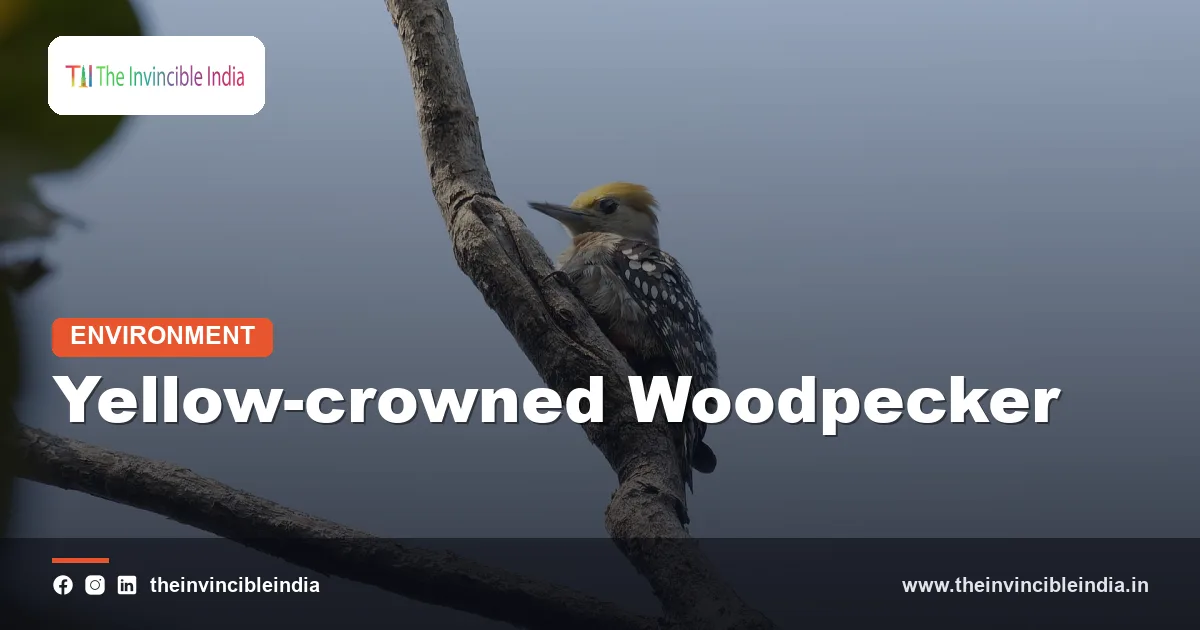
The yellow-crowned woodpecker (Leiopicus mahrattensis) is a small brown-and-white pied woodpecker with a golden-yellow crown that lives in the open woods, orchards and gardens of the Indian subcontinent. It is also called the yellow-fronted pied woodpecker, and it belongs to the woodpecker family Picidae, a group of birds adapted to climb trees, drum on wood and extract insects from beneath bark.
Among the woodpeckers found in India, the yellow-crowned woodpecker is one of the easiest to meet, because it lives in dry, open habitats and even in gardens and village groves. It is a small, active bird that works its way up trunks and along branches, often tapping gently rather than hammering loudly. This explainer describes how to recognise it, where it lives, how a woodpecker body works and why trees with dead wood matter to the species.
| Scientific name | Leiopicus mahrattensis (formerly Dendrocopos mahrattensis) |
|---|---|
| Family | Picidae (woodpeckers, wrynecks and piculets) |
| Size | About 17 to 18 cm long, roughly the size of a bulbul |
| Range in India | Widespread across much of the Indian subcontinent in dry and open country; absent from dense wet forests and the higher Himalaya |
| Habitat | Open dry deciduous woodland, scrub, orchards, roadside avenues, village groves and gardens |
| Diet | Ants, beetle larvae and other insects, along with some fruit and nectar |
| Breeding | Nest hole excavated in a tree trunk or branch; typically two to four white eggs; both parents share the work |
| Conservation status | Least Concern on the IUCN Red List; protected under the Wildlife (Protection) Act, 1972 |
Key Takeaways
- The yellow-crowned woodpecker is a small pied woodpecker of the family Picidae, recognised by its golden-yellow crown and brown-and-white barred back.
- The yellow-crowned woodpecker prefers open and dry habitats such as scrub, orchards, avenue trees and gardens, rather than dense evergreen forest.
- The yellow-crowned woodpecker feeds mainly on ants, beetle larvae and other insects, which it finds by tapping and probing bark and dead wood.
- Male yellow-crowned woodpeckers have a red patch at the back of the crown, while females lack the red and show a yellow or golden crown.
- The yellow-crowned woodpecker excavates its own nest hole in a tree, and other animals later use abandoned woodpecker holes.
- The yellow-crowned woodpecker is classified as Least Concern, and it persists in human-modified landscapes when old trees are retained.
What Does a Yellow-crowned Woodpecker Look Like?
A yellow-crowned woodpecker looks like a small, compact woodpecker with a golden-yellow crown, a brown-and-white spotted or barred back, and pale underparts with dark streaks. The bird is about the size of a bulbul, with a straight, chisel-like bill and a stiff tail that helps it brace against a trunk.
Head and body
The golden crown and forehead are the most distinctive feature. The male has a patch of red at the back of the crown, while the female lacks it. Both sexes have a pale face with dark streaks, and the back and wings are dark brown, marked with white bars and spots that give a barred, pied appearance. The underparts are whitish and streaked, and there is a reddish or orange tint on the lower belly.
Voice and drumming
The call of the yellow-crowned woodpecker is a sharp, short “chik” or a rattling series of notes. Its drumming is relatively soft and quick, and a listener may mistake it for small branches tapping in the wind. The drum is used for communication and territory, rather than only for feeding.
How to separate it from similar woodpeckers
- Brown-capped pygmy woodpecker: distinctly smaller, with a plain brown cap and a barred back.
- Fulvous-breasted woodpecker: larger, with a black-and-white barred back and a plain fulvous breast, mainly found in the Himalayan foothills.
- Rufous woodpecker: uniformly rufous in colour, with no pied pattern.
- Black-rumped flameback: larger, golden-backed and with a bold black-and-white head.
Where Does the Yellow-crowned Woodpecker Live in India?
The yellow-crowned woodpecker lives across a large part of the Indian subcontinent, mainly in dry, open and semi-open habitats of the plains and low hills. It is found in much of peninsular and northern India, although it is absent from dense evergreen forest and from the high Himalaya.
Its name “mahrattensis” refers to the Maratha country of western India, where the species was first described for science. The bird is resident, which means that it stays in the same general area through the year and does not undertake long seasonal migrations.
Typical habitats
- Open deciduous woodland and thorn scrub with scattered large trees.
- Mango, guava and other orchards and plantation edges.
- Roadside avenue trees and village groves.
- Parks, campuses and large urban gardens with mature trees.
- Dry riverbeds fringed by acacia and other trees.
The species is quite tolerant of people, provided that there are some mature trees with dead branches and enough insect food. This tolerance is one reason why the yellow-crowned woodpecker is often listed among the commoner woodpeckers in dry parts of the country.
What Does the Yellow-crowned Woodpecker Eat?
The yellow-crowned woodpecker eats mainly insects, especially ants, termites, beetle larvae and other small creatures that it extracts from bark and wood, and it also takes fruit and nectar. Insects make up the major share of its diet, and a single bird may spend much of the day working systematically over trunks and branches.
The bird employs several feeding methods.
- Gleaning: picking insects off the surface of bark and leaves as it climbs.
- Probing: inserting the bill into cracks, crevices and old borer holes.
- Tapping and excavating: pecking at weakened or dead wood to uncover grubs and ants.
- Fruit and nectar: visiting flowering trees and ripe fruit, particularly when insects are scarce.
By feeding on wood-boring beetle larvae and ants, woodpeckers help to limit certain insect populations, and they are often considered beneficial to orchards and plantations. The relationship is not simple, since woodpeckers target insects that are already present, and they do not usually harm healthy trees.
How Does a Woodpecker Peck Without Hurting Its Head?
A woodpecker pecks without hurting its head because of a combination of body features that spread and reduce the force of impact, including a strong skull, a specialised bill and neck muscles, and a small brain that is tightly held. These features are shared across the woodpecker family, including the yellow-crowned woodpecker.
| Adaptation | What it does |
|---|---|
| Chisel-shaped bill | Cuts into wood and cracks open bark and dead branches |
| Strong neck and skull muscles | Direct the force of each blow along a straight line |
| Zygodactyl feet (two toes forward, two backward) | Give a firm grip on vertical trunks |
| Stiff tail feathers | Act as a prop, bracing the bird against the trunk |
| Long, barbed tongue | Reaches into tunnels and pulls out insects and larvae |
| Nasal bristles and protective eyelid | Keep out wood dust and chips while pecking |
The long tongue is a particularly clever adaptation. In many woodpeckers it wraps around the inside of the skull and is stored there when not in use, so that it can extend far beyond the bill tip to reach insects in narrow galleries.
How Does the Yellow-crowned Woodpecker Breed?
The yellow-crowned woodpecker breeds by excavating a nest hole in a tree trunk or branch, laying about two to four white eggs, and sharing incubation and chick-feeding between both parents. The breeding season in India falls mostly in the warmer, drier months of the year, although the exact timing varies by region.
Choosing and digging the hole
The pair selects a dead or partly dead branch or trunk where the wood is soft enough to dig but solid enough to hold a chamber. The entrance is small and round, and the cavity widens below. Wood chips are carried out or dropped. Digging can take days or weeks, and both birds take part.
Eggs and nestlings
The eggs are white, as is typical of cavity nesters, because they do not need camouflage. Both parents incubate and then feed the nestlings with insects. The young remain inside the hole until they can fly, which protects them from many predators.
Value to other species
Woodpecker holes are valuable to other animals because few other species can make cavities in solid wood. Old holes are often reused by barbets, small owls such as the spotted owlet, mynas, parakeets, tits, flycatchers, squirrels and even bees. For this reason, woodpeckers are regarded as ecosystem engineers.
Why Are Dead Trees Important for the Yellow-crowned Woodpecker?
Dead trees are important for the yellow-crowned woodpecker because they supply both the insects it feeds on and the soft wood in which it excavates its nest, so removing all dead wood can leave woodpeckers without a place to live. A dead limb on an otherwise living tree is often a full ecosystem in itself.
- Food: decaying wood hosts ants, termites and beetle larvae.
- Nest sites: soft, dead wood is much easier to excavate than hard living timber.
- Roosting: woodpeckers often sleep in cavities, which protect them from weather and night predators.
- Drumming posts: dry branches resonate loudly, making ideal signal posts.
In gardens, avenues and village groves, safe practice usually involves pruning dangerous branches while leaving some deadwood in place away from houses and footpaths. Even a single old tree with a few dead limbs can support a woodpecker pair and a series of later cavity tenants.
Is the Yellow-crowned Woodpecker Common in India?
Yes, the yellow-crowned woodpecker is fairly common in suitable dry and open habitat across a large part of India, and it is classified as Least Concern on the IUCN Red List. It is also protected as a wild bird under the Wildlife (Protection) Act, 1972.
The species adapts well to modified environments, such as orchards and tree-lined roads, which helps it to remain widespread. Its numbers are probably affected by the loss of mature trees, heavy use of pesticides that reduce its insect food, and tidy gardening that removes all dead wood. Because it is resident and not strongly migratory, local habitat quality matters a great deal for each bird.
Ways to help woodpeckers
- Retain old native trees in gardens, campuses and avenues.
- Leave safe standing dead limbs wherever possible.
- Avoid broad-spectrum pesticides that reduce insect food.
- Provide a shallow water dish for birds in hot weather.
- Plant native fruiting and flowering trees that supply fruit and nectar.
How Can You Spot a Yellow-crowned Woodpecker?
You can spot a yellow-crowned woodpecker by watching the trunks and main branches of large trees in open woodland, orchards and gardens for a small, pied bird climbing in short hops and listening for its sharp call or soft tapping. Early morning, when the bird is most active, is usually the best time.
- Scan the trunks and large limbs of mango, neem, babul and other mature trees.
- Look for a small bird with a golden crown, rather than the red or black heads of larger woodpeckers.
- Listen for a soft, rapid drumming and for sharp “chik” notes.
- Watch for a bobbing, undulating flight between trees, with a few quick wingbeats followed by a short glide.
- Use binoculars and keep still, since the bird usually moves around the trunk to avoid a person who approaches too closely.
How Does the Yellow-crowned Woodpecker Behave Through the Day?
The yellow-crowned woodpecker spends its day moving from tree to tree in search of food, usually alone, in a pair, or occasionally with a mixed group of small birds that forage through the same woodland. Its routine is a mix of climbing, probing, short flights and brief rests, and it is most active in the cooler hours of morning and late afternoon.
Climbing and foraging
The bird climbs in a series of quick hops, usually spiralling upward around the trunk and then flying to the base of the next tree to start again. It pauses often to tap, listen and probe. In a hot dry landscape, it tends to remain in the shade of the larger limbs during the middle of the day.
Territory and social life
Pairs defend a home range around their nest tree, and they communicate with calls and with drumming on resonant branches. Outside the breeding season, the birds may join loose mixed-species flocks that include bulbuls, tits, flycatchers and babblers, which gain safety from the many watchful eyes in the group.
Sleeping
Yellow-crowned woodpeckers generally roost at night in a hole in a tree, often an old nest cavity. A sheltered roost protects the bird from rain, wind and many night predators, and it explains why even a single old cavity can remain in use for years.
| Time of year | Typical activity |
|---|---|
| Cooler months | Steady foraging; mixed-flock membership; territory calls |
| Hot, dry months | Pair formation, drumming, nest-hole excavation and egg-laying in many areas |
| Monsoon | Feeding of fledglings and abundant insect food; dispersal of young birds |
Bottom Line
The yellow-crowned woodpecker is a small, golden-crowned climber that brings the woodpecker’s remarkable toolkit to dry woodlands, orchards and gardens across India. It thrives wherever mature trees and a little dead wood are left standing, and its nest holes benefit a whole community of other animals.
Frequently Asked Questions
What is a yellow-crowned woodpecker?
A yellow-crowned woodpecker is a small brown-and-white pied woodpecker of the family Picidae with a golden-yellow crown. It is also called the yellow-fronted pied woodpecker. It lives in the open woods, orchards and gardens of the Indian subcontinent.
Where is the yellow-crowned woodpecker found in India?
The yellow-crowned woodpecker is found across much of India in dry, open and semi-open habitats such as scrub, orchards, village groves and avenues. It is a resident bird that does not migrate. It is absent from dense evergreen forests and the high Himalaya.
What does the yellow-crowned woodpecker eat?
The yellow-crowned woodpecker eats mostly insects, especially ants, termites and beetle larvae, which it finds in bark and dead wood. It also eats some fruit and flower nectar. Insects are especially important when it is feeding its chicks.
How can you tell male and female yellow-crowned woodpeckers apart?
You can tell the sexes apart by the back of the crown, because the male has a red patch there while the female does not. Both sexes share the golden-yellow crown and the brown-and-white pied pattern on the back. The difference is small and needs a good view.
How does a woodpecker avoid injuring its brain?
A woodpecker avoids injuring its brain because of a strong skull, powerful neck muscles and a small, tightly held brain that together spread out the force of each blow. Its chisel-shaped bill also cuts efficiently, and the stiff tail braces the body against the trunk. These features are shared across the woodpecker family.
Is the yellow-crowned woodpecker protected?
Yes, the yellow-crowned woodpecker is protected in India as a wild bird under the Wildlife (Protection) Act, 1972. It is classified as Least Concern on the IUCN Red List because it is widespread and adaptable. Its habitat still depends on mature trees and dead wood being retained.
{“@context”:”https://schema.org”,”@graph”:[{“@type”:”FAQPage”,”mainEntity”:[{“@type”:”Question”,”name”:”What is a yellow-crowned woodpecker?”,”acceptedAnswer”:{“@type”:”Answer”,”text”:”A yellow-crowned woodpecker is a small brown-and-white pied woodpecker of the family Picidae with a golden-yellow crown. It is also called the yellow-fronted pied woodpecker. It lives in the open woods, orchards and gardens of the Indian subcontinent.”}},{“@type”:”Question”,”name”:”Where is the yellow-crowned woodpecker found in India?”,”acceptedAnswer”:{“@type”:”Answer”,”text”:”The yellow-crowned woodpecker is found across much of India in dry, open and semi-open habitats such as scrub, orchards, village groves and avenues. It is a resident bird that does not migrate. It is absent from dense evergreen forests and the high Himalaya.”}},{“@type”:”Question”,”name”:”What does the yellow-crowned woodpecker eat?”,”acceptedAnswer”:{“@type”:”Answer”,”text”:”The yellow-crowned woodpecker eats mostly insects, especially ants, termites and beetle larvae, which it finds in bark and dead wood. It also eats some fruit and flower nectar. Insects are especially important when it is feeding its chicks.”}},{“@type”:”Question”,”name”:”How can you tell male and female yellow-crowned woodpeckers apart?”,”acceptedAnswer”:{“@type”:”Answer”,”text”:”You can tell the sexes apart by the back of the crown, because the male has a red patch there while the female does not. Both sexes share the golden-yellow crown and the brown-and-white pied pattern on the back. The difference is small and needs a good view.”}},{“@type”:”Question”,”name”:”How does a woodpecker avoid injuring its brain?”,”acceptedAnswer”:{“@type”:”Answer”,”text”:”A woodpecker avoids injuring its brain because of a strong skull, powerful neck muscles and a small, tightly held brain that together spread out the force of each blow. Its chisel-shaped bill also cuts efficiently, and the stiff tail braces the body against the trunk. These features are shared across the woodpecker family.”}},{“@type”:”Question”,”name”:”Is the yellow-crowned woodpecker protected?”,”acceptedAnswer”:{“@type”:”Answer”,”text”:”Yes, the yellow-crowned woodpecker is protected in India as a wild bird under the Wildlife (Protection) Act, 1972. It is classified as Least Concern on the IUCN Red List because it is widespread and adaptable. Its habitat still depends on mature trees and dead wood being retained.”}}]}]}


