

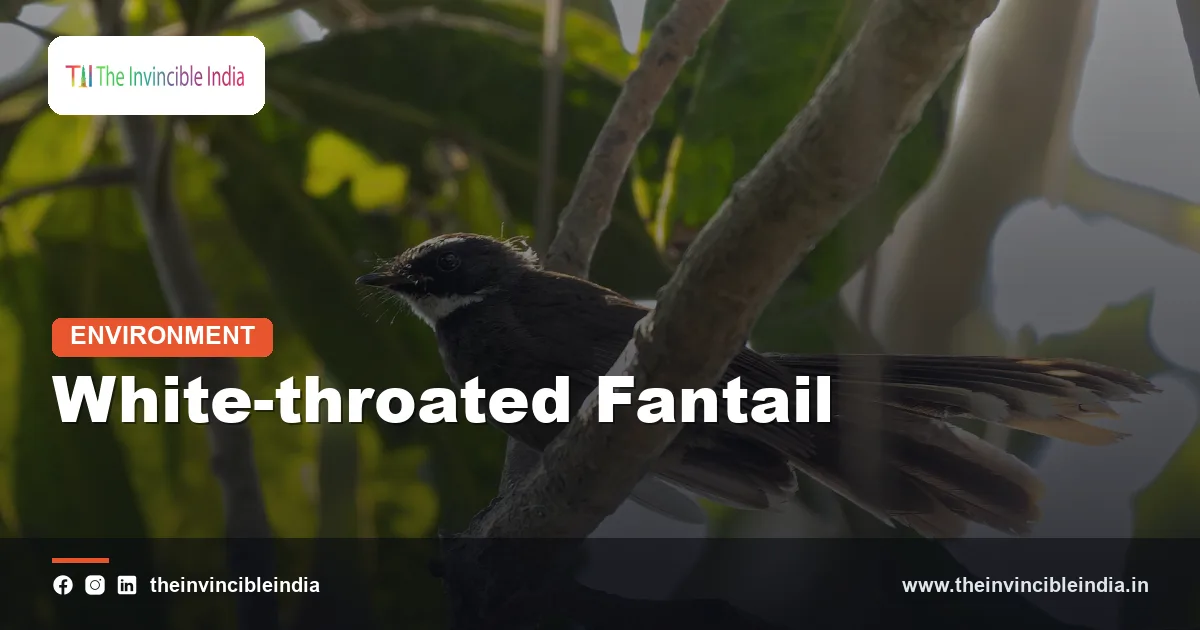
The white-throated fantail (Rhipidura albicollis) is a small, dark, restless insect-eating bird of Indian forests and wooded gardens that spreads its long tail into a fan and flits from perch to perch while chasing flies. It belongs to the fantail family Rhipiduridae, a group of small flycatching birds whose most striking habit is the constant fanning, wagging and swaying of the tail.
The white-throated fantail is easy to notice because it never seems to rest: the wings droop, the tail opens and closes, and the whole body pivots from side to side as the bird scans for insects. It also sings a clear, descending whistle that carries well through forest and garden. This explainer covers how to recognise the species, where it lives in India, how it feeds and nests and how to separate it from the similar fantails.
| Scientific name | Rhipidura albicollis |
|---|---|
| Family | Rhipiduridae (fantails) |
| Size | About 17 to 19 cm long, including a long tail that makes up much of the length |
| Range in India | Himalaya and its foothills, the north-east, central Indian hills and the Western and Eastern Ghats; also found in parts of South-east Asia |
| Habitat | Moist forest, forest edges, bamboo, scrub, plantations and wooded gardens, mostly in hills |
| Diet | Small flying insects, caught in aerial sallies and short chases |
| Breeding | Small, neat cup nest of fine fibres and cobweb on a thin branch; usually two to four eggs; both parents share nest duties |
| Conservation status | Least Concern on the IUCN Red List; protected under the Wildlife (Protection) Act, 1972 |
Key Takeaways
- The white-throated fantail is a small dark-bodied fantail with a white throat, a white eyebrow stripe and a long tail that is tipped with white.
- The white-throated fantail catches flying insects by darting out from a perch, fanning its tail and twisting in the air before returning to a perch.
- The white-throated fantail is resident in much of India, ranging through the Himalaya, the north-east, central hills and the Western and Eastern Ghats, and some birds move to lower elevations in winter.
- The white-throated fantail builds a small, tapering cup nest, bound with cobweb and set on a thin branch, which looks like a tiny wine glass.
- The white-throated fantail sings a clear, sweet, descending series of whistled notes that is often heard before the bird is seen.
- The white-throated fantail is classified as Least Concern, and it is a useful natural controller of flying insects in forests and gardens.
What Does a White-throated Fantail Look Like?
A white-throated fantail looks like a slim, dark sooty-brown or slate-grey bird with a clean white throat, a white stripe above the eye, a dark breast band and a long, rounded tail with white tips. The upperparts are dark and the belly is paler, while the white throat stands out sharply against the dark head and chest.
Field marks
- White throat: a clean white bib that gives the species its name.
- White eyebrow: a short, pale line above the eye that gives the bird a lively expression.
- Dark breast: a dusky band below the white throat, shading to a paler belly.
- White-tipped tail: the tail feathers have pale tips that show clearly when the tail is spread.
- Thin, flat bill: a small dark bill with bristles at the base, which helps the bird to capture insects in flight.
Males and females look similar, and young birds are slightly browner, with buff edges to some feathers. The bird is about the size of a bulbul but much slimmer, and the tail looks very long when it is closed and almost semicircular when fanned out.
Where Does the White-throated Fantail Live in India?
The white-throated fantail lives in India’s hill and forest regions, including the Himalaya and its foothills, the north-east, the hills of central India and the Western and Eastern Ghats. It is a mostly resident bird, though some populations move short distances up and down mountains with the seasons.
Beyond India the species extends through parts of South-east Asia, and several regional forms differ slightly in plumage tone. In India, it is most often found in moist, shady forest and its edges, in bamboo and in well-wooded gardens, rather than in dry open country.
Preferred habitats
- Moist deciduous and evergreen forest with a well-developed understorey.
- Forest clearings, trails, stream banks and edges where insects fly.
- Bamboo clumps and tangled secondary growth.
- Tea, coffee and other plantations with shade trees.
- Hill-station gardens with large trees and dense shrubs.
Seasonal movements
In the Himalaya, some white-throated fantails breed at moderate elevations and descend to the foothills and plains edge in winter, when insects become scarce at height. In southern and central India, the bird tends to stay in the same hills through the year. Such altitudinal movements are common among small insect-eating birds of mountain regions.
How Does the White-throated Fantail Catch Insects?
The white-throated fantail catches insects by sallying: it perches in the shade, spots a flying insect, dashes out with fanned tail and quick turns, snaps it up and returns to a perch. This is the classic flycatching technique, and the fanned tail works as a rudder and brake that allows the bird to turn sharply.
Several features help the bird in this role.
- Fanned tail: the broad tail gives lift and manoeuvrability, so the bird can twist and hover briefly.
- Drooped wings: the wings are held low and are flicked open at the moment of a chase.
- Rictal bristles: stiff bristles around the bill help to guide insects into the mouth.
- Wide gape: the flat bill opens wide enough to take small flies, moths and gnats.
Some people believe the fanning of the tail serves to flush hidden insects, startling them into flight so that the bird can catch them. This theory is widely discussed and plausible, but the behaviour probably also serves other purposes, such as signalling to other fantails and balancing the body during sharp turns.
What Does the White-throated Fantail Eat?
The white-throated fantail eats small flying insects, including flies, midges, small moths, gnats, beetles and other tiny arthropods, nearly all of which it takes in the air or from leaf surfaces. Because the bird feeds on pests and nuisance insects, it is regarded as a beneficial species in gardens and plantations.
A fantail often works the lower and middle levels of the forest, staying within a few metres of the ground in many habitats. It may visit the same favourite perches many times, returning after each aerial sally. Birds in the hills also join mixed-species feeding flocks, in which each species feeds in a slightly different way and the many eyes help detect predators.
| Feeding method | Description |
|---|---|
| Aerial sally | Short flight from a perch to snap up a flying insect, then a return to a perch |
| Hover-gleaning | Brief hovering to pick an insect from the underside of a leaf |
| Flushing | Fanning the tail and wings to startle insects out of hiding |
| Following other animals | Catching insects disturbed by large mammals or other birds moving through the vegetation |
Why Does the Fantail Spread and Wag Its Tail?
The fantail spreads and wags its tail mainly to help in catching insects, since the open fan provides control during sharp aerial turns and may also startle prey into the open. Wagging and fanning may also serve as social signals between birds in a pair or a group.
The behaviour is so constant that it defines the group. Fantails fan the tail while perched, while hopping, in flight and while singing. Observers often notice the following movements.
- A rhythmic swing of the tail from side to side.
- A sudden opening of the fan, with the white tips flashing.
- A drooping of the wings to expose the sides of the body.
- A quick pirouette on the perch, turning the whole body to face a new direction.
The white tips of the tail feathers make the display visible even in shaded, dim forest light. In a gloomy understorey, a flash of white may be one of the clearest signals available.
How Does the White-throated Fantail Build Its Nest?
The white-throated fantail builds a small cup-shaped nest of fine plant fibres, grass and cobweb on a thin, often horizontal branch, usually at a modest height above the ground. The finished nest is neat and compact, with a tapering base and a tail-like projection below, so it resembles a tiny wine glass.
Nest construction
Both parents collect material and bind it together with spider silk. The outside is often decorated with lichen, moss or bits of bark, which camouflage the nest against the branch. The nest is so small that an incubating bird looks like a bump on the limb, with its tail often sticking up over the rim.
Eggs and care of the young
The female lays about two to four small eggs, which are pale with fine markings. Both the male and the female take turns incubating and later feed the chicks with tiny insects. Fantails are bold nest defenders and may fluster much larger birds, such as crows and even raptors, by fluttering around them and calling loudly.
Breeding season
The breeding season varies by region and elevation, but it falls mostly in the warmer, wetter part of the year, when insects are plentiful. In some places a pair may raise more than one brood in a season.
What Does the White-throated Fantail Sound Like?
The white-throated fantail sings a clear, sweet, descending series of whistles, usually a few notes that glide downward in pitch, and it also gives sharper chattering and clicking calls when alarmed. The song is often heard from a low perch within forest or garden, and the bird may sing with the tail fanned.
Because the bird lives in shady undergrowth where visibility is limited, the song is helpful for locating it. Birdwatchers recognise the descending whistle as a signature sound of many hill forests in India. The song is used by males to hold territory and attract mates, and both sexes use short calls to keep in contact.
How Is the White-throated Fantail Different from Other Fantails?
The white-throated fantail differs from other Indian fantails mainly in its plain white throat without spots on the chest, its dark body and its habitat, and it is most often confused with the white-spotted fantail and the white-browed fantail. Careful attention to the chest and head markings usually settles the identification.
| Species | Key features | Typical habitat |
|---|---|---|
| White-throated fantail | Dark body, clean white throat, short pale eyebrow, white-tipped tail | Moist forest, edges and wooded gardens in hills |
| White-spotted fantail | Similar dark body, but with a band of white spots across the chest | Forests and hill areas, mostly in the peninsula and central regions |
| White-browed fantail | Broad white eyebrow that meets over the forehead, darker breast, more extensive white on the tail | Scrub, gardens and open woodland in the plains |
Fantails differ from true flycatchers in their fanning and wagging behaviour, in their broad, rounded tails and in their lively, never-still posture. Both groups catch insects in flight, but a fantail’s constant motion makes it relatively easy to distinguish in the field.
Is the White-throated Fantail Threatened?
No, the white-throated fantail is not threatened and is classified as Least Concern on the IUCN Red List. It has a wide range and is fairly common in suitable habitat, and in India it is legally protected as a wild bird under the Wildlife (Protection) Act, 1972.
The species adapts moderately well to altered habitats such as plantations and hill gardens, as long as there are enough trees and insects. Its main long-term pressures are habitat loss in forested hills, reduction of insect life through pesticide use and the clearing of understorey vegetation.
Ways to help fantails
- Retain native trees and understorey shrubs in gardens, estates and plantations.
- Reduce the use of insecticides, which remove the bird’s food.
- Protect forest corridors in the hills so that birds can move between elevations.
- Avoid cutting nesting trees and branches during the breeding season.
How Can You Watch White-throated Fantails?
You can watch white-throated fantails by walking quietly along forest trails, plantation roads and garden paths in hill areas and looking for a small dark bird with a fanned tail darting out from low perches. Early morning and late afternoon are usually the busiest times, and the bird is often found near streams and clearings where insects gather.
- Listen for the descending whistle and for sharp chattering notes.
- Watch low perches along the edge of a trail, where the bird returns repeatedly after each sally.
- Use binoculars to confirm the white throat and to see whether chest spots are present.
- Keep a good distance from nests, which are small, delicate and easily abandoned if the birds are disturbed.
- Join mixed-species flocks in the hills for a chance to see fantails alongside warblers, tits and babblers.
Bottom Line
The white-throated fantail is a small, energetic insect-hunter whose fanning tail, white throat and sweet descending song make it one of the most charming birds of Indian hill forests and gardens. It remains common where trees and insects are plentiful, and it is a reminder of how much activity can be packed into a bird no larger than a bulbul.
Frequently Asked Questions
What is a white-throated fantail?
A white-throated fantail is a small, dark, insect-eating bird of the family Rhipiduridae with a white throat and a long, white-tipped tail that it spreads like a fan. It catches flying insects in quick aerial sallies. It lives in forests and wooded gardens of India, mostly in the hills.
Where is the white-throated fantail found in India?
The white-throated fantail is found in the Himalaya and its foothills, the north-east, the hills of central India and the Western and Eastern Ghats. It prefers moist forest, forest edges, bamboo and wooded gardens. Some birds move to lower elevations in winter.
Why does the fantail fan its tail?
The fantail fans its tail mainly to improve its control during sharp aerial turns and possibly to startle insects into flight. The white tips of the tail feathers also act as a visual signal in dim forest light. The behaviour is constant, which gives the group its name.
What does the white-throated fantail eat?
The white-throated fantail eats small flying insects such as flies, midges, gnats, small moths and beetles. It catches most of them in the air after a short dash from a perch. Because it eats many pest insects, it is considered beneficial in gardens and plantations.
How can you tell a white-throated fantail from a white-spotted fantail?
You can tell them apart by the chest, because the white-spotted fantail has a band of white spots across the breast while the white-throated fantail has a clean dark breast below its white throat. The two species are otherwise similar in colour and behaviour. Habitat and range help as well.
Is the white-throated fantail protected?
Yes, the white-throated fantail is protected in India as a wild bird under the Wildlife (Protection) Act, 1972. It is classified as Least Concern on the IUCN Red List because it is widespread and fairly common. Its habitat still depends on trees, understorey vegetation and a good supply of insects.
{“@context”:”https://schema.org”,”@graph”:[{“@type”:”FAQPage”,”mainEntity”:[{“@type”:”Question”,”name”:”What is a white-throated fantail?”,”acceptedAnswer”:{“@type”:”Answer”,”text”:”A white-throated fantail is a small, dark, insect-eating bird of the family Rhipiduridae with a white throat and a long, white-tipped tail that it spreads like a fan. It catches flying insects in quick aerial sallies. It lives in forests and wooded gardens of India, mostly in the hills.”}},{“@type”:”Question”,”name”:”Where is the white-throated fantail found in India?”,”acceptedAnswer”:{“@type”:”Answer”,”text”:”The white-throated fantail is found in the Himalaya and its foothills, the north-east, the hills of central India and the Western and Eastern Ghats. It prefers moist forest, forest edges, bamboo and wooded gardens. Some birds move to lower elevations in winter.”}},{“@type”:”Question”,”name”:”Why does the fantail fan its tail?”,”acceptedAnswer”:{“@type”:”Answer”,”text”:”The fantail fans its tail mainly to improve its control during sharp aerial turns and possibly to startle insects into flight. The white tips of the tail feathers also act as a visual signal in dim forest light. The behaviour is constant, which gives the group its name.”}},{“@type”:”Question”,”name”:”What does the white-throated fantail eat?”,”acceptedAnswer”:{“@type”:”Answer”,”text”:”The white-throated fantail eats small flying insects such as flies, midges, gnats, small moths and beetles. It catches most of them in the air after a short dash from a perch. Because it eats many pest insects, it is considered beneficial in gardens and plantations.”}},{“@type”:”Question”,”name”:”How can you tell a white-throated fantail from a white-spotted fantail?”,”acceptedAnswer”:{“@type”:”Answer”,”text”:”You can tell them apart by the chest, because the white-spotted fantail has a band of white spots across the breast while the white-throated fantail has a clean dark breast below its white throat. The two species are otherwise similar in colour and behaviour. Habitat and range help as well.”}},{“@type”:”Question”,”name”:”Is the white-throated fantail protected?”,”acceptedAnswer”:{“@type”:”Answer”,”text”:”Yes, the white-throated fantail is protected in India as a wild bird under the Wildlife (Protection) Act, 1972. It is classified as Least Concern on the IUCN Red List because it is widespread and fairly common. Its habitat still depends on trees, understorey vegetation and a good supply of insects.”}}]}]}


