

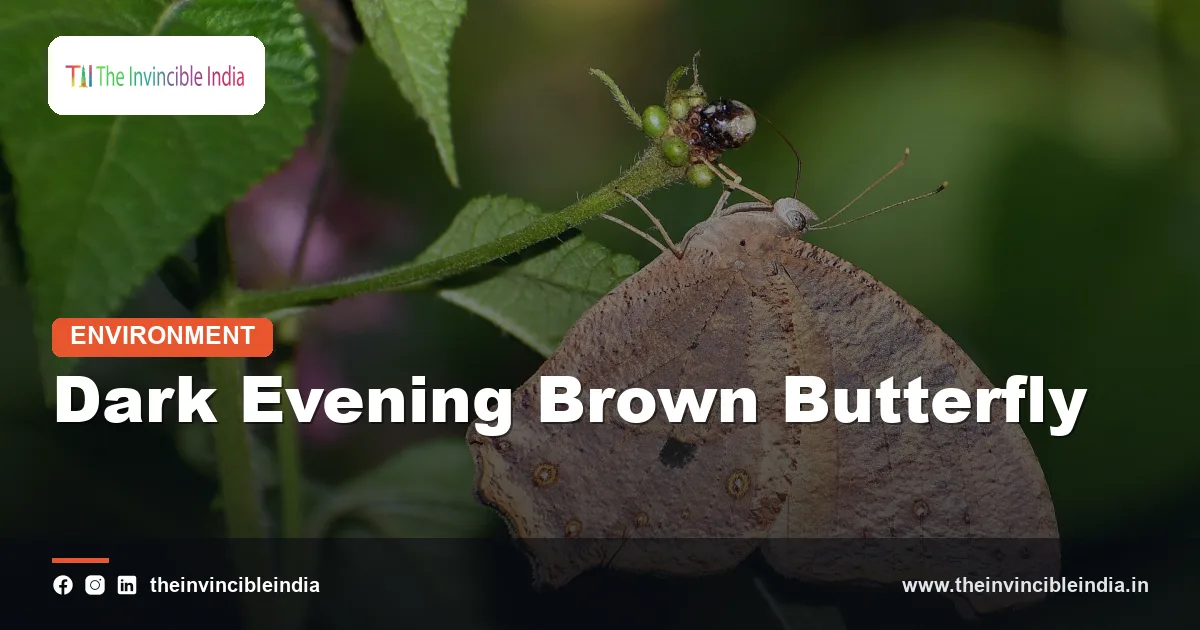
The dark evening brown (Melanitis phedima) is a medium-sized brown nymphalid butterfly of South and Southeast Asia that flies mainly at dusk, rests by day among dead leaves, and shows eyespots and a leaf-like pattern on its underside that change with the season. Found in shady gardens, forest edges and wooded country across India, the dark evening brown is often seen only as an erratic shape in the fading light, which is why it is so seldom photographed with its wings open.
Its close relative, the common evening brown, is more widely known, and the two are often confused. This article explains how to identify the dark evening brown, how its wet-season and dry-season forms differ, where it lives, what its caterpillars eat, and why its twilight habits and camouflage make it one of the most interesting ordinary butterflies of the Indian countryside.
Quick Facts: Dark Evening Brown
| Common name | Dark evening brown |
|---|---|
| Scientific name | Melanitis phedima (Cramer, 1780) |
| Family and subfamily | Nymphalidae (brush-footed butterflies), subfamily Satyrinae (satyrs and browns) |
| Wingspan | Medium-sized; roughly 6 to 7 cm in many accounts |
| Caterpillar host plants | Grasses, including Ischaemum semisagittatum, Andropogon, Cymbopogon, Pennisetum, Setaria, Oplismenus compositus and bamboo (Bambusa arundinacea) |
| Range in India | Wooded regions of peninsular, central and eastern India, with several regional subspecies; widespread in South and Southeast Asia |
| Habitat | Shaded gardens, forest edges, damp woodland and bamboo or grass patches |
| Flight season | Present through much of the year; wet-season and dry-season forms alternate |
| Notable features | Dusk flight, erratic movement, eyespots on the underside, seasonal polyphenism |
Key Takeaways
- The dark evening brown, Melanitis phedima, is a medium-sized satyrine butterfly that flies mainly at dusk with an erratic flight.
- The dark evening brown exists in two seasonal forms, a wet-season form with prominent eyespots and a dry-season form with a mottled, leaf-like underside.
- Dark evening brown caterpillars feed on grasses, including Ischaemum, Andropogon, Cymbopogon, Pennisetum, Setaria and bamboo.
- The dry-season dark evening brown has a more pointed forewing and a longer hindwing tail than the wet-season form.
- The dark evening brown is easily confused with the common evening brown (Melanitis leda), which belongs to the same genus.
- The dark evening brown shelters in shade and leaf litter by day and becomes active in twilight, a pattern known as crepuscular behaviour.
What is the dark evening brown butterfly?
The dark evening brown is a species of brush-footed butterfly in the genus Melanitis, a group of dusk-flying browns found across the tropics of Asia and Africa. It was described by the Dutch naturalist Pieter Cramer in 1780, and later writers described several synonyms that are now treated as variants of the same species.
Melanitis belongs to the subfamily Satyrinae, whose members are called satyrs, browns or ringlets. Satyrines are mostly brown or grey butterflies with eyespots, they feed as caterpillars on grasses and similar plants, and many fly in low light. The dark evening brown fits this description well.
The English name refers to its dark colour and to its habit of coming out in the evening. Several related species share the pattern, and the group is often called the evening browns in India.
How can you identify a dark evening brown?
A dark evening brown can be identified by its dusky brown upperside with an orange-brown patch on the forewing, the eyespots and marbled brown pattern of its underside, and its habit of flying in the evening. The upperside colour and wing shape change with the season.
- Male, wet season: dusky brown above with an ochreous (yellow-brown) patch on the forewing and a plain hindwing; the underside has several eyespots with white centres.
- Female, wet season: paler than the male, with a large pale area near the forewing tip containing a black spot with a white centre.
- Male, dry season: deeper, purplish brown above with a more pointed forewing and a longer hindwing tail; the underside is mottled and the eyespots are less distinct.
- Posture: usually at rest with wings closed and the body tilted among leaf litter, which hides the upperside pattern.
Separating the dark evening brown from the common evening brown (Melanitis leda) is difficult in the field and often requires close photographs of both surfaces. Differences in forewing shape, the arrangement of the eyespots and the colour of the forewing patch are used by specialists, and an uncertain record is best reported at genus level.
Why does the dark evening brown have two seasonal forms?
The dark evening brown has two seasonal forms because its appearance is tuned to the conditions it faces, with the wet-season form favouring eyespots and the dry-season form favouring leaf-like camouflage. This phenomenon, in which one genetic species produces different forms in different seasons, is called polyphenism.
In the green, humid rainy season, the butterfly has many eyespots on the underside, which are thought to draw the attacks of predators to the edge of the wing and away from the body. In the dry season, when leaves lie brown on the ground, the butterfly shows a mottled underside and a more pointed wing outline that resemble a dead leaf.
The seasonal change is controlled by the temperature and other cues that the developing caterpillar experiences, not by a change in species. Two siblings raised in different seasons may therefore look strikingly unlike each other, which can confuse an inexperienced observer.
| Feature | Wet-season form | Dry-season form |
|---|---|---|
| Upperside colour | Dusky brown with ochreous forewing patch | Deeper, purplish brown |
| Forewing shape | More rounded | More pointed |
| Hindwing tail | Short or absent | Longer |
| Underside | Prominent white-centred eyespots | Mottled, leaf-like, eyespots faint |
Where does the dark evening brown live in India?
The dark evening brown lives in wooded and well-vegetated parts of India, including the Western Ghats, central Indian forests and eastern regions, and it is also found in Nepal, Sri Lanka and Southeast Asia. Several geographical subspecies are recognised within India, which reflects the large range and varied habitats of the species.
The butterfly prefers shady places: forest edges, damp woodland, bamboo clumps, plantations, and gardens with shrubs and tall grasses. It is less likely to be found in treeless dry land, though it may appear in well-planted urban gardens and parks when the host grasses and shelter are present.
Specialist field guides treat the dark evening brown as widespread and locally common. Because it is active at dusk, it is recorded less often than day-flying butterflies, and its range is probably better than the maps suggest.
What do dark evening brown caterpillars eat?
Dark evening brown caterpillars eat the leaves of grasses, including Ischaemum semisagittatum, species of Andropogon, Cymbopogon, Pennisetum and Setaria, the creeping grass Oplismenus compositus and bamboo (Bambusa arundinacea). Satyrine caterpillars are characteristically grass-feeders.
Some of these genera are familiar. Cymbopogon includes lemongrass, Pennisetum includes pearl millet, and Setaria includes foxtail millet, so the host list overlaps with cultivated plants. The caterpillar is nevertheless mainly recorded on wild and ornamental grasses, and a few chewed leaves do not make it a significant crop pest.
The females lay eggs on or near the grass. The newly hatched caterpillars feed on the leaf blades, and their green colour and slender shape make them blend into the grass. Typical satyrine caterpillars are green and taper to a forked tail end, while the head may carry small horns, though readers should check species-level descriptions before treating these features as certain.
Why does the dark evening brown fly at dusk?
The dark evening brown flies at dusk because it is crepuscular, meaning that it is most active in the low light of dawn and evening, and this habit lets it avoid many day-flying predators. During the bright hours it rests among dead leaves and shaded foliage, where its leaf-like underside makes it almost invisible.
Its flight at dusk is described as erratic, with sudden changes of direction and rapid bursts. The unpredictable movement makes it hard for a bird or other hunter to follow, and the butterfly generally flies low to the ground in gardens and forest edges.
Activity in twilight also matches the feeding habits of many satyrines, which are drawn to fermenting fruit, sap and other decaying plant matter. Such food sources release strong scents in the cool of the evening, so the timing helps the butterfly to find them.
How does the dark evening brown protect itself?
The dark evening brown protects itself mainly through camouflage, eyespots and evasive flight. With its wings closed, the mottled underside looks like a dead leaf, and at rest the butterfly seldom moves unless it is disturbed.
Leaf mimicry
The dry-season form has a pointed forewing and tail that resemble the tip and stalk of a dry leaf. This helps the butterfly survive the months when green cover is scarce.
Eyespots
The wet-season form has white-centred eyespots on the underside. When a bird pecks at a conspicuous spot, it may strike the wing margin and not the body, giving the butterfly a chance to escape with a torn wing.
Evasive flight
If disturbed in daytime, the butterfly flies off in a rapid, zigzag course for a short distance and settles again, often with its back against a trunk or a clump of leaves.
How does the dark evening brown differ from the common evening brown?
The dark evening brown differs from the common evening brown mainly in details of forewing shape, wing colour and eyespot pattern, and the two species are often found in the same places. Both belong to the genus Melanitis, both fly at dusk and both use grasses as host plants.
- Common evening brown (Melanitis leda): very widespread, found in gardens and open country across India, and the species that most people encounter.
- Dark evening brown (Melanitis phedima): associated with more shaded, wooded surroundings, and distinguished by differences in forewing outline and markings.
- Great evening brown (Melanitis zitenius): a larger relative of forest habitats in the east and south.
The two commonest species can be confirmed reliably only from clear photographs, preferably of both the upperside and the underside. Many records posted online are corrected by experts after review, so a careful observer should record the details and the season of the sighting.
What role does the dark evening brown play in nature?
The dark evening brown plays a role as a grass-feeding herbivore, a consumer of fermenting fruit and sap, and a prey species for birds, lizards, bats and spiders. Its caterpillars convert grass tissue into animal biomass, and its adults feed on resources that few other insects use at dusk.
Butterflies such as the dark evening brown form an important link between plants and predators. They are food for insectivorous birds and reptiles, and their presence reflects the availability of native grasses, leaf litter and shaded refuges in a landscape.
Because the species is not highly specialised, it tolerates moderate disturbance. Its decline in an area usually indicates a deeper problem, such as the clearing of the understorey, over-mowing, heavy pesticide use or the loss of tree cover.
How can you attract or observe the dark evening brown?
You can observe the dark evening brown by visiting a shaded garden, plantation edge or woodland trail around dusk and watching for low, erratic flight over grass and shrubs. Gardeners can encourage the species by leaving patches of native grasses unmown and by keeping a little leaf litter beneath trees.
- Allow clumps of tall grass or ornamental grasses to grow in a quiet corner.
- Keep leaf litter and shade under shrubs where the butterfly can rest by day.
- Avoid broad-spectrum insecticides and weedkillers, which harm caterpillars on grasses.
- Place a piece of overripe fruit in a shaded spot in the evening to see if the butterflies come to feed.
A camera with a fast lens helps in the dim light. Photographing the underside while the butterfly rests is easier than trying to catch it in flight.
Bottom Line
The dark evening brown is a modest-looking butterfly with an extraordinary set of adaptations: dusk activity, seasonal changes in wing pattern, eyespots and a dead-leaf disguise. Paying attention to such everyday species shows how much natural history is hidden in Indian gardens and forest edges.
Frequently Asked Questions
What is the dark evening brown butterfly?
The dark evening brown is a medium-sized brown butterfly named Melanitis phedima, belonging to the satyr subfamily. It flies mainly at dusk and rests among leaves by day. It occurs in South and Southeast Asia, including many parts of India.
Why is it called an evening brown?
It is called an evening brown because it is most active at dusk, in the low light of evening. During the day it stays hidden in shade and leaf litter. This twilight behaviour is called crepuscular activity.
What do dark evening brown caterpillars eat?
Dark evening brown caterpillars eat grasses, including Ischaemum semisagittatum, Andropogon, Cymbopogon, Pennisetum, Setaria, Oplismenus compositus and bamboo. The females lay eggs on or near these plants. The caterpillars are green and blend into the grass.
How does the dry-season form differ from the wet-season form?
The dry-season form has a deeper purplish-brown upperside, a more pointed forewing, a longer hindwing tail and a mottled leaf-like underside. The wet-season form has a plainer upperside and conspicuous white-centred eyespots below. The change, known as polyphenism, helps the butterfly match the season.
How can I tell the dark evening brown from the common evening brown?
The two species are similar and are best told apart by close photographs of forewing shape, colour and eyespot pattern. Both fly at dusk and feed on grasses. If the details are unclear, it is acceptable to record the sighting only as an evening brown.
Is the dark evening brown a pest of crops?
The dark evening brown is not regarded as a significant crop pest. Its caterpillars are recorded mainly on wild and ornamental grasses, and although some host genera include cereal crops, damage is not a recognised concern. The butterfly is better seen as part of the natural food web.
{“@context”:”https://schema.org”,”@graph”:[{“@type”:”FAQPage”,”mainEntity”:[{“@type”:”Question”,”name”:”What is the dark evening brown butterfly?”,”acceptedAnswer”:{“@type”:”Answer”,”text”:”The dark evening brown is a medium-sized brown butterfly named Melanitis phedima, belonging to the satyr subfamily. It flies mainly at dusk and rests among leaves by day. It occurs in South and Southeast Asia, including many parts of India.”}},{“@type”:”Question”,”name”:”Why is it called an evening brown?”,”acceptedAnswer”:{“@type”:”Answer”,”text”:”It is called an evening brown because it is most active at dusk, in the low light of evening. During the day it stays hidden in shade and leaf litter. This twilight behaviour is called crepuscular activity.”}},{“@type”:”Question”,”name”:”What do dark evening brown caterpillars eat?”,”acceptedAnswer”:{“@type”:”Answer”,”text”:”Dark evening brown caterpillars eat grasses, including Ischaemum semisagittatum, Andropogon, Cymbopogon, Pennisetum, Setaria, Oplismenus compositus and bamboo. The females lay eggs on or near these plants. The caterpillars are green and blend into the grass.”}},{“@type”:”Question”,”name”:”How does the dry-season form differ from the wet-season form?”,”acceptedAnswer”:{“@type”:”Answer”,”text”:”The dry-season form has a deeper purplish-brown upperside, a more pointed forewing, a longer hindwing tail and a mottled leaf-like underside. The wet-season form has a plainer upperside and conspicuous white-centred eyespots below. The change, known as polyphenism, helps the butterfly match the season.”}},{“@type”:”Question”,”name”:”How can I tell the dark evening brown from the common evening brown?”,”acceptedAnswer”:{“@type”:”Answer”,”text”:”The two species are similar and are best told apart by close photographs of forewing shape, colour and eyespot pattern. Both fly at dusk and feed on grasses. If the details are unclear, it is acceptable to record the sighting only as an evening brown.”}},{“@type”:”Question”,”name”:”Is the dark evening brown a pest of crops?”,”acceptedAnswer”:{“@type”:”Answer”,”text”:”The dark evening brown is not regarded as a significant crop pest. Its caterpillars are recorded mainly on wild and ornamental grasses, and although some host genera include cereal crops, damage is not a recognised concern. The butterfly is better seen as part of the natural food web.”}}]}]}


