

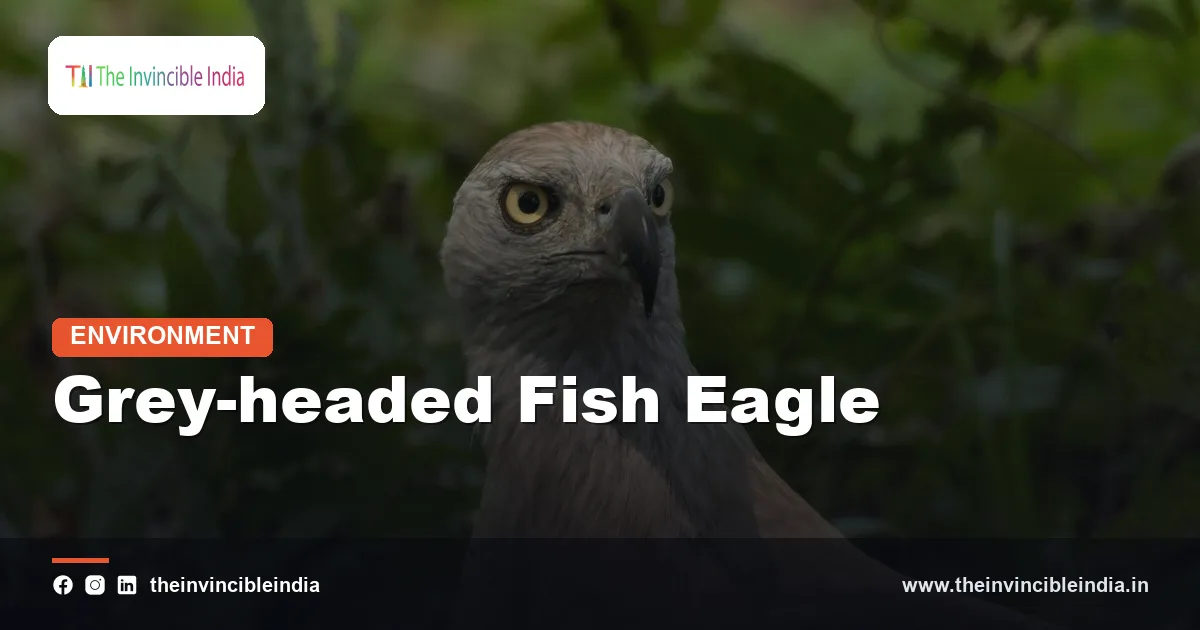
The grey-headed fish eagle (Icthyophaga ichthyaetus) is a medium-large, brown fish-hunting eagle with a grey head, a white belly and a white tail tipped with a broad black band, found around lakes, rivers and wetlands in India and across South and Southeast Asia. It is a bird of freshwater, usually seen perched on a tall tree beside the water or giving loud, nasal calls at dawn and dusk.
The species is a secretive and thinly spread resident rather than a common sight. Because it depends on clean water, plentiful fish and tall nest trees, it is a good indicator of healthy wetlands, and it is classed as Near Threatened by the IUCN. This guide explains how to recognise it, where it lives and why it needs protection.
Grey-headed Fish Eagle Quick Facts
| Common name | Grey-headed fish eagle |
|---|---|
| Scientific name | Icthyophaga ichthyaetus |
| Family | Accipitridae (hawks, eagles and kites) |
| Size | About 60 to 75 cm long, with a wingspan of roughly 1.5 to 1.7 metres |
| Habitat in India | Lowland rivers, lakes, reservoirs, marshes and mangrove-fringed waters with tall trees nearby |
| Range in India | Patchy resident in the Himalayan foothills and Terai, the Gangetic plains, the north-east, Odisha and parts of peninsular India |
| Diet | Mainly live fish; also water birds, reptiles and occasional carrion |
| Breeding | Large stick nest in a tall tree near water; usually breeds in the cooler, drier months |
| Conservation status | Near Threatened on the IUCN Red List |
Key Takeaways
- The grey-headed fish eagle is a resident fish-eating eagle of Indian lakes, rivers and wetlands with a grey head, brown back, white belly and white tail tipped with black.
- The grey-headed fish eagle catches fish by swooping low over the surface and snatching prey in its talons, and it also takes water birds and reptiles.
- The grey-headed fish eagle is listed as Near Threatened by the IUCN because its populations are shrinking with the loss and pollution of wetlands.
- The grey-headed fish eagle is noisy at dawn and dusk, giving loud, nasal, honking calls that carry across the water.
- The grey-headed fish eagle builds a large stick nest in a tall tree near water and relies on old, undisturbed trees to breed.
- The grey-headed fish eagle is smaller than Pallas’s fish eagle and browner than the osprey, and its grey head and banded white tail are the best marks for telling the three apart.
What does a grey-headed fish eagle look like?
A grey-headed fish eagle looks like a stocky, dark brown eagle with a pale grey head and neck, a white lower belly and undertail, and a rounded white tail with a broad black band at the tip. The upperparts are brown, the underparts are reddish-brown on the chest and breast, and the legs and feet are pale.
The bird is about 60 to 75 cm long. It has a rather small head and a strong, hooked bill, and the eye is pale. The sexes look alike, though females are larger. Young birds are mottled brown and paler, with a less defined tail band, and they gradually acquire the grey head of the adult.
Flight and shape
In flight the bird has broad, rounded wings, a fairly short, rounded tail and a heavily built body. The underwings look dark brown against the pale belly. The white tail with its broad black terminal band is often the easiest feature to spot, especially when the bird is seen from below as it passes overhead.
Voice
The grey-headed fish eagle is vocal. Its call is a loud, harsh, nasal series of notes, often described as a honking or screaming sound, and pairs often call together at first light and before sunset. Hearing the call is frequently the first sign that the species is present.
Where does the grey-headed fish eagle live in India?
The grey-headed fish eagle lives near freshwater and brackish waters across northern, eastern and peninsular India, mostly in the plains and foothills where rivers, lakes and marshes are bordered by tall trees. It is a resident, not a migrant, and it is found in low densities.
The species ranges from the Himalayan foothills in India, Nepal and Bhutan, through Bangladesh and Myanmar to Southeast Asia and the islands of Indonesia and the Philippines. Within India, it is most regularly recorded in places such as:
- The Terai and foothills of Uttarakhand, Uttar Pradesh and Bihar
- Wetlands and river stretches in Assam and the wider north-east, including grassland and riverine reserves
- Reservoirs, lakes and river courses in Odisha, West Bengal and other eastern states
- Scattered sites in central and peninsular India, where forested rivers and large tanks survive
It generally prefers still or slow water with abundant fish, open perches and large trees. Dammed reservoirs, oxbow lakes and quiet river bends are typical places to find it.
What does the grey-headed fish eagle eat?
The grey-headed fish eagle eats mainly live fish, but it will also take water birds, reptiles and carrion when fish are scarce. It is a fish specialist that is also flexible enough to survive on other food.
Fishing method
The eagle watches from a perch and then flies low over the water, grabbing a fish close to the surface with its talons without plunging deep or submerging. The soles of the feet have rough spicules that help to hold slippery prey. Unlike the osprey, it does not usually hover or dive headfirst into the water.
Other food
The bird may seize waterfowl, snakes, turtles and other animals near the water. It also eats dead fish and scraps, and sometimes steals food from other birds of prey. A pair may fish in one stretch of water for years, returning to the same favoured perches.
How can you tell a grey-headed fish eagle from other fish-eating raptors?
You can tell a grey-headed fish eagle from other fish-eating raptors by its grey head, brown back and white tail with a black end band, as well as its stocky shape and its habit of perching in trees. Several raptors hunt fish in Indian waters, and they differ in colour and behaviour.
| Species | Main differences |
|---|---|
| Grey-headed fish eagle | Grey head, brown back, white belly and white tail with broad black tip; loud nasal calls |
| Pallas’s fish eagle | Larger, with a pale buff head and a dark tail crossed by a white band; found along large rivers |
| Osprey | White underparts with a dark eye stripe; hovers and dives feet first; mostly a winter visitor |
| White-bellied sea eagle | Larger, with a white head, chest and belly and grey back; usually on coasts |
| Brahminy kite | Smaller, with a chestnut body and a white head and breast; common on coasts and wetlands |
| Lesser fish eagle | Smaller and darker, with a brown body and a uniformly brown tail; mainly along forested rivers |
The grey-headed fish eagle is sometimes confused with the lesser fish eagle, which is smaller and more forest-bound. In general, a medium-large eagle with a grey head and a banded white tail over fresh water is likely to be this species.
How does the grey-headed fish eagle breed?
The grey-headed fish eagle breeds by building a large stick nest high in a big tree close to water, and it usually lays two or three eggs, mostly in the cooler months. Pairs use the same nest for several years and add to it each season.
The nest is a broad platform of sticks lined with greenery and often sited in a tall tree with a view of the water. Both parents incubate the eggs and feed the chicks, and the young take several weeks to leave the nest. Often only one or two young survive to fledge.
The need for tall, old trees near the water is a key vulnerability. Where such trees are cut or where people disturb the nests, the birds may abandon a site, even if the water itself still holds plenty of fish.
Why is the grey-headed fish eagle Near Threatened?
The grey-headed fish eagle is classed as Near Threatened by the International Union for Conservation of Nature (IUCN) because wetlands across its range are being drained, polluted and disturbed, and its population is believed to be declining. The species is already scarce in many areas, and it is vulnerable to anything that reduces fish or nesting trees.
- Wetland loss: Drainage, encroachment and conversion of marshes and lakes remove feeding grounds.
- Pollution: Chemicals, sewage and industrial waste harm fish stocks and may contaminate prey.
- Loss of nest trees: Felling of tall riverine and lakeside trees removes nest and perch sites.
- Overfishing and netting: Reduced fish populations and entanglement in fishing gear can affect the birds.
- Disturbance: Boats, noise and human activity near nests cause breeding failure.
- Hunting and persecution: Occasional shooting and capture still occur in some areas.
How is the grey-headed fish eagle protected in India?
The grey-headed fish eagle is protected in India under the Wildlife (Protection) Act, 1972, which prohibits hunting and disturbing wild raptors, and many of its strongholds lie within protected areas and Ramsar-listed wetlands. Legal protection alone is not enough without healthy water bodies.
Conservation measures that help the species include:
- Protecting wetlands, river corridors and lakeside forest
- Retaining old, tall trees along riverbanks and reservoirs
- Limiting pollution and unsustainable fishing
- Reducing disturbance near known nests during the breeding season
- Monitoring populations through citizen-science and field surveys
Why is the grey-headed fish eagle an indicator of healthy wetlands?
The grey-headed fish eagle is an indicator of healthy wetlands because it needs abundant fish, clean water and undisturbed tall trees, and it sits near the top of the aquatic food chain. When the bird disappears from a lake or river, it often points to a decline in water quality or habitat.
Its presence also benefits other wildlife. The same wetlands that hold the eagle usually shelter waterbirds, otters, turtles and fish, as well as providing water for people. Conserving a site for the eagle therefore helps to protect a whole community of species and the services that wetlands provide.
How does the grey-headed fish eagle behave through the year?
The grey-headed fish eagle behaves as a settled, territorial resident that stays near the same stretch of water through the year, with pairs defending a feeding range and a nest site. Unlike migratory raptors, it does not travel long distances, although it may move short distances when water levels change.
Much of the day is spent perched quietly on a tall branch, dead tree or post overlooking the water, with short, purposeful flights to fish. Pairs are often seen together, and they may call in duet during the breeding season. In the dry months, when water levels drop and fish become concentrated, the birds may gather where food is easiest to catch.
Young birds disperse after becoming independent and may wander to other water bodies in search of a territory. This dispersal is important because it allows the species to colonise new lakes and rivers, provided that suitable trees and fish are present.
How can you watch grey-headed fish eagles responsibly?
You can watch grey-headed fish eagles responsibly by scanning the tall trees beside lakes and rivers from a distance, preferably in the early morning or late afternoon, and by keeping boats and people well away from nests.
- Look for a large brown bird with a pale grey head perched on a dead branch overlooking water.
- Listen for loud, nasal calls at dawn and dusk.
- Use binoculars and keep a long distance from the nest tree.
- Avoid approaching nests in the breeding season, and never play recorded calls to attract the birds.
- Share records with local birding groups to help track the species.
Bottom Line
The grey-headed fish eagle is a quiet but noisy-voiced guardian of Indian wetlands, fishing from tall perches and nesting in old trees near water. Its Near Threatened status is a reminder that clean water, fish and large trees are all needed to keep such a bird, and the waters it lives on, in good health.
Frequently Asked Questions
What is a grey-headed fish eagle?
A grey-headed fish eagle is a medium-large eagle that lives near freshwater and hunts mainly fish. It has a grey head, brown back, white belly and a white tail with a broad black tip. It is a resident of the Indian subcontinent and Southeast Asia.
Where can you see a grey-headed fish eagle in India?
You can see a grey-headed fish eagle at lakes, reservoirs and rivers in the Terai, the Gangetic plains, the north-east and parts of eastern and peninsular India. It prefers waters with tall trees nearby. It is thinly spread, so patient scanning of treetops is useful.
How does a grey-headed fish eagle catch fish?
A grey-headed fish eagle catches fish by watching from a perch and then gliding low over the water to snatch a fish near the surface with its talons. It does not usually dive in headfirst like an osprey. It may also take water birds and reptiles.
Is the grey-headed fish eagle endangered?
The grey-headed fish eagle is not classed as Endangered but as Near Threatened by the IUCN. Its numbers are falling because wetlands are being lost, polluted and disturbed. It is protected under the Wildlife (Protection) Act, 1972 in India.
How can you tell a grey-headed fish eagle from an osprey?
The grey-headed fish eagle is browner and stockier, with a grey head, a white tail with a black band and a habit of perching in trees. The osprey has white underparts, a dark eye stripe and a habit of hovering and diving feet first. The osprey is mostly a winter visitor in India.
What does the call of a grey-headed fish eagle sound like?
The call of a grey-headed fish eagle is a loud, harsh and nasal honking or screaming series of notes. Pairs often call together at dawn and dusk, and the sound carries far across open water. The call is often the first sign that the bird is nearby.
{“@context”:”https://schema.org”,”@graph”:[{“@type”:”FAQPage”,”mainEntity”:[{“@type”:”Question”,”name”:”What is a grey-headed fish eagle?”,”acceptedAnswer”:{“@type”:”Answer”,”text”:”A grey-headed fish eagle is a medium-large eagle that lives near freshwater and hunts mainly fish. It has a grey head, brown back, white belly and a white tail with a broad black tip. It is a resident of the Indian subcontinent and Southeast Asia.”}},{“@type”:”Question”,”name”:”Where can you see a grey-headed fish eagle in India?”,”acceptedAnswer”:{“@type”:”Answer”,”text”:”You can see a grey-headed fish eagle at lakes, reservoirs and rivers in the Terai, the Gangetic plains, the north-east and parts of eastern and peninsular India. It prefers waters with tall trees nearby. It is thinly spread, so patient scanning of treetops is useful.”}},{“@type”:”Question”,”name”:”How does a grey-headed fish eagle catch fish?”,”acceptedAnswer”:{“@type”:”Answer”,”text”:”A grey-headed fish eagle catches fish by watching from a perch and then gliding low over the water to snatch a fish near the surface with its talons. It does not usually dive in headfirst like an osprey. It may also take water birds and reptiles.”}},{“@type”:”Question”,”name”:”Is the grey-headed fish eagle endangered?”,”acceptedAnswer”:{“@type”:”Answer”,”text”:”The grey-headed fish eagle is not classed as Endangered but as Near Threatened by the IUCN. Its numbers are falling because wetlands are being lost, polluted and disturbed. It is protected under the Wildlife (Protection) Act, 1972 in India.”}},{“@type”:”Question”,”name”:”How can you tell a grey-headed fish eagle from an osprey?”,”acceptedAnswer”:{“@type”:”Answer”,”text”:”The grey-headed fish eagle is browner and stockier, with a grey head, a white tail with a black band and a habit of perching in trees. The osprey has white underparts, a dark eye stripe and a habit of hovering and diving feet first. The osprey is mostly a winter visitor in India.”}},{“@type”:”Question”,”name”:”What does the call of a grey-headed fish eagle sound like?”,”acceptedAnswer”:{“@type”:”Answer”,”text”:”The call of a grey-headed fish eagle is a loud, harsh and nasal honking or screaming series of notes. Pairs often call together at dawn and dusk, and the sound carries far across open water. The call is often the first sign that the bird is nearby.”}}]}]}


