

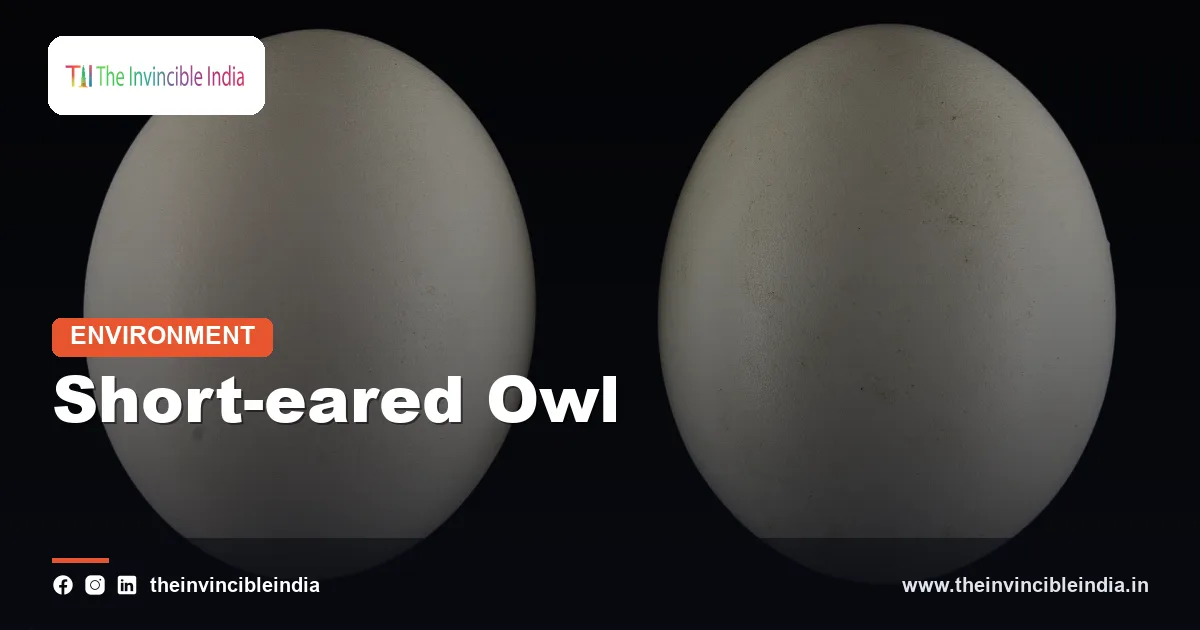
The short-eared owl (Asio flammeus) is a medium-sized, buff-and-brown owl of open country that hunts by day as well as at dusk, and it reaches India mainly as a winter visitor, quartering grasslands, marshes and fallow fields for voles and other small rodents. Unlike most owls, it is often seen flying in daylight, with a buoyant, moth-like flight low over the ground.
The short-eared owl is one of the most widely distributed owls in the world, breeding across the northern hemisphere and parts of South America and many islands. In India it is uncommon and thinly spread, so a sighting is a notable event. This guide explains how to recognise it, where it appears in India, what it eats, how it hunts and breeds, and what threats it faces.
| Feature | Details |
|---|---|
| Common name | Short-eared owl |
| Scientific name | Asio flammeus |
| Family | Strigidae (typical owls), order Strigiformes |
| Size | About 34 to 43 cm long; wingspan roughly 95 to 110 cm; females slightly larger than males |
| Range and habitat in India | Winter visitor, recorded mostly in the north and north-west and in scattered other regions; open grassland, marsh, fallow and stubble fields, scrub and river margins |
| Diet | Voles, mice and other small rodents, with small birds, insects and occasionally frogs |
| Breeding and migration | Breeds on the ground in northern and temperate regions; many northern birds migrate south in winter, some reaching South Asia |
| Conservation status | Least Concern (IUCN); protected under the Wildlife (Protection) Act, 1972 |
Key Takeaways
- The short-eared owl (Asio flammeus) is a ground-nesting owl of open country that reaches India chiefly as a winter visitor from northern breeding grounds.
- Short-eared owls are often active in daylight, flying low over grassland and fields with slow, floppy wingbeats and glides on raised wings.
- The short-eared owl has mottled buff-and-brown plumage, round yellow eyes ringed with dark patches, and tiny ear tufts that are rarely visible.
- The short-eared owl feeds mainly on small rodents such as voles and mice, and its numbers in a region often rise and fall with rodent abundance.
- Short-eared owls nest on the ground, scraping a shallow hollow in grass, which makes eggs and chicks vulnerable to predators and farm machinery on the breeding grounds.
- The IUCN lists the short-eared owl as Least Concern worldwide, though some regional populations have declined because grassland and marshes have been drained or converted.
What Is the Short-eared Owl?
The short-eared owl is a medium-sized owl in the family Strigidae, known scientifically as Asio flammeus, and it is a member of the genus Asio, the eared owls, which also includes the long-eared owl and the African and Madagascar marsh owls. The “ears” are not ears at all, but small feather tufts on the head which may be raised or flattened.
The name “flammeus” is Latin for flame-coloured, a reference to the warm buff and orange tones of the plumage. Several subspecies have been described across the world, including island forms in places such as Hawaii and the Galápagos.
Unlike forest owls, the short-eared owl spends most of its time in open habitats. Its long wings and relatively light body suit continuous slow flight over wide spaces, and it often roosts on the ground in tall grass.
How Can You Identify a Short-eared Owl?
A short-eared owl can be identified by its mottled buff-and-brown plumage, round yellow eyes surrounded by dark patches, a pale facial disc and long, narrow wings with dark wrist marks underneath. In flight it looks long-winged and pale, with a rounded head and short tail.
At rest
When perched on the ground or a low post, the bird looks rounded and streaky, with a pale face and a dark-ringed eye that gives it a fierce look. The tiny ear tufts are often hard to see and are raised only when the bird is alert or alarmed.
In flight
The upper wing shows buff patches near the tips, a dark band along the trailing edge and a contrasting pale-and-dark pattern. Underneath, a black patch at the wrist (carpal patch) stands out against pale wings. The flight is buoyant and tilting, rather like a giant moth or a harrier.
Similar owls
The long-eared owl is more slender, has longer ear tufts and orange eyes, and is a bird of woodland. The barn owl is much paler, with a heart-shaped face and no ear tufts.
Where Does the Short-eared Owl Appear in India?
The short-eared owl appears in India as a winter visitor, mostly in the north and north-west, and in open habitats such as grasslands, wetlands, fallow land, crop stubble and river islands. Records come from scattered places across the country, but the species is never abundant.
Several features of the habitat are important:
- Open ground: short vegetation lets the owl detect movement by sight and sound.
- Rodent supply: grassland and farmland with high numbers of voles, mice and gerbils attract hunting owls.
- Roosting cover: patches of tall grass, reeds or scrub shelter owls during the day.
- Wetland margins: marshes, lake edges and flood plains often hold prey and shelter.
The owl is sometimes seen in protected grasslands and wetlands, such as those in the Indo-Gangetic plain and in the arid and semi-arid regions of the north-west. Winter is the main period, roughly from October to March, though the exact timing varies from year to year.
What Does the Short-eared Owl Eat?
The short-eared owl eats mainly small mammals, especially voles and mice, together with small birds, insects and sometimes frogs and lizards. Rodents are by far its most important prey in most parts of the world.
| Prey group | Examples | Notes |
|---|---|---|
| Small mammals | Voles, mice, gerbils, shrews, young rats | Main food; taken on or near the ground |
| Birds | Larks, pipits, buntings, waders, nestlings | Important when rodents are scarce |
| Insects | Beetles, grasshoppers, large moths | Eaten occasionally, especially in warm weather |
| Other | Frogs, lizards, bats | Taken opportunistically |
Like other owls, the short-eared owl swallows prey whole or in large pieces and later coughs up pellets of undigested fur and bone. Scientists collect and study these pellets to learn what the owl has eaten and how many rodents live in an area.
How Does the Short-eared Owl Hunt?
The short-eared owl hunts by flying slowly and low over open ground, a method called quartering, and dropping onto prey that it detects by sight and by sound. Its flat facial disc channels sound to its ears, helping it locate rodents moving under grass cover.
- Quartering flight: the owl flies back and forth in regular patterns over a field or marsh.
- Hovering and dropping: it briefly hovers or banks, then drops with feet forward to seize prey.
- Dusk and dawn activity: hunting peaks at twilight, though the species also hunts in daylight, especially in winter.
- Perch hunting: the bird may watch from a post or low mound before pouncing.
The owl often hunts in the same habitat as harriers, such as the pied harrier and marsh harrier. Both use similar quartering flight, and the two kinds of raptor sometimes chase each other for prey or hunting space.
How Does the Short-eared Owl Breed?
The short-eared owl breeds on the ground in open country, laying its eggs in a shallow scrape lined with grass, and this occurs mostly in northern temperate and sub-Arctic regions rather than in India. Pairs show spectacular courtship flights in which the male claps his wings together beneath his body.
The main features of breeding include:
- Nest: a shallow depression hidden in tall grass, heather or crops.
- Clutch: commonly four to seven eggs, and larger clutches when food is abundant.
- Parental roles: the female incubates the eggs, and the male hunts for the family.
- Chicks: they leave the nest on foot before they can fly, spreading out in the grass and being fed by the parents.
Clutch sizes and the number of pairs can rise sharply in years when voles are abundant. In poor years, owls may skip breeding or move to other regions, which explains why the species is sometimes called nomadic.
Why Does the Short-eared Owl Come to India?
The short-eared owl comes to India because northern breeding grounds become cold, snow-covered and short of prey in winter, and birds move south to places where small rodents remain available. Not all individuals migrate, and the scale of movement depends on food supply and weather.
The species is a partial and irruptive migrant. In years of rodent shortage, large numbers may move long distances, whereas in good years more birds stay close to their breeding areas. This helps explain why sightings in India can vary from one winter to the next.
Birds reaching India probably come from breeding grounds in Central Asia and northern Eurasia. They are generally solitary or in loose groups, and may use the same wintering sites in successive years if conditions are favourable.
How Is the Short-eared Owl Different from Other Owls?
The short-eared owl differs from most other Indian owls in being active in daylight, living in open grassland and having small ear tufts, yellow eyes and long wings. Many Indian owls are nocturnal, woodland or village birds, so the difference in behaviour is a good clue.
| Species | Approximate length | Habitat | Main field marks |
|---|---|---|---|
| Short-eared owl | 34 to 43 cm | Open grassland, marsh, fallow fields | Streaked buff plumage, yellow eyes, black wrist patches, daytime flight |
| Barn owl | 33 to 39 cm | Farmland, buildings, villages | Pale heart-shaped face, no ear tufts, dark eyes |
| Long-eared owl | 35 to 40 cm | Woodland and scrub | Long ear tufts, orange eyes, slim body |
| Spotted owlet | 20 to 21 cm | Towns, villages, orchards | Small, white-spotted, yellow eyes, no ear tufts |
| Indian eagle-owl | 50 to 56 cm | Rocky scrub, ravines, forest edge | Large, prominent ear tufts, orange eyes |
The barn owl may fly at dusk over similar farmland, but its pale heart-shaped face and white underparts separate it easily. The short-eared owl is more patterned and has a broader, more rounded head with dark eye rings.
Is the Short-eared Owl Threatened?
No, the short-eared owl is not globally threatened and is classed as Least Concern by the IUCN, though it has declined in several regions where grasslands and wetlands have been lost. It is considered thinly distributed and difficult to monitor because of its nomadic habits.
- Grassland loss: conversion to crops, plantations and housing removes hunting and nesting habitat.
- Drainage of wetlands: draining marshes reduces cover and prey.
- Rodenticides and pesticides: poisoned rodents can pass toxins to owls.
- Collisions: roads, wires and fences cause deaths for low-flying birds.
- Nest disturbance: ground-nesting makes eggs and chicks vulnerable to predators, farm machinery and livestock.
The short-eared owl is legally protected in India under the Wildlife (Protection) Act, 1972. Protecting natural grasslands and wetlands is the best way to help this and other open-country wildlife.
How Can You See a Short-eared Owl?
You can see a short-eared owl by visiting open grassland or wetland in winter, particularly in the north and north-west, and watching in the late afternoon and at dusk for a pale owl flying low over the ground. Quiet watching from a vehicle or a distance is best, since the birds are easily disturbed.
- Choose protected grasslands, river islands and wetland edges with plenty of rodents.
- Scan fields and marsh margins from about two hours before sunset.
- Look for a long-winged, moth-like bird with slow wingbeats and dark wrist patches.
- Do not flush roosting owls, because disturbance in winter wastes valuable energy.
- Share records with bird platforms to help track winter distribution.
Bottom Line
The short-eared owl is a long-winged, day-flying owl of open grassland that visits India in winter to hunt voles, mice and small birds. It is globally secure but depends on intact grasslands and wetlands, and it remains a rare and special sighting for Indian birdwatchers.
Frequently Asked Questions
Is the short-eared owl found in India?
Yes, the short-eared owl occurs in India, mainly as a winter visitor. Most records come from the north and north-west, with scattered sightings elsewhere. It prefers open grasslands, marshes and fallow fields.
Why is the short-eared owl active during the day?
The short-eared owl is active in daylight because it hunts open ground where rodents can be seen and heard, and it is not restricted to darkness like many forest owls. It is most active at dawn and dusk, but it is also often seen hunting in the daytime in winter. This flexible schedule helps it find food in cold weather.
What does a short-eared owl eat?
A short-eared owl eats mainly small rodents such as voles, mice and gerbils. It also takes small birds, insects and occasionally frogs. Prey is usually found by flying low and listening for movement.
Where does the short-eared owl nest?
The short-eared owl nests on the ground, in a shallow scrape lined with grass. It does not typically breed in India but in northern temperate and sub-Arctic regions. The female incubates the eggs while the male hunts.
How can you tell a short-eared owl from a barn owl?
A short-eared owl has yellow eyes with dark rings, streaked buff-brown plumage and tiny ear tufts, while a barn owl has a pale heart-shaped face and dark eyes. The short-eared owl also flies in a buoyant, harrier-like way in open grassland. The barn owl is more often found near buildings and farms.
Is the short-eared owl endangered?
No, the short-eared owl is rated Least Concern by the IUCN and is not globally endangered. Some local populations have declined due to the loss of grassland and wetlands. In India it is protected by law.
{“@context”:”https://schema.org”,”@graph”:[{“@type”:”FAQPage”,”mainEntity”:[{“@type”:”Question”,”name”:”Is the short-eared owl found in India?”,”acceptedAnswer”:{“@type”:”Answer”,”text”:”Yes, the short-eared owl occurs in India, mainly as a winter visitor. Most records come from the north and north-west, with scattered sightings elsewhere. It prefers open grasslands, marshes and fallow fields.”}},{“@type”:”Question”,”name”:”Why is the short-eared owl active during the day?”,”acceptedAnswer”:{“@type”:”Answer”,”text”:”The short-eared owl is active in daylight because it hunts open ground where rodents can be seen and heard, and it is not restricted to darkness like many forest owls. It is most active at dawn and dusk, but it is also often seen hunting in the daytime in winter. This flexible schedule helps it find food in cold weather.”}},{“@type”:”Question”,”name”:”What does a short-eared owl eat?”,”acceptedAnswer”:{“@type”:”Answer”,”text”:”A short-eared owl eats mainly small rodents such as voles, mice and gerbils. It also takes small birds, insects and occasionally frogs. Prey is usually found by flying low and listening for movement.”}},{“@type”:”Question”,”name”:”Where does the short-eared owl nest?”,”acceptedAnswer”:{“@type”:”Answer”,”text”:”The short-eared owl nests on the ground, in a shallow scrape lined with grass. It does not typically breed in India but in northern temperate and sub-Arctic regions. The female incubates the eggs while the male hunts.”}},{“@type”:”Question”,”name”:”How can you tell a short-eared owl from a barn owl?”,”acceptedAnswer”:{“@type”:”Answer”,”text”:”A short-eared owl has yellow eyes with dark rings, streaked buff-brown plumage and tiny ear tufts, while a barn owl has a pale heart-shaped face and dark eyes. The short-eared owl also flies in a buoyant, harrier-like way in open grassland. The barn owl is more often found near buildings and farms.”}},{“@type”:”Question”,”name”:”Is the short-eared owl endangered?”,”acceptedAnswer”:{“@type”:”Answer”,”text”:”No, the short-eared owl is rated Least Concern by the IUCN and is not globally endangered. Some local populations have declined due to the loss of grassland and wetlands. In India it is protected by law.”}}]}]}


