

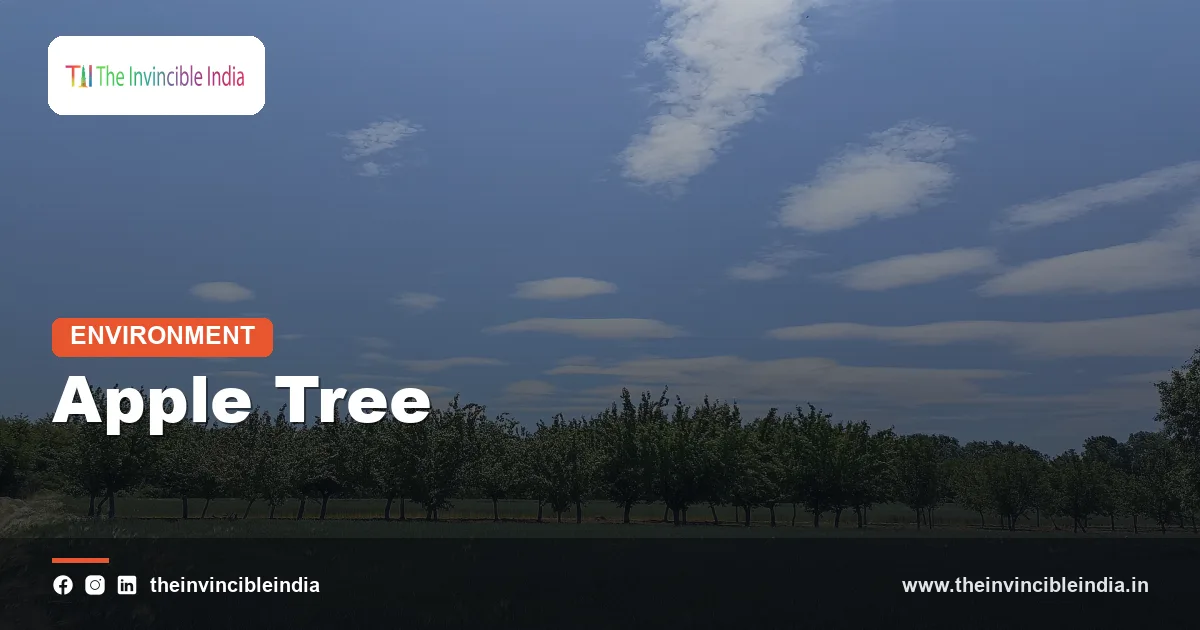
The apple (Malus domestica) is a temperate, deciduous fruit tree of the rose family that is grown in the cool hills of the Indian Himalaya, mainly in Jammu and Kashmir, Himachal Pradesh and Uttarakhand, and prized for its spring blossom and crisp, sweet-tart fruit. The apple tree is India’s most important temperate fruit crop, and orchards of apple trees support the livelihoods of lakhs of hill families.
The apple needs cold winters to flower and fruit well, which is why commercial cultivation in India is confined to mountain slopes at roughly 1,500 to 2,700 metres above sea level. This article explains what an apple tree is, where and how apples are grown in India, the main varieties, the yearly cycle of the orchard, the problems growers face and the many uses of the fruit.
| Quick Fact | Details |
|---|---|
| Common name | Apple (Hindi: seb) |
| Scientific name | Malus domestica |
| Family | Rosaceae (the rose family) |
| Where grown in India | Jammu and Kashmir, Himachal Pradesh, Uttarakhand, and smaller areas of Arunachal Pradesh and Nagaland |
| Growing altitude | Commonly about 1,500 to 2,700 metres above sea level |
| Season | Blossom in March to April; harvest from roughly July to November depending on variety and altitude |
| Fruit | A pome, round to slightly flattened, red, green or yellow, with a crisp, juicy flesh |
| Common varieties | Royal Delicious, Red Delicious, Golden Delicious, Gala, Fuji, Granny Smith, Ambri |
| Uses | Fresh eating, juice, cider, jam, dried slices, vinegar and cooking |
Key Takeaways
- The apple (Malus domestica) is a temperate deciduous fruit tree of the family Rosaceae that is grown commercially in the Indian Himalaya.
- Apple cultivation in India is concentrated in Jammu and Kashmir, Himachal Pradesh and Uttarakhand, with Jammu and Kashmir and Himachal Pradesh producing most of the national crop.
- An apple tree needs a cold winter of roughly 1,000 hours or more below about 7 degrees Celsius to break dormancy and flower normally.
- Most apple varieties cannot fertilise themselves, so orchards plant compatible pollinizer trees and rely on honeybees during the short spring flowering period.
- Apple growing in the Himalaya is exposed to hailstorms, late frost, scab disease and shifting winter temperatures linked to climate change.
- The wild ancestor of the cultivated apple comes from the mountains of Central Asia, and the crop was introduced into the Indian hills as an orchard fruit by planters and missionaries.
What is an apple tree?
An apple tree is a medium-sized, deciduous tree of the genus Malus in the rose family, Rosaceae, grown for its edible fruit. The cultivated apple is classified as Malus domestica, and it belongs to the same plant family as pear, cherry, plum, peach and almond.
The tree loses its leaves in autumn, remains dormant through winter and blooms in spring with clusters of white to pink-tinged flowers. The fruit is botanically a pome, a type of fleshy fruit in which the edible part grows from the swollen flower base around a central core that holds the seeds. Standard seedling trees can reach many metres in height, but modern orchards use dwarfing rootstocks that keep trees small, productive and easy to pick.
The wild ancestor of the cultivated apple is generally traced to the mountains of Central Asia, especially the forests of the Tian Shan region, and the fruit travelled along trade routes over thousands of years before reaching the Himalaya. India also has native wild relatives, such as the Himalayan crab apple, but the large commercial apple varieties are introduced cultivars.
Where is the apple grown in India?
The apple is grown in the cool temperate hills of northern India, with Jammu and Kashmir, Himachal Pradesh and Uttarakhand as the principal producing states. Smaller plantings exist in Arunachal Pradesh and Nagaland, and trial cultivation has appeared in other high-altitude areas.
Jammu and Kashmir, especially the Kashmir Valley districts of Shopian, Pulwama, Baramulla, Anantnag and Kupwara, accounts for the largest share of India’s apple crop. Himachal Pradesh is the second major producer, with apple belts in Shimla, Kullu, Mandi, Kinnaur, Chamba and Lahaul-Spiti. Uttarakhand grows apples in districts such as Uttarkashi, Chamoli and Nainital, on a smaller scale. Exact production figures vary from year to year with weather, so recent government statistics should be consulted for current numbers, but the broad pattern of Jammu and Kashmir and Himachal Pradesh dominating the crop has remained stable.
Why does the apple need the hills?
The apple needs the hills because the tree requires a long, cold winter to break dormancy and flower. Without enough hours of low temperature, buds open unevenly, flowering is weak and fruit set is poor. At very high altitudes, however, spring frost and short growing seasons limit the crop, so the best orchards lie in a middle band of the mountains.
How did the apple come to the Indian hills?
The apple came to the Indian hills through introductions by British officials, orchardists and missionaries in the nineteenth and early twentieth centuries, building on older fruit growing in the Kashmir Valley. Kashmir had grown local apples for a long time, and later introductions of improved European and American varieties transformed the industry.
In Himachal Pradesh, the story of the apple is often linked to Samuel Evans Stokes, an American who settled near Kotgarh in the Shimla hills in the early twentieth century. He is widely credited with introducing the Starking Delicious variety, and his orchard showed hill farmers that apples could pay far better than traditional grain crops. Earlier plantings in the Kullu valley are also attributed to a British officer in the nineteenth century. Over the following decades, state horticulture departments, research stations and cooperatives spread improved varieties and orchard methods.
The result was a profound change in the economy of the hills. In several districts, apple orchards replaced or supplemented subsistence farming, and roads, cold stores, packing units and markets grew up around the crop.
What are the main varieties of apple grown in India?
The main apple varieties grown in India are Royal Delicious, Red Delicious, Golden Delicious and related red strains, with newer varieties such as Gala, Fuji and Granny Smith spreading in modern orchards. Traditional local types such as Ambri remain valued in Kashmir for their flavour.
| Variety | Fruit character | Notes |
|---|---|---|
| Royal Delicious | Deep red, sweet, firm | Long a leading commercial variety in the Himalayan states |
| Red Delicious and Starking strains | Bright red with a tapered shape | Introduced widely in Himachal; many spur-type strains exist |
| Golden Delicious | Yellow-green, sweet | Commonly used as a pollinizer for red varieties |
| Gala and Fuji | Red-striped, very sweet, crisp | Increasingly used in high-density orchards |
| Granny Smith | Green, tart | Keeps well and suits cooking |
| Ambri | Aromatic, sweet-tart, medium size | Traditional Kashmir variety known for flavour |
Varieties are chosen according to altitude, chilling hours, disease resistance, market demand and storage life. Many modern plantings use compact “spur-type” strains that fruit heavily on short branches, which suits dense planting systems.
What is the yearly cycle of an apple orchard?
The yearly cycle of an apple orchard follows the seasons: winter dormancy, spring flowering, summer fruit growth and an autumn harvest. Each stage needs specific care from the grower, and the timing shifts with altitude, so lower orchards flower and ripen earlier than higher ones.
- Winter (December to February): Trees are dormant. Growers prune the branches, apply dormant sprays and add manure. Cold hours accumulate during this period.
- Spring (March to April): Buds break and trees flower. Bees move through the blossom and pollination takes place. Orchardists watch carefully for frost and hail.
- Summer (May to July): Fruit sets and grows. Growers thin extra fruitlets, spray against disease and pests, and irrigate where needed.
- Late summer and autumn (July to November): Early varieties are picked from about July or August, while later varieties are picked through September and October. Fruit is graded, packed in cartons or boxes and sent to markets or cold stores.
- Late autumn: Leaves turn and fall, and the tree prepares for dormancy again.
How is the apple pollinated?
The apple is pollinated mainly by bees, because most apple varieties are self-incompatible and need pollen from a different, compatible variety to set fruit. Orchard planning therefore includes planting a pollinizer variety, such as Golden Delicious or a flowering crab apple, among the main commercial trees.
The flowering window of an apple tree lasts only about one to two weeks, so growers often keep honeybee colonies in the orchard during bloom. Cold, wet or windy weather at that time limits bee flight and can reduce the crop. The need for reliable pollination is one reason why both beekeeping and the protection of wild pollinators are important to hill horticulture.
What problems do apple growers face?
Apple growers face weather risks, diseases, pests and market difficulties, and the most serious weather risks are hailstorms, late spring frost and unseasonal warmth in winter. These hazards can reduce yield and fruit quality in a single day.
- Hailstorms: Hail damages fruit skin and branches in late spring and summer, and growers use hail nets in many orchards.
- Apple scab: A fungal disease caused by Venturia inaequalis that produces dark spots on leaves and fruit, especially in wet seasons.
- Other diseases and pests: Marssonina blotch, powdery mildew, woolly apple aphid, mites and codling moth can reduce yield if unmanaged.
- Insufficient chilling: Warmer winters reduce chilling hours, which can lead to poor flowering in lower orchards.
- Transport and storage: Mountain roads can be blocked by landslides or snow, delaying fruit reaching markets. Cold stores and controlled-atmosphere stores help extend the selling period.
Because of these pressures, research institutions in the hill states have promoted disease-resistant varieties, integrated pest management, drip irrigation and high-density planting on dwarfing rootstocks.
How is climate change affecting the apple?
Climate change is affecting the apple in India by shortening winter chill, shifting flowering dates and moving the best growing zone to higher altitudes. Orchardists in several hill districts report that apple belts have extended upward into areas such as Kinnaur and Lahaul-Spiti, while some lower orchards struggle with warming.
The shift brings both opportunity and risk. Higher-altitude land may become suitable for apple, but it often lies in fragile terrain, and moving orchards uphill involves new investment and can change land use. Researchers study low-chill varieties, better rootstocks and improved water management to help growers adapt. Because the apple economy supports many families, adaptation is an important topic for regional planning.
What are the uses of the apple?
The apple is used mainly as a fresh fruit, and it is also processed into juice, concentrate, cider, jam, jelly, dried slices and vinegar. Its firm flesh allows it to be stored for months in cold storage, so apples reach city markets well beyond the harvest season.
Fruit that is too small or blemished for the fresh market is often diverted to processing units, which make juice and concentrate. In the kitchen, apples are eaten raw, stewed, baked into pies and cakes, and added to chutneys and salads. The fruit contains dietary fibre and vitamin C, and it forms a regular part of a balanced diet, though it is not a medicine. The wood of old apple trees is used in small quantities for fuel and for carving, and the orchards themselves draw tourists to the hills during blossom and harvest seasons.
How are apples stored and marketed?
Apples are stored in cold stores and controlled-atmosphere stores after harvest, and they are marketed through wholesale mandis, auctions and direct sales to traders in the large cities of northern India. Unlike cherries, apples keep for months when held at low temperature, which lets growers sell over a longer season.
After picking, fruit is sorted by size, colour and freshness, and the best grade is packed in cartons or wooden boxes. Cartons have largely replaced older wooden crates in many areas because they protect the fruit better in transit. Fruit is then carried down the mountain roads by truck to wholesale markets such as those in Delhi, Chandigarh and other regional centres, and the arrival of trucks in the market is a familiar sight during the autumn season.
- Grading: Apples are sorted into grades by size, colour and surface quality, and higher grades fetch higher prices.
- Packing: Cartons with trays or cushioning prevent bruising on rough hill roads.
- Cold storage: Low-temperature storage slows ripening and allows sales after the harvest peak.
- Processing: Windfalls and low-grade fruit go to juice, concentrate and cider units.
Prices fluctuate with the size of the harvest, the condition of roads and competition from imported apples. For this reason, grower organisations, cooperatives and state agencies play a role in marketing, storage and the promotion of Indian apples.
Bottom Line
The apple is the signature fruit of the Indian Himalaya, grown on cool slopes in Jammu and Kashmir, Himachal Pradesh and Uttarakhand. It depends on cold winters, careful pollination and good road and storage links, and it faces rising weather and climate pressure.
Frequently Asked Questions
Which Indian state produces the most apples?
Jammu and Kashmir generally produces the largest share of India’s apples, followed by Himachal Pradesh and Uttarakhand. Exact quantities change each year with weather, so recent government horticulture data should be checked for current figures.
At what altitude does the apple grow best in India?
The apple grows best in India at about 1,500 to 2,700 metres above sea level, where winters are cold enough to give the tree sufficient chilling. Lower sites often receive too little cold, while very high sites risk spring frost and a short growing season.
When is the apple harvest season in India?
The apple harvest season in India runs roughly from July to November, depending on variety and altitude. Early varieties ripen first at lower elevations, while main-crop types such as Royal Delicious and Red Delicious are mostly picked in September and October.
Can an apple tree grow in the plains of India?
Standard apple varieties cannot normally fruit well in the plains of India because the winters are too warm to meet the tree’s chilling requirement. Some low-chill varieties have been tried in warmer areas with limited success, but commercial production remains confined to the hills.
Who introduced the apple to Himachal Pradesh?
Samuel Evans Stokes, an American who settled near Kotgarh in the Shimla hills in the early twentieth century, is widely credited with popularising the commercial apple in Himachal Pradesh, notably the Starking Delicious variety. Earlier plantings by British officials in the Kullu valley also contributed to the spread of apple growing.
Why do apple orchards need bees?
Apple orchards need bees because most apple varieties are self-incompatible and require cross-pollination from a different variety. Bees carry pollen between flowers during the short bloom period of one to two weeks, and good pollination leads to better fruit set and larger, more even apples.
{“@context”:”https://schema.org”,”@graph”:[{“@type”:”FAQPage”,”mainEntity”:[{“@type”:”Question”,”name”:”Which Indian state produces the most apples?”,”acceptedAnswer”:{“@type”:”Answer”,”text”:”Jammu and Kashmir generally produces the largest share of India’s apples, followed by Himachal Pradesh and Uttarakhand. Exact quantities change each year with weather, so recent government horticulture data should be checked for current figures.”}},{“@type”:”Question”,”name”:”At what altitude does the apple grow best in India?”,”acceptedAnswer”:{“@type”:”Answer”,”text”:”The apple grows best in India at about 1,500 to 2,700 metres above sea level, where winters are cold enough to give the tree sufficient chilling. Lower sites often receive too little cold, while very high sites risk spring frost and a short growing season.”}},{“@type”:”Question”,”name”:”When is the apple harvest season in India?”,”acceptedAnswer”:{“@type”:”Answer”,”text”:”The apple harvest season in India runs roughly from July to November, depending on variety and altitude. Early varieties ripen first at lower elevations, while main-crop types such as Royal Delicious and Red Delicious are mostly picked in September and October.”}},{“@type”:”Question”,”name”:”Can an apple tree grow in the plains of India?”,”acceptedAnswer”:{“@type”:”Answer”,”text”:”Standard apple varieties cannot normally fruit well in the plains of India because the winters are too warm to meet the tree’s chilling requirement. Some low-chill varieties have been tried in warmer areas with limited success, but commercial production remains confined to the hills.”}},{“@type”:”Question”,”name”:”Who introduced the apple to Himachal Pradesh?”,”acceptedAnswer”:{“@type”:”Answer”,”text”:”Samuel Evans Stokes, an American who settled near Kotgarh in the Shimla hills in the early twentieth century, is widely credited with popularising the commercial apple in Himachal Pradesh, notably the Starking Delicious variety. Earlier plantings by British officials in the Kullu valley also contributed to the spread of apple growing.”}},{“@type”:”Question”,”name”:”Why do apple orchards need bees?”,”acceptedAnswer”:{“@type”:”Answer”,”text”:”Apple orchards need bees because most apple varieties are self-incompatible and require cross-pollination from a different variety. Bees carry pollen between flowers during the short bloom period of one to two weeks, and good pollination leads to better fruit set and larger, more even apples.”}}]}]}


