

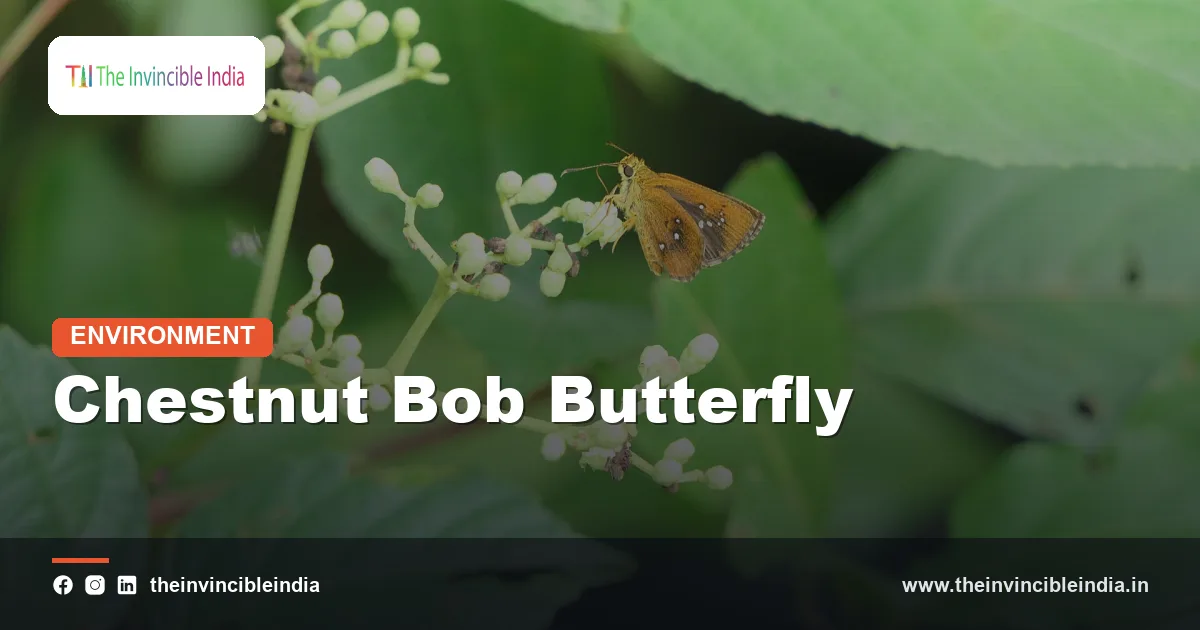
The chestnut bob (Iambrix salsala) is a small, fast-flying brown skipper butterfly of the family Hesperiidae, found in Indian gardens, forest edges and bamboo or grass thickets, where its caterpillars fold leaves into silk-bound shelters. It is named for the warm chestnut tone of its underside, and it is one of the many skippers that are easy to overlook because they are plain, quick and fond of shade. Its stout body, darting flight and hooked antennae set it apart from the more familiar swallowtails, whites and blues.
This article explains what the chestnut bob is, why skippers are placed in their own family, how to recognise this species, where it lives in India, how its caterpillars build and use leaf shelters and how it differs from other small brown skippers. It is written for beginners and gardeners who want stable, reliable information.
| Common name | Chestnut bob |
|---|---|
| Scientific name | Iambrix salsala |
| Family and subfamily | Hesperiidae (skippers), subfamily Hesperiinae (the grass skippers) |
| Wingspan | Roughly 3 to 4 cm, a small to medium skipper |
| Larval host plants | Grasses and bamboos (family Poaceae); records vary by region |
| Range and habitat in India | Peninsular India including the Western Ghats, and the Himalayan foothills eastward to the north-east; gardens, moist wooded country, forest edges and bamboo or grassy thickets |
| Flight season and broods | Flies for much of the year in warm regions, with several broods and more adults in and after the monsoon |
| Notable features | Dark brown above with small pale spots, chestnut-brown underside, darting flight, hooked antenna tips and leaf-folding caterpillars |
Key Takeaways
- The chestnut bob, scientific name Iambrix salsala, is a small brown skipper butterfly in the family Hesperiidae with a wingspan of roughly 3 to 4 cm.
- The chestnut bob is named for the chestnut-brown colour of its underside, which contrasts with its dark brown upperside and small pale spots.
- Chestnut bob caterpillars feed on grasses and bamboos and live inside shelters made by folding or rolling leaves with silk.
- The chestnut bob is found in India in gardens, moist forest edges and bamboo or grassy thickets, especially in the Western Ghats, the foothills of the Himalaya and the north-east.
- Skippers such as the chestnut bob are placed in the family Hesperiidae because they have stout bodies, large heads and antennae that end in a hooked tip.
- The chestnut bob is a fast, darting flier that often rests in shade, which makes it more often glimpsed than studied.
What is the chestnut bob butterfly?
The chestnut bob butterfly is a small skipper, a member of the family Hesperiidae, whose scientific name is Iambrix salsala. It belongs to the subfamily Hesperiinae, often called the grass skippers, because most of its relatives have caterpillars that feed on grasses and similar plants.
The common name “chestnut bob” combines a colour, chestnut, with the word “bob”, which is used in English names for several small skippers in the region. The colour refers to the rich brown seen on the underside of the hindwing, which can look almost reddish in good light.
Like other skippers, the chestnut bob is a butterfly of the edges: forest edges, garden borders, path margins and the fringes of bamboo clumps. It is rarely seen far from its host plants, and it is more likely to be noticed as a quick brown blur than as a distinct pattern.
Why is the chestnut bob called a skipper?
The chestnut bob is called a skipper because skippers fly with quick, darting, skipping movements, and they form a separate butterfly family, Hesperiidae, distinct from swallowtails, whites, blues and brush-footed butterflies. The name describes the way the butterfly seems to skip from one perch to the next.
Skippers differ from other butterflies in several ways. They have a stout, moth-like body, a relatively large head, strong flight muscles and widely spaced antennae whose club ends in a small hook, called an apiculus. Their caterpillars usually live inside shelters made of leaves bound with silk. Many skippers rest with the forewings held at a different angle from the hindwings, which gives them a jet-like profile.
Skippers are sometimes described as intermediate between butterflies and moths, but they are true butterflies. Hesperiidae is one of the major butterfly families, and India has many species in it, including grass skippers, awls, flats and palm darts.
How can you identify a chestnut bob?
A chestnut bob can be identified by its small size, a dark brown upperside with small pale spots on the forewing, a chestnut-brown underside with small pale markings, and its fast, darting flight. The stout body and hooked antenna tips confirm that it is a skipper.
Upperside
The upperside is dark brown, with small, pale, semi-transparent spots on the forewing. The hindwing is plainer. The pattern is subtle, and the butterfly is often seen with its wings only partly open.
Underside
The underside is the more helpful view. It is a warm chestnut or rufous brown, and small pale spots show on the forewing and the hindwing. The colour is richer and more reddish than the dull brown of many other skippers.
Behaviour as a clue
The chestnut bob flies quickly and unpredictably, often stopping on the upper surface of a leaf and then darting away again. When perched, it frequently keeps its wings half open, with the forewings raised a little above the hindwings, a posture common among grass skippers.
Where does the chestnut bob live in India?
The chestnut bob lives in peninsular India, including the Western Ghats, and in the Himalayan foothills eastward into the north-east, usually in moist, wooded or semi-wooded country with bamboo or tall grass. It is found in forest edges, shaded paths, plantations and well-planted gardens.
Within these regions, the species is associated with places where grasses and bamboos grow in partial shade rather than in open, dry ground. It may be seen along roadside edges in hill country, in coffee and tea estates with bamboo clumps, and in suburban gardens that have clumps of bamboo or ornamental grasses.
Because skippers generally have good flight power, individuals can wander a little from their home patches, but breeding colonies depend on the presence of host plants. Where bamboo clumps are cleared, local populations may disappear.
What do chestnut bob caterpillars eat and how do they build shelters?
Chestnut bob caterpillars eat the leaves of grasses and bamboos, and they live inside shelters that they make by folding or rolling a leaf and fastening it with silk. The shelter protects the caterpillar from sun, rain and predators, and the caterpillar comes out mainly to feed.
The process begins soon after the egg hatches. The tiny caterpillar cuts and folds a section of a leaf blade, binding the edges with silk threads. As the caterpillar grows, it makes larger shelters, and it may rebuild several times. The head of a skipper caterpillar is large compared with its narrow neck, which helps in recognising it.
Host-plant records vary in detail by region, and observers have noted bamboo species and several kinds of grasses. This flexibility within the family Poaceae is common for grass skippers, and it helps explain why the butterfly can live in gardens that have ornamental grasses or bamboo hedges.
How does the chestnut bob life cycle work?
The chestnut bob passes through four stages, egg, caterpillar, pupa and adult, and in warm regions the whole cycle takes roughly a month or a little more. Several broods overlap in a year, and the number of adults is highest in and after the monsoon, when grasses and bamboo shoots are fresh.
| Stage | What happens |
|---|---|
| Egg | A small, rounded egg is laid singly on a blade of grass or bamboo leaf |
| Caterpillar | The caterpillar lives in a folded or rolled leaf shelter, feeds on leaf tissue and moults several times |
| Pupa | The caterpillar pupates inside a silk-lined leaf shelter, where it is hidden from view |
| Adult | The butterfly emerges, feeds on nectar, mates and lays eggs on new host-plant growth |
Because the early stages stay hidden in shelters, many gardeners have butterflies of this kind without ever seeing the caterpillar. A closer look at rolled leaf blades on bamboo and grasses, especially after rain, can reveal the shelters.
How does the chestnut bob behave?
The chestnut bob behaves like many grass skippers: it flies fast and low, rests on leaves in shade or dappled light, and visits flowers for nectar. It is more active in the warmer part of the morning and again in the late afternoon, and it may disappear into shade at midday.
Males commonly choose a perch on a leaf and defend it, darting out to chase other insects that pass by before returning to the same spot. This is a common strategy in skippers, and it explains why a watcher who sees a skipper dart away and come back is often seeing a male on territory.
Adults feed on nectar from small flowers, and they sometimes sip moisture from damp ground or bird droppings. They tend to be wary but are predictable: if one is disturbed, waiting quietly near the same perch usually brings it back within a few minutes.
How is the chestnut bob different from other small brown skippers?
The chestnut bob differs from other small brown skippers chiefly in the warm chestnut colour of its underside and its small pale spots. Several other brown skippers share the same gardens and forest edges, so careful comparison is needed.
| Butterfly | Key difference from the chestnut bob |
|---|---|
| Indian palm bob (Suastus gremius) | A related “bob” with whitish spots on the hindwing underside; its caterpillars feed on palms |
| Restricted demon (Notocrypta curvifascia) | Larger, with a bold white band across the forewing |
| Grass demon (Udaspes folus) | Dark brown with white patches, and a plain look from above |
| Rice swift (Borbo cinnara) | Paler and plainer, usually found in open grassy ground |
| Common banded awl (Hasora chromus) | Larger, with a pale band on the underside of the hindwing |
The best approach is to observe the underside colour and the placement of spots, and to check the habitat. Skippers are hard even for experts, so photographs with the wings both open and closed are valuable.
How can you find and photograph a chestnut bob?
You can find a chestnut bob by checking the shaded edges of gardens, paths and bamboo clumps in the morning and late afternoon. The butterfly often returns to the same leaf perch, so patience usually pays.
- Search near bamboo clumps, tall grasses and the shaded margins of garden beds.
- Stand still near a favoured perch and wait for the butterfly to return.
- Take photographs with the wings closed and, if possible, half open, to show both the chestnut underside and the spotted upperside.
- Look for rolled or folded grass and bamboo leaves, which may hold caterpillars or pupae.
- Avoid cutting bamboo or ornamental grass clumps during the monsoon, when breeding is at its peak.
A fast shutter speed helps, since skippers move abruptly. Early morning light also tends to produce better colour for the chestnut tones on the underside.
Is the chestnut bob threatened?
The chestnut bob is not generally considered threatened, although local populations depend on the survival of bamboo and grass cover in moist, wooded areas. Habitat clearing, over-tidy gardening and heavy pesticide use are the main local pressures.
Because the species is small and plain, it receives less attention than showy butterflies, and long-term data are limited. Citizen-science records of dates and places are therefore valuable. Skippers as a group also act as quiet indicators of healthy edge habitats, since they need both grasses for caterpillars and flowers for adults.
Gardeners can support skippers without special effort. Letting a corner of lawn grow long, keeping a bamboo clump or two, and avoiding spraying on grasses all help. Skippers also visit small flowers such as lantana, ixora and basil, so a garden with a mix of grass cover and flowering shrubs can sustain both the caterpillars and the adults.
It is worth remembering that skipper identification is a skill built over many seasons. Even experienced naturalists often leave a skipper unidentified when a clear photograph is missing. Recording the habitat, the host plant nearby and the date can be as useful as the species name itself, and it prevents wrong records from entering public databases.
Bottom Line
The chestnut bob is a small, quick brown skipper whose chestnut underside and leaf-folding caterpillars make it a good entry point to a large and often neglected butterfly family. Leaving clumps of bamboo and grass in a garden is a simple way to support it.
Frequently Asked Questions
What is the scientific name of the chestnut bob butterfly?
The scientific name of the chestnut bob butterfly is Iambrix salsala. It belongs to the family Hesperiidae, the skippers, and the subfamily Hesperiinae. It is a small brown butterfly with a chestnut-coloured underside.
Why is the chestnut bob called a skipper?
The chestnut bob is called a skipper because it flies with quick, darting movements and belongs to the butterfly family Hesperiidae. Skippers have stout bodies, large heads and antennae with hooked tips. Their caterpillars usually live in shelters made from leaves.
What do chestnut bob caterpillars eat?
Chestnut bob caterpillars eat the leaves of grasses and bamboos, which belong to the family Poaceae. They live inside leaf shelters that they fold or roll and fasten with silk. They come out mainly to feed and are rarely seen.
Where is the chestnut bob found in India?
The chestnut bob is found in peninsular India, including the Western Ghats, and in the Himalayan foothills eastward into the north-east. It lives in gardens, forest edges and bamboo or grassy thickets with some shade. It is usually seen near its host plants.
How big is a chestnut bob butterfly?
A chestnut bob butterfly has a wingspan of roughly 3 to 4 cm, which makes it a small to medium skipper. Its upperside is dark brown with small pale spots. The underside is a warm chestnut brown.
How can I tell a chestnut bob from other brown skippers?
You can tell a chestnut bob from other brown skippers mainly by the warm chestnut colour of its underside and the small pale spots on its wings. Other skippers may be duller, paler or marked with bold white bands. Photographs of both the upperside and underside help to confirm the identification.
{“@context”:”https://schema.org”,”@graph”:[{“@type”:”FAQPage”,”mainEntity”:[{“@type”:”Question”,”name”:”What is the scientific name of the chestnut bob butterfly?”,”acceptedAnswer”:{“@type”:”Answer”,”text”:”The scientific name of the chestnut bob butterfly is Iambrix salsala. It belongs to the family Hesperiidae, the skippers, and the subfamily Hesperiinae. It is a small brown butterfly with a chestnut-coloured underside.”}},{“@type”:”Question”,”name”:”Why is the chestnut bob called a skipper?”,”acceptedAnswer”:{“@type”:”Answer”,”text”:”The chestnut bob is called a skipper because it flies with quick, darting movements and belongs to the butterfly family Hesperiidae. Skippers have stout bodies, large heads and antennae with hooked tips. Their caterpillars usually live in shelters made from leaves.”}},{“@type”:”Question”,”name”:”What do chestnut bob caterpillars eat?”,”acceptedAnswer”:{“@type”:”Answer”,”text”:”Chestnut bob caterpillars eat the leaves of grasses and bamboos, which belong to the family Poaceae. They live inside leaf shelters that they fold or roll and fasten with silk. They come out mainly to feed and are rarely seen.”}},{“@type”:”Question”,”name”:”Where is the chestnut bob found in India?”,”acceptedAnswer”:{“@type”:”Answer”,”text”:”The chestnut bob is found in peninsular India, including the Western Ghats, and in the Himalayan foothills eastward into the north-east. It lives in gardens, forest edges and bamboo or grassy thickets with some shade. It is usually seen near its host plants.”}},{“@type”:”Question”,”name”:”How big is a chestnut bob butterfly?”,”acceptedAnswer”:{“@type”:”Answer”,”text”:”A chestnut bob butterfly has a wingspan of roughly 3 to 4 cm, which makes it a small to medium skipper. Its upperside is dark brown with small pale spots. The underside is a warm chestnut brown.”}},{“@type”:”Question”,”name”:”How can I tell a chestnut bob from other brown skippers?”,”acceptedAnswer”:{“@type”:”Answer”,”text”:”You can tell a chestnut bob from other brown skippers mainly by the warm chestnut colour of its underside and the small pale spots on its wings. Other skippers may be duller, paler or marked with bold white bands. Photographs of both the upperside and underside help to confirm the identification.”}}]}]}


