

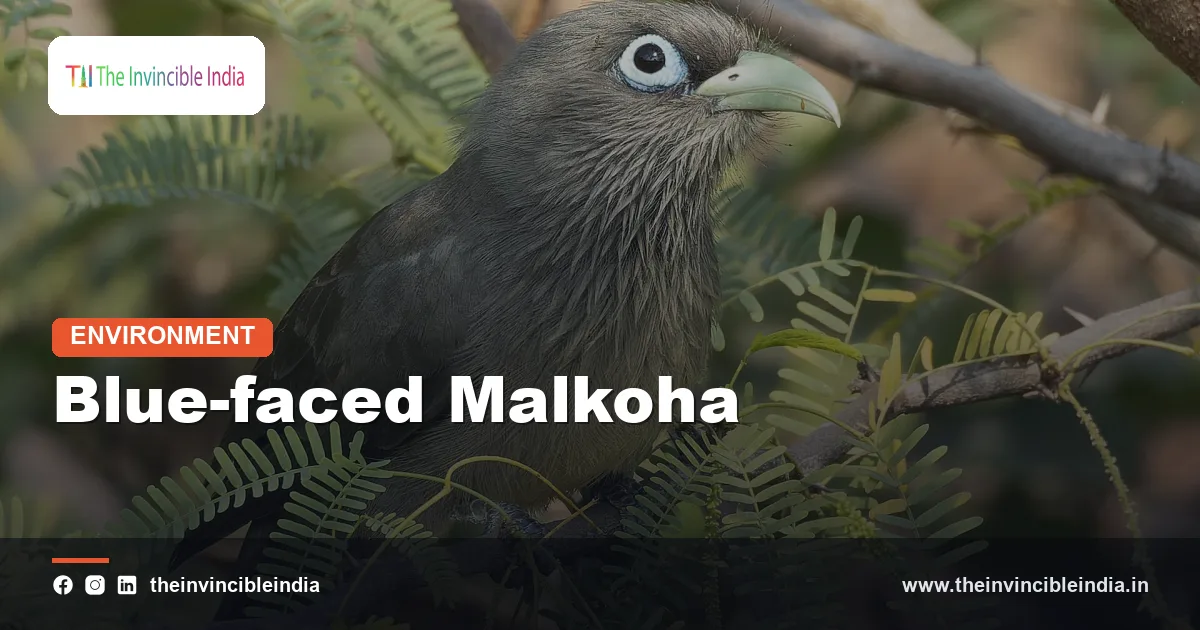
The blue-faced malkoha (Phaenicophaeus viridirostris) is a long-tailed, secretive member of the cuckoo family that lives in the scrub and dry forests of peninsular India and Sri Lanka, recognised by its pale green bill and the bare bluish skin around its eyes. Unlike the better-known koel and the common hawk-cuckoo, the blue-faced malkoha builds its own nest and raises its own young rather than laying eggs in the nests of other birds.
The blue-faced malkoha is easy to miss because it creeps through dense thorny thickets and rarely sits in the open for long. Understanding its looks, habits and habitat explains why this unusual cuckoo relative is more often heard rustling in the undergrowth than seen.
| Quick Fact | Details |
|---|---|
| Common name | Blue-faced malkoha (also called the small green-billed malkoha) |
| Scientific name | Phaenicophaeus viridirostris |
| Family | Cuculidae (cuckoos, coucals and malkohas), order Cuculiformes |
| Size | About 39 cm from bill to tail tip, with the tail making up more than half the length |
| Range and habitat in India | Scrub jungle, thorn forest, dry deciduous forest and thickets across peninsular India, and also Sri Lanka |
| Diet | Insects, caterpillars, grasshoppers, small lizards and occasionally fruit |
| Breeding | Not a brood parasite; builds a twig platform nest in a thorny bush and lays about two to three white eggs |
| Conservation status | Least Concern on the IUCN Red List; a resident species |
Key Takeaways
- The blue-faced malkoha is a long-tailed cuckoo relative that lives in the scrub and dry forests of peninsular India and Sri Lanka.
- Blue-faced malkoha adults have a pale green bill, a patch of bare bluish skin around the eye and a long tail tipped with white.
- The blue-faced malkoha is not a brood parasite, so each pair builds a nest, incubates the eggs and feeds the young.
- Blue-faced malkoha feed mostly on insects and caterpillars, along with lizards and occasional fruit, which makes the bird a useful natural pest controller.
- The blue-faced malkoha is shy and moves by clambering and gliding through dense branches rather than flying in the open.
- The blue-faced malkoha is listed as Least Concern, but clearing of thorn scrub and dense thickets can reduce local populations.
What is the blue-faced malkoha?
The blue-faced malkoha is a large, slim, long-tailed bird in the cuckoo family that lives in dry scrub and forest in southern Asia. It belongs to a group called malkohas, which are non-parasitic cuckoos that behave more like skulking, tree-dwelling insect hunters than like the familiar calling cuckoos.
The word malkoha comes from the Sinhalese language of Sri Lanka, where it is used for these birds. The species name viridirostris is Latin and means green-billed, a direct reference to the pale green bill. The bird is sometimes called the small green-billed malkoha, to distinguish it from larger green-billed relatives in other regions.
In build, the blue-faced malkoha is slender and elongated, with a long, graduated tail that it often holds low and cocked as it moves. Its sexes look alike, so males and females cannot easily be told apart in the field.
What does a blue-faced malkoha look like?
A blue-faced malkoha has grey-green upperparts, whitish or pale grey underparts, a pale green bill, a patch of bluish bare skin around the eye, and a long dark tail with broad white tips on each feather. The overall impression is of a sleek, greyish-green bird with a large, drooping tail.
Key identification features
- A thick, slightly curved, pale green or yellowish-green bill.
- Bare skin around the eye, bluish and noticeable at close range.
- A long, graduated tail with white tips to the outer feathers, often visible as a row of white spots from below.
- Dark upperparts with a glossy green-grey sheen in good light.
- A whitish or pale grey throat and breast fading to buffy-grey underparts.
Feet and posture
Like other cuckoos, the blue-faced malkoha has zygodactyl feet, with two toes pointing forward and two backward. This arrangement gives a strong grip on twigs and helps the bird climb through thickets. The bird often perches horizontally with the tail hanging down and runs along branches rather than hopping in the way smaller songbirds do.
Where is the blue-faced malkoha found in India?
The blue-faced malkoha is found across peninsular India, mainly in the southern and central parts of the peninsula, and also in Sri Lanka. It is a resident bird, staying in the same region through the year, and it does not undertake long seasonal migrations.
The species is closely tied to drier landscapes. It occurs from the plains of the Deccan to the Eastern Ghats and the rain-shadow regions of the southern states. It is generally absent from the wet evergreen forests of the high Western Ghats, and it is not found in the Himalayas or the north-east.
Its distribution is patchy, because the bird needs dense thorny cover. A good thicket in a dry district may hold a pair or two, while a neighbouring open field has none. Local distribution can shift when scrub is cleared or when it regrows on abandoned land.
What habitat does the blue-faced malkoha prefer?
The blue-faced malkoha prefers dense scrub, thorn forest and dry deciduous woodland with a tangled understorey. It likes places where thick bushes provide cover and where trees offer shaded branches for foraging and nesting.
The kinds of places where it is regularly reported include:
- Scrub jungle and thorn thickets made up of acacia, Zizyphus and Prosopis species.
- Dry deciduous forest with a shrubby understorey.
- Rocky hillsides and ravines with dense bushes.
- Thickets along streams and tanks in dry districts.
- Overgrown orchards, plantations and abandoned farmland with a cover of bushes.
Dense cover is essential. The blue-faced malkoha is not a bird of open grassland or bare ground, and it rarely flies far across open spaces. It stays close to the safety of branches and leaves, using the canopy of low trees and bushes as its main highway.
How does the blue-faced malkoha behave?
The blue-faced malkoha is a shy and stealthy bird that moves through foliage by creeping, clambering and short gliding flights, usually keeping to the interior of thickets. It is most often seen alone or in pairs, and it is quiet and unobtrusive for much of the day.
Movement
The bird travels in a characteristic way. It hops and runs along branches, climbs up through a bush, and then glides down to the base of the next one with spread wings and tail. Its flight is weak and brief, and it seldom crosses wide gaps. This habit of moving from tree to tree by gliding gives it a distinctive silhouette, with the long tail trailing behind.
Time of day
The blue-faced malkoha is active in the early morning and late afternoon, and it often sits quietly in shaded cover during the hottest hours. It may sun itself in the open for a few minutes after cool nights or rain, a habit shared with some other cuckoos.
Voice
The voice of the blue-faced malkoha is a series of low, hoarse, croaking or clucking notes, rather than the musical calls of better-known cuckoos. Birdwatchers often detect the bird by these notes or by the rustle of its movement in dry leaves.
What does the blue-faced malkoha eat?
The blue-faced malkoha eats mainly insects and their larvae, especially caterpillars and grasshoppers, and it also takes small lizards, spiders and occasional fruit. It is primarily a hunter of invertebrates and small reptiles, which it finds by searching leaves, twigs and the lower parts of bushes.
Hairy caterpillars, which many birds avoid, are a favourite food of many cuckoos and malkohas, and the blue-faced malkoha is no exception. It also snatches grasshoppers and other large insects, and it will take geckos and small skinks from tree trunks or bushes when it finds them.
By consuming large numbers of caterpillars and grasshoppers, the blue-faced malkoha helps to limit leaf damage in dry-country trees and in farm edges. This role, though modest for a single bird, adds up across the large areas of scrub the species inhabits.
How does the blue-faced malkoha breed?
The blue-faced malkoha builds its own nest, usually a loose platform of twigs placed in a thorny bush or low tree, and lays about two to three white eggs. It is not a brood parasite, which sets it apart from many other members of the cuckoo family in India.
The breeding season is generally linked to the rains, when insect food is abundant, although it can vary with region. Both parents are thought to share nest-building, incubation and the feeding of the chicks. The nest is often well hidden in dense foliage or thorny branches, which makes it hard for predators and for observers to find.
Most of the cuckoo family are known for parasitising other birds, so the nesting habit of the malkohas is an important reminder that the family contains several lifestyles. The following table compares the blue-faced malkoha with two other cuckoo relatives often seen in India.
| Feature | Blue-faced malkoha | Sirkeer malkoha | Asian koel |
|---|---|---|---|
| Scientific name | Phaenicophaeus viridirostris | Taccocua leschenaultii | Eudynamys scolopaceus |
| Nesting habit | Builds its own nest | Builds its own nest | Brood parasite |
| Bill colour | Pale green | Bright red with a yellow tip | Pale greenish |
| Habitat | Dense scrub and dry forest | Scrub, dry forest and farmland edges | Gardens, groves and towns |
| Behaviour | Skulking, solitary or in pairs | Skulking, often runs on the ground | Noisy, conspicuous |
Is the blue-faced malkoha a brood parasite?
No, the blue-faced malkoha is not a brood parasite, because it builds its own nest and raises its own chicks. In this respect it differs from the Asian koel, the common hawk-cuckoo and many other Indian cuckoos, which lay their eggs in the nests of other species.
Biologists classify the malkohas, coucals and ground cuckoos as non-parasitic cuckoos. Only some branches of the cuckoo family evolved the habit of laying eggs in other birds’ nests. The malkohas belong to the group that kept the more ordinary habit of building a nest and rearing young.
This distinction is useful for identification and for understanding bird behaviour. If you see a long-tailed, greenish cuckoo-like bird creeping through a thorny bush with nesting material, it is much more likely to be a malkoha than a parasitic cuckoo.
What is the conservation status of the blue-faced malkoha?
The blue-faced malkoha is listed as Least Concern on the IUCN Red List, which means that it is not currently considered threatened with extinction. It remains fairly widespread across the dry regions of peninsular India and Sri Lanka.
Several pressures could reduce local numbers, however:
- Clearing of thorn scrub and dry forest for agriculture, housing and infrastructure.
- Removal of dense thickets and hedgerows from farmland.
- Heavy pesticide use that reduces the insect food supply.
- Fires and overgrazing that degrade the shrubby understorey the bird needs.
In India, the blue-faced malkoha is covered by the Wild Life (Protection) Act, 1972, as are most native bird species. Dry-forest sanctuaries and reserve forests help protect the habitat, but many birds live outside formal protected areas, in scrubby patches on the edges of farms and villages.
How can you see a blue-faced malkoha?
The best way to see a blue-faced malkoha is to visit dense dry scrub or thorn forest in peninsular India in the early morning, walk slowly, and watch for a long tail trailing from a bush. Patience matters, because the bird is wary and tends to slip away behind foliage.
Some practical tips for finding the bird:
- Listen for hoarse, low croaking notes and for rustling in dry leaves.
- Scan the lower and middle layers of thickets rather than the treetops.
- Look for the pale green bill and the long white-tipped tail, which are the quickest identification marks.
- Stand near the edge of a thicket or beside a forest track and wait quietly, since the bird may emerge to bask or to cross a gap.
- Visit dry-forest sanctuaries in states such as Karnataka, Tamil Nadu, Andhra Pradesh and Telangana, where the habitat suits the species.
Binoculars are a great help because the bird often remains partly hidden. Photographers usually have the most success by waiting at a spot where the bird is known to cross between thickets.
Why does the blue-faced malkoha matter?
The blue-faced malkoha matters because it is a reliable indicator of healthy, tangled dry scrub and forest and because it controls large numbers of caterpillars and grasshoppers. Its presence shows that the understorey of a dry landscape is intact and still supports a food chain of insects and small reptiles.
The bird also shows how varied the cuckoo family is. The familiar image of a cuckoo laying eggs in another bird’s nest does not apply to the malkohas, which are devoted parents and active hunters. For students of Indian natural history, the blue-faced malkoha is a good example of how a bird family can include several different ways of life.
Finally, the species reminds people that dry scrub and thorn forest deserve protection. These habitats are sometimes treated as wasteland, but they support a distinctive community of birds that cannot survive in tidy, open land.
Bottom Line
The blue-faced malkoha is a shy, long-tailed, insect-eating relative of the cuckoos that lives in the dense scrub and dry forests of peninsular India and Sri Lanka. It builds its own nest, feeds on caterpillars and lizards, and remains common enough to be rated Least Concern, though it depends on tangled thickets that are easy to lose.
Frequently Asked Questions
What is a blue-faced malkoha?
A blue-faced malkoha is a long-tailed bird of the cuckoo family found in the scrub and dry forests of peninsular India and Sri Lanka. It has a pale green bill and bare bluish skin around the eye. Its scientific name is Phaenicophaeus viridirostris.
Is the blue-faced malkoha a cuckoo?
Yes, the blue-faced malkoha belongs to the cuckoo family, Cuculidae, but it is a non-parasitic member of the group. It builds its own nest and raises its own chicks. In this it differs from the Asian koel and many other Indian cuckoos.
Where is the blue-faced malkoha found?
The blue-faced malkoha is found in dense scrub, thorn forest and dry deciduous woodland across peninsular India and in Sri Lanka. It is a resident bird that does not migrate. It is generally absent from wet evergreen forest, the Himalayas and the north-east.
What does the blue-faced malkoha eat?
The blue-faced malkoha eats mainly insects, especially caterpillars and grasshoppers, along with spiders, small lizards and occasional fruit. It hunts by searching leaves and branches inside thickets. Its diet helps control leaf-eating pests.
How can you identify a blue-faced malkoha?
You can identify a blue-faced malkoha by its pale green bill, the bare bluish patch around the eye and its long, white-tipped tail. It has grey-green upperparts and paler underparts. It usually moves quietly through dense bushes by clambering and gliding.
Is the blue-faced malkoha endangered?
No, the blue-faced malkoha is not endangered and is rated Least Concern on the IUCN Red List. It remains fairly widespread in suitable habitat. Local numbers can fall if thorn scrub and dense thickets are cleared.
{“@context”:”https://schema.org”,”@graph”:[{“@type”:”FAQPage”,”mainEntity”:[{“@type”:”Question”,”name”:”What is a blue-faced malkoha?”,”acceptedAnswer”:{“@type”:”Answer”,”text”:”A blue-faced malkoha is a long-tailed bird of the cuckoo family found in the scrub and dry forests of peninsular India and Sri Lanka. It has a pale green bill and bare bluish skin around the eye. Its scientific name is Phaenicophaeus viridirostris.”}},{“@type”:”Question”,”name”:”Is the blue-faced malkoha a cuckoo?”,”acceptedAnswer”:{“@type”:”Answer”,”text”:”Yes, the blue-faced malkoha belongs to the cuckoo family, Cuculidae, but it is a non-parasitic member of the group. It builds its own nest and raises its own chicks. In this it differs from the Asian koel and many other Indian cuckoos.”}},{“@type”:”Question”,”name”:”Where is the blue-faced malkoha found?”,”acceptedAnswer”:{“@type”:”Answer”,”text”:”The blue-faced malkoha is found in dense scrub, thorn forest and dry deciduous woodland across peninsular India and in Sri Lanka. It is a resident bird that does not migrate. It is generally absent from wet evergreen forest, the Himalayas and the north-east.”}},{“@type”:”Question”,”name”:”What does the blue-faced malkoha eat?”,”acceptedAnswer”:{“@type”:”Answer”,”text”:”The blue-faced malkoha eats mainly insects, especially caterpillars and grasshoppers, along with spiders, small lizards and occasional fruit. It hunts by searching leaves and branches inside thickets. Its diet helps control leaf-eating pests.”}},{“@type”:”Question”,”name”:”How can you identify a blue-faced malkoha?”,”acceptedAnswer”:{“@type”:”Answer”,”text”:”You can identify a blue-faced malkoha by its pale green bill, the bare bluish patch around the eye and its long, white-tipped tail. It has grey-green upperparts and paler underparts. It usually moves quietly through dense bushes by clambering and gliding.”}},{“@type”:”Question”,”name”:”Is the blue-faced malkoha endangered?”,”acceptedAnswer”:{“@type”:”Answer”,”text”:”No, the blue-faced malkoha is not endangered and is rated Least Concern on the IUCN Red List. It remains fairly widespread in suitable habitat. Local numbers can fall if thorn scrub and dense thickets are cleared.”}}]}]}


