

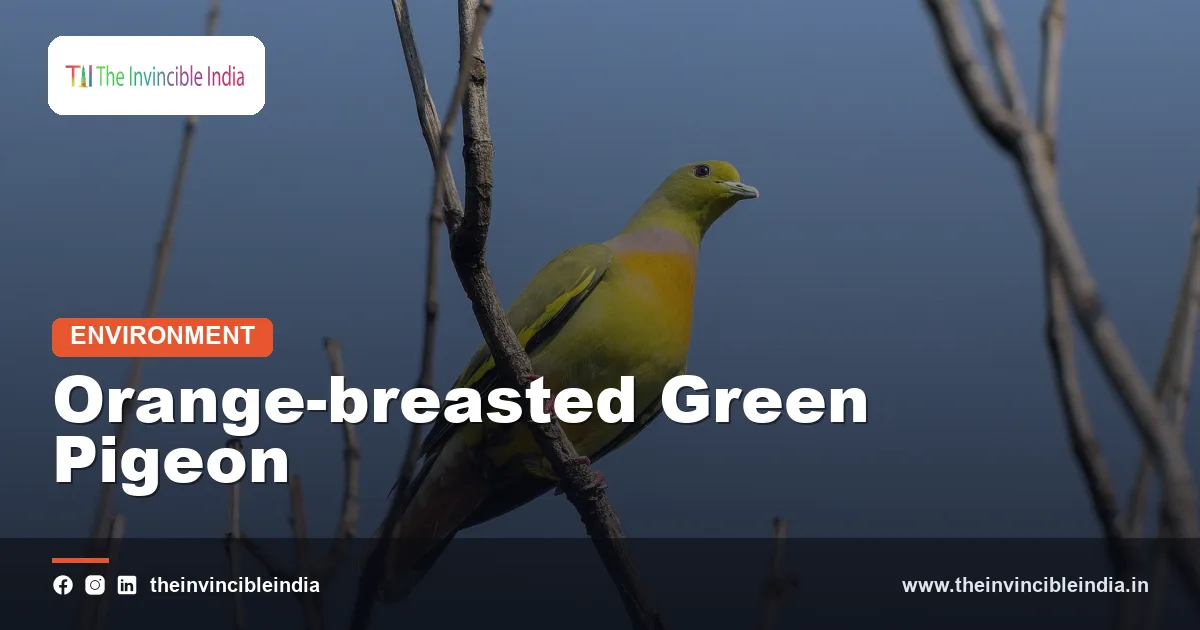
The orange-breasted green pigeon (Treron bicinctus) is a fruit-eating forest pigeon of the Indian subcontinent and South-East Asia, in which the male is green above with a lilac-and-orange band across the breast and the female is plain green. Moving in small flocks and feeding mostly on wild figs and berries, the orange-breasted green pigeon blends so well with leafy canopies that it is often noticed only when it takes off in fast flight.
As a specialist fruit eater, the orange-breasted green pigeon plays a quiet role in the life of Indian forests, since the trees it visits for food depend on animals like it to spread their seeds. Understanding its looks, diet and habits shows how closely this bird is tied to fruiting trees.
| Quick Fact | Details |
|---|---|
| Common name | Orange-breasted green pigeon |
| Scientific name | Treron bicinctus |
| Family | Columbidae (pigeons and doves), order Columbiformes |
| Size | About 29 cm long, slightly larger than a myna |
| Range and habitat in India | Deciduous and moist forest and wooded country in the Himalayan foothills, the north-east, the Western and Eastern Ghats and other hill ranges of peninsular India; also Sri Lanka and South-East Asia |
| Diet | Wild figs and other small fruits and berries, taken mainly from the canopy |
| Breeding | Builds a flimsy platform of twigs in a tree; usually lays two white eggs; both parents care for the young |
| Conservation status | Least Concern on the IUCN Red List; a largely resident species |
Key Takeaways
- The orange-breasted green pigeon is a fruit-eating forest pigeon of the Indian subcontinent and South-East Asia, about 29 cm long.
- Male orange-breasted green pigeons have a lilac and orange wash across the breast, while females are plain green and lack this colour.
- The orange-breasted green pigeon feeds mainly on wild figs and other small fruit, and it often gathers in flocks at fruiting trees.
- Its green plumage gives the orange-breasted green pigeon excellent camouflage in leafy canopies, so the bird is frequently heard before it is seen.
- Orange-breasted green pigeons help to spread the seeds of forest trees such as figs, which supports forest regeneration.
- The orange-breasted green pigeon is rated Least Concern, but it depends on forests with fruiting trees and can decline where such habitat is lost.
What is the orange-breasted green pigeon?
The orange-breasted green pigeon is a medium-sized, plump, arboreal pigeon that lives in forests and wooded country and feeds on fruit. It is one of the green pigeons, a group in the genus Treron that is widespread across tropical Asia and Africa and is known for its olive-green plumage.
The scientific name Treron comes from a Greek word meaning timid, which suits the shy nature of these birds. The species name bicinctus means two-banded, referring to the pair of bands visible on the breast of the male, one lilac and one orange.
The bird is a typical pigeon in build, with a small head, a short neck, a compact body and short legs. Unlike the familiar blue rock pigeon of Indian towns, which is a ground-feeder, the orange-breasted green pigeon spends almost its entire life in trees and rarely visits the ground, except to drink or to take mineral-rich soil in some places.
What does an orange-breasted green pigeon look like?
An orange-breasted green pigeon looks mostly green, with a grey-blue crown, a yellowish-green neck and back, and in the male a lilac-pink and orange band on the breast. The female lacks the coloured breast and is a duller, uniform green.
Male
The male has a bluish-grey crown, a green face and neck, and a strikingly coloured breast that shades from lilac or pinkish at the top to a bright orange wash lower down. The wings are green with a yellow edge, and the tail is grey-green with a darker band near the end. The underparts below the breast are greenish-yellow.
Female and young
The female is plainer, with a green breast and body that merge into the same tone as the leaves. Young birds resemble the female. The yellow edges to the wing feathers are visible in both sexes and form a pale stripe along the folded wing.
Other features
- A short, thick bill with a pale base and a tip that is slightly hooked.
- Reddish or pinkish feet, which help the bird to cling to slender fruiting twigs.
- A rounded tail with a dark subterminal band that is clearest in flight.
Where is the orange-breasted green pigeon found in India?
The orange-breasted green pigeon is found in wooded hills and plains of India, including the Himalayan foothills, the north-eastern states, the Western Ghats, the Eastern Ghats and other forested ranges of the peninsula. Beyond India, its range extends to Sri Lanka and parts of South-East Asia.
It is a bird of low and middle elevations rather than of high mountains. In India it favours areas where moist deciduous or semi-evergreen forest provides a steady supply of fruiting trees, and it is often absent from open country and treeless regions.
The bird is largely resident, but green pigeons are known to move locally in search of fruiting trees. A tree laden with ripe figs may attract flocks for a few days, after which the birds disappear until the next tree comes into fruit. This nomadic habit makes their appearance in any given spot somewhat unpredictable.
What does the orange-breasted green pigeon eat?
The orange-breasted green pigeon eats fruit, mainly wild figs from banyan, peepal and other species of Ficus, along with small berries and other soft fruit found in the canopy. It is a specialist frugivore, and fruit makes up nearly all of its diet.
The bird typically swallows small fruit whole. It clambers about among the thin outer twigs of a fruiting tree, sometimes hanging upside down to reach fruit, and gulps down several in succession. Its digestive tract includes a muscular gizzard that helps break down the food, and the bird may rest quietly after feeding to digest.
The following list shows the usual types of food sources:
- Figs of banyan, peepal, gular and other wild fig trees.
- Small berries of forest trees and shrubs.
- Fruit of trees growing at forest edges and in plantations.
- Occasional buds and shoots when fruit is scarce.
Because figs fruit at different times in different places, fig trees act as keystone resources in tropical forest. A single large fig can feed dozens of bird species, from hornbills and barbets to bulbuls and green pigeons.
How does the orange-breasted green pigeon behave?
The orange-breasted green pigeon is a sociable, quiet bird that usually moves in small flocks and spends most of its time perched in leafy treetops. It sits very still, relying on its green plumage to avoid detection, and it takes off suddenly with a clatter of wings when disturbed.
Flight
The flight of the orange-breasted green pigeon is fast, direct and powerful, with quick wingbeats. A flock may sweep across a clearing from one fruiting tree to another, then plunge into the foliage and vanish. The wing action produces a noticeable whirring or clapping sound at take-off.
Voice
The voice is a soft, musical, whistling series of notes that rises and falls, sometimes described as mellow and almost human in quality. The calls are often given from a high perch in the early morning and during feeding. The soft whistles help birds to keep in contact when they are hidden in dense foliage.
Social habits
Green pigeons usually travel in groups of a few to a dozen or more birds, and larger gatherings may form at an abundant fruit source. Flocks feed together and often roost in the same trees. They are mostly active through the day, with peaks in the morning and the late afternoon.
How does the orange-breasted green pigeon breed?
The orange-breasted green pigeon breeds by building a loose platform of twigs in a tree and laying usually two white eggs, which both parents incubate. The nest is flimsy and may be placed on a horizontal branch or in a fork, often at moderate height.
Like other pigeons, the parents feed their chicks with a nutritious secretion called crop milk, produced in the lining of the crop in both sexes. The chicks are fed this milk at first and later receive partly digested fruit. The young leave the nest after a couple of weeks, though they may stay with their parents for a while longer.
The breeding season varies with region and with the availability of fruit. In many parts of India, nesting takes place in the warmer months, but it can extend through much of the year where food is abundant. Because the nest is so lightly built, eggs and chicks are vulnerable to heavy rain and to predators.
How does the orange-breasted green pigeon differ from other green pigeons?
The orange-breasted green pigeon differs from other Indian green pigeons mainly in the colour of the male’s breast, which shows both lilac and orange bands, and in its grey-blue crown. Several other species of green pigeon share its forest habitat and fruit diet, so careful observation is needed to separate them.
| Species | Scientific name | Distinguishing feature |
|---|---|---|
| Orange-breasted green pigeon | Treron bicinctus | Male has lilac and orange bands on the breast; grey-blue crown |
| Yellow-footed green pigeon | Treron phoenicopterus | Yellow legs, a grey cap and a lilac shoulder patch; the state bird of Maharashtra |
| Pompadour green pigeon | Treron pompadora | Male has a chestnut-purple back and a grey or greenish cap, depending on subspecies |
| Thick-billed green pigeon | Treron curvirostra | Heavy bill with a bare greenish base; maroon back in the male |
| Ashy-headed green pigeon | Treron phayrei | Pale ashy head and a reddish-brown wash on the male’s shoulder |
The yellow-footed green pigeon is the most widely known of these in India, partly because of its status as a state bird. All green pigeons are fruit specialists that prefer treetops, and they are most reliably told apart by the details of male plumage.
Why are green pigeons important for forests?
Green pigeons are important for forests because they eat fruit and move between fruiting trees, which can help to scatter seeds and support the regeneration of forest trees. Wild figs in particular have very small seeds, and many of these may pass through a bird’s gut and be deposited elsewhere.
Forest ecologists describe birds like the orange-breasted green pigeon as fruit-eating ecosystem partners. By travelling between trees, they connect patches of forest and help trees reproduce over a wider area. The effect varies from species to species and from one habitat to another, but the overall pattern holds: fruit-eating birds are an integral part of tropical forest function.
Some green pigeon species grind a share of the seeds they eat in the gizzard, so their value as seed dispersers differs from that of large imperial pigeons, which swallow big fruits whole. Even so, the orange-breasted green pigeon contributes to the web of relationships that keeps fig and other fruit trees productive.
What is the conservation status of the orange-breasted green pigeon?
The orange-breasted green pigeon is rated Least Concern on the IUCN Red List, which means that it is not considered to be at serious risk of extinction at present. It has a wide range across South and South-East Asia and remains fairly frequent in suitable forest.
Threats to the species are mostly related to the condition of its habitat and to hunting in some areas:
- Loss and fragmentation of forest through logging, farming and development.
- Felling of large fruiting trees such as figs, which removes key food sources.
- Hunting or trapping of pigeons for food in some regions.
- Pesticides and disturbance in plantations and forest edges.
In India, the orange-breasted green pigeon is protected under the Wild Life (Protection) Act, 1972, as with most native wild birds. Forest reserves, national parks and sanctuaries protect much of its habitat, while retaining old fig trees in forests, plantations and village groves is a simple step that benefits many fruit-eating birds.
How can you see an orange-breasted green pigeon?
The best way to see an orange-breasted green pigeon is to find a fruiting fig tree in a forest and wait quietly nearby in the early morning or late afternoon. Fruiting trees attract flocks of green pigeons along with barbets, bulbuls, hornbills and other fruit-eating birds.
These tips can help:
- Look for fruiting trees by checking for fallen fruit, droppings and feeding commotion.
- Scan the thin outer twigs of the canopy, where the birds feed, with binoculars.
- Listen for soft whistles and for the clatter of wings as a flock takes off.
- Watch for fast, direct flight across clearings, which often gives the best view of the pale wing edges.
- Visit forest sanctuaries in the Western Ghats, the Eastern Ghats, the Himalayan foothills and the north-east.
Camouflage makes the bird hard to spot even when it is close. Staying still for a few minutes and letting the eyes adjust to the movement in the foliage often reveals birds that were there all along.
Bottom Line
The orange-breasted green pigeon is a shy, green, fruit-eating pigeon of Indian and South-East Asian forests, in which the male carries a lilac-and-orange breast band. It feeds on wild figs and berries, travels in small flocks, and remains of Least Concern, though it needs fruiting trees and intact forest to thrive.
Frequently Asked Questions
What is an orange-breasted green pigeon?
An orange-breasted green pigeon is a fruit-eating forest pigeon found in India, Sri Lanka and South-East Asia. The male has a lilac and orange band on the breast, while the female is plain green. Its scientific name is Treron bicinctus.
What does the orange-breasted green pigeon eat?
The orange-breasted green pigeon eats mainly wild figs and other small fruit and berries. It feeds in the treetops, often in flocks, and swallows the fruit whole. Fruit makes up nearly all of its diet.
How can you tell male and female orange-breasted green pigeons apart?
You can tell the sexes apart by the breast, because the male has a lilac and orange band while the female is plain green. Both sexes share green upperparts and yellow edges on the wing feathers. Young birds look like the female.
Where is the orange-breasted green pigeon found in India?
The orange-breasted green pigeon is found in forests and wooded hills across the Himalayan foothills, the north-east, the Western Ghats, the Eastern Ghats and other parts of peninsular India. It prefers areas with fruiting trees. It is largely resident, though flocks move locally to find fruit.
How does the orange-breasted green pigeon breed?
The orange-breasted green pigeon breeds by building a flimsy platform of twigs in a tree and usually laying two white eggs. Both parents incubate the eggs and feed the chicks with crop milk. The young leave the nest after about two weeks.
Is the orange-breasted green pigeon endangered?
No, the orange-breasted green pigeon is not endangered and is rated Least Concern on the IUCN Red List. It remains fairly common in suitable forest across its wide range. Loss of forest and fruiting trees can reduce local numbers.
{“@context”:”https://schema.org”,”@graph”:[{“@type”:”FAQPage”,”mainEntity”:[{“@type”:”Question”,”name”:”What is an orange-breasted green pigeon?”,”acceptedAnswer”:{“@type”:”Answer”,”text”:”An orange-breasted green pigeon is a fruit-eating forest pigeon found in India, Sri Lanka and South-East Asia. The male has a lilac and orange band on the breast, while the female is plain green. Its scientific name is Treron bicinctus.”}},{“@type”:”Question”,”name”:”What does the orange-breasted green pigeon eat?”,”acceptedAnswer”:{“@type”:”Answer”,”text”:”The orange-breasted green pigeon eats mainly wild figs and other small fruit and berries. It feeds in the treetops, often in flocks, and swallows the fruit whole. Fruit makes up nearly all of its diet.”}},{“@type”:”Question”,”name”:”How can you tell male and female orange-breasted green pigeons apart?”,”acceptedAnswer”:{“@type”:”Answer”,”text”:”You can tell the sexes apart by the breast, because the male has a lilac and orange band while the female is plain green. Both sexes share green upperparts and yellow edges on the wing feathers. Young birds look like the female.”}},{“@type”:”Question”,”name”:”Where is the orange-breasted green pigeon found in India?”,”acceptedAnswer”:{“@type”:”Answer”,”text”:”The orange-breasted green pigeon is found in forests and wooded hills across the Himalayan foothills, the north-east, the Western Ghats, the Eastern Ghats and other parts of peninsular India. It prefers areas with fruiting trees. It is largely resident, though flocks move locally to find fruit.”}},{“@type”:”Question”,”name”:”How does the orange-breasted green pigeon breed?”,”acceptedAnswer”:{“@type”:”Answer”,”text”:”The orange-breasted green pigeon breeds by building a flimsy platform of twigs in a tree and usually laying two white eggs. Both parents incubate the eggs and feed the chicks with crop milk. The young leave the nest after about two weeks.”}},{“@type”:”Question”,”name”:”Is the orange-breasted green pigeon endangered?”,”acceptedAnswer”:{“@type”:”Answer”,”text”:”No, the orange-breasted green pigeon is not endangered and is rated Least Concern on the IUCN Red List. It remains fairly common in suitable forest across its wide range. Loss of forest and fruiting trees can reduce local numbers.”}}]}]}


