

The grey-necked bunting (Emberiza buchanani) is a small, pale, seed-eating songbird that breeds in the dry hills of Central Asia and spends the winter in India, where it feeds in flocks on rocky hillsides, stony scrub and harvested fields. With a soft grey head, a whitish eye-ring, a pinkish bill and warm buff underparts, the grey-necked bunting is a subtle bird that is easy to overlook among the browns and greys of dry country.
This article explains what the grey-necked bunting is, how to recognise it, where it winters in India, what it eats, where it breeds, and how it can be told from similar buntings. It also covers its migration, its conservation status and the habits that help birdwatchers locate it in winter.
| Common name | Grey-necked bunting |
|---|---|
| Scientific name | Emberiza buchanani |
| Family | Emberizidae (buntings) |
| Size | About 15 to 16 cm long, slightly smaller than a house sparrow |
| Range in India | Winter visitor, mainly to the drier western, central and peninsular regions |
| Habitat | Dry rocky hillsides, stony scrub, open dry grassland, harvested fields and stubble |
| Diet | Mainly seeds of grasses and weeds; some insects, especially in the breeding season |
| Breeding and migration | Breeds in the arid hills of Central Asia and Iran; migrates south to winter in India and neighbouring countries |
| Conservation status | Least Concern on the IUCN Red List |
Key Takeaways
- The grey-necked bunting is a small songbird, Emberiza buchanani, that breeds in Central Asia and visits India in the winter months.
- An adult grey-necked bunting has a pale grey head and neck, a whitish eye-ring, a pink bill and buff to pinkish-cinnamon underparts.
- The grey-necked bunting feeds mainly on the seeds of grasses and weeds, which it picks from the ground in small flocks.
- The grey-necked bunting prefers dry, rocky hillsides and stubble fields in western, central and southern India rather than forest or wet country.
- The grey-necked bunting is a close relative of the ortolan bunting and can be confused with it and with other pale buntings in winter.
- The grey-necked bunting is classified as Least Concern, although dry-country habitats are under pressure from changing land use.
What is the grey-necked bunting?
The grey-necked bunting is a small seed-eating songbird of the bunting family, Emberizidae, that breeds on arid hill slopes in Central Asia and migrates to India and nearby regions for the winter. Its scientific name, Emberiza buchanani, honours Francis Buchanan-Hamilton, a Scottish physician and naturalist who worked in India in the early nineteenth century.
Buntings are sparrow-sized birds with short, strong, conical bills used for cracking seeds. Many species in the genus Emberiza have distinctive head patterns and are important to birdwatchers in India because several of them visit only in winter. The grey-necked bunting is one of the plainer species, and its charm lies in its clean grey head and soft warm colours.
Because it is a migrant, the grey-necked bunting is present in India only for part of the year, and the birds seen here are individuals that have crossed mountains and deserts on the way from their breeding grounds. In its winter quarters the species is generally gregarious, living in loose flocks that move between feeding areas.
What does the grey-necked bunting look like?
The grey-necked bunting is a pale bird with a grey head and neck, a whitish ring around the eye, a pale pinkish bill and buff to cinnamon underparts, while the back is sandy brown with darker streaks. The overall impression is of a pale, delicate bunting with little contrast on the head.
The main features can be listed as follows.
- Head and neck: soft grey, with a pale moustachial stripe and a yellowish-buff throat patch in many adults.
- Eye: a narrow whitish eye-ring that gives the face a gentle look.
- Bill: pale pink to flesh coloured, which stands out in good light.
- Breast and belly: unstreaked or faintly marked, buff to pinkish-cinnamon.
- Back and wings: sandy brown with dark streaks and two pale wing bars.
- Tail: dark with white outer feathers, seen when the bird flies up.
- Legs: pinkish-brown.
Males are brighter and cleaner than females, which are duller and slightly streaked on the head and breast. Immature birds look more heavily streaked and less grey. Because winter plumage can be worn and dusty, field identification often depends on a combination of the pink bill, the pale head and the lack of strong streaks on the underparts.
Where does the grey-necked bunting live in India?
The grey-necked bunting lives in India as a winter visitor, mainly in the drier regions of the west, centre and south, where it occupies rocky hillsides, stony scrub, dry grassland and harvested fields. It is characteristic of open dry country and is not a bird of forest or wet lowlands.
In India it is most often reported from states with extensive dry habitats, such as Rajasthan, Gujarat, Maharashtra, Madhya Pradesh, Karnataka and parts of Andhra Pradesh and Tamil Nadu, and it also reaches neighbouring countries in South Asia. It tends to arrive from around September to October and to leave by March or April, though dates vary with weather and region.
The habitats it uses are listed below.
- Rocky hillsides: bare slopes with scattered shrubs, boulders and sparse grass.
- Scrub and thorn country: low bushes interspersed with open stony ground.
- Dry grassland: short grazed grass, especially where there are seed-bearing weeds.
- Agricultural land: stubble after the harvest of millets, sorghum and wheat, and fallow fields.
- Roadsides and dry riverbeds: open stony areas near water that offer seeds and grit.
What does the grey-necked bunting eat?
The grey-necked bunting eats mainly seeds, particularly the seeds of grasses and herbaceous weeds, which it picks up from the ground or from low plants. In the breeding season it also takes insects and other small invertebrates, which are an important food for growing chicks.
In winter in India, flocks forage on the ground, hopping and walking over bare earth, stubble and grass while pecking at fallen seeds. Their short, conical bills crush husks efficiently. They may also visit water sources in the morning or evening to drink, especially in very dry weather.
The seed diet makes the grey-necked bunting dependent on the survival of uncultivated margins, weedy field edges and dry grassland, which provide natural food. Farmers’ fields are used for foraging after harvest, but these birds are not a significant crop pest, since they feed on spilled grain and weeds rather than standing crops.
Where does the grey-necked bunting breed and migrate?
The grey-necked bunting breeds in the dry, rocky hills and mountain slopes of Central Asia and neighbouring regions, including parts of Iran and Central Asian ranges, and then migrates south for the winter to India and nearby countries. The breeding range lies north-west of India, and birds reach the subcontinent by crossing mountain and desert country.
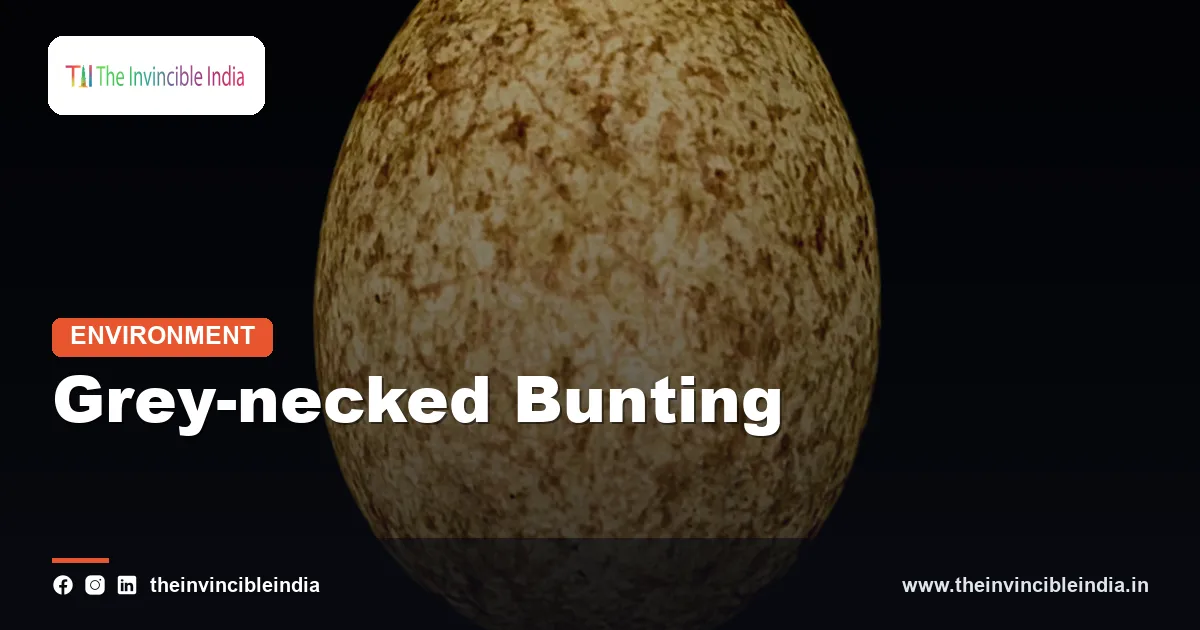
On the breeding grounds, the bird favours open, stony and sparsely vegetated slopes, usually at moderate to high elevations. Pairs build a cup-shaped nest of grasses and fine roots on the ground or in a rock crevice, often sheltered by a stone or a small bush. A typical clutch contains four or five pale, marked eggs, and the male sings from a rock or shrub to defend the territory. The song is brief and simple, a series of short, thin notes.
The timing of the cycle is roughly as follows.
- Spring and early summer: breeding in Central Asian hills.
- Late summer to autumn: migration south, with arrival in India from around September or October.
- Winter: flocks feed in dry regions of India.
- Late winter to early spring: departure northwards, with most birds gone from India by April.
Details of migration routes and stopover sites are less well studied than those of many larger birds, and the grey-necked bunting is sometimes recorded away from its usual range as a vagrant.
How do you tell the grey-necked bunting from similar buntings?
The grey-necked bunting can be told from similar buntings by its clean grey head, whitish eye-ring, pinkish bill and unstreaked buff-pink underparts. Several other buntings that winter in India look superficially similar, so a direct comparison is useful.
| Bunting | Head and face | Underparts | Notes |
|---|---|---|---|
| Grey-necked bunting | Pale grey with whitish eye-ring and pinkish bill | Buff to pinkish-cinnamon, mostly unstreaked | Dry rocky hills and stubble in winter |
| Ortolan bunting | Greenish-grey head with yellowish throat and moustache, pink bill and conspicuous eye-ring | Rufous-orange belly | A close relative; a scarcer winter visitor to India |
| Rock bunting | Grey head with bold black stripes | Rufous below | Striped head makes it easy to separate |
| Red-headed bunting | Males have a reddish-chestnut head; females are plain yellowish-buff | Yellow in males, buff in females | Often seen in large flocks in agricultural land |
| Chestnut-eared bunting | Grey crown, chestnut ear patch and necklace of streaks | Whitish with a dark band across the chest | More frequent in hills and the north-east |
The ortolan bunting is the nearest lookalike. It has a more yellowish throat and moustache and a greener tinge on the head, whereas the grey-necked bunting generally looks cleaner and paler and has a softer, more uniform appearance.
How does the grey-necked bunting behave in winter?
The grey-necked bunting is gregarious in winter and forages in small to medium flocks on open ground, often mixing with larks, pipits and other buntings. When disturbed, the flock flies up together, showing white in the tail, and settles again a short distance away on a rock or low shrub.
Its behaviour in the wintering range has several recognisable features.
- It feeds mostly on the ground, walking or hopping in short bursts.
- It perches on rocks, fence lines and shrubs between feeding bouts.
- It gives short, thin “tsip” or “chip” contact calls, especially in flight.
- It often visits water in the early morning and late afternoon.
- It keeps to open ground where it can watch for predators such as hawks and shrikes.
The bird’s pale colours blend well with sandy soil and pale rock, so a flock may be invisible until it flies. Birdwatchers often find the species by scanning stony slopes slowly and watching for small, sandy-grey birds that move in short runs between rocks.
Is the grey-necked bunting threatened?
The grey-necked bunting is not considered globally threatened, as the IUCN lists it as Least Concern because of its large breeding range and apparently stable numbers. Nonetheless, dry open habitats in India face pressure from changing land use, and birds that depend on them deserve attention.
Possible threats to the species and its habitat include the following.
- Conversion of dry grassland and scrub to cultivation, plantations or wind and solar installations.
- Overgrazing and degradation of seasonal grasses that provide seeds.
- Quarrying and mining on rocky hillsides.
- Use of pesticides and herbicides that reduce seed and insect supplies.
- Trapping and hunting of small birds in some regions, which is illegal in India for protected species.
Open natural ecosystems such as scrub and grassland are often wrongly regarded as wasteland, but they provide winter habitat for migrants such as the grey-necked bunting and many resident species. Protecting such areas supports a wide group of dry-country wildlife.
How can you see a grey-necked bunting?
The best way to see a grey-necked bunting is to visit rocky scrub, dry grassland or harvested fields in the drier parts of India between about November and February, and to scan the ground for small, pale flocks. Quiet observation from a distance usually works better than walking through the habitat.
Some practical tips include the following.
- Go in the early morning, when buntings are active and come to drink.
- Use binoculars to check the head pattern, bill colour and eye-ring of each pale bird.
- Look through flocks of larks and sparrows, because buntings often mix with them.
- Photograph the bird from several angles to help compare it with ortolan and other buntings.
- Record the date and place, since winter bird records help track changes in migration.
Bottom Line
The grey-necked bunting is a quiet, pale winter visitor that brings a touch of Central Asian hill country to the dry parts of India. It is not rare or endangered, but it relies on open rocky and grassy habitats that are easy to overlook. Learning to recognise it is a rewarding step in understanding bird migration and dry-country ecology.
Frequently Asked Questions
Is the grey-necked bunting a resident or a migrant in India?
The grey-necked bunting is a winter migrant in India. It breeds in the dry hills of Central Asia and arrives in India from around September or October, leaving again by March or April.
What does the grey-necked bunting look like?
The grey-necked bunting has a pale grey head and neck, a whitish eye-ring, a pink bill and buff to pinkish-cinnamon underparts. Its back is sandy brown with dark streaks. Females and young birds are duller and more streaked than males.
What does the grey-necked bunting eat?
The grey-necked bunting eats mainly seeds of grasses and weeds, which it picks from the ground. In the breeding season it also eats insects and other small invertebrates, which are important food for its chicks.
Where can I find the grey-necked bunting in India?
The grey-necked bunting can be found in winter on dry rocky hillsides, stony scrub, dry grassland and harvested fields, mainly in western, central and southern India. It prefers open, arid country rather than forest.
How is the grey-necked bunting different from the ortolan bunting?
The grey-necked bunting is generally paler and cleaner, with a grey head and pinkish-buff underparts, while the ortolan bunting has a greener head, a yellowish throat and moustache, and a richer orange-rufous belly. The two are close relatives and can look alike at a distance.
Is the grey-necked bunting endangered?
No, the grey-necked bunting is listed as Least Concern by the IUCN because it has a large range and no known major decline. Even so, loss of dry grassland, scrub and rocky hill habitat can reduce its wintering areas in India.
{“@context”:”https://schema.org”,”@graph”:[{“@type”:”FAQPage”,”mainEntity”:[{“@type”:”Question”,”name”:”Is the grey-necked bunting a resident or a migrant in India?”,”acceptedAnswer”:{“@type”:”Answer”,”text”:”The grey-necked bunting is a winter migrant in India. It breeds in the dry hills of Central Asia and arrives in India from around September or October, leaving again by March or April.”}},{“@type”:”Question”,”name”:”What does the grey-necked bunting look like?”,”acceptedAnswer”:{“@type”:”Answer”,”text”:”The grey-necked bunting has a pale grey head and neck, a whitish eye-ring, a pink bill and buff to pinkish-cinnamon underparts. Its back is sandy brown with dark streaks. Females and young birds are duller and more streaked than males.”}},{“@type”:”Question”,”name”:”What does the grey-necked bunting eat?”,”acceptedAnswer”:{“@type”:”Answer”,”text”:”The grey-necked bunting eats mainly seeds of grasses and weeds, which it picks from the ground. In the breeding season it also eats insects and other small invertebrates, which are important food for its chicks.”}},{“@type”:”Question”,”name”:”Where can I find the grey-necked bunting in India?”,”acceptedAnswer”:{“@type”:”Answer”,”text”:”The grey-necked bunting can be found in winter on dry rocky hillsides, stony scrub, dry grassland and harvested fields, mainly in western, central and southern India. It prefers open, arid country rather than forest.”}},{“@type”:”Question”,”name”:”How is the grey-necked bunting different from the ortolan bunting?”,”acceptedAnswer”:{“@type”:”Answer”,”text”:”The grey-necked bunting is generally paler and cleaner, with a grey head and pinkish-buff underparts, while the ortolan bunting has a greener head, a yellowish throat and moustache, and a richer orange-rufous belly. The two are close relatives and can look alike at a distance.”}},{“@type”:”Question”,”name”:”Is the grey-necked bunting endangered?”,”acceptedAnswer”:{“@type”:”Answer”,”text”:”No, the grey-necked bunting is listed as Least Concern by the IUCN because it has a large range and no known major decline. Even so, loss of dry grassland, scrub and rocky hill habitat can reduce its wintering areas in India.”}}]}]}


