

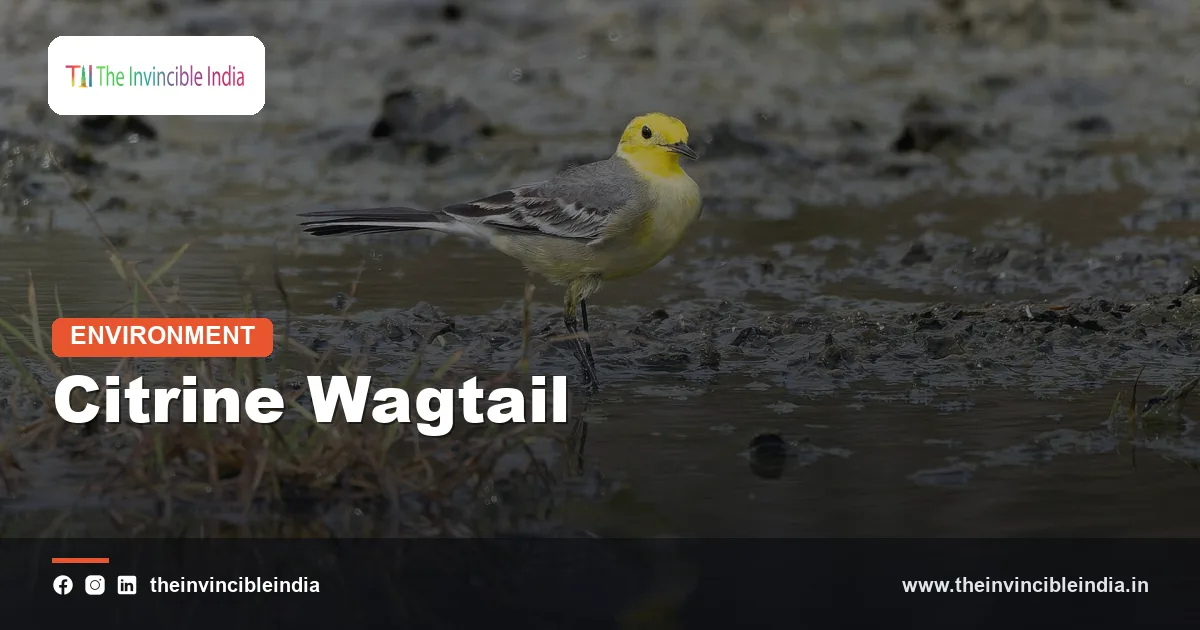
The citrine wagtail (Motacilla citreola) is a small, long-tailed songbird of the wagtail family, best known for the bright lemon-yellow head and underparts of the breeding male, and it is a common winter visitor to wetlands, paddy fields and grassy pool edges across India. Wagtails are slim, ground-feeding birds that walk briskly and bob their tails up and down, and the citrine wagtail is one of the most striking of the group, with a plain grey or black back and two bold white bars on each wing.
Most citrine wagtails seen in India breed far to the north, in the tundra, marshes and high meadows of Siberia, Central Asia and the Tibetan plateau, and arrive on the subcontinent from late summer to autumn. A smaller number breed in the high Himalaya. This guide explains how to recognise the bird, how it differs from look-alike wagtails, where it lives, what it eats, how it breeds and how it fares as a species.
| Quick Fact | Detail |
|---|---|
| Common name | Citrine wagtail (also called yellow-headed wagtail) |
| Scientific name | Motacilla citreola |
| Family | Motacillidae (wagtails, pipits and longclaws) |
| Size | About 16 to 17 cm long, with a long, narrow, constantly moving tail |
| Range | Breeds across northern Eurasia and the Tibetan plateau and high Himalaya; winters mainly in South and Southeast Asia, including most of India |
| Diet | Insects, small flies, beetles, tiny molluscs and other small invertebrates, with a few seeds |
| Breeding | Cup nest on the ground in a grass tussock near water; usually 4 to 6 eggs |
| Conservation status | Least Concern on the IUCN Red List, with a very large breeding range |
Key Takeaways
- The citrine wagtail is a small wagtail, about 16 to 17 cm long, whose breeding male has a bright yellow head and underparts.
- The citrine wagtail breeds mainly in northern Eurasia and on the Tibetan plateau, and spends the winter across much of India.
- Adult citrine wagtails in winter dress are told apart by a grey crown, a yellowish face outline and two broad white bars on each wing.
- The citrine wagtail feeds on insects and other small invertebrates, which it picks from damp ground and shallow water.
- The citrine wagtail nests on the ground near water and is listed as Least Concern by the IUCN.
- Wetlands, paddy fields and marsh edges are the best places in India to look for the citrine wagtail between autumn and early spring.
What is the citrine wagtail?
The citrine wagtail is a small passerine bird in the family Motacillidae, a group that also contains the other wagtails and the pipits. The word citrine means lemon-coloured, and the Latin species name citreola refers to the same yellow that dominates the breeding male. In older books and in some field guides the species is called the yellow-headed wagtail, a name that is still used informally.
Like all wagtails, the citrine wagtail is slender, with a thin pointed bill, long legs, and a tail that is long relative to the body. It spends most of its time on the ground or on low perches, walking rather than hopping. It belongs to the same genus, Motacilla, as the white wagtail, the grey wagtail and the yellow wagtail, and the four are frequently seen on the same Indian wetland.
The species is a bird of open, damp country. It is closely tied to water, wet grass and soft mud, which hold the insects it eats. Unlike many birds of forests or villages, the citrine wagtail is seldom found far from a pond, marsh, stream, flooded field or irrigation channel.
How can you identify a citrine wagtail?
The citrine wagtail can be identified by its combination of a pale-faced or yellow head, a plain grey or black back, a long dark tail with white outer edges, and two broad white wing bars, and the exact pattern depends on the sex, season and age of the bird. Because the plumage changes through the year, it helps to know four basic stages.
Breeding male
The breeding male has an unmistakable bright yellow head, neck and underparts. A narrow black band runs across the back of the neck like a collar. The back is grey in the western form of the species and black in the Himalayan and Tibetan form, which is often called the black-backed citrine wagtail. The wings are dark with broad white edges to the feathers, creating a white panel.
Breeding female
The breeding female is similar but duller. The yellow is paler, the crown often carries grey, and the black neck collar is weak or missing. In the field a duller bird in spring may look intermediate between the male and the winter plumage.
Non-breeding adults and juveniles
In winter, which is when most Indian sightings occur, the citrine wagtail has a grey crown and back and a pale yellowish-white face. A thin yellow line above the eye and a yellow frame around the cheek patch are good clues. The underparts range from white to pale yellow. Juveniles are greyer and browner, with a more buff or whitish face, and may lack any clear yellow at all. Even in this dull dress the two bright white wing bars, the pale forehead and the long black tail remain the main field marks.
Voice
The citrine wagtail has a loud, rather harsh, buzzing call, often written as a rising tsree or zree, given in flight and when alarmed. Learning this note is one of the quickest ways to pick a citrine wagtail out of a mixed flock of wagtails over a marsh.
How is the citrine wagtail different from similar wagtails?
The citrine wagtail differs from the yellow wagtail, grey wagtail and white wagtail mainly in the shape of its face pattern, the colour of its back and the width of its white wing bars. Four wagtail species are commonly seen in India in winter, and beginners often confuse them. The table below sets out the main differences.
| Species | Back colour in winter | Head and face | Wing and tail |
|---|---|---|---|
| Citrine wagtail | Grey (black in the Himalayan form when breeding) | Pale yellowish face, grey crown, yellow frame around the cheek | Two broad white wing bars; long black tail |
| Yellow wagtail | Olive-green or brownish | Variable by subspecies; often a pale eyebrow and a dark cheek | Wing bars narrower and less obvious; shorter tail |
| Grey wagtail | Clean blue-grey | Grey head with a thin white eyebrow | Very long tail; bright yellow under the tail at all seasons |
| White wagtail | Grey or black depending on race | White face with a black bib in most forms | Mostly black and white overall; no true yellow |
The yellow wagtail has an olive or brownish back, whereas the citrine wagtail in winter has a distinctly grey back. The grey wagtail also has yellow, but only on the lower belly and under the tail, while its face is not yellow. The white wagtail lacks yellow altogether. A pale yellow face paired with a pure grey back and broad white wing panels points to the citrine wagtail.
Where does the citrine wagtail live and breed?
The citrine wagtail breeds across a broad belt of northern Eurasia, from European Russia and Siberia through Central Asia and Mongolia to the Tibetan plateau and the high Himalaya. It prefers wet meadows, boggy tundra, willow-scrub marshes and the grassy edges of lakes and streams during the breeding season.
In the Himalaya, the black-backed form breeds at high altitude, in alpine meadows and marshy ground in regions such as Ladakh and adjoining areas. Many of these birds move to lower ground when winter arrives. Birds from the vast northern breeding range move south in autumn and spread across South Asia and parts of Southeast Asia, including southern China, Thailand and neighbouring countries.
The wide breeding range helps explain why the species is regarded as secure. No single wetland or country holds the whole population, and individual birds can shift between sites from year to year.
When and where is the citrine wagtail seen in India?
The citrine wagtail is seen in India mainly as a winter visitor, arriving from about August to October and leaving by March or April, and it can turn up in almost any state with suitable wetland habitat. Birdwatchers record it in the plains of north India, in the Gangetic floodplain, across central India, in the Deccan, along the coast and in southern states.
It favours the following kinds of places in India:
- Freshwater marshes and the margins of ponds, jheels and reservoirs.
- Paddy fields, especially flooded or freshly harvested stubble fields.
- Wet grassland and village commons where cattle graze.
- Irrigation channels, canal banks and sewage-fed pools.
- Shallow river banks and sandy islands with short grass.
Famous wetland reserves such as Keoladeo National Park in Rajasthan, Bharatpur’s marshes and the large wetlands of Gujarat, Odisha and Kerala are known to attract wagtails in good numbers, although the citrine wagtail is just as likely to appear at an unprotected village pond. Spring is a particularly rewarding time, because males moult into bright breeding plumage before departure, and birders may see yellow-headed individuals in March and April.
Wagtails often roost together in large numbers at night. In winter, the citrine wagtail may join roosts of other wagtails in reedbeds, sugarcane fields or trees close to water, and then disperse widely to feed by day.
What does the citrine wagtail eat?
The citrine wagtail eats mainly small insects and other invertebrates, which it picks from mud, wet grass and the water surface. Its diet includes flies, mosquitoes and midges, small beetles, bugs, ants, caterpillars, tiny snails and spiders, and occasionally a few seeds.
The bird forages by walking steadily across open ground, stopping to snatch prey with its fine bill. It may run a few steps to catch a moving insect, make a short upward flutter to take one in the air, or wade into very shallow water. It often follows grazing cattle and buffaloes, which stir insects out of the grass. This habit is common to many wagtails and gives the cattle egret and the wagtails a similar feeding style in village pastures.
Because it hunts insects, the citrine wagtail is useful to farmers. In paddy fields it takes many small insects that would otherwise remain on the crop or in the mud. This is one reason why healthy, pesticide-light wetlands and rice fields matter to wagtails and other insect-eating migrants.
Why does the citrine wagtail wag its tail?
The citrine wagtail wags its tail because tail-bobbing is a characteristic behaviour of the whole wagtail family, but scientists have not settled on a single explanation. The name wagtail simply describes this constant up-and-down motion of the long tail, which continues as the bird walks and when it stands still.
Several ideas have been proposed. One suggestion is that the movement flushes hidden insects from vegetation. Another is that the wagging signals to predators that the bird is alert and not worth chasing. A third is that it helps the bird keep its balance on uneven ground or floating plants. The movement may also serve as a signal to other wagtails. Researchers continue to study the behaviour, and several of these functions may apply at once.
For birdwatchers, the tail motion is a useful clue. A small, slim bird walking at the edge of water and bobbing its rear end is almost certainly a wagtail or a pipit, and the speed and amplitude of the wag can help separate the species when combined with plumage and calls.
How does the citrine wagtail breed?
The citrine wagtail breeds in the northern summer, building a cup-shaped nest on the ground, usually hidden in a grass tussock, a hollow beside a bank or under a low shrub near water. The nest is made of grass stems, moss and roots and is lined with soft material such as hair, wool or feathers.
The female lays a clutch that is typically four to six eggs, pale and speckled. The eggs are incubated mainly by the female, and both parents feed the nestlings with insects. The young leave the nest within about two weeks of hatching and are fed for a short time afterwards. Males sing and display from low perches and in short flights over the territory.
Because the nest is on the ground, eggs and chicks are exposed to predators and to flooding. High-latitude summers are short, so the birds nest and rear their young within a few weeks. This compact breeding schedule explains why the bird is absent from India for much of the year and why it is often seen in changing plumage in March and April.
What is the conservation status of the citrine wagtail?
The citrine wagtail is classified as Least Concern on the IUCN Red List, which means that it is not currently considered at risk of extinction. The reasons are its very large breeding and wintering range and a population that is not thought to be declining fast enough to meet the criteria for a higher threat category.
Even so, the bird depends on wetlands, and wetlands are among the most heavily modified habitats in the world. Drainage for farming and construction, pollution, disturbance and the loss of ponds and marshes can reduce the places where the citrine wagtail feeds and roosts in winter. Changing land use in its northern breeding grounds may also affect the species over time.
Within India, wild birds including wagtails are legally protected under the Wild Life (Protection) Act, 1972, which prohibits hunting and trade in most wild species. Protecting wetlands, village ponds and traditional paddy landscapes helps the citrine wagtail along with many other migrants.
How can you watch citrine wagtails responsibly?
You can watch citrine wagtails best by visiting a wetland at the edge of a pond or marsh in the early morning or late afternoon, using binoculars from a distance and staying still. Wagtails are active and approachable, but they fly off if people walk straight towards them.
- Use binoculars so that you can watch from a respectful distance and avoid flushing birds.
- Look first at short grass, mud and the water’s edge rather than at tall reeds.
- Check every wagtail in a flock for yellow on the face, since citrine wagtails often mix with other species.
- Learn the call, because the buzzing note often reveals the bird before you see it.
- Avoid playing recorded calls or using flash, which stresses wild birds.
- Record your sightings in a citizen science platform so that the data help scientists track migration.
Local birdwatching groups across India regularly run walks at wetlands and can help beginners recognise winter wagtails. Because plumage changes through the season, repeated visits from October to April teach more than a single trip.
Bottom Line
The citrine wagtail is a small, bright and easily watched winter visitor that links the northern marshes of Eurasia and the high Himalaya with Indian wetlands. Its yellow head, grey back and bold white wing bars, combined with its restless tail, make it a rewarding species for beginners, and its dependence on water is a reminder of why wetlands matter.
Frequently Asked Questions
What is a citrine wagtail?
A citrine wagtail is a small, long-tailed songbird of the wagtail family, known for the bright yellow head and underparts of the breeding male. It breeds in northern Eurasia and on the Tibetan plateau and visits India in winter. It is found around marshes, ponds and paddy fields.
Is the citrine wagtail a migratory bird?
Yes, the citrine wagtail is a migratory bird that breeds in the north and winters farther south. Most birds seen in India arrive from about August to October and leave by March or April. Some populations breed in the high Himalaya and move to lower ground in winter.
How do you tell a citrine wagtail from a yellow wagtail?
The easiest way is the back colour and wing pattern. A citrine wagtail has a grey back and two broad white wing bars, while a yellow wagtail has an olive or brownish back and narrower wing bars. The citrine wagtail also shows a yellowish frame around the cheek and a longer tail.
What does a citrine wagtail eat?
A citrine wagtail eats mainly small insects and other invertebrates such as flies, midges, beetles, tiny snails and spiders. It picks them from wet ground and shallow water as it walks. It often feeds near grazing cattle, which disturb insects in the grass.
Where can you see citrine wagtails in India?
Citrine wagtails can be seen in India at freshwater marshes, ponds, reservoirs, flooded paddy fields and wet grasslands during the winter months. They are recorded in many states, from the northern plains to the south. Wetland reserves such as Keoladeo National Park are good places to look.
Is the citrine wagtail endangered?
No, the citrine wagtail is not endangered and is listed as Least Concern by the IUCN. Its range is very large and its population is not considered to be under severe threat. Loss of wetlands is still a long-term concern for the species and for many other wetland birds.
{“@context”:”https://schema.org”,”@graph”:[{“@type”:”FAQPage”,”mainEntity”:[{“@type”:”Question”,”name”:”What is a citrine wagtail?”,”acceptedAnswer”:{“@type”:”Answer”,”text”:”A citrine wagtail is a small, long-tailed songbird of the wagtail family, known for the bright yellow head and underparts of the breeding male. It breeds in northern Eurasia and on the Tibetan plateau and visits India in winter. It is found around marshes, ponds and paddy fields.”}},{“@type”:”Question”,”name”:”Is the citrine wagtail a migratory bird?”,”acceptedAnswer”:{“@type”:”Answer”,”text”:”Yes, the citrine wagtail is a migratory bird that breeds in the north and winters farther south. Most birds seen in India arrive from about August to October and leave by March or April. Some populations breed in the high Himalaya and move to lower ground in winter.”}},{“@type”:”Question”,”name”:”How do you tell a citrine wagtail from a yellow wagtail?”,”acceptedAnswer”:{“@type”:”Answer”,”text”:”The easiest way is the back colour and wing pattern. A citrine wagtail has a grey back and two broad white wing bars, while a yellow wagtail has an olive or brownish back and narrower wing bars. The citrine wagtail also shows a yellowish frame around the cheek and a longer tail.”}},{“@type”:”Question”,”name”:”What does a citrine wagtail eat?”,”acceptedAnswer”:{“@type”:”Answer”,”text”:”A citrine wagtail eats mainly small insects and other invertebrates such as flies, midges, beetles, tiny snails and spiders. It picks them from wet ground and shallow water as it walks. It often feeds near grazing cattle, which disturb insects in the grass.”}},{“@type”:”Question”,”name”:”Where can you see citrine wagtails in India?”,”acceptedAnswer”:{“@type”:”Answer”,”text”:”Citrine wagtails can be seen in India at freshwater marshes, ponds, reservoirs, flooded paddy fields and wet grasslands during the winter months. They are recorded in many states, from the northern plains to the south. Wetland reserves such as Keoladeo National Park are good places to look.”}},{“@type”:”Question”,”name”:”Is the citrine wagtail endangered?”,”acceptedAnswer”:{“@type”:”Answer”,”text”:”No, the citrine wagtail is not endangered and is listed as Least Concern by the IUCN. Its range is very large and its population is not considered to be under severe threat. Loss of wetlands is still a long-term concern for the species and for many other wetland birds.”}}]}]}


