

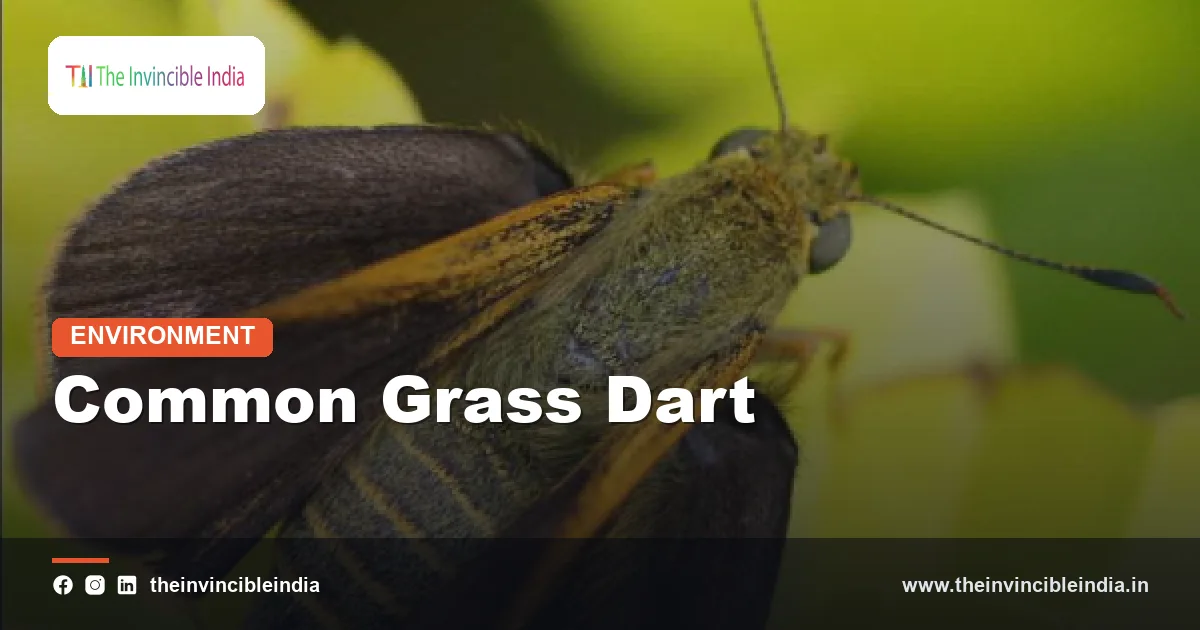
The common grass dart (Taractrocera maevius) is a small, fast-flying, orange-brown skipper butterfly of the family Hesperiidae that darts between flowers over lawns, fields and open grassland in India. It is easy to overlook because it is small and quick, but it is one of the most widespread skippers of the Indian plains, and its caterpillars live inside little shelters made from grass blades.
The common grass dart gets its name from its habit of shooting low over the grass in short, rapid dashes and then stopping suddenly on a leaf or flower. This article explains how to recognise it, what its caterpillars eat, where it lives, how it differs from other small skippers, and why skippers are a distinct and fascinating group of butterflies.
| Common name | Common grass dart |
|---|---|
| Scientific name | Taractrocera maevius (Fabricius, 1793) |
| Family and subfamily | Hesperiidae (skippers), subfamily Hesperiinae |
| Wingspan | Roughly 25 to 35 mm |
| Larval host plants | Various grasses of the family Poaceae |
| Range and habitat in India | Widespread across the plains and lower hills; lawns, grassland, field margins, scrub and sunny forest clearings |
| Flight season and broods | Flies through much of the year with several broods; most numerous in and after the monsoon |
| Notable features | Dark brown upper side with orange patches; pale ring of spots on the hindwing underside; darting flight; caterpillar lives in a grass shelter |
Key Takeaways
- The common grass dart (Taractrocera maevius) is a small skipper butterfly with a wingspan of roughly 25 to 35 mm, found widely across India.
- Common grass dart butterflies are dark brown above with orange patches, and the hindwing underside carries a pale curved band of spots.
- Caterpillars of the common grass dart feed on grasses and live inside shelters made by joining grass blades with silk.
- The common grass dart flies in quick, low darts between flowers and perches, and it often rests with its wings partly open.
- The common grass dart belongs to the family Hesperiidae, whose members have hooked antenna tips, stout bodies and fast flight.
- The common grass dart is not considered threatened in India and survives well in lawns, farmland margins and open grassland.
What is the common grass dart butterfly?
The common grass dart is a skipper, a member of the family Hesperiidae, which is a large and distinct group of butterflies usually smaller and more thick-bodied than the swallowtails, whites and brush-footed butterflies. The species was described by the Danish entomologist Johan Christian Fabricius in 1793 as Taractrocera maevius.
The genus Taractrocera contains the “darts” and “grass darts” of Asia and Australasia. In India, the common grass dart is the most widespread member, and it is typically seen on open, sunny ground with short grass. A close relative, the Tamil grass dart (Taractrocera ceramas), occurs in parts of southern and north-eastern India.
Skippers are named for their quick, skipping flight. Many are drab brown, but the grass darts have bright orange markings that make them more attractive than their size suggests.
How can you identify a common grass dart?
A common grass dart can be identified by its small size, its dark brown upper side marked with orange-yellow patches, its darting flight, and a pale ring or curved band of spots on the underside of the hindwing. When it settles, it is frequently seen on grass blades or small flowers.
Upper side
The upper side is dark brown to blackish-brown. The forewing carries a group of small orange-yellow spots, and the hindwing has a larger orange patch near the middle. The colours can look duller in worn individuals and brighter in fresh ones. The sexes are similar, though the female is usually slightly larger.
Under side
The underside is more useful for identification. The forewing has a warm orange tint with pale spots, while the hindwing is olive-brown to dark brown with a curved band or ring of pale yellowish spots. This ring-like pattern is the most reliable field mark for the genus.
Flight and posture
The common grass dart flies in short, fast, zig-zag dashes close to the ground and then lands abruptly. It often sits with its forewings and hindwings held at slightly different angles, a typical skipper posture, and it can look like a small moth when perched. Its body is stout and its head is broad, which are features of all skippers.
What do common grass dart caterpillars eat?
Common grass dart caterpillars eat various grasses in the family Poaceae, including the grasses that grow in lawns, field margins and open grassland. Because suitable grasses are common nearly everywhere, the butterfly is not tied to any single plant.
The female lays her eggs singly on grass blades. After hatching, the caterpillar cuts and rolls a blade, or joins several blades with silk, to form a tubular shelter in which it hides during the day and from which it emerges to feed. The shelter protects it from birds, wasps and hot sunshine.
Adult butterflies feed on nectar from small flowers, many of them common weeds that grow at the same sites as the host grasses. They are seen visiting low flowering plants in lawns and along path edges.
How does the common grass dart grow from egg to adult?
The common grass dart passes through four stages, egg, caterpillar, pupa and adult, and it builds a shelter for the two middle stages. In warm weather the cycle is short, and there are several generations in a year.
- Egg: A small, rounded egg laid singly on a grass blade.
- Caterpillar: A pale green or yellowish-green larva with a distinct, darker head and a narrow neck, typical of skippers. It lives inside a rolled grass shelter.
- Pupa: The pupa forms within the shelter, often wrapped in loose silk and a little white powder, and is held in place by silk threads.
- Adult: The butterfly emerges from the shelter, dries its wings and starts feeding and mating soon afterwards.
This sheltered life means that the immature stages of the common grass dart are rarely seen, even though the adults are common. Searching for rolled grass blades with a caterpillar inside takes patience and a good eye.
Where in India is the common grass dart found?
The common grass dart is found across most of India, from the plains to the lower hills, in sunny and open habitats with grass. It is common in peninsular India and also occurs along the Himalayan foothills and in Northeast India.
Outside India, the species ranges through Sri Lanka, Bangladesh, Myanmar and much of Southeast Asia, with several regional forms recognised. The broad distribution fits the adaptable habits of the butterfly, which exploits ordinary grassy ground wherever it is found.
Typical places to look include:
- Lawns, school grounds and parks with short, sunny grass
- Road verges, canal banks and railway embankments
- Field margins and fallow land, particularly around cultivated areas
- Open grassland, scrub and clearings within light forest
When is the common grass dart on the wing?
The common grass dart is on the wing for most of the year in warm parts of India, with the largest numbers during and just after the monsoon, when grass is lush and caterpillars develop quickly. In colder northern areas, adults are scarce in winter and appear again as temperatures rise.
During the day, the butterfly is most active in bright sunshine, from mid-morning until the early afternoon. In cloudy weather, it rests low in the grass with its wings partly closed. Males often perch on a leaf tip or grass stem and dash out to investigate passing insects, which is a typical behaviour of territorial skippers.
How is a skipper different from other butterflies?
A skipper differs from other butterflies in having a stout body, a broad head, hooked tips on its antennae and a rapid, darting flight. The common grass dart shows all of these features, and the table below sets out the main contrasts between skippers and the better-known butterfly families.
| Feature | Skippers (Hesperiidae) | Most other butterflies |
|---|---|---|
| Body | Stout, thick and moth-like | Slender to moderately robust |
| Antenna tips | Club with a small hook or point | Club without a hook |
| Flight | Quick, darting and skipping | Often flapping, gliding or fluttering |
| Larval home | Silk shelter made from rolled leaves | Usually open on the leaf |
| Resting posture | Wings often held partly open or at two angles | Wings usually closed over the back or fully open |
These traits explain why skippers are sometimes described as the link between butterflies and moths, though they are true butterflies and are classified in their own family.
How is the common grass dart different from similar skippers?
The common grass dart differs from similar Indian skippers mainly in its small size, the orange patches on its dark upper side and the ring of pale spots on its hindwing underside. Several other small skippers share its habitat, so the following notes help to separate them.
- Tamil grass dart (Taractrocera ceramas): A close relative with a similar overall look, found in more restricted regions; a close photograph of the wing pattern is needed to separate the two.
- Small branded swift (Pelopidas mathias): A larger, plainer brown skipper with pale spots and, in the male, a dark brand on the forewing.
- Other grass-feeding skippers: Many are brown with small pale spots and lack the orange upper-side patches and hindwing ring of the common grass dart.
Skippers are among the hardest butterflies to identify from a distance, so photographing both the upper side and the underside is the safest approach.
How can you watch a common grass dart?
The easiest way to watch a common grass dart is to stand still beside a sunny patch of grass with small flowers and wait for a tiny orange-brown butterfly to dash in and settle. Because the species returns repeatedly to favourite perches and flowers, patience is usually rewarded within a few minutes.
These tips help in the field:
- Watch the same patch of grass for a while rather than walking about, since a darting skipper will often come back to the same stem.
- Look for butterflies sipping nectar from low flowers in the late morning, when they are less restless.
- Photograph the hindwing underside with its ring of pale spots, as this is the key identification feature.
- Look for rolled or tied grass blades, which may hold a caterpillar or a pupa, and avoid opening them.
A short, regular visit to one lawn or field edge over several weeks shows how numbers rise after the rains and how the butterflies move between flowers, perches and host grasses.
Why does the common grass dart matter?
The common grass dart matters because it is a widespread pollinator of low flowers and a food source for spiders, lizards, mantises and birds, and its presence indicates sunny grassy habitat that is not heavily sprayed or paved. Where grass darts fly, the ground layer of the ecosystem is usually intact.
Skippers as a whole are an important part of butterfly diversity, since the family Hesperiidae contains a large share of the world’s butterfly species. Learning to recognise them improves any butterfly count, because they are often ignored or recorded only as “brown skippers”.
The butterfly also offers a simple lesson in how insects use plants. A caterpillar that rolls a grass blade into a tube shows how small animals build shelters, and the habit can be watched in a garden or school ground with little equipment.
Is the common grass dart threatened, and how can it be helped?
The common grass dart is not regarded as threatened in India, because it breeds on common grasses and tolerates disturbed land. Local numbers can fall where lawns are repeatedly sprayed, mown very short or replaced by paving and concrete.
People can help by:
- Leaving a patch of grass uncut for part of the year, particularly in the monsoon
- Avoiding insecticides and herbicides on lawns and field edges
- Growing small, open-faced flowers beside grassy areas to provide nectar
- Recording sightings with date, place and photographs in citizen-science projects
Bottom Line
The common grass dart is a small orange-and-brown skipper with a fast, darting flight, a ring of pale spots on its hindwing underside and a caterpillar that lives in a grass shelter. Leaving a little long grass and a few small flowers is enough to keep it in gardens and open land.
Frequently Asked Questions
What is the scientific name of the common grass dart?
The scientific name of the common grass dart is Taractrocera maevius, described by Johan Christian Fabricius in 1793. It belongs to the family Hesperiidae, the skippers, and the subfamily Hesperiinae. Several regional forms are recognised across Asia.
Why is it called a grass dart?
The common grass dart is called a grass dart because it flies in quick, darting dashes close to the ground and its caterpillars feed on grasses. The pattern of short, fast flights followed by sudden stops is typical of the group. Its habitat in grassy places adds to the name.
What do common grass dart caterpillars eat?
Common grass dart caterpillars eat the leaves of various grasses in the family Poaceae. They live inside shelters made by rolling or joining grass blades with silk. Adult butterflies feed on nectar from small flowers.
Is the common grass dart a butterfly or a moth?
The common grass dart is a butterfly, not a moth. It belongs to the skippers (Hesperiidae), a family of true butterflies that have club-tipped antennae with a small hook, are active in daylight and often look moth-like because of their stout bodies. Skippers differ from most moths in having these hooked, clubbed antennae.
Where can I see a common grass dart in India?
You can see a common grass dart in sunny, grassy places across much of India, including lawns, road verges, field margins and open scrub. It is most active in bright morning and midday sunshine. Numbers are usually highest during and just after the monsoon.
Is the common grass dart rare?
The common grass dart is not rare in India, and it is not considered threatened. It breeds on widespread grasses and adapts well to lawns and farmland edges. Heavy spraying and constant close mowing are the main local threats.
{“@context”:”https://schema.org”,”@graph”:[{“@type”:”FAQPage”,”mainEntity”:[{“@type”:”Question”,”name”:”What is the scientific name of the common grass dart?”,”acceptedAnswer”:{“@type”:”Answer”,”text”:”The scientific name of the common grass dart is Taractrocera maevius, described by Johan Christian Fabricius in 1793. It belongs to the family Hesperiidae, the skippers, and the subfamily Hesperiinae. Several regional forms are recognised across Asia.”}},{“@type”:”Question”,”name”:”Why is it called a grass dart?”,”acceptedAnswer”:{“@type”:”Answer”,”text”:”The common grass dart is called a grass dart because it flies in quick, darting dashes close to the ground and its caterpillars feed on grasses. The pattern of short, fast flights followed by sudden stops is typical of the group. Its habitat in grassy places adds to the name.”}},{“@type”:”Question”,”name”:”What do common grass dart caterpillars eat?”,”acceptedAnswer”:{“@type”:”Answer”,”text”:”Common grass dart caterpillars eat the leaves of various grasses in the family Poaceae. They live inside shelters made by rolling or joining grass blades with silk. Adult butterflies feed on nectar from small flowers.”}},{“@type”:”Question”,”name”:”Is the common grass dart a butterfly or a moth?”,”acceptedAnswer”:{“@type”:”Answer”,”text”:”The common grass dart is a butterfly, not a moth. It belongs to the skippers (Hesperiidae), a family of true butterflies that have club-tipped antennae with a small hook, are active in daylight and often look moth-like because of their stout bodies. Skippers differ from most moths in having these hooked, clubbed antennae.”}},{“@type”:”Question”,”name”:”Where can I see a common grass dart in India?”,”acceptedAnswer”:{“@type”:”Answer”,”text”:”You can see a common grass dart in sunny, grassy places across much of India, including lawns, road verges, field margins and open scrub. It is most active in bright morning and midday sunshine. Numbers are usually highest during and just after the monsoon.”}},{“@type”:”Question”,”name”:”Is the common grass dart rare?”,”acceptedAnswer”:{“@type”:”Answer”,”text”:”The common grass dart is not rare in India, and it is not considered threatened. It breeds on widespread grasses and adapts well to lawns and farmland edges. Heavy spraying and constant close mowing are the main local threats.”}}]}]}


