

The clamorous reed warbler (Acrocephalus stentoreus) is a large, plain brown warbler of reed beds, marshes and wetland edges across the Middle East and South Asia, named for its loud, rasping, far-carrying song. It is seldom seen well because it clings to the stems deep inside dense reeds, so most people notice it first as a harsh, churring voice rising from a patch of tall vegetation beside a lake, canal or paddy field.
The clamorous reed warbler is one of the bigger members of the reed warbler family and one of the most vocal wetland songbirds in India. This explainer covers how to identify it, where it lives, why it sings so loudly, what it eats, how it nests, how it differs from look-alike warblers and why the reed beds it depends on deserve protection.
| Quick Facts: Clamorous Reed Warbler | |
|---|---|
| Common name | Clamorous reed warbler (also called the Indian great reed warbler in older Indian field guides) |
| Scientific name | Acrocephalus stentoreus |
| Family and order | Acrocephalidae (reed warblers and allies), order Passeriformes |
| Size | Roughly 18-20 cm; large and stout for a warbler, with a long, heavy bill |
| Key field marks | Plain brown upperparts, buff underparts, whitish throat, pale eyebrow stripe, long pointed bill and a rounded tail |
| Habitat in India | Reed beds, cattail and bulrush stands, marshes, lake margins, flooded canals and tall wetland vegetation |
| Diet | Insects, spiders and other small invertebrates picked from reed stems and the water surface |
| Breeding and movement | Cup nest woven between upright reed stems; resident in parts of its range and a seasonal or local migrant elsewhere |
| Conservation status | Least Concern on the IUCN Red List, though dependent on healthy wetlands |
Key Takeaways
- The clamorous reed warbler is a large plain-brown warbler about 18-20 cm long, with a pale eyebrow stripe and a long, strong bill.
- The clamorous reed warbler gets its name from its loud, harsh, churring song, which carries a long distance across open water and reed beds.
- The scientific name of the clamorous reed warbler, Acrocephalus stentoreus, refers to Stentor, the loud-voiced herald of Greek legend.
- The clamorous reed warbler lives almost entirely in dense reeds and tall wetland vegetation, and it feeds mainly on insects and spiders.
- The clamorous reed warbler weaves a deep cup nest between upright reed stems, which sway with the wind but hold the nest above the water.
- The IUCN lists the clamorous reed warbler as Least Concern, but the draining and clearing of reed beds is the most important local threat.
What is the clamorous reed warbler?
The clamorous reed warbler is a songbird of the reed warbler genus Acrocephalus, a group of insect-eating birds that spend most of their lives in wetland vegetation. The genus name comes from Greek words meaning “sharp-headed”, a reference to the slightly flattened, pointed head profile that helps these birds slip between tightly packed stems.
The clamorous reed warbler belongs to the family Acrocephalidae, which groups the reed warblers with related marsh and tree warblers. In older books it was often treated as an eastern form of the great reed warbler of Europe, and the Indian bird was sometimes labelled the Indian great reed warbler. Modern checklists generally treat the clamorous reed warbler as a separate species with its own song, range and habits.
Several geographic races are recognised across a range that stretches from northeastern Africa and the Middle East through Pakistan and India and eastwards through Southeast Asia towards Australasia. The birds differ slightly in size and the warmth of their brown plumage, but all share the same loud voice and the same reliance on reeds.
How can you identify a clamorous reed warbler?
A clamorous reed warbler can be identified by its large size, uniform olive-brown upperparts, buff-white underparts, pale eyebrow stripe and long, pointed bill. Seen in good light, the throat looks clean whitish and the flanks and undertail look warmer buff, while the tail is long and rounded.
Key field marks
- Size and shape: noticeably bigger and bulkier than most warblers, closer in size to a bulbul than to a leaf warbler.
- Plumage: plain olive-brown above with no streaks or wing bars, and pale buff below, with little contrast.
- Face: a faint pale eyebrow stripe above a darker line through the eye, giving a calm, plain-faced look.
- Bill: long, strong and pointed, with a pale lower mandible and a paler inside to the mouth that shows when the bird sings.
- Behaviour: clings sideways to vertical reed stems, climbing with its large feet, and flits briefly across gaps between clumps.
The clamorous reed warbler has no bold marks, so identification depends heavily on size, bill, habitat and voice. Experienced birdwatchers often confirm the species by ear before they ever get a clear look.
Where does the clamorous reed warbler live in India?
The clamorous reed warbler lives in reed beds and tall wetland vegetation across much of India, especially around lakes, marshes, river backwaters, irrigation canals and flooded fields. It is recorded in many states, from the Kashmir valley and the northern plains to the peninsula and the coasts, wherever dense reeds, cattails or sugarcane-like stands grow near water.
The clamorous reed warbler is not a bird of open lawns or dry scrub. Its typical Indian habitats include:
- Large freshwater lakes and reservoirs fringed with common reed (Phragmites) and bulrush.
- Wetland reserves and bird sanctuaries where reed beds are protected from burning and cutting.
- Canal and drain edges, ponds and village tanks that have thick reed growth.
- Mangrove and brackish creek edges, and sometimes wet sugarcane and tall paddy bunds.
Within these habitats, the clamorous reed warbler stays low and inside the vegetation, usually below head height, and it rarely strays far from standing water.
Why is the clamorous reed warbler so loud?
The clamorous reed warbler is so loud because its habitat blocks sight but not sound: in dense reeds a bird can see only a short distance, so a powerful voice is the best way to hold a territory and attract a mate. The song is an energetic series of harsh, rasping, churring notes and repeated phrases, delivered in long bouts and often from early morning into the night during the breeding season.
The loudness is the origin of the English name and of the Latin species name. Stentoreus comes from Stentor, a herald in Greek tradition said to have a voice as powerful as fifty men. Listeners often describe the song as frog-like or croaking, and it can sound surprisingly harsh for a bird of its size.
What the song is used for
- Males sing to claim and defend a patch of reeds against rival males.
- Song advertises the male to females that are choosing a nesting territory.
- Calls help paired birds keep in contact when they cannot see each other through the stems.
Because of this, a patch of reeds with several singing males can sound like a noisy, argumentative chorus even when not a single bird is visible.
What does the clamorous reed warbler eat?
The clamorous reed warbler eats mainly insects, spiders and other small invertebrates, which it picks from reed stems, leaves and the surface of the water. Its diet includes beetles, flies, dragonflies, damselflies, caterpillars, grasshoppers, bugs and spiders, with larger prey caught more often than by small warblers because of the bird’s heavy bill.
The clamorous reed warbler forages by climbing and gleaning. It grips a vertical stem with its strong toes, scans the vegetation, then leans out to snatch prey or hops lower to take items near the water. Occasionally it takes small aquatic animals from the edge of the water. During the breeding season, adults feed their nestlings almost entirely on insects, which is why healthy reed beds full of invertebrates matter so much for raising young.
By eating large numbers of insects, including pest species that breed in water or on marsh plants, the clamorous reed warbler plays a small but real role in controlling insect populations around wetlands.
How does the clamorous reed warbler breed?
The clamorous reed warbler breeds by building a deep, woven cup nest attached to several upright reed stems, usually above the water or over damp ground. The nest is made of reed leaves, grass blades and plant fibres, and is lined with finer material such as grass, down and plant fluff.
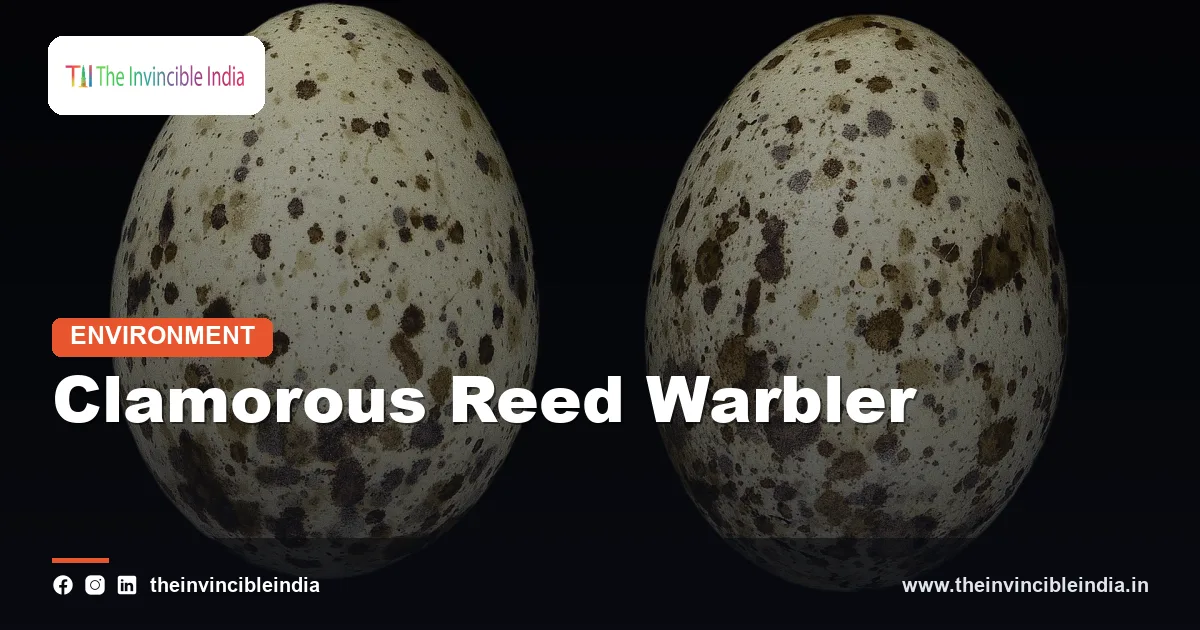
The female lays a small clutch, typically three to five pale eggs with darker blotches and spots. Both parents are generally involved in feeding the nestlings once the eggs hatch. The timing of nesting differs from region to region and often follows the rains, when insects are plentiful and reed growth is tall enough to hide the nest.
- Nest site: woven between three or more vertical stems so that the cup rides up and down as the reeds grow or sway.
- Nest shape: deep and narrow, which keeps eggs and chicks from tipping out in wind.
- Protection: dense surrounding reeds and standing water make it harder for ground predators to reach the nest.
Young birds leave the nest while still weak flyers and spend their first days clambering about the stems, guided by the sound of their parents.
How is the clamorous reed warbler different from similar reed-bed warblers?
The clamorous reed warbler differs from similar reed-bed warblers mainly in its larger size, heavier bill and loud, harsh song. Several other brown warblers share the same habitat in India, especially in winter, so a comparison helps.
| Species | Relative size | Distinguishing points |
|---|---|---|
| Clamorous reed warbler | Large (about 18-20 cm) | Plain brown, long strong bill, loud harsh churring song |
| Great reed warbler | Large | Very similar, usually somewhat heavier and with a stronger eyebrow; best separated by structure and voice |
| Blyth’s reed warbler | Medium | Smaller, greyer-brown, shorter bill, found in scrub and gardens as well as reeds |
| Paddyfield warbler | Small | Short bill, bold pale eyebrow, rufous rump, often in damp grass and paddy edges |
| Streaked scrub-type warblers | Variable | Show streaking on the head or back, unlike the plain clamorous reed warbler |
The clamorous reed warbler is thus best recognised as the biggest, plainest and noisiest of the group, though separating it from the closely related great reed warbler can challenge even experts.
Is the clamorous reed warbler migratory?
The clamorous reed warbler is partly migratory: some populations are resident year-round, while others move seasonally between breeding and wintering areas. Across its wide range, birds from cooler or drier northern parts of the range tend to move south, while those in warm, wet areas often stay put.
In India this means that the clamorous reed warbler can be a resident breeder in some wetlands and a winter visitor or local wanderer in others. Singing, which is loudest during the breeding season, becomes less frequent in winter, so the bird is easier to overlook then. Such movements are poorly documented compared with those of showy migrants, because the species is secretive and often only detected by voice.
Because populations mix in some places, local bird lists and checklists are the best guide to when the clamorous reed warbler is likely to be present at a particular wetland.
Why do reed beds matter for the clamorous reed warbler?
Reed beds matter for the clamorous reed warbler because the species depends on them for food, nesting sites and shelter, and few other habitats provide all three. A reed bed is a dense stand of tall wetland grasses growing in shallow water, and it is one of the most productive habitats for insects.
Why reed beds are valuable
- They support huge numbers of insects, which feed warblers, rails, herons and many other birds.
- They filter and trap sediment and some pollutants, helping keep lake and river water cleaner.
- They reduce erosion along banks and soften the force of floodwater.
- They shelter fish nurseries and amphibians, supporting local fisheries.
When reed beds are drained for farming, burned for fresh grazing, cut for thatch in the breeding season or buried by dumping, the clamorous reed warbler and many companion species lose their homes.
Is the clamorous reed warbler threatened?
The clamorous reed warbler is not globally threatened: the IUCN classifies it as Least Concern because it has a very large range and a presumed large population. Locally, however, individual populations can decline when wetlands are drained, polluted or choked with invasive plants.
The main pressures on the clamorous reed warbler are the same as those facing wetlands generally: land reclamation, encroachment, sewage and agricultural runoff, overgrazing, unscheduled burning of reeds, and unsustainable harvesting of reed and bulrush. Protecting a wetland and managing its reed beds carefully therefore helps this warbler even if the species itself is not considered rare.
In India, many important wetlands are covered by protected-area rules or by the international Ramsar framework for wetland conservation, which indirectly benefits reed-dependent birds.
How can you watch and hear a clamorous reed warbler?
The best way to watch a clamorous reed warbler is to visit a reed-fringed wetland early in the morning in the breeding season, stand quietly at the edge and listen for the loud churring song. Patience matters more than equipment: the bird often reveals itself briefly when it climbs to the top of a stem to sing.
- Visit at dawn or dusk, when males sing most actively.
- Learn the song first; locating the voice usually leads to the bird.
- Use binoculars and scan the upper third of reed stems rather than the base.
- Stay on paths and bunds, and avoid wading into reeds, which can wreck nests.
- Avoid playing recorded songs repeatedly, because this stresses nesting birds.
Wetland sanctuaries, large lakes and well-vegetated reservoirs offer the best chances, and local birdwatching groups can point to reliable sites.
Bottom Line
The clamorous reed warbler is a big, plain, noisy warbler whose life is bound to reed beds. It is not rare, but it is a good indicator of healthy wetland vegetation, and its harsh song is one of the characteristic sounds of Indian marshes.
Frequently Asked Questions
What is a clamorous reed warbler?
A clamorous reed warbler is a large, plain brown warbler that lives in reed beds and marshes and is known for its loud, harsh song. Its scientific name is Acrocephalus stentoreus. It feeds mainly on insects and spiders picked from reed stems.
Why is it called the clamorous reed warbler?
The clamorous reed warbler is called clamorous because of its loud, rasping, churring song. The species name stentoreus refers to Stentor, a loud-voiced herald in Greek legend. The song carries far across water and reeds.
How big is the clamorous reed warbler?
The clamorous reed warbler is roughly 18 to 20 cm long, which is large for a warbler. It has a stout build, a long pointed bill and a rounded tail. It is bulkier than most other warblers found in Indian wetlands.
Where can I see a clamorous reed warbler in India?
You can see a clamorous reed warbler in reed-fringed lakes, marshes, reservoirs and canals across much of India. It stays low inside dense vegetation, so listening for its loud song at dawn or dusk is the best way to find it. Wetland sanctuaries with protected reed beds are good places to look.
What does the clamorous reed warbler eat?
The clamorous reed warbler eats insects, spiders and other small invertebrates. It gleans them from reed stems and from near the water surface. Nestlings are fed almost entirely on insects.
Is the clamorous reed warbler endangered?
No, the clamorous reed warbler is not endangered, and the IUCN lists it as Least Concern. Its range is very large and its numbers are presumed to be large. However, local populations can decline when reed beds and wetlands are drained, burned or polluted.
{“@context”:”https://schema.org”,”@graph”:[{“@type”:”FAQPage”,”mainEntity”:[{“@type”:”Question”,”name”:”What is a clamorous reed warbler?”,”acceptedAnswer”:{“@type”:”Answer”,”text”:”A clamorous reed warbler is a large, plain brown warbler that lives in reed beds and marshes and is known for its loud, harsh song. Its scientific name is Acrocephalus stentoreus. It feeds mainly on insects and spiders picked from reed stems.”}},{“@type”:”Question”,”name”:”Why is it called the clamorous reed warbler?”,”acceptedAnswer”:{“@type”:”Answer”,”text”:”The clamorous reed warbler is called clamorous because of its loud, rasping, churring song. The species name stentoreus refers to Stentor, a loud-voiced herald in Greek legend. The song carries far across water and reeds.”}},{“@type”:”Question”,”name”:”How big is the clamorous reed warbler?”,”acceptedAnswer”:{“@type”:”Answer”,”text”:”The clamorous reed warbler is roughly 18 to 20 cm long, which is large for a warbler. It has a stout build, a long pointed bill and a rounded tail. It is bulkier than most other warblers found in Indian wetlands.”}},{“@type”:”Question”,”name”:”Where can I see a clamorous reed warbler in India?”,”acceptedAnswer”:{“@type”:”Answer”,”text”:”You can see a clamorous reed warbler in reed-fringed lakes, marshes, reservoirs and canals across much of India. It stays low inside dense vegetation, so listening for its loud song at dawn or dusk is the best way to find it. Wetland sanctuaries with protected reed beds are good places to look.”}},{“@type”:”Question”,”name”:”What does the clamorous reed warbler eat?”,”acceptedAnswer”:{“@type”:”Answer”,”text”:”The clamorous reed warbler eats insects, spiders and other small invertebrates. It gleans them from reed stems and from near the water surface. Nestlings are fed almost entirely on insects.”}},{“@type”:”Question”,”name”:”Is the clamorous reed warbler endangered?”,”acceptedAnswer”:{“@type”:”Answer”,”text”:”No, the clamorous reed warbler is not endangered, and the IUCN lists it as Least Concern. Its range is very large and its numbers are presumed to be large. However, local populations can decline when reed beds and wetlands are drained, burned or polluted.”}}]}]}


