

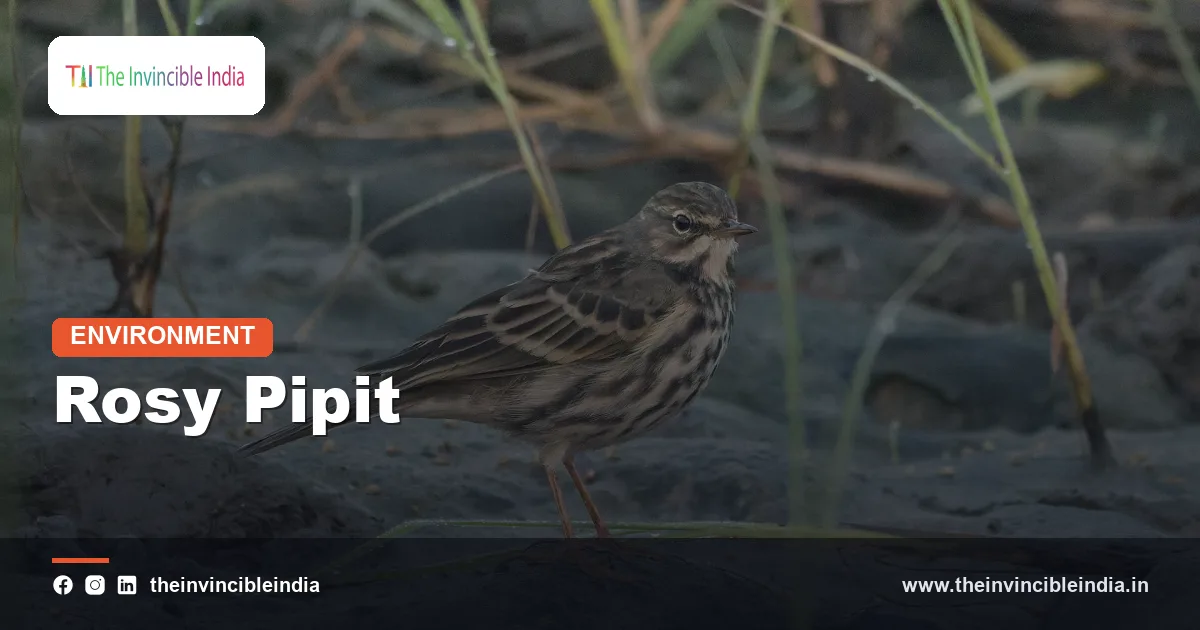
The rosy pipit (Anthus roseatus) is a small, ground-dwelling songbird of the Himalaya that breeds on high alpine meadows and descends to wet grassland, marsh edges and paddy stubble in the plains for the winter. In breeding dress the male shows a soft pink flush across the breast and a clean grey head with a bold pale eyebrow, which gives the bird its name. In winter the pink fades and the bird looks like a streaky, brown pipit, which is the form most Indian birdwatchers meet.
The rosy pipit is a good example of an altitudinal migrant, a bird that travels not across continents but up and down mountain slopes with the seasons. Understanding its two plumages, its two habitats and its quiet, bobbing way of feeding makes it far easier to pick out of the many brown birds that walk across Indian fields and wetland edges.
| Attribute | Detail |
|---|---|
| Common name | Rosy pipit |
| Scientific name | Anthus roseatus |
| Family | Motacillidae (pipits and wagtails) |
| Size | About 15 to 16 cm in length, slightly larger than a sparrow in build |
| Breeding range in India | Alpine meadows and rocky slopes of the Himalaya, roughly 3,000 to 4,500 m |
| Winter range in India | Foothills, the Terai and northern plains, near wet grassland, marsh edges and fields |
| Diet | Small insects, other invertebrates and some seeds |
| Movement | Altitudinal migrant that moves downslope and into the plains in winter |
| Conservation status | Least Concern on the IUCN Red List |
Key Takeaways
- The rosy pipit (Anthus roseatus) is a Himalayan pipit in the family Motacillidae that breeds in alpine meadows and winters in lowland wet grassland.
- A breeding male rosy pipit has a pinkish, almost unstreaked breast and a grey head with a prominent pale supercilium, while a winter bird is brown and heavily streaked.
- The rosy pipit is an altitudinal migrant, meaning it moves down from high mountain breeding grounds to the plains rather than travelling across continents.
- The rosy pipit feeds mainly on insects and other small invertebrates picked from the ground, with seeds added in the colder months.
- The rosy pipit nests on the ground, hidden under a tussock or stone, and lays a small clutch of speckled eggs in the short Himalayan summer.
- The rosy pipit is classified as Least Concern by the IUCN because it has a very large range, although its mountain habitats are sensitive to climate change.
What is the rosy pipit?
The rosy pipit is a small songbird in the pipit genus Anthus, which belongs to the family Motacillidae along with the wagtails. Pipits are slim, long-legged birds that walk rather than hop, with thin bills for picking insects and a habit of wagging or bobbing the tail. They are mostly brown and streaked, which keeps them well hidden on open ground.
The rosy pipit breeds across the high mountains of Central Asia, including the Himalaya, and in India its breeding grounds lie in the alpine zone of the northern ranges. Its English name refers to the rose-pink wash on the underparts of the breeding male, a feature that appears only for a short season. For most of the year the species is simply a neat, streaky pipit with dark legs and a clear eyebrow.
The bird sits within a group of closely related pipits that includes the water pipit and the buff-bellied pipit, and these relatives have been grouped and regrouped by taxonomists over the years. The rosy pipit is today generally treated as a distinct species with its own breeding range in the Himalaya and the Tibetan plateau.
How can you identify a rosy pipit?
A rosy pipit is identified by its size of about 15 to 16 cm, a fine bill, a well-marked pale supercilium and, in breeding dress, a pink-washed breast. The bird stands upright on fairly long legs and walks with a quick, deliberate gait, pausing to bob its tail.
Breeding plumage
In breeding plumage the rosy pipit has a grey head, a long creamy-white supercilium and an almost plain pinkish-buff throat and breast. The back is greyish-brown with dark streaks, and the wings show pale edges to the feathers. This is the plumage seen on the high meadows between late spring and summer.
Winter plumage
In winter plumage the rosy pipit loses the pink and shows bold dark streaking on a buffy-white breast and flanks. The head becomes browner, but the pale eyebrow stays clear. Many winter birds look very much like a water pipit, and careful observers pay attention to the strongly streaked underparts, the brownish legs and the call.
Useful field marks include the following.
- A distinct pale eyebrow that is often broader behind the eye.
- Dark streaks on the breast and flanks in winter that are bolder and thicker than in many other pipits.
- Legs that are pale brown rather than the dark brown or black of some relatives.
- A thin, high call, usually a short “tsip” or “tseep”, given as the bird flies up.
Where does the rosy pipit live in India?
The rosy pipit lives in two different parts of India depending on the season: the high Himalayan alpine zone in the breeding season and the lower hills, foothills and northern plains in winter. This seasonal split is the most useful single fact for anyone trying to find the species.
In summer the bird occupies open, treeless ground above the forest line, typically between about 3,000 and 4,500 m. The habitat is short alpine turf, rocky slopes, dwarf scrub and the margins of streams and snowmelt. Such areas are found in Jammu and Kashmir, Ladakh, Himachal Pradesh, Uttarakhand, Sikkim and Arunachal Pradesh.
In winter the species moves down to lower elevations. It can then be found in damp meadows, the edges of ponds and marshes, harvested paddy fields, fallow land and riverside grass in the foothills, the Terai and the northern and eastern plains. The birds are usually found where the ground is soft, damp or recently cleared, because that is where small insects are easy to reach.
Why does the rosy pipit migrate down the mountains?
The rosy pipit migrates downslope because its high alpine breeding grounds become snow-covered and almost foodless in winter, so the bird must move to lower, warmer places where insects remain active. This type of movement is called altitudinal migration.
Altitudinal migration differs from long-distance migration in that the distance covered may be only tens or a few hundred kilometres, yet the change in habitat is large. A bird that spent the summer on a cold meadow above 3,500 m may spend the winter on a warm paddy field close to sea level. The species is therefore seen on Indian plains only between roughly autumn and early spring.
The timing varies from year to year with weather. A hard early snowfall can push birds downslope earlier, while a mild autumn may let them linger. Because of this flexibility, observers sometimes see the first rosy pipits of the season in the hills well before the first ones appear in the plains.
What does the rosy pipit eat?
The rosy pipit eats mainly small insects and other invertebrates, which it picks from the ground, from the surface of damp mud and from low vegetation. Beetles, flies, small caterpillars, spiders and similar prey make up most of the summer diet.
In winter the diet becomes more mixed. Seeds of grasses and small herbs are eaten along with whatever insects are available, and birds on damp ground often probe the surface of soft mud. The bird walks steadily, stops, looks, and then lunges forward to seize a prey item with its slender bill.
Rosy pipits in winter often feed in loose groups or alongside other pipits, wagtails and larks. They are not strongly territorial in the non-breeding season, which is why several birds can sometimes be seen feeding along the same stretch of wet ground.
How does the rosy pipit breed?
The rosy pipit breeds during the short high-altitude summer, building a small cup-shaped nest on the ground. The nest is usually placed in a hollow beneath a tuft of grass, a small shrub or a rock, where it is shielded from wind and from view.
The nest is made of grass stems and roots and lined with finer grass and sometimes hair. The female typically lays a small clutch of speckled eggs, usually in the range of three to five. Both parents help feed the nestlings, bringing insects to the nest repeatedly during the day.
Male rosy pipits perform a display flight over their territory. The bird rises from the ground, sings a trill as it climbs, and then parachutes down with wings and tail spread, often landing near the spot where it took off. This song flight is used to advertise the territory and to attract a mate.
Because the breeding season is brief, the entire cycle from laying to fledging is compressed into a few weeks. By late summer or early autumn, young and adult birds begin to move downslope together.
How does the rosy pipit differ from similar pipits?
The rosy pipit differs from similar pipits mainly in its pink breeding plumage, its broad pale eyebrow and its strongly streaked winter underparts. Separating pipits in the field is a classic birdwatching challenge, and the table below compares a few Indian species.
| Species | Typical habitat in India | Key feature |
|---|---|---|
| Rosy pipit | Alpine meadows in summer; wet fields and marsh edges in winter | Pink-washed breast when breeding; bold streaks and clear eyebrow in winter |
| Water pipit | Higher mountain slopes and streams; winters at lower levels | Often dark legs and finer streaking; paler eyebrow in many plumages |
| Tree pipit | Open woodland and scrub in winter | Short hind claw, more yellowish tone and a more tree-based habit |
| Paddyfield pipit | Open fields and grassland, resident | Larger, longer-legged and sandier, with a plainer face |
Experienced observers rely on a combination of leg colour, the strength of the streaking, the shape of the supercilium and, above all, the call. Photographs showing the underparts and legs are particularly useful for confirming the identification.
What are the rosy pipit’s song and behaviour?
The rosy pipit is a quiet, ground-loving bird whose song is a simple trill given mainly in display flight, and whose usual call is a thin, high-pitched “tsip”. Outside the breeding season the bird is mostly silent apart from this short flight call.
Its behaviour is characteristic of pipits. The bird walks rather than hops, stops frequently, bobs its tail and flicks into the air when disturbed, usually flying only a short distance before landing again. When alarmed it may perch briefly on a low stone, a fence post or a bush to look around.
In the plains the species often feeds with other small ground birds and can be easy to overlook. A moving group of small brown birds on a harvested field may contain rosy pipits, and patience is usually required to separate them from other pipits.
Is the rosy pipit threatened?
The rosy pipit is not considered threatened and is listed as Least Concern by the International Union for Conservation of Nature (IUCN). The species has a very large breeding range across the mountains of Central Asia and is not known to be declining fast enough to qualify for a higher category.
Even so, the bird is tied closely to two kinds of habitat that face pressure. The alpine breeding zone is sensitive to warming, changing snow cover and heavier grazing, while the wintering wetlands and wet fields are affected by drainage, pollution and the conversion of land. Long-term monitoring of the bird can help show how such changes affect Himalayan wildlife.
Conservation of high-altitude meadows and of wetlands in the plains helps the rosy pipit along with many other species, including other pipits, wagtails and mountain birds.
Where and when can you watch a rosy pipit in India?
The best time to see a rosy pipit in the plains is from late autumn to early spring, while the best chance to see a pink-breasted male is on high Himalayan meadows in summer. Winter birds are widespread, though never conspicuous.
- Visit damp meadows, shallow wetland edges and recently harvested paddy fields in the foothills and northern plains between November and March.
- Walk slowly along the margin of ponds or slow streams and scan the ground for upright, streaky pipits.
- Look for a pale eyebrow, a heavy streaked breast and pale brown legs, and listen for the thin flight call.
- In summer, trek to alpine meadows above the tree line in the Himalaya to see males in breeding plumage and the song flight.
- Photograph the underparts and legs, which help to separate the species from the water pipit and others.
Binoculars and a quiet approach make a big difference, because pipits flush easily if approached directly.
Bottom Line
The rosy pipit is a Himalayan breeding pipit that spends winter on lowland wet ground across northern India, changing from a pink-flushed bird to a streaky brown one. It is common enough not to be a conservation worry, but its seasonal journey from mountain to plain makes it a useful indicator of the health of both habitats.
Frequently Asked Questions
What is a rosy pipit?
A rosy pipit is a small songbird, Anthus roseatus, in the family Motacillidae that breeds in the high Himalaya. The male has a pink wash on the breast in the breeding season, and in winter both sexes look brown and streaky. It spends the cold months in lowland wet grassland and fields.
Where does the rosy pipit breed?
The rosy pipit breeds on alpine meadows and rocky slopes of the Himalaya, generally between about 3,000 and 4,500 m. In India this includes Jammu and Kashmir, Ladakh, Himachal Pradesh, Uttarakhand, Sikkim and Arunachal Pradesh. The nest is a small ground cup hidden under a tuft or stone.
Is the rosy pipit a migratory bird?
Yes, the rosy pipit is a migratory bird, but mainly an altitudinal migrant. It moves down from high mountain breeding grounds to the foothills and plains in autumn and returns upslope in spring. The distances are shorter than those of long-distance migrants, but the change in habitat is large.
What does the rosy pipit eat?
The rosy pipit eats mainly small insects and other invertebrates, which it picks from the ground and from damp mud. In winter it also takes seeds of grasses and small herbs. It forages on foot, walking and pausing, often alongside other small ground-feeding birds.
How is the rosy pipit different from the water pipit?
The rosy pipit differs from the water pipit mainly in breeding colour, leg colour and the strength of the streaking. A breeding rosy pipit has a pink breast, and a winter bird has bold dark streaks and usually paler brown legs. The two species can look alike in winter, so call and leg colour are useful checks.
Is the rosy pipit endangered?
No, the rosy pipit is not endangered and is rated Least Concern by the IUCN. Its range is very large and its population is not believed to be falling quickly. Changes to alpine meadows and lowland wetlands could still affect the species in the long term.
{“@context”:”https://schema.org”,”@graph”:[{“@type”:”FAQPage”,”mainEntity”:[{“@type”:”Question”,”name”:”What is a rosy pipit?”,”acceptedAnswer”:{“@type”:”Answer”,”text”:”A rosy pipit is a small songbird, Anthus roseatus, in the family Motacillidae that breeds in the high Himalaya. The male has a pink wash on the breast in the breeding season, and in winter both sexes look brown and streaky. It spends the cold months in lowland wet grassland and fields.”}},{“@type”:”Question”,”name”:”Where does the rosy pipit breed?”,”acceptedAnswer”:{“@type”:”Answer”,”text”:”The rosy pipit breeds on alpine meadows and rocky slopes of the Himalaya, generally between about 3,000 and 4,500 m. In India this includes Jammu and Kashmir, Ladakh, Himachal Pradesh, Uttarakhand, Sikkim and Arunachal Pradesh. The nest is a small ground cup hidden under a tuft or stone.”}},{“@type”:”Question”,”name”:”Is the rosy pipit a migratory bird?”,”acceptedAnswer”:{“@type”:”Answer”,”text”:”Yes, the rosy pipit is a migratory bird, but mainly an altitudinal migrant. It moves down from high mountain breeding grounds to the foothills and plains in autumn and returns upslope in spring. The distances are shorter than those of long-distance migrants, but the change in habitat is large.”}},{“@type”:”Question”,”name”:”What does the rosy pipit eat?”,”acceptedAnswer”:{“@type”:”Answer”,”text”:”The rosy pipit eats mainly small insects and other invertebrates, which it picks from the ground and from damp mud. In winter it also takes seeds of grasses and small herbs. It forages on foot, walking and pausing, often alongside other small ground-feeding birds.”}},{“@type”:”Question”,”name”:”How is the rosy pipit different from the water pipit?”,”acceptedAnswer”:{“@type”:”Answer”,”text”:”The rosy pipit differs from the water pipit mainly in breeding colour, leg colour and the strength of the streaking. A breeding rosy pipit has a pink breast, and a winter bird has bold dark streaks and usually paler brown legs. The two species can look alike in winter, so call and leg colour are useful checks.”}},{“@type”:”Question”,”name”:”Is the rosy pipit endangered?”,”acceptedAnswer”:{“@type”:”Answer”,”text”:”No, the rosy pipit is not endangered and is rated Least Concern by the IUCN. Its range is very large and its population is not believed to be falling quickly. Changes to alpine meadows and lowland wetlands could still affect the species in the long term.”}}]}]}


